
A Masterclass in Strategic Ambiguity, Taught by Beijing, Graded by Manila
By Louis “Barok” C. Biraogo — August 13, 2026
THERE is a particular species of legal defense that sounds magnificent in a press release but dissolves into vapor the moment you demand to see the document it describes. The Department of Foreign Affairs delivered a masterclass in this dark art on August 11, 2026, insisting its secret Provisional Understanding with China preserves every Philippine right, surrenders nothing, and has shepherded fifteen resupply missions to the rusting hulk of the BRP Sierra Madre without a single shot fired. This is either the most elegant piece of statecraft since the Peace of Westphalia, or it is a slow-motion constitutional heist dressed in diplomatic pieties. The public, naturally, is asked to guess which.
The Text Nobody Has Read
Let us begin where all serious inquiries must: with the text nobody has read.
The DFA wants you to believe the Understanding is a simple operational protocol—schedules, radio channels, a mutual agreement not to ram each other’s boats. China’s Ambassador Jing Quan, however, describes something rather more expansive: a document whose “spirit” prohibits Philippine construction activity, mandates prior notification, and transforms Chinese Coast Guard baton strikes into righteous enforcement actions. On July 20, 2026, two Filipino sailors learned the difference between these interpretations when Chinese personnel boarded their vessel and introduced wooden clubs to Philippine skulls. The DFA called it a violation of the understanding’s spirit. Beijing called it a consequence of Philippine violations of that same spirit. This is not a disagreement over phrasing. This is two nations operating from entirely different documents while insisting they are reading the same page.
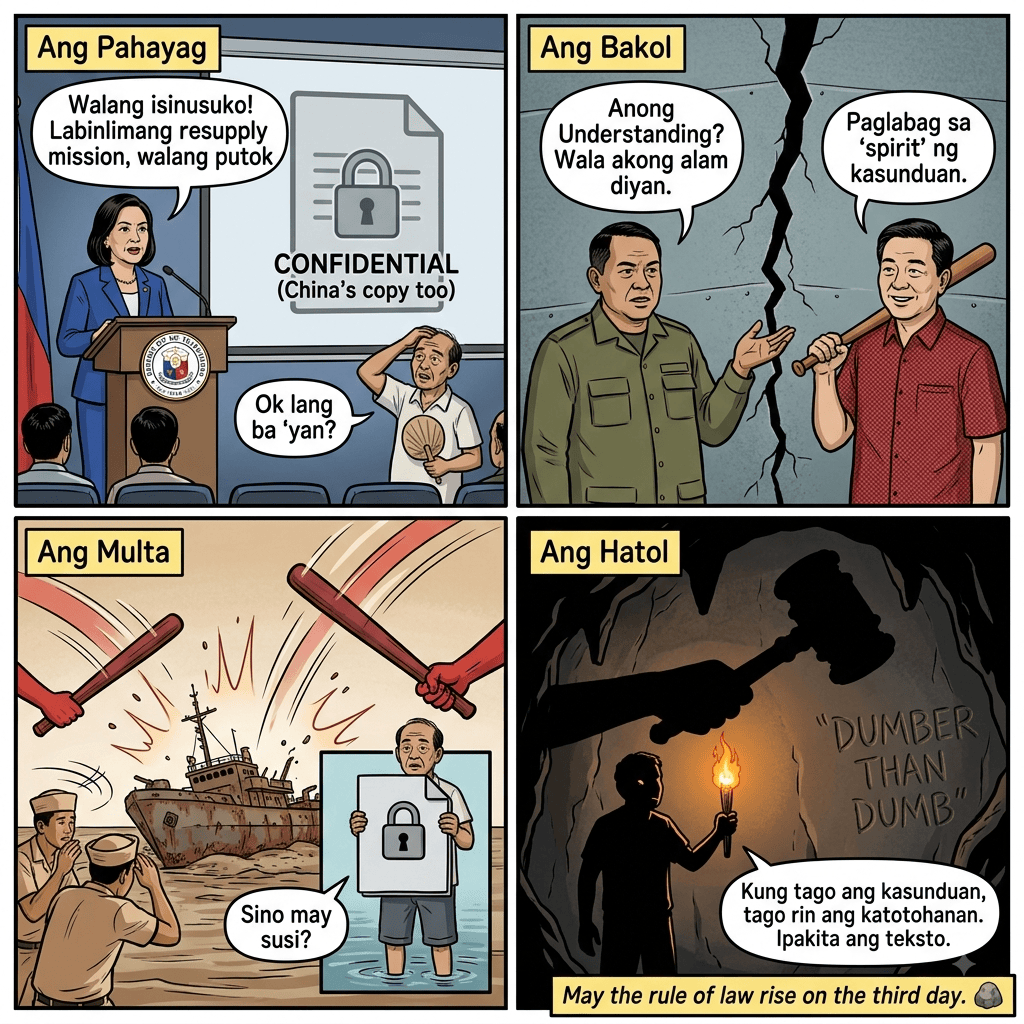
Ang kasunduang walang lagda, may bisa pa rin sa dagat natin.
Cabinet Discord and Structural Rot
The structural rot runs deeper than semantics. DFA Secretary Ma. Theresa Lazaro confirms the Understanding exists and was approved at the highest levels of government. Defense Secretary Gilberto Teodoro Jr. says he knows of no such agreement and that China has no business near Ayungin at all. Pause on that. The Cabinet official constitutionally responsible for the armed forces conducting these very missions claims ignorance of the diplomatic framework governing them. Either the inter-agency coordination process that produced this Understanding is a Potemkin village—all painted facades and empty rooms—or one of these two officials is not being candid with the public. Neither possibility inspires confidence that anyone in Malacañang actually knows what was promised to whom.
The DFA’s Legal Defense
But the DFA does have a case, and it would be intellectually dishonest to pretend otherwise. The 2016 Arbitral Award found definitively that Ayungin Shoal is a low-tide elevation within the Philippines’ exclusive economic zone, that China has no entitlement whatsoever, and that Beijing’s obstruction of Philippine resupply missions violated international law. The DFA now argues that a provisional arrangement facilitating those exact resupply missions—the very activity the Tribunal vindicated—cannot logically undermine the Award it implements. Fifteen incident-free missions stand as empirical evidence that, whatever its flaws, this mechanism has kept Filipino sailors alive and supplied. UNCLOS Article 74(3) contemplates provisional arrangements of a practical nature pending final delimitation. The Supreme Court’s Saguisag doctrine recognizes executive agreements implementing existing treaty obligations as valid without Senate concurrence. The President’s preeminent role in foreign affairs is settled constitutional terrain.
This argument is elegant, coherent, and entirely dependent on a factual premise the DFA refuses to verify: that the document says what they claim it says.
The Transparency Concession
And here the DFA commits its cardinal, possibly unforgivable, error. It has ceded to Beijing an effective veto over Philippine domestic transparency. The text remains secret, the DFA explains, because both governments must consent before either can publish it. Read that sentence again slowly. The Republic of the Philippines—whose Constitution enshrines the people’s right to information on matters of public concern, whose Senate has filed two resolutions demanding disclosure, whose sovereignty is supposedly the non-negotiable foundation of all this diplomacy—must now ask China’s permission to show its own citizens what its own government agreed to. If this is not a sovereignty concession, it is a performance so convincing that the distinction has ceased to matter.
What Beijing Claims the Understanding Restricts
What might the hidden text contain? Ambassador Jing has been remarkably forthcoming about his interpretation: Philippine construction work breached the Understanding’s “spirit,” implying the Understanding’s letter constrains Philippine structural activity on a vessel that serves as a military outpost on Philippine sovereign territory. If this is accurate—if the Philippines has promised not to repair or reinforce the Sierra Madre without Chinese acquiescence—then the DFA has not simply negotiated procedures for exercising Philippine rights. It has negotiated limits on them. An executive agreement that restricts the maintenance of a military installation within Philippine maritime zones does not implement UNCLOS; it amends the practical content of Philippine sovereignty. That requires Senate concurrence under Article VII, Section 21 of the Constitution. That requires public debate. That requires something other than a spokesman’s reassurance and an invitation to trust the professionals.
“Dumber Than Dumb”: Carpio’s Verdict
Justice Antonio Carpio has called the arrangement “dumber than dumb” and an impeachable betrayal of public trust. His impeachment threat is constitutionally foreclosed for now—the one-year bar triggered by the House’s dismissal of complaints in January 2026 runs until approximately January 2027 under Gutierrez v. House of Representatives—but his core legal insight cannot be dismissed as political theater. An adjudicated right, finally and definitively settled by international tribunal, needs no bilateral management. The 2016 Award did not say the Philippines may resupply its outpost contingent upon Beijing’s good graces. It said the Philippines has the right, China has no standing to object, and Chinese obstruction is unlawful. Entering any arrangement that treats this settled conclusion as an open question for negotiation implicitly resurrects the very controversy the Tribunal laid to rest.
The Strategic Danger of Procedural Erosion
The strategic danger is not formal surrender but procedural erosion—what international lawyers call acquiescence and what everyone else recognizes as the slow-motion normalization of Chinese jurisdiction. Today it is an “exchange of information.” Tomorrow it is prior notification. The day after, Beijing invokes the Understanding’s “spirit” to demand consultation on construction activities. Within a decade, Philippine officials are explaining to a new generation of senators that Chinese approval for Ayungin operations is simply how things have always been done. This is not paranoia. It is the precise arc of gray-zone expansion China has perfected across the South China Sea.
A Prudent Path Forward
What is to be done? The prudent middle path is neither the DFA’s trust-us opacity nor Carpio’s tear-it-up maximalism. Keep the mechanism that has demonstrably reduced dangerous encounters, but subject it to the constitutional stress test it has so far evaded. Publish the text—or at minimum, deliver a sanitized legal summary to the Senate answering the questions that matter: Does China have a veto? Is construction restricted? Is notification permission? Clarify publicly and repeatedly that information exchange is not authorization. Maintain redundant resupply capabilities—drones, fast boats, airdrop contingencies—so that no single diplomatic point of failure can starve a Philippine garrison. Reaffirm the 2016 Award not as rhetorical backdrop but as non-negotiable legal baseline.
The Ultimate Test
The Marcos administration’s ultimate test is deceptively simple: Did we negotiate procedures for exercising our rights, or did we negotiate limits on them? The DFA has a defense, articulate and even plausible, but it does not yet have a complete public case. And in a constitutional republic where sovereignty resides in the people, the burden of proof rests on those who would keep the evidence hidden.
I therefore call, with the grim hope of a cynic who has learned to expect disappointment but refuses to stop demanding better: Let the Philippines and China uphold the 2016 Arbitral Award as the legal baseline, settle disputes through UNCLOS and binding dialogue, finalize a strong Code of Conduct, demilitarize disputed areas, and pursue joint resource development without coercion. Let diplomatic relations be genuinely improved—grounded not in power asymmetries but in mutual respect, equality, and the unflinching application of international law. Let the Philippines steadfastly reject being reduced to a pawn in any geopolitical contest, and let China accord this sovereign nation the full dignity, equality, and treatment due every independent state—without coercion, intimidation, or condition.
Let us demand, finally, unshakable peace and lasting harmony—not the paper peace of secret deals and suppressed scrutiny, but the durable peace that only transparency, mutual respect, and the rule of law can build. The youth of this land deserve a future where the sea is not a flashpoint but a bridge to shared prosperity. The first step toward that bridge is simple: show us the text.
May the rule of law rise on the third day. 🪨
Key Citations
A. Reports & Studies
- Permanent Court of Arbitration. South China Sea Arbitration (Philippines v. China), Award. 12 July 2016, https://pca-cpa.org/en/cases/7/.
- United Nations. United Nations Convention on the Law of the Sea. 10 Dec. 1982, https://www.un.org/depts/los/convention_agreements/texts/unclos/unclos_e.pdf.
B. News Articles
- “Chinese envoy: Filipinos were doing construction work on ship, violated agreement.” GMA Network, 23 July 2026, https://www.gmanetwork.com/news/topstories/nation/995836/chinese-envoy-filipinos-were-doing-construction-work-on-ship-violated-agreement/story/.
- “Dumber than dumb’ Ayungin deal slammed.” Philippine Star, 25 July 2026, https://www.philstar.com/headlines/2026/07/25/2544556/dumber-dumb-ayungin-deal-slammed.
- “Philippine Navy personnel hurt in China coast guard baton attack.” Philippine Star, 21 July 2026, https://www.philstar.com/headlines/2026/07/21/2543548/philippine-navy-personnel-hurt-china-coast-guard-baton-attack.
- “Probe of PHL’s ‘provisional understanding’ with China on resupply missions sought.” BusinessWorld, 11 Aug. 2026, https://bworldonline.com/the-nation/2026/08/11/769605/probe-of-phls-provisional-understanding-with-china-on-resupply-missions-sought/.
- “‘Provisional understanding’ with China confirmed by DFA.” Philippine Star, 24 July 2026, https://www.philstar.com/headlines/2026/07/24/2544316/provisional-understanding-china-confirmed-dfa.
C. Official Websites & Jurisprudence
- Constitution of the Republic of the Philippines. Art. III, Sec. 7, https://elibrary.judiciary.gov.ph/thebookshelf/showdocs/45/25549.
- Constitution of the Republic of the Philippines. Art. VII, Sec. 21, https://elibrary.judiciary.gov.ph/thebookshelf/showdocs/45/25550.
- Department of Foreign Affairs. Official Website, https://dfa.gov.ph/.
- Gutierrez v. House of Representatives. G.R. No. 193459, 15 Feb. 2011, https://lawphil.net/judjuris/juri2011/feb2011/gr_193459_2011.html.
- Saguisag v. Ochoa. G.R. No. 212426, 12 Jan. 2016, https://lawphil.net/judjuris/juri2016/jan2016/gr_212426_2016.html.
- ₱8B BBM Pork: CCTV for Every Captain’s Kumpare?
- ₱8.9 Billion, 331 Ghost Police Stations: The TIKAS Scandal Explained

- ₱8.4 Billion, 42,000 Barangays, 1 Election: The “Bawat Barangay Makikinabang” Vote-Buying Masterclass
- ₱75 Million Heist: Cops Gone Full Bandit

- ₱6.77B Ghost Haunts Duterte: RTC Dismisses Mans Carpio’s Desperate Plea
- ₱6.7-Trillion Temptation: The Great Pork Zombie Revival and the “Collegial” Vote-Buying Circus

- ₱53 Million Man Tells ₱695-a-Day Workers to Stop Being ‘Mayabang’: The Audacity of BSP’s Remolona
- ₱3.06 Billion for Evacuation Centers—But Nobody Knows Where They’ll Stand (Or If They’ll Exist)
- ₱10B Ghost in New Clark City: Matibag’s Haunted Séance for Cayetano

- ₱1.9 Billion for 382 Units and a Rooftop Pool: Poverty Solved, Next Problem Please

- ₱1.35 Trillion for Education: Bigger Budget, Same Old Thieves’ Banquet
- ₱1 Billion Congressional Seat? Sorry, Sold Out Na Raw — Si Bello Raw Ang Hindi Bumili




Leave a comment