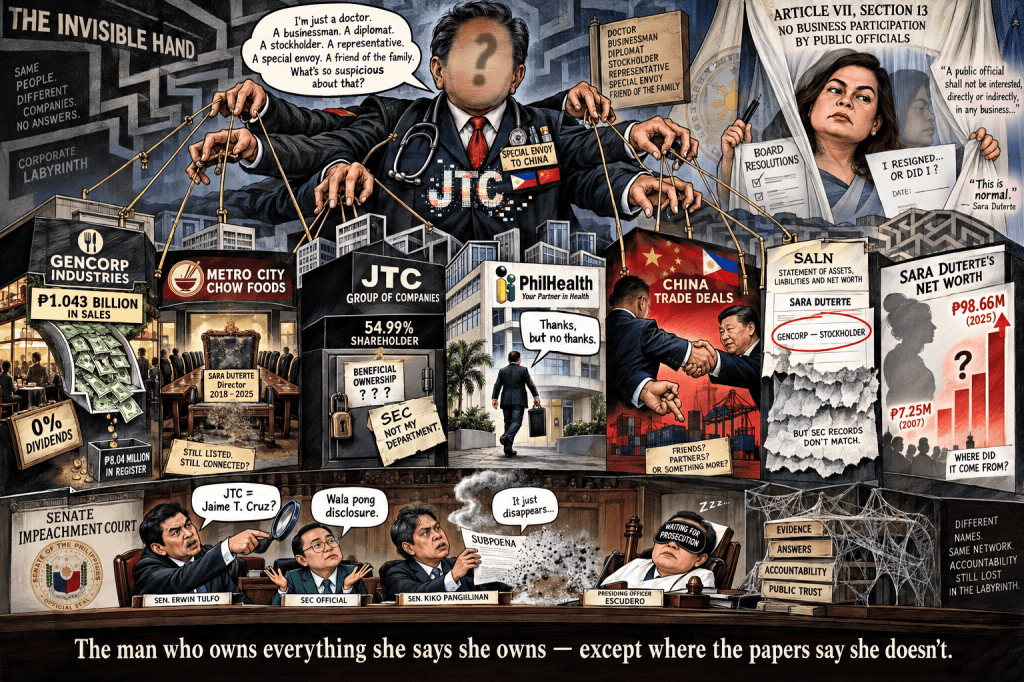
A doctor, a businessman, a diplomat—and apparently the answer to every question Sara Duterte’s financial disclosures can’t.
By Louis ‘Barok‘ C. Biraogo — September 23, 2026
LET me tell you a story about a man named Jaime Tan Cruz.
He’s a doctor. He’s a businessman. He was almost the head of the Philippine Health Insurance Corporation (PhilHealth). He was the Philippines’ special envoy to China for trade and investments. And apparently, he is everywhere Vice President Sara Duterte’s corporate interests are—except, conveniently, where the documents say she actually owns something.
If you’re not suspicious yet, you’re not paying attention.
The Senate impeachment court spent the better part of this week tracing a corporate labyrinth that would make a hedge fund manager blush. At the center of it: Cruz, a man whose initials may or may not spell out his own company’s name—the Securities and Exchange Commission (SEC) isn’t sure—and whose corporate fingerprints appear on at least seven Duterte-adjacent companies stretching back nearly two decades.
Let’s walk through this together, slowly, because the details matter and the mainstream coverage has been sleepwalking through the implications.
Halo-Halo Holdings: Mix Everything, See Nothing
Here’s what SEC Director Gerardo Del Rosario told the Senate under oath:
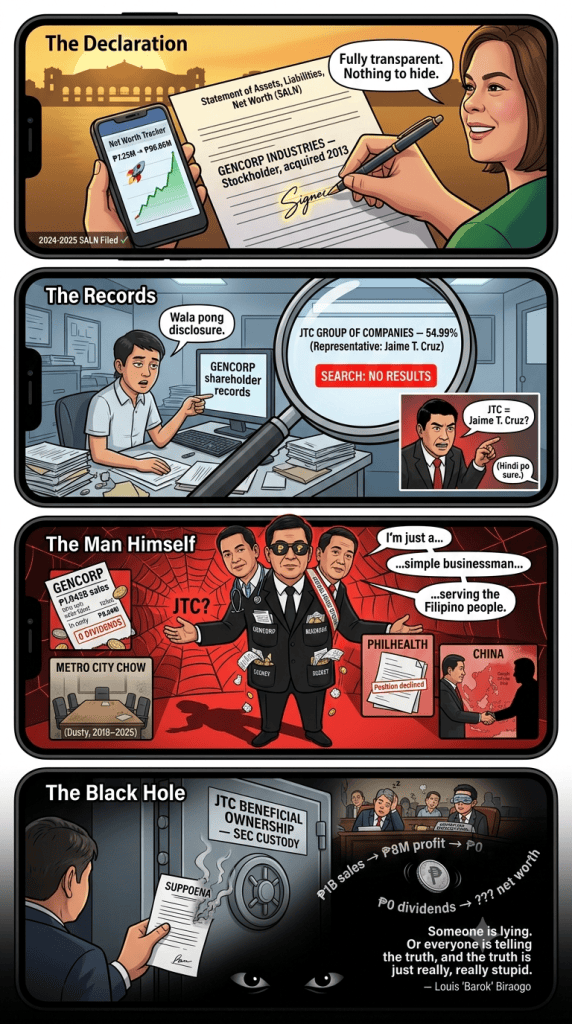
VP Sara Duterte declared Gencorp Industries Inc. as a business interest in her 2024 and 2025 Statements of Assets, Liabilities and Net Worth (SALNs). She said she was a stockholder. She said she acquired the interest in 2013.
But when the SEC pulled Gencorp’s incorporation records and General Information Sheets? Her name wasn’t there. Not as incorporator. Not as stockholder. Not as director.
Instead, the majority shareholder—54.99 percent—is JTC Group of Companies Philippines Inc., represented in Gencorp’s records by one Jaime T. Cruz.
Now, Senator Erwin Tulfo, doing the kind of cross-examination that makes you wonder why he isn’t on the prosecution panel, asked the obvious question: Does JTC stand for Jaime T. Cruz?
The SEC’s answer: “Wala pong disclosure” in the articles of incorporation.
Convenient. Almost too convenient.
Follow the Money. Or Don’t. Your Choice.
Here’s where it gets interesting—and by “interesting,” I mean “the kind of thing that should trigger a full forensic audit but will probably get buried under a procedural motion.”
Gencorp reported ₱1.043 billion in sales from 2021 to 2024. That’s a lot of money. For a company registered to operate a restaurant.
But net income? ₱8.04 million over four years. That’s a profit margin of less than 0.8 percent.
And dividends? Zero. No declared dividends. None. Zilch.
So let’s recap: The Vice President declares a business interest in a company that, according to SEC records, doesn’t know she exists. That company does over a billion pesos in sales but barely cracks eight million in profit and pays out nothing. Meanwhile, she’s on the board of Metro City Chow Foods—a company where Cruz is the largest original subscriber—from 2018 through 2025, including her entire vice presidency.
Oh, and Metro City Chow also declared no dividends.
So where does the wealth come from? Prosecutors say Duterte’s net worth jumped from ₱7.25 million in 2007 to ₱98.66 million in 2025—a ₱91.4 million increase. The companies she’s associated with aren’t paying out. The SALN says she’s a stockholder in Gencorp. The SEC says she isn’t.
Someone is lying. Or everyone is telling the truth, and the truth is just really, really stupid.
The China Connection Nobody Wants to Talk About
Here’s the part that should make every Filipino who cares about foreign policy sit up straight.
Jaime T. Cruz was Rodrigo Duterte’s special envoy to China for trade and investments. Appointed October 15, 2019. He was also offered the PhilHealth presidency—the top job at the agency that handles billions in public health funds—and turned it down.
Let that sink in.
A man who runs a multi-industry conglomerate with a 55 percent stake in a company that VP Sara Duterte says she owns but SEC records say she doesn’t—this man was the President’s point person for trade and investment with China. During the height of the South China Sea tensions. During negotiations on infrastructure deals. During the pandemic.
The prosecution hasn’t connected Cruz’s diplomatic role to any specific business benefit. Not yet. But the appearance problem is nuclear-grade.
Imagine being a Chinese trade official sitting across from Cruz. You know he’s connected to the Duterte family’s business network. You know he’s got skin in the game. And he’s supposed to be negotiating on behalf of the Filipino people?
Even if nothing improper happened—even if every contract was clean and every deal was aboveboard—the optics are catastrophic. This is why the 1987 Constitution of the Republic of the Philippines exists. This is why Article VII, Section 13 says the President and Vice President “shall not, during their tenure, directly or indirectly, participate in any business.”
Not because participation is inherently corrupt. Because participation creates the conditions for corruption, and the appearance of corruption is its own kind of rot.
The Metro City Chow Problem: The One Thing That Isn’t Ambiguous
If you want to understand how the defense is going to try to spin this, watch what they do with Metro City Chow Foods.
Because here’s the thing: unlike Gencorp, where Duterte’s name is mysteriously absent from SEC records despite her SALN declaration, Metro City Chow has her name all over it.
She was an original subscriber—500 shares, worth ₱50,000, a 20 percent stake. She was on the board of directors from 2018 through 2025. She was on the Compensation Committee. Cruz was the largest subscriber—1,997 shares—and her co-director.
This isn’t a secret. This isn’t a discrepancy. This is documented, public, and uncontested.
Which raises a simple question: Why didn’t she resign?
Republic Act No. 6713 (The Code of Conduct and Ethical Standards for Public Officials and Employees), Section 9 is clear. When a conflict of interest arises, a public official must resign from the private business within 30 days and divest their shareholding within 60 days. The 1987 Constitution’s prohibition on participating in business isn’t advisory. It’s mandatory.
The defense will argue—they already are arguing—that the SEC has no personal knowledge of whether she actually attended board meetings or voted on anything. They’ll say a board can act through quorum, that being listed as a director doesn’t mean she was actually directing.
That’s a cute argument. It’s also legally irrelevant.
The prohibition is on participation. Holding a board seat is participation. Being listed as a director is participation. The 1987 Constitution doesn’t say “don’t participate unless you skip the meetings.” It says don’t participate. Period.
And here’s the kicker: if she wasn’t actually participating—if she was just a name on a piece of paper collecting dust—then why keep the seat? Why not resign? Why not divest? What possible reason is there for a sitting Vice President to remain on the board of a food corporation unless she wanted the connection maintained?
The Beneficial Ownership Black Hole
Senator Kiko Pangilinan, in a moment of clarity that cut through the procedural fog, identified the real issue: Who actually owns JTC?
The SEC witness said JTC holds 54.99 percent of Gencorp. He said a majority shareholder has “substantial influence” over board composition and corporate decisions. He said beneficial ownership declarations exist—they’re submitted to the SEC—but they’re “not in my department’s custody”.
So the documents that would answer the central question—who ultimately controls the money—are sitting somewhere in the SEC, unexamined, while senators debate whether to subpoena them.
This is not a hard problem. The Senate impeachment court has subpoena power. The prosecution has asked for documents. The defense hasn’t objected on privilege grounds. And yet Presiding Officer Escudero said the court would “await action from the prosecution”.
The prosecution is right there. They’ve been presenting evidence for weeks. If they want the JTC records, they can ask for them. If they don’t ask, you have to wonder why.
Maybe they’re afraid of what the records show. Maybe they’re afraid of what they don’t show. Maybe—and this is the cynical take—maybe they prefer the ambiguity. Ambiguity is politically useful. It lets you insinuate without proving. It lets you keep the narrative alive without being held to a standard of evidence.
But this isn’t a press conference. This is a trial. And in a trial, you either prove your case or you don’t.
The Defense’s Best Argument (That Nobody Is Making Loud Enough)
Let me be fair. The defense has a point. Several, actually.
First: Cruz’s business relationships with the Duterte family predate Sara’s vice presidency by years. Metro City Chow was formed in 2007. The corporate network was built during Rodrigo’s time as Davao City mayor, long before anyone was thinking about national office. Pre-existing relationships are not automatically conflicts.
Second: Duterte disclosed Gencorp in her SALN. Twice. If she was trying to hide something, why declare it? The prosecution’s own theory—that she lied about being a stockholder—requires her to have voluntarily created a paper trail that contradicts her alleged concealment.
Third: The Supreme Court has repeatedly held that conflict of interest under Republic Act No. 3019 (Anti-Graft and Corrupt Practices Act) requires proof of actual financial interest and official intervention—not mere association. In Acosta v. People, the Court emphasized that evidence must establish the necessary pecuniary interest; relationship alone cannot substitute for proof.
These are legitimate points. They deserve serious engagement.
But here’s what the defense isn’t saying: They’re not explaining why Duterte is absent from Gencorp’s SEC records while present in her SALN. They’re not explaining why JTC’s ownership structure remains opaque. They’re not explaining why a company with a billion pesos in sales and no dividends is somehow relevant to the Vice President’s financial disclosures.
And they’re definitely not explaining why Jaime T. Cruz—a man whose corporate network intersects with the Vice President’s declared interests at multiple points—was the President’s trade envoy to China.
What This Is Really About
Strip away the procedure. Ignore the motions. Forget the parliamentary jockeying.
This is about whether the Philippines will tolerate a political-business class that treats public office as an extension of private enterprise.
The Duterte family built an empire in Davao—political, economic, and social. Sara Duterte inherited a place in that empire. Jaime Cruz was one of its architects. When Rodrigo went to Malacañang, he brought his network with him. When Sara became Vice President, the network came along.
The question isn’t whether any specific transaction was illegal. The question is whether the system—the interlocking directorates, the nominee arrangements, the beneficial ownership fog, the diplomatic appointments for business allies—is compatible with democratic governance.
It isn’t. It never has been. And the Cruz evidence, whatever its ultimate legal weight, exposes the architecture.
The Uncomfortable Possibility
Here’s the thing nobody wants to say out loud: We may never know the full truth.
The beneficial ownership records are in SEC custody, not the court’s. The JTC documents haven’t been subpoenaed. Cruz himself hasn’t testified. The prosecution may or may not call him. The defense may or may not object.
And even if all the documents come out, even if every share is traced and every dollar accounted for, we’re still left with the fundamental problem: the law is only as strong as the will to enforce it.
Article VII, Section 13 has existed since 1987. It has been violated, probably, by officials across administrations. It is rarely enforced. The Ombudsman is slow. The courts are slower. Impeachment is political, not criminal. And conviction requires 16 senators—two-thirds of the chamber—to agree that a sitting Vice President should be removed.
The Cruz evidence makes the case stronger. It connects dots that were previously separate. It raises questions that deserve answers.
But it won’t matter if the Senate decides that the appearance of conflict is enough to investigate but not enough to convict. It won’t matter if the prosecution overplays its hand and turns a legitimate inquiry into a partisan circus. It won’t matter if the public, exhausted by scandal, tunes out before the verdict.
The Bottom Line
Jaime T. Cruz is either the unluckiest businessman in the Philippines—a man whose name keeps appearing in corporate records connected to the Vice President for no particular reason—or he is the key to understanding how the Duterte network operates.
The SEC records show a pattern: Cruz appears in company after company, often as the largest subscriber or the corporate representative. Duterte appears in some, but not all. The companies do business with government. The Vice President declares interests that don’t match the corporate filings. And the man at the center of the web was the President’s envoy to China.
None of this proves a crime. All of it proves a problem.
The Senate impeachment court has the power to get the documents that would clarify the picture. Senator Pangilinan has already proposed it. The question is whether the prosecution will act, whether the defense will cooperate, and whether the senators will follow the evidence wherever it leads.
If they don’t, the Cruz affair will become just another entry in the long, sad ledger of Philippine scandals that were too complicated to prosecute and too politically sensitive to resolve.
If they do, we might finally learn who Jaime Cruz really is—and who he really works for.
Either way, I’ll be here. Watching. Taking notes. Wondering why the simplest questions are always the hardest to answer.
Louis ‘Barok’ C. Biraogo is the author of Kweba ni Barok, a blog about law, politics, and the things people in power hope you won’t notice. He has been described as “suspicious” by people who have something to hide.
Key Citations
A. Legal & Official Sources
- The 1987 Constitution of the Republic of the Philippines. Official Gazette of the Republic of the Philippines, 1987, http://www.officialgazette.gov.ph/constitutions/1987-constitution/.
- The 1987 Constitution of the Republic of the Philippines – Article VII. Official Gazette of the Republic of the Philippines, 1987, http://www.officialgazette.gov.ph/constitutions/the-1987-constitution-of-the-republic-of-the-philippines/the-1987-constitution-of-the-republic-of-the-philippines-article-vii/.
- Republic Act No. 6713. An Act Establishing a Code of Conduct and Ethical Standards for Public Officials and Employees. 1989, lawphil.net/statutes/repacts/ra1989/ra_6713_1989.html.
- Republic Act No. 3019. Anti-Graft and Corrupt Practices Act. 17 Aug. 1960, http://www.officialgazette.gov.ph/1960/08/17/republic-act-no-3019/.
- Acosta v. People. G.R. Nos. 225154-57, Supreme Court of the Philippines, 24 Nov. 2021, lawphil.net/judjuris/juri2021/nov2021/gr_225154-57_2021.html.
- The Basics: Statement of Assets, Liabilities, and Net Worth. Official Gazette of the Republic of the Philippines, http://www.officialgazette.gov.ph/saln/.
B. News Reports
- Gita-Carlos, Ruth Abbey. “Duterte Names Special Envoys to Japan, China.” Philippine News Agency, 16 Oct. 2019, http://www.pna.gov.ph/articles/1083378.
- “Former China Envoy Jaime Cruz Linked to Sara Duterte, Carpio Firms.” GMA News Online, GMA Network, 22 Sept. 2026, http://www.gmanetwork.com/news/topstories/nation/1003243/former-china-envoy-jaime-cruz-linked-to-sara-duterte-carpio-firms/story/.
- “Impeachment Trial: Jaime Tan Cruz Was Ex-Pres Duterte’s Envoy to China.” Inquirer.net, 22 Sept. 2026, newsinfo.inquirer.net/2309490/impeachment-trial-jaime-tan-cruz-was-ex-pres-dutertes-envoy-to-china.
- ₱8B BBM Pork: CCTV for Every Captain’s Kumpare?
- ₱8.9 Billion, 331 Ghost Police Stations: The TIKAS Scandal Explained

- ₱8.4 Billion, 42,000 Barangays, 1 Election: The “Bawat Barangay Makikinabang” Vote-Buying Masterclass

- ₱75 Million Heist: Cops Gone Full Bandit

- ₱6.77B Ghost Haunts Duterte: RTC Dismisses Mans Carpio’s Desperate Plea
- ₱6.77 Billion and Zero Cash: The Sara Duterte SALN Math That Doesn’t Add Up

- ₱6.7-Trillion Temptation: The Great Pork Zombie Revival and the “Collegial” Vote-Buying Circus

- ₱58.53B, Zero Receipts: The LGSF Pork Barrel Nobody Wants to Name
- ₱53 Million Man Tells ₱695-a-Day Workers to Stop Being ‘Mayabang’: The Audacity of BSP’s Remolona

- ₱4.4 Billion and a Witness Who Can’t Explain It: The Duterte Impeachment’s Most Expensive Non-Answer
- ₱3.06 Billion for Evacuation Centers—But Nobody Knows Where They’ll Stand (Or If They’ll Exist)
- ₱16 Billion, 280 Accounts, 8 Helicopters: Boying Remulla’s Case Against the Yaps Is Not a Drill







Leave a comment