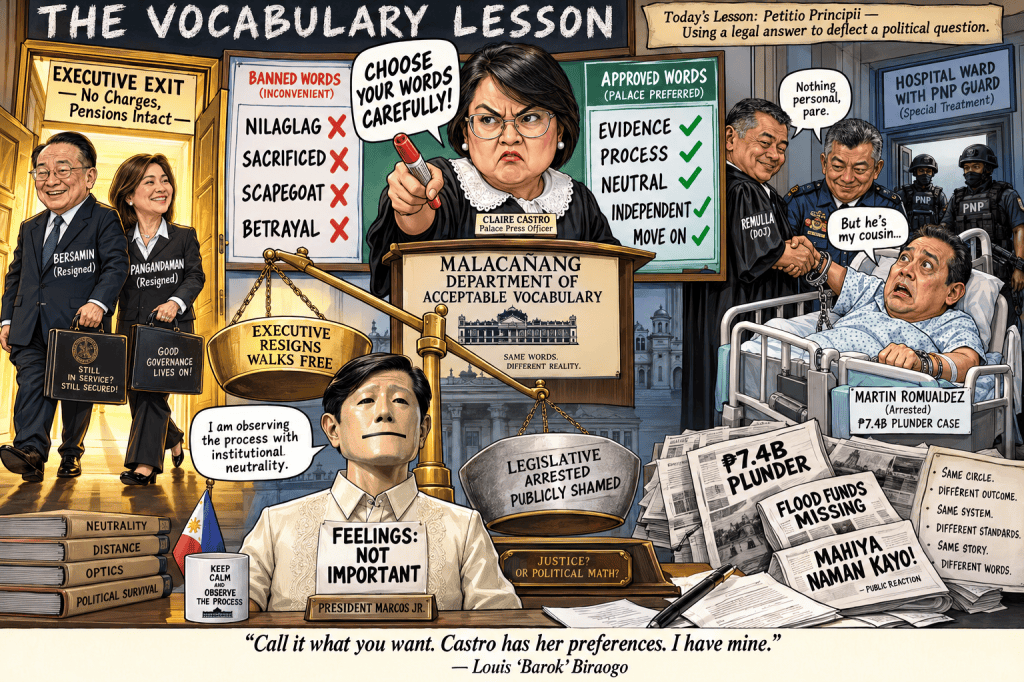
When the Palace spends more time policing vocabulary than explaining why executive officials walked while the Speaker got a warrant.
By Louis ‘Barok‘ C. Biraogo — September 23, 2026
MALACAÑANG has a word problem.
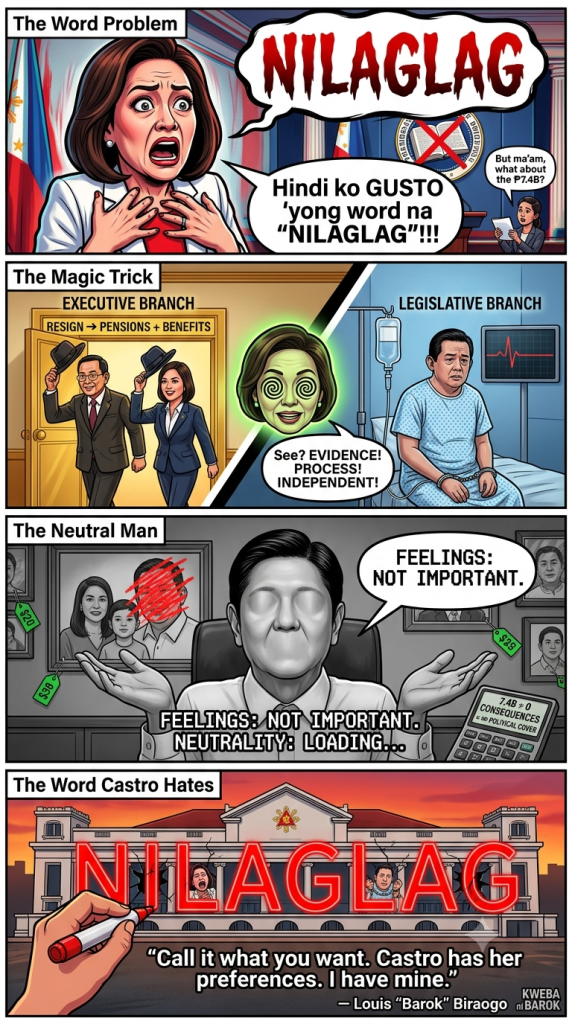
Claire Castro, the Palace’s press officer, is bothered by the word “nilaglag.” She really, truly does not like it.
“Hindi ko gusto ‘yong word na ‘nilaglag,’” she declared on September 9, 2026, as if the Filipino language had personally offended her. “Kung may mga kritikong nagsasabing ‘nilaglag,’ hindi namin nais gamitin ang word na nilaglag.”
The word means “thrown under the bus.” It’s what you call it when someone in power sacrifices an ally—someone inconvenient, someone who has become a liability. It is, in political terms, the equivalent of ejecting the co-pilot and hoping the passengers don’t notice the body falling past the window.
And Claire Castro would really, really prefer if we didn’t use it.
The Evidence-Based Defense That Isn’t
The Palace’s rebuttal is beautifully circular: The Ombudsman found evidence. Therefore, Romualdez was prosecuted. Therefore, he wasn’t thrown under the bus. Therefore, stop using that word.
“Dahil ito naman po, according to the Office of the Ombudsman, meron silang nakitang ebidensya. So walang dapat nilalaglag dito,” Castro explained.
This is what logicians call petitio principii—begging the question. The existence of evidence sufficient for probable cause does not answer the political question of why this person, why now. Castro is using a legal answer to deflect a political inquiry. That’s not a defense. That’s a rhetorical sleight of hand.
The Ombudsman did find evidence. The charge sheet alleges Romualdez accumulated approximately ₱7.44 billion from commissions, kickbacks, and “commitments” from government projects between 2022 and 2025, citing testimony from former Department of Public Works and Highways (DPWH) officials, security aides, and documents including property titles and bank deposits. Serious stuff.
But serious evidence does not prove the absence of political motivation. It proves the presence of evidence. The question of whether Romualdez was also politically expendable—whether his prosecution serves interests beyond justice—remains unanswered by Castro’s tautology.
The Timing Is the Tell
Let’s pretend we believe Malacañang completely. The Ombudsman acted independently. Marcos had no idea. The arrest warrant appeared like a bolt from the blue.
Now the timeline.
The flood control scandal broke in late 2025. Mass protests erupted. Six hundred thousand people rallied at an Iglesia ni Cristo (INC) gathering in November. Marcos delivered his State of the Nation Address (SONA) with the now-infamous line: “Mahiya naman kayo.” A stern presidential scolding, delivered from a podium, to a public already shamed by the corruption itself.
Then, in November 2025, Executive Secretary Lucas Bersamin and Budget Secretary Amenah Pangandaman—both executive officials—resigned. No criminal charges. No plunder. Just resignations, with all the pensions and benefits that accrue to officials who leave under a cloud of “personal reasons.”
And then, months later, in September 2026, Romualdez—a legislator—gets slapped with a non-bailable plunder charge and arrested at a hospital while reportedly suffering from cardiovascular issues and an anxiety attack.
The executive officials walked. The legislator got the warrant. If you’re keeping score, that’s the executive branch losing nothing, the legislative branch losing its Speaker, and the President losing… what, exactly?
Oh, right. He lost a cousin. How painful.
The “Neutral” President and His Feelings
When asked about Marcos’ personal feelings regarding his cousin’s arrest, Castro’s response was a masterclass in evasion.
“Ang pakiramdam po ng Pangulo, personal ay hindi naman po siguro ito dapat na alamin natin,” she said. The President’s feelings are personal; we don’t need to know them. “Hindi na po siguro makakaapekto kung anuman ang damdamin ng Pangulo, masaya, malungkot anuman, hindi na po siya importante.”
The President’s feelings—happy, sad, whatever—are no longer important.
This is a stunning admission. The President has a cousin. That cousin has been arrested. The President’s feelings about this are not important. The President is neutral.
Neutral. The word Castro used repeatedly. The President is simply allowing the process to unfold. The President is, in effect, a spectator to his own family’s legal drama, watching from the bleachers like everyone else.
Is this credible? Or is it intended to be so obviously performative that questioning it marks you as a cynic, someone who simply refuses to accept that institutions work?
The Palace is playing “Plausible Deniability.” The rules: say nothing that can be contradicted, commit to no interpretation of events, and use the word “process” as a shield against all political questions.
The Constitutional Paradox (Or, Why Castro Is Technically Right and Politically Wrong)
Castro is, in a narrow sense, correct.
The President cannot order the Ombudsman to prosecute. The President cannot order the Sandiganbayan to convict. The Constitution created the Office of the Ombudsman as an independent body precisely to insulate it from executive pressure. If Marcos had intervened to protect Romualdez, that would itself be a constitutional violation. The correct response to “why doesn’t Marcos stop this?” is, paradoxically, “he shouldn’t and he can’t.”
But this technical correctness is Castro’s greatest vulnerability. It allows her to answer a political question with a constitutional answer, over and over, until the questioner gives up.
“Was Romualdez sacrificed for political reasons?”
“The Ombudsman is independent.”
“But why was he arrested while executive officials merely resigned?”
“The Ombudsman found evidence.”
“But why now?”
“The President is neutral.”
This is not a conversation. It is a wall. And Castro is very, very good at being a wall.
The Real Question: Where Does the Trail End?
The deepest problem with the Palace’s narrative is not that it’s false—though it may well be. The deepest problem is that it cannot be tested by any evidence Castro has provided or is likely to provide.
What would it take to prove Romualdez was sacrificed? Evidence of presidential coordination with the Ombudsman. Evidence that the decision to prosecute was political, not evidentiary. Evidence that similarly situated figures were protected. The kind of evidence that only exists in private conversations and unrecorded meetings—the kind almost never available while the actors are still alive and still in power.
What would it take to prove he was not sacrificed? Castro’s answer is, essentially, “the Ombudsman said so.” But the Ombudsman is not a neutral observer. The Ombudsman is a participant. And Jesus Crispin Remulla is the brother of Interior Secretary Jonvic Remulla—who, by his own admission, is “very close” friends with Romualdez, a fraternity brother, someone who went to UP with him.
“Kami rin ni Martin ay very close,” Jonvic Remulla said, explaining why the arrest was so painful, so difficult, so professional. “Pero in the interest of the state, gagawin na namin ang lahat.”
This is the new Philippine governance model: accountability administered by people who happen to be personally close to the accused. The Remulla brothers—one prosecuting, one arresting—both describe themselves as friends of the man they’re putting in jail. That doesn’t prove impropriety. But it does make the claim of pristine independence a harder sell.
It’s either a testament to Philippine professionalism or a lesson in how small this country’s power circle really is.
The Word Castro Hates
Claire Castro does not like the word “nilaglag.”
I understand why. It carries an accusation. It implies betrayal, calculation, the cold logic of political survival. It suggests that someone in power looked at a relationship and decided it was worth less than the cost of maintaining it. It suggests that family bonds, political alliances, decades of mutual benefit, all of it can be discarded when the math changes.
Castro wants different words. Words like “evidence.” Words like “process.” Words like “independence.” Words that describe institutions rather than people, systems rather than choices.
But here’s the thing about words: the ones we avoid are often the ones that describe reality most accurately.
Romualdez was arrested. Executive officials resigned. The President is “neutral.” The Ombudsman is “independent.” The Remulla brothers are “professional.”
And a man who was once the second most powerful person in the Philippine government is now in a hospital room with armed guards outside his door, facing a non-bailable charge, while his cousin—the President—is apparently too busy being neutral to have feelings about it.
Call it what you want. Castro has her preferences. I have mine.
I’ll call it what it looks like.
Louis ‘Barok’ C. Biraogo is the author of the Kweba ni Barok blog, a UP graduate, and a member of Upsilon Sigma Phi. He shares a fraternity with people in this story. He does not share their ₱7.44 billion in unexplained wealth, their kickback arrangements, or their Palace spokesperson explaining that his feelings are “not important.”
Key Citations
A. Legal & Official Sources
- Republic of the Philippines. The 1987 Constitution of the Republic of the Philippines. Official Gazette, https://www.officialgazette.gov.ph/constitutions/1987-constitution/.
- “Begging the Question.” Wikipedia, Wikimedia Foundation, https://en.wikipedia.org/wiki/Begging_the_question. Accessed 22 Sept. 2026.
B. News Articles
- Santos, Jel. “Marcos’ Personal Feelings on Romualdez Arrest No Longer Matter — Palace.” Manila Bulletin, 9 Sept. 2026, https://mb.com.ph/2026/09/09/marcos-personal-feelings-on-romualdez-arrest-no-longer-matter-palace.
- Ramirez, Renalyn. “Ombudsman Files Plunder Case vs Romualdez over Flood-Control Scandal.” Philstar.com, 7 Sept. 2026, https://www.philstar.com/headlines/2026/09/07/2554626/ombudsman-files-plunder-case-vs-romualdez-over-flood-control-scandal.
- “Philippine Ex-Speaker Arrested in $118M Plunder Case.” OCCRP, 8 Sept. 2026, https://www.occrp.org/en/news/philippine-ex-speaker-arrested-in-118m-plunder-case.
- “‘There Is So Much Corruption’: Hundreds of Thousands Protest in Manila over Missing Flood Funds.” The Guardian, 17 Nov. 2025, https://www.theguardian.com/world/2025/nov/17/manila-philippines-corruption-protest-flood-funds.
- “PBBM Cracks Down on Flood Control Corruption: ‘Mahiya Kayo sa Inyong Kapwa Pilipino.’” Philippine Information Agency, 28 July 2025, https://pia.gov.ph/news/pbbm-cracks-down-on-flood-control-corruption-mahiya-kayo-sa-inyong-kapwa-pilipino/.
- “Martin Romualdez Arrested over Plunder Charges, Says DILG Chief.” GMA News Online, 7 Sept. 2026, https://www.gmanetwork.com/news/topstories/nation/1001505/martin-romualdez-arrested-over-plunder-charges-says-dilg-chief/story/.
- Peralta-Malonzo, Third Anne. “Marcos Has ‘Zero Intervention’ on Romualdez’s Arrest.” SunStar Manila, 8 Sept. 2026, https://www.sunstar.com.ph/manila/marcos-has-zero-intervention-on-romualdezs-arrest-detention.
- Esmaquel, Paterno R., II. “News Reflection: Malacañang Does Not Like the Word ‘Nilaglag.’” Rappler, 21 Sept. 2026, https://www.rappler.com/voices/news-reflection-malacanang-does-not-like-word-thrown-under-bus/.
C. Official Websites
- Presidential Communications Office. “President Marcos Accepts Resignations of ES Bersamin and DBM Secretary Pangandaman.” PCO, 17 Nov. 2025, https://pco.gov.ph/news_releases/president-marcos-accepts-resignations-of-es-bersamin-and-dbm-secretary-pangandaman/.
- Presidential Communications Office. Official Website. https://pco.gov.ph/.
- Department of Public Works and Highways. Official Website. https://www.dpwh.gov.ph/.
- Sandiganbayan. Official Website. https://sb.judiciary.gov.ph/.
- Iglesia Ni Cristo. Official Website. https://iglesianicristo.net/.
- Biraogo, Louis C. “About Me.” Kweba ni Barok, https://kwebanibarok.com/about/.
- Office of the Ombudsman. Vision, Mission, Mandate and Quality Policy. Office of the Ombudsman of the Philippines, https://www.ombudsman.gov.ph/?page_id=129250.
- “Ang Hirap Maging Mahirap”: The PAO Scandal That Proves Government Contempt Is Nothing New

- “Far-Off” My Axx: Malacañang’s Claire Castro Drowns in Her Own Legal Gaslighting
- “Forthwith” to Farce: How the Senate is Killing Impeachment—And Why Enrile’s Right (Even If You Can’t Trust Him)
- “HINDI AKO NAG-RESIGN!”

- “I Know Nothing”: Baste Duterte’s Amnesia Defense Meets ₱33M in GenCorp Contracts

- “I’m calling you from my new Globe SIM. Send load!”

- “Mahiya Naman Kayo!” Marcos’ Anti-Corruption Vow Faces a Flood of Doubt

- “Manageable” Debt, Unmanageable Lies: DBM’s ₱21 Trillion Fairy Tale

- “Meow, I’m calling you from my new Globe SIM!”

- “Natrabaho”: One Word, One Ombudsman, and a Judiciary on Trial
- “No Special Jail for Crooks!” Boying Remulla Slams VIP Perks for Flood Scammers

- “Philippine-Controlled” or Yankee Gas Station? The Davao Fuel Depot Farce Exposed






Leave a Reply