The House Moved Its Budget Deliberation to a Date Its Loudest Critic Was Gone—Then Called It Procedure
By Louis ‘Barok‘ C. Biraogo — September 22, 2026
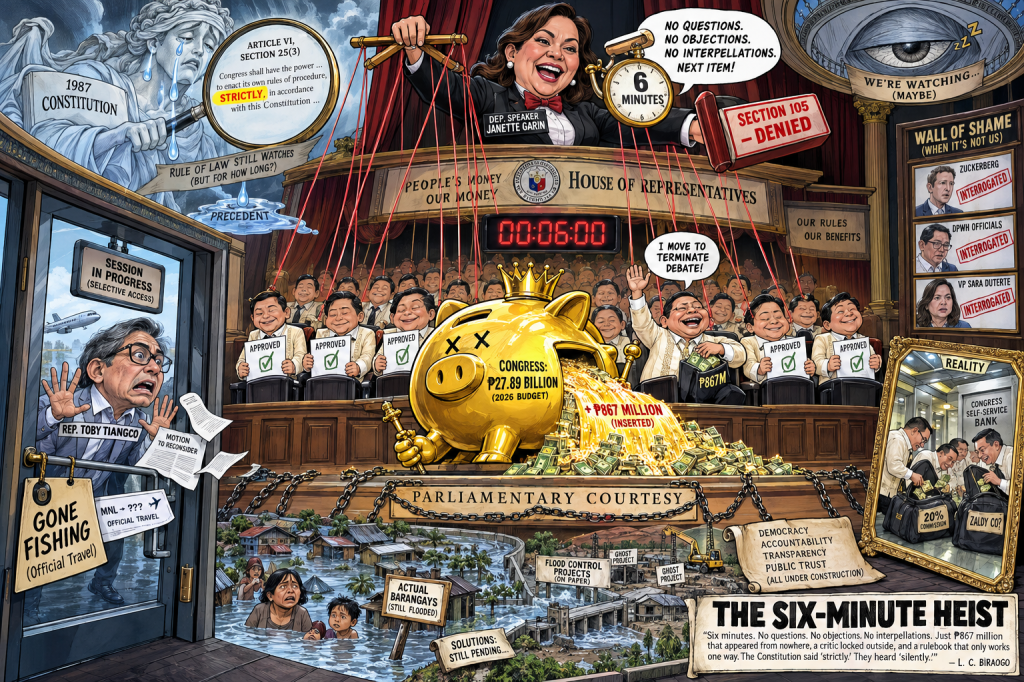
ON September 17, 2026, the House of Representatives approved its own ₱27.89-billion budget in approximately six minutes. No questions. No objections. No interpellations. Just a sponsorship speech, a helpful observation that the minority was absent, and a motion to terminate debate from a minority legislator himself.
Six minutes. Less time than it takes to explain to a constituent why their flood control project doesn’t exist.
This is the institution that spent days grilling the Department of Public Works and Highways (DPWH) over its ₱643.95-billion budget. The same body that suspended the Department of Information and Communications Technology (DICT) budget to demand answers from Meta’s Zuckerberg. The same chamber that reduced the Office of the Vice President (OVP)’s budget as punishment for non-cooperation.
But when it comes to their own money? Six minutes. Zero questions. Approved.
And when Navotas Rep. Toby Tiangco tried to reopen deliberations on September 21—arguing the schedule had been moved from September 24 to September 17 while he was abroad on official business—Deputy Speaker Janette Garin declared his motion out of order.
Her reasoning? Section 105 of the House Rules: only a member who voted with the majority may move for reconsideration. Tiangco wasn’t there. Therefore, his motion was procedurally defective.
Technically elegant. Substantively hollow. And utterly predictable.
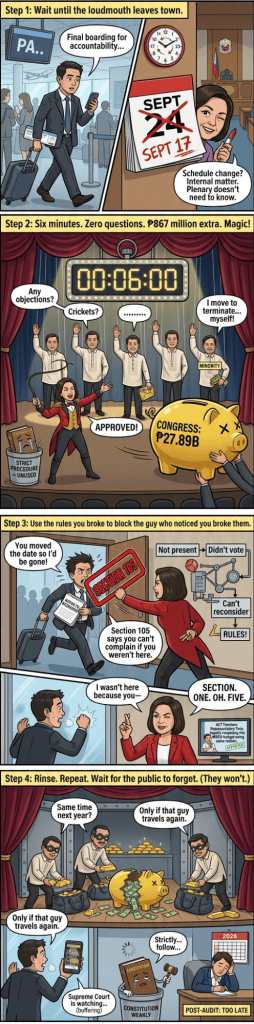
Tiangco’s motion failed on a procedural technicality. But the technicality itself was manufactured by the procedural irregularity—the schedule change—that Tiangco was protesting. The House moved the deliberation earlier, waited until a known critic was absent, approved the budget without debate, and then invoked the rules to prevent the critic from returning.
This isn’t procedure. This is choreography.
The Constitutional Provision Everyone Is Ignoring
Article VI, Section 25(3) of the 1987 Constitution states:
“The procedure in approving appropriations for the Congress shall strictly follow the procedure for approving appropriations for other departments and agencies.”
The word “strictly” is not ambiguous. It is not advisory.
When executive agencies appear before the appropriations committee, they endure hours—sometimes days—of interpellation. The Metropolitan Manila Development Authority (MMDA)’s ₱6.56-billion budget was debated. The Department of Justice (DOJ)’s ₱43-billion allocation was examined line by line.
The House’s own ₱27.89-billion budget? Six minutes. No questions.
This isn’t just a violation of the spirit of the Constitution. It’s a mockery of the text.
The Math That Should Keep You Awake at Night
According to the Department of Budget and Management (DBM)’s FY2027 National Expenditure Program (NEP), the recommended allocation for Congress was ₱27.023 billion. The House version? ₱27.89 billion. That’s an increase of approximately ₱867 million above the President’s recommendation.
Article VI, Section 25(1) states:
“The Congress may not increase the appropriations recommended by the President for the operation of the Government as specified in the budget.”
In Pimentel III v. House of Representatives (December 2025), the Supreme Court addressed constitutional challenges to budget adjustments, with Justice Caguioa arguing the prohibition against increases applies to appropriations specified in the NEP.
Without interpellation, we don’t know where the extra ₱867 million came from. We don’t know what it’s for. We don’t know if it was offset by cuts elsewhere. The six-minute approval ensures these questions remain unanswered.
The Schedule Change Nobody Will Explain
The original schedule had the Congress budget slated for September 24. That date was moved to September 17. Tiangco was abroad on official business. The House knew this—Garin herself confirmed the Secretary-General had verified Tiangco was on official travel.
So the deliberation was moved earlier. A member known for scrutinizing the House budget was absent. The budget was approved in six minutes.
Garin’s explanation? Schedule changes were discussed “internally within the appropriations panel” and were “not subject to plenary debate.”
Translation: We decided in private. We won’t explain it. And we won’t let you question it.
The MMDA Precedent Nobody Wants to Discuss
The same body that denied Tiangco’s motion to reopen its own budget had previously allowed ACT Teachers Rep. Antonio Tinio to reopen deliberations on the MMDA’s budget.
The House was more generous with an external agency’s budget than with its own.
Tiangco cited this precedent. Garin’s response? Section 105. The rule. The technicality.
But here’s the question she never answered: Was the MMDA reopening also subject to Section 105? Or was it treated as a different kind of motion—one the House had discretion to grant? If the latter, why wasn’t that same discretion available for the House’s own budget?
Procedural rules are applied differently depending on whose interests are at stake. When the subject is an external agency, the House is magnanimous. When the subject is the House itself, the rules become rigid.
This is not equal treatment. This is selective enforcement.
The Supreme Court Is Already Watching
The Supreme Court is currently hearing consolidated cases challenging constitutional aspects of the 2024, 2025, and 2026 national budgets, including questions about unprogrammed appropriations, congressional insertions, and the limits of legislative budget authority.
There’s also the Ombudsman’s plunder charges against former Speaker Martin Romualdez over alleged kickbacks from flood control projects—charges describing him as “the central figure in a scheme built on the diversion of public funds.” And Tiangco’s own allegations about a “budget-selling scheme” where projects were allegedly inserted for a 20-percent commission.
In this context, the six-minute approval is not merely a procedural irregularity. It is an act of institutional self-preservation at a moment when public scrutiny of congressional spending has never been more justified.
The “Parliamentary Courtesy” Canard
Defenders will invoke “parliamentary courtesy.” But parliamentary courtesy has limits. When the OVP faced deliberations, lawmakers grilled Vice President Sara Duterte over her confidential funds. The House even reduced the OVP’s budget as punishment.
When scrutinizing a political adversary, the House is relentless. When scrutinizing itself, it is expedient.
This isn’t courtesy. It’s self-preservation masquerading as tradition.
What Tiangco’s Motion Actually Revealed
Tiangco’s motion, as framed, was procedurally problematic under Section 105. He didn’t vote with the majority because he wasn’t there. Garin had a textual basis for her ruling.
But that’s what makes the episode so revealing. The House leadership could have said: “We recognize the procedural defect, but given legitimate transparency concerns, we will voluntarily provide additional information.”
Instead: “Motion denied. Move on.”
This is the response of an institution that has something to hide. Or, at minimum, an institution that doesn’t care enough about public perception to pretend otherwise.
The Questions That Remain Unanswered
Because the budget was approved in six minutes and Tiangco’s motion was denied, these questions remain unanswered:
- Where did the extra ₱867 million come from? Was it offset by cuts elsewhere? Which agencies lost funding?
- What is the money for? Personnel? Infrastructure? Capital outlay? “Extraordinary expenses”?
- How was the 2026 budget spent? Tiangco had requested details on previous House budget utilization. That request was never resolved.
- Who decided to move the schedule? And why? If the decision disadvantaged a known critic and facilitated a six-minute approval, the public has a right to know.
The Institutional Conflict That Cannot Be Ignored
Congress is simultaneously the appropriator, the beneficiary, the scrutinizer, and the subject of the appropriation.
This creates an inherent conflict of interest that demands heightened transparency, not diminished transparency. The Constitution recognized this conflict when it included Article VI, Section 25(3). The framers understood Congress might be tempted to design a special, easier budget process for itself. So they required “strict” procedural parity.
The six-minute approval violated the spirit—and arguably the letter—of that provision.
What Should Happen Next
- The Senate will eventually review the Congress budget as part of the bicameral process. But institutional comity may prevent aggressive challenges to the House’s own budget, especially when the Senate’s allocation is part of the same package.
- The Commission on Audit (COA) will eventually audit actual expenditures. But post-audit accountability is no substitute for pre-appropriation deliberation. By the time COA finds irregularities, the money has already been spent.
- Civil society organizations could file a certiorari petition. The Belgica v. Ochoa precedent provides standing for citizens to challenge unconstitutional appropriations. But litigation is slow, and by the time the Supreme Court rules, the 2027 budget will likely have been executed.
The Real Question
The six-minute approval is not an isolated incident. It is the logical culmination of a political culture in which accountability is something demanded of others but never applied to oneself.
The House has determined that its own spending deserves less scrutiny than the agencies it oversees. It has decided that the constitutional mandate of “strict” procedural parity is expendable when the subject is Congress itself.
This is not efficiency. It is not parliamentary courtesy. It is not institutional self-respect.
It is the institution that wrote the rules deciding that the rules don’t apply to it.
And that, more than any single budget allocation, is the problem.
Louis ‘Barok’ C. Biraogo is the author of the Kweba ni Barok blog, where he writes about Philippine politics, law, and the occasionally successful attempt to hold power accountable.
Key Citations
A. Legal & Official Sources
- The 1987 Constitution of the Republic of the Philippines. Official Gazette of the Republic of the Philippines, http://www.officialgazette.gov.ph/constitutions/1987-constitution/.
- Rules of the House of Representatives. House of Representatives, Republic of the Philippines, https://docs.congress.hrep.online/download/docs/hrep.house.rules.adopted.ebook.pdf.
- Aquilino Pimentel III, et al. v. House of Representatives, et al. G.R. No. 274778, Supreme Court of the Philippines, 3 Dec. 2025, sc.judiciary.gov.ph/274778-275405-276233-aquilino-pimentel-iii-et-al-vs-house-of-representatives-represented-by-the-speaker-ferdinand-martin-romualdez-et-al-bayan-muna-chairman-neri-colmenares-et-al-vs-president/.
- Belgica, Greco Antonious Beda B., et al. v. Hon. Executive Secretary Paquito N. Ochoa Jr., et al. G.R. No. 208566, Supreme Court of the Philippines, 19 Nov. 2013, lawphil.net/judjuris/juri2013/nov2013/gr_208566_so_2013.html.
B. News Reports
- Orcullo, Jerod. “House Denies Tiangco Move to Reopen Deliberation on Congress Budget.” Daily Tribune, 21 Sept. 2026, tribune.net.ph/2026/09/21/house-denies-tiangco-move-to-reopen-deliberation-on-congress-budget.
- “House Rejects Tiangco Bid to Reopen Plenary Debates on 2027 Congressional Budget.” BusinessMirror, 21 Sept. 2026, businessmirror.com.ph/2026/09/21/house-rejects-tiangco-bid-to-reopen-plenary-debates-on-2027-congressional-budget/.
- Orcullo, Jerod. “Tiangco: ‘Pay Zaldy Co 20%’ to Get Budget Projects.” Daily Tribune, 22 July 2026, tribune.net.ph/2026/07/22/tiangco-pay-zaldy-co-20-to-get-budget-projects.
- “Philippines: Marcos Cousin Martin Romualdez Charged with Plunder over Flood Control Scandal.” Khaleej Times, 7 Sept. 2026, khaleejtimes.com/world/asia/philippines-marcos-cousin-martin-romualdez-charged-with-plunder-over-flood-control-scandal.
- Clapano, Jose Rodel. “House Reduces OVP’s 2026 Budget to P733 Million.” The Philippine Star, 11 Oct. 2025, philstar.com/headlines/2025/10/11/2478995/house-reduces-ovps-2026-budget-p733-million.
- “Palace to Submit P7.2-Trillion 2027 Budget to Congress Tuesday.” Manila Bulletin, 10 Aug. 2026, mb.com.ph/2026/08/10/palace-to-submit-p72-trillion-2027-budget-to-congress-on-aug-11.

- ₱9 Billion in ‘Savings’? DILG’s Fire Truck Deal Smells Like Smoke

- ₱8B BBM Pork: CCTV for Every Captain’s Kumpare?

- ₱8.9 Billion, 331 Ghost Police Stations: The TIKAS Scandal Explained

- ₱8.4 Billion, 42,000 Barangays, 1 Election: The “Bawat Barangay Makikinabang” Vote-Buying Masterclass

- ₱75 Million Heist: Cops Gone Full Bandit

- ₱6.77B Ghost Haunts Duterte: RTC Dismisses Mans Carpio’s Desperate Plea
- ₱6.77 Billion and Zero Cash: The Sara Duterte SALN Math That Doesn’t Add Up

- ₱6.7-Trillion Temptation: The Great Pork Zombie Revival and the “Collegial” Vote-Buying Circus

- ₱58.53B, Zero Receipts: The LGSF Pork Barrel Nobody Wants to Name
- ₱53 Million Man Tells ₱695-a-Day Workers to Stop Being ‘Mayabang’: The Audacity of BSP’s Remolona
- ₱4.4 Billion and a Witness Who Can’t Explain It: The Duterte Impeachment’s Most Expensive Non-Answer
- ₱3.06 Billion for Evacuation Centers—But Nobody Knows Where They’ll Stand (Or If They’ll Exist)





Leave a Reply