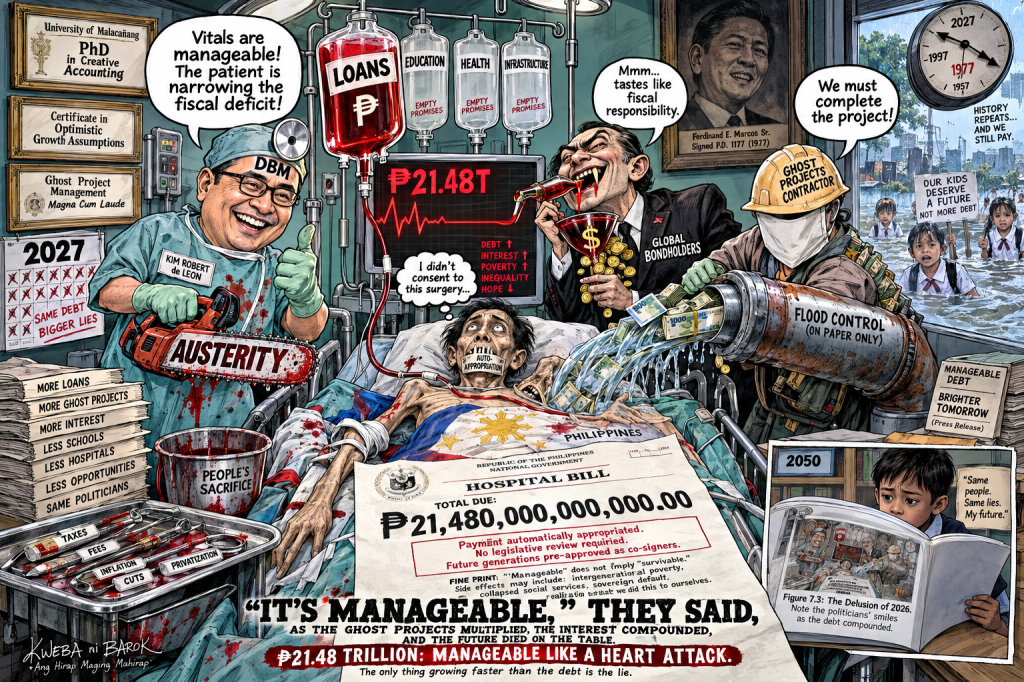
The DBM says the debt is fine. The ₱1.1 trillion interest bill says otherwise.
By Louis ‘Barok’ C. Biraogo — September 23, 2026
LET me say this plainly: ₱21.48 trillion is not a number. It is a confession.
It is the government admitting, through the cold arithmetic of its own budget documents, that it has been living beyond its means for years, borrowing against the future to pay for the present, and hoping—praying, really—that the Filipino people are too distracted by the latest celebrity scandal or flood-control outrage to notice the fiscal freight train coming down the tracks.
The Department of Budget and Management (DBM) projects national government debt to hit ₱21.479 trillion by end-2027. That is a 9% jump from the ₱19.765 trillion projected for 2026. It is a 68% increase from the ₱12.79 trillion inherited by the Marcos administration in June 2022. And it is, by any rational measure, a staggering indictment of a government that promised “prudent fiscal management” and delivered instead a borrowing binge of historic proportions.
But here is the thing. The DBM would like you to believe this is fine.
“Our debt remains manageable,” Acting Secretary Kim Robert C. de Leon assured us, because the government is “narrowing the fiscal deficit while fully providing for debt servicing.”
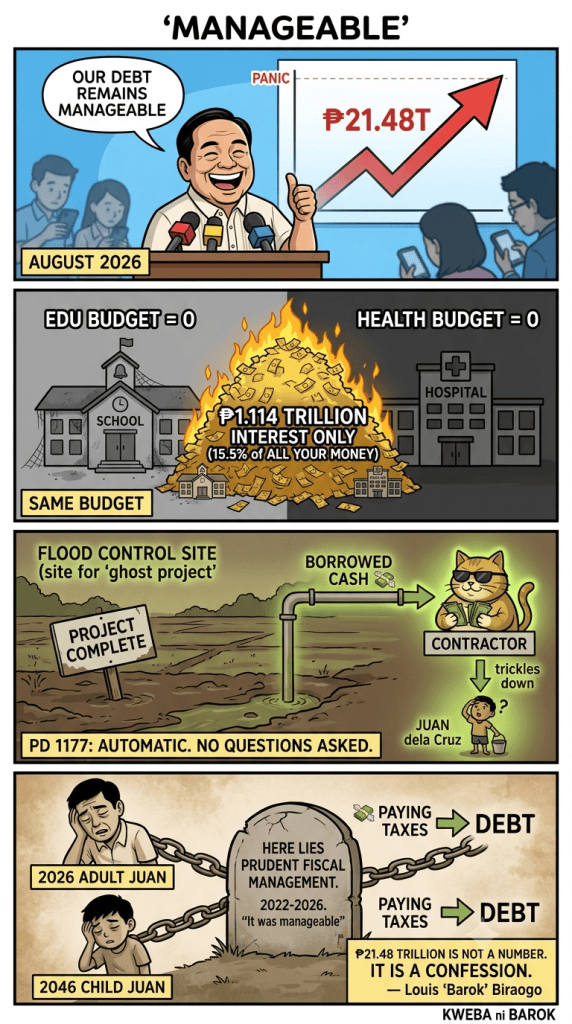
Manageable. That is the word they keep using. As if ₱21.48 trillion is just a number on a spreadsheet. As if the ₱1.114 trillion in interest payments alone—15.5% of the entire proposed 2027 budget—is not money that could have funded education, healthcare, or infrastructure that actually works.
Let us be clear about what “manageable” actually means in this context. It means the government can still borrow. It means creditors still have confidence. It means we have not yet reached the point of default. But it does not mean the situation is good. It does not mean the trajectory is sustainable. And it certainly does not mean Filipinos should accept this as normal.
#DBM #PhilippineDebt #21Trillion #Budget2027 #KwebaNiBarok
The Arithmetic of Deception
Let us do some basic math that the DBM would prefer you ignore.
The proposed 2027 budget is ₱7.2 trillion. Of that, ₱1.114 trillion goes to interest payments alone. That is more than the entire budget for education. More than the entire budget for health. More than the combined budgets of most government agencies that actually deliver services to people.
The DBM frames this as a sign of fiscal responsibility—we are honoring our obligations, they say. But honoring obligations to creditors while shortchanging obligations to citizens is not responsibility. It is a perverse prioritization that treats bondholders as more important than schoolchildren.
And it gets worse. Under a severe downside scenario developed by the Congressional Policy and Budget Research Department (CPBRD), the debt-to-Gross Domestic Product (GDP) ratio could hit 70.7% by 2027 if growth underperforms. The government is projecting 5-6% GDP growth. The CPBRD’s severe scenario assumes nominal GDP growth of just 2.9%.
That is not a remote possibility. That is a very real risk in an economy that grew by just 2.3% in the second quarter of 2026. The government’s growth assumptions are, to put it generously, optimistic. To put it honestly, they are the kind of projections that get made when you need the numbers to work for political reasons rather than economic ones.
The Ghost-Project Multiplier
Here is where the story gets truly obscene.
The government is not just borrowing to fund productive investments. It is borrowing to fund projects that may not exist.
The flood-control scandal—which has already prompted Fitch to revise its outlook on the Philippines to negative—revealed what many of us suspected: billions of pesos in borrowed funds went to ghost projects, overpriced contracts, and substandard infrastructure that either does not work or does not exist.
The DBM’s response? Restore ₱107.4 billion in flood-control funding for 2027, arguing that unfinished projects need to be completed.
Let us translate this from bureaucratic euphemism into plain language:
We are going to borrow more money to finish projects that may have been fraudulent to begin with, because stopping now would mean admitting that the original money was wasted.
This is the ghost-project multiplier in action. A nonexistent or substandard project does not just waste its original appropriation. It creates four layers of fiscal damage:
- the principal borrowed
- the interest accruing
- the economic benefits foregone
- the cost of eventually doing it right
A ₱1-billion ghost project becomes a ₱2-billion or ₱3-billion liability by the time taxpayers finish paying for it. And the people who orchestrated the fraud? They are not paying. They are probably planning their next project.
The Legal Fiction of Automatic Appropriations
Now, let us talk about the constitutional elephant in the room.
Under Presidential Decree No. 1177 (Budget Reform Decree of 1977), signed by Ferdinand Marcos Sr. in 1977, all expenditures for principal and interest on public debt are “automatically appropriated.” This means debt service payments bypass congressional scrutiny entirely. They are paid first, before any other government spending, without any annual legislative review.
The Freedom from Debt Coalition has long called for the repeal of PD 1177, arguing that it removes legislative oversight, prioritizes creditors over citizens, and is a “legacy of dictatorship.”
They are right. And the Supreme Court has effectively told Congress to fix it itself.
In Guingona v. Carague (1991), the Court ruled that PD 1177 constitutes a “lawful authorization” unless repealed by Congress. In other words: If you do not like it, legislators, do something about it.
Congress has not. For decades, lawmakers have complained about automatic appropriations while doing precisely nothing to change the system. They hold hearings. They make speeches. They file bills that go nowhere. And then they approve the budget with the automatic debt service provision intact, because challenging it would mean challenging the entire fiscal architecture that keeps them in power.
Meanwhile, the Supreme Court’s ruling in Belgica v. Ochoa (2013) established that Congress cannot abdicate its power of the purse to the executive. The Court struck down the pork barrel system precisely because it violated the constitutional principle that “no money shall be paid out of the Treasury except in pursuance of an appropriation made by law.”
But PD 1177 does exactly that—it appropriates money automatically, without any specific annual legislative action. The only difference between the Priority Development Assistance Fund (PDAF) and automatic debt appropriations is that one was struck down by the Court and the other was not.
Why? Because challenging debt service is politically dangerous. It raises the specter of default. It threatens the bond market. It is the third rail of Philippine fiscal politics.
But the constitutional principle is the same. If Congress cannot delegate its appropriation power to individual legislators for pork, how can it delegate that power to a 1977 decree for debt service?
The Growth Gambit
The government’s entire defense rests on one assumption: that economic growth will bail us out.
If GDP grows faster than debt accumulates, the debt-to-GDP ratio falls even as absolute debt rises. This is the “grow out of it” strategy, and it has worked for other countries at other times.
But it only works if growth actually materializes. And the early signs are not encouraging.
The economy grew by just 2.3% in the second quarter of 2026. The government’s full-year target is 5-6%. The Senate Economic Planning Office (SEPO) has warned that the budget’s assumptions are “highly dependent on a strong economic recovery.”
In other words: The entire fiscal strategy is a bet on a growth rebound that may not come. If growth disappoints, the debt ratio rises. If the debt ratio rises, borrowing costs increase. If borrowing costs increase, the deficit widens. If the deficit widens, more borrowing is needed.
This is the vicious cycle that every debt crisis in history has followed. The Philippines is not there yet. But the path is visible, and the government is walking it with its eyes wide shut.
The Intergenerational Theft
Here is the moral dimension that gets lost in all the technical discussions about debt sustainability.
When the government borrows ₱3.3 trillion in 2027—of which ₱1.6 trillion is just to refinance maturing obligations—it is not just making a financial decision. It is making an ethical one.
The beneficiaries of this borrowing are largely today’s adults: contractors who build the projects, politicians who claim credit for them, voters who receive services funded by the deficit.
The payers are largely tomorrow’s adults: children who will inherit the debt without having consented to it, workers who will pay taxes to service obligations incurred before they could vote, generations who will have less fiscal space for their own priorities because we spent their inheritance.
This is not necessarily wrong. Borrowing for productive infrastructure that benefits future generations can be justified. Borrowing for education and health that builds human capital can be justified.
But borrowing to fund ghost projects, overpriced contracts, and consumption that leaves no lasting asset? That is not investment. That is theft—theft from people who have no voice in the decision.
The DBM says the debt is “manageable.” For whom? For the bondholders who receive their interest payments on time? For the contractors who received their payments regardless of whether they delivered? For the politicians who get to cut ribbons on projects that may not exist?
The people for whom this debt is manageable are not the people who will pay for it.
The Scandal of Complacency
What is most striking about the government’s response to the debt trajectory is not the numbers themselves. It is the complacency.
The International Monetary Fund (IMF) says the debt is sustainable under baseline conditions. The DBM says it is manageable. Moody’s affirms the investment-grade rating. And so the government concludes: Nothing to see here. Move along.
But “sustainable under baseline conditions” is not the same as “safe.” Baseline conditions assume everything goes right. They assume growth meets targets. They assume no external shocks. They assume no corruption scandals that disrupt spending. They assume no peso depreciation that increases the local-currency cost of external debt.
What happens when baseline conditions do not hold? The CPBRD’s severe scenario—70.7% debt-to-GDP by 2027—provides a hint. And that is not even the worst case. It is just the “severe” case.
The government is not preparing for the severe case. It is not even acknowledging it. It is projecting debt-to-GDP declining to 63% by 2030 and calling that a success. But a 63% debt ratio is still far above the pre-pandemic 39.6% and above the 60% threshold that is widely considered a prudential ceiling for emerging markets.
The Philippines is not Greece. It is not Argentina. It is not on the verge of default. But it is also not in a comfortable fiscal position, and pretending otherwise is not governance. It is denial.
What Would Actually Fix This
Let me be constructive, because criticism without solutions is just complaining.
First, Congress should repeal PD 1177 and restore annual legislative review of debt service. This would not cause a default—the debt would still be paid—but it would force lawmakers to actually debate fiscal priorities instead of rubber-stamping automatic appropriations. It would also create political accountability: If legislators want to cut debt service to fund social programs, they would have to say so explicitly and defend that choice.
Second, the government needs to publish a comprehensive debt audit. Every loan, every project, every peso borrowed and spent should be traceable. The public has a right to know what their future tax payments are actually paying for.
Third, the growth assumptions underlying the fiscal plan need to be stress-tested against realistic scenarios. If the plan only works under optimistic assumptions, it is not a plan. It is a hope.
Fourth, corruption must be treated as a fiscal issue, not just a moral one. Every peso stolen from a debt-financed project is a peso that taxpayers will repay with interest. The flood-control scandal is not just a governance failure. It is a debt-sustainability risk.
Finally, the government should stop pretending that “manageable” is the same as “good.” ₱21.48 trillion is manageable in the same way that a patient with high blood pressure is “manageable.” It is manageable until it is not. And when it is not, the consequences are severe.
The Bottom Line
The Philippines is not facing an imminent debt crisis. The peso debt is mostly domestic, mostly fixed-rate, and mostly long-term. The country retains market access. The economy is still growing, albeit slowly.
But the trajectory is troubling, the legal framework is archaic, the growth assumptions are optimistic, and the corruption risks are real.
The government’s response—reassurance, complacency, and a refusal to acknowledge the scale of the challenge—is not reassuring. It is the same response that every government in history has offered before a fiscal reckoning.
The ghosts of the Marcos dictatorship’s debt crisis haunt this debate. The automatic appropriations law that enables the current borrowing binge was signed by Ferdinand Marcos Sr. in 1977. The corruption that wastes borrowed funds is a continuation of the same patronage networks that looted the country decades ago. And the burden that will fall on future generations is the same intergenerational theft that fueled the debt crisis of the 1980s.
The more things change, the more they stay the same.
₱21.48 trillion is not just a number. It is a warning. The question is whether anyone in Malacañang is listening.
Louis ‘Barok’ C. Biraogo is the author of the Kweba ni Barok blog, where he writes about law, politics, and the occasional constitutional crisis. He is not a licensed financial adviser, but he can do basic arithmetic.
Key Citations
A. Legal & Official Sources
- The 1987 Constitution of the Republic of the Philippines. Official Gazette of the Republic of the Philippines, 1987, http://www.officialgazette.gov.ph/constitutions/1987-constitution/.
- The 1987 Constitution of the Republic of the Philippines, art. VI, sec. 29(1). Official Gazette of the Republic of the Philippines, http://www.officialgazette.gov.ph/constitutions/the-1987-constitution-of-the-republic-of-the-philippines/the-1987-constitution-of-the-republic-of-the-philippines-article-vi/.
- Presidential Decree No. 1177. Budget Reform Decree of 1977. 30 July 1977, http://www.lawphil.net/statutes/presdecs/pd1977/pd_1177_1977.html.
- Guingona, Jr. v. Carague. G.R. No. 94571, Supreme Court of the Philippines, 22 Apr. 1991, http://www.lawphil.net/judjuris/juri1991/apr1991/gr_94571_1991.html.
- Belgica v. Ochoa. G.R. No. 208566, Supreme Court of the Philippines, 19 Nov. 2013, lawphil.net/judjuris/juri2013/nov2013/gr_208566_2013.html.
- International Monetary Fund. Philippines: 2025 Article IV Consultation—Press Release; Staff Report; and Statement by the Executive Director for the Philippines. IMF Staff Country Reports, vol. 2025, no. 333, 2025, http://www.elibrary.imf.org/view/journals/002/2025/333/article-A001-en.xml.
- Fitch Ratings. “Fitch Revises the Philippines’ Outlook to Negative; Affirms at ‘BBB.’” 20 Apr. 2026, http://www.fitchratings.com/research/sovereigns/fitch-revises-philippines-outlook-to-negative-affirms-at-bbb-20-04-2026.
B. News Reports
- “PH Gov’t Debt Seen Surging to Record High P21.5T in ’27.” Inquirer.net, 12 Aug. 2026, business.inquirer.net/605260/ph-govt-debt-seen-surging-to-record-high-p21-5t-in-27.
- Cordero, Ted. “DBM Sets Aside P1.143T for Debt Burden in 2027 Budget; Says Debt Manageable.” GMA News Online, 14 Aug. 2026, http://www.gmanetwork.com/news/money/economy/998599/dbm-sets-aside-p1-143t-for-debt-burden-in-2027-budget-says-debt-manageable/story/.
- Ramirez, Renalyn. “DBM Proposes P7.2-Trillion National Budget for 2027.” Philstar.com, 26 June 2026, http://www.philstar.com/headlines/2026/06/26/2537999/dbm-proposes-p72-trillion-national-budget-2027.
- “Debt Ratio Seen Rising to 70.7% by 2027 in Severe Conditions.” Inquirer.net, 17 Sept. 2026, business.inquirer.net/611532/debt-ratio-seen-rising-to-70-7-by-2027-in-severe-conditions.
- “Philippines Q2 GDP Grows 2.3% Yr/Yr, Slower than Expected.” Reuters, 7 Aug. 2026, http://www.reuters.com/world/asia-pacific/philippines-q2-gdp-grows-23-yryr-slower-than-expected-2026-08-07/.
- Untalan, Sherylin. “₱107.4B Earmarked for Flood Control Projects in Proposed 2027 Budget.” GMA News Online, 11 Aug. 2026, http://www.gmanetwork.com/news/topstories/nation/998109/107-4b-earmarked-for-flood-control-projects-in-proposed-2027-budget/story/.
- Cabuenas, Jon Viktor D. “Moody’s Affirms PH ‘Baa2’ Rating, Stable Outlook.” GMA News Online, 25 Aug. 2026, http://www.gmanetwork.com/news/money/economy/999711/moody-s-affirms-ph-baa2-rating-stable-outlook/story/.

- “Ang Hirap Maging Mahirap”: The PAO Scandal That Proves Government Contempt Is Nothing New
- “Far-Off” My Axx: Malacañang’s Claire Castro Drowns in Her Own Legal Gaslighting
- “Forthwith” to Farce: How the Senate is Killing Impeachment—And Why Enrile’s Right (Even If You Can’t Trust Him)

- “HINDI AKO NAG-RESIGN!”

- “I Know Nothing”: Baste Duterte’s Amnesia Defense Meets ₱33M in GenCorp Contracts
- “I’m calling you from my new Globe SIM. Send load!”

- “Mahiya Naman Kayo!” Marcos’ Anti-Corruption Vow Faces a Flood of Doubt

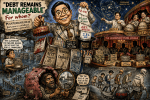
- “Manageable” Debt, Unmanageable Lies: DBM’s ₱21 Trillion Fairy Tale
- “Meow, I’m calling you from my new Globe SIM!”

- “Natrabaho”: One Word, One Ombudsman, and a Judiciary on Trial

- “No Special Jail for Crooks!” Boying Remulla Slams VIP Perks for Flood Scammers
- “Philippine-Controlled” or Yankee Gas Station? The Davao Fuel Depot Farce Exposed





Leave a Reply