Leni Got the Money, Marcos Got the Optics, and the Filipino People Got Another Lump-Sum Loophole to Worry About
By Louis ‘Barok‘ C. Biraogo — September 22, 2026
WELCOME back, mga ka-kweba. Today we’re going to talk about the most expensive pair of pink socks in Philippine political history.
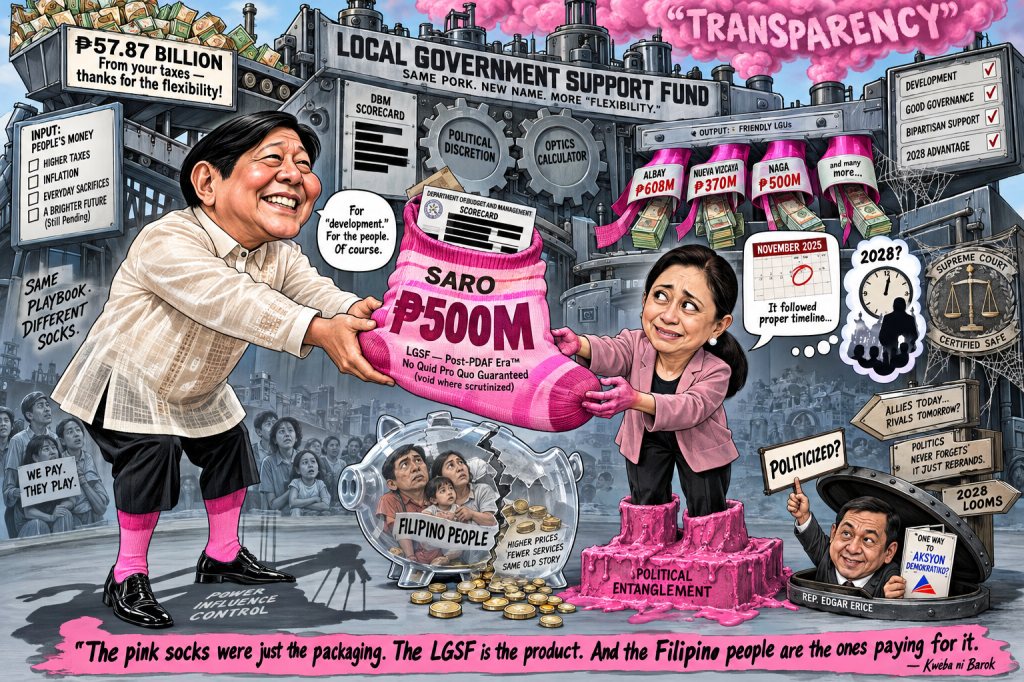
I’m talking, of course, about the P500-million allocation for the Jesse M. Robredo Coliseum in Naga City—a controversy so perfectly calibrated for the post-Priority Development Assistance Fund (PDAF) era that it deserves its own case study in how to launder political patronage through constitutional loopholes. And I use the word “launder” deliberately, because if you squint hard enough at the documentary trail, you might just convince yourself that ₱500 million fell from heaven for purely humanitarian reasons.
Spoiler alert: it didn’t.
The Timeline: A Documentary Trail or a Convenient Alibi?
Let’s start with the facts, because the facts, in this case, are the most sophisticated PR device ever deployed by a mayor who claims she’s “not in my horizon” for 2028.
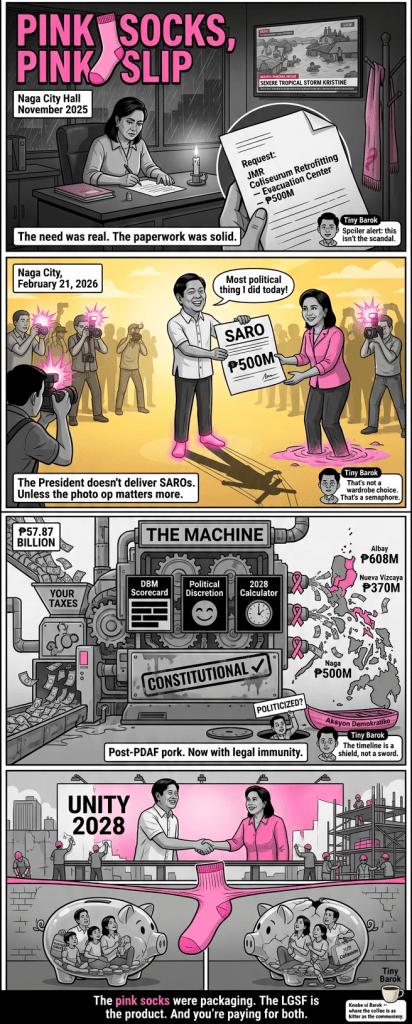
The documentary record—and this is where the Robredo camp has done its homework—shows that Mayor Leni Robredo wrote to Senator Kiko Pangilinan on November 13, 2025, requesting support for the coliseum retrofitting. The Naga City Council unanimously endorsed the request five days later, estimating the project at ₱500 million.
This is, by any measure, competent local governance. You see a need, you identify the funding source, you seek political allies who can navigate the national budget maze. This is how Local Government Units (LGUs) have always operated. If you’re looking for a smoking gun, the November 13 letter isn’t it.
But here’s what the Robredo faithful conveniently gloss over: the letter doesn’t prove the absence of political calculus; it only proves the presence of paperwork.
The request existed. The need was documented. The council endorsed it. And yet, between November 2025 and February 2026, this request somehow found its way to the desk of Executive Secretary Ralph Recto, was approved “in principle” in early February, and then, on February 21, 2026, President Ferdinand Marcos Jr. personally handed over the Special Allotment Release Order (SARO) during a visit to Naga City.
Let me repeat that. The President of the Philippines personally turned over a SARO for an LGU infrastructure project.
This is not how SAROs are normally delivered. SAROs are administrative documents. They are issued by the Department of Budget and Management (DBM), transmitted through official channels, and acknowledged by the LGU. The President does not typically serve as a courier for ₱500-million releases to cities that happen to be led by his former presidential rival.
Unless, of course, the optics matter more than the administration.
The Pink Socks: Symbolism Over Substance
Which brings us to the pink socks.
According to contemporary accounts, Marcos wore pink socks during his Naga visit—the color of Robredo’s 2022 presidential campaign—and joked that it was the “most political thing” he did that day.
I don’t know about you, but when a president makes a point of wearing the opposition’s campaign color while handing over half a billion pesos, that’s not a wardrobe choice. That’s a statement of intent. That’s a political semaphore. That’s Marcos saying, without saying, “I’m not your enemy anymore. Let’s talk about 2028.”
And here’s the thing: Robredo’s camp knows this. They know that the February 21 event was not just about disaster resilience. It was about repositioning. It was about signaling. It was about creating a visual that would be burned into the electorate’s memory for the next two years.
But they also know that they can’t say that. Because if Robredo admits that she’s accepting political favors from Marcos, she alienates the very opposition base that has sustained her since 2016. So instead, we get the timeline defense: “Look, the request predates the release! There’s no quid pro quo!”
Fine. But the timeline only proves that the request predated the release. It doesn’t prove that the approval wasn’t accelerated for political reasons. It doesn’t prove that the prioritization wasn’t influenced by Marcos’s desire to build an anti-Duterte coalition. It doesn’t prove that the personal turnover wasn’t designed to create exactly the kind of visual that would fuel 2028 speculation.
The timeline is a shield, not a sword. It deflects the crudest version of the quid pro quo allegation—the one where Marcos invented the project out of thin air—but it does nothing to address the more sophisticated version: that a legitimate project received preferential treatment because the beneficiary happened to be a politically useful ally-in-the-making.
The LGSF Loophole: PDAF by Another Name?
Now let’s talk about the money itself, because this is where the Kweba’s spidey senses really start tingling.
The ₱500 million comes from the Local Government Support Fund (LGSF), which has exploded from ₱23 billion in 2025 to ₱57.87 billion in 2026—more than double in a single year.
Let me say that again. The LGSF more than doubled in one fiscal year.
And what is the LGSF? It’s a lump-sum appropriation in the General Appropriations Act that the President and the DBM can allocate to LGUs at their discretion. The Supreme Court upheld it in Belgica v. Executive Secretary (2019), ruling that it has a “discernible public purpose” and is therefore distinct from the unconstitutional congressional pork barrel.
But here’s the inconvenient truth that nobody in Malacañang wants to talk about: the LGSF is presidential pork by any other name.
The DBM guidelines for the 2026 LGSF explicitly prioritize “rehabilitation, repair, improvement, expansion, or upgrading of multipurpose buildings, such as multipurpose hall, sports stadium, and health stations.” And the allocation is based on a “scorecard developed by the DBM” that considers factors like “adherence to established governance standards,” “fiscal transparency,” and “public safety.”
Sounds objective, right? Except the scorecard is developed by the DBM, which is under the Office of the President. And the DBM can also consider “the necessity, just and equitable distribution among LGUs and availability of funds.”
Translation: the President and his budget secretary decide who gets what, when, and how much.
Is it illegal? No. The Supreme Court has blessed it. Is it transparent? Barely. Is it susceptible to political manipulation? Absolutely.
The LGSF is the perfect post-PDAF vehicle for executive patronage. It’s constitutional, it’s lump-sum, and it’s large enough to fund pet projects for politically useful LGUs. And with ₱57.87 billion sloshing around in 2026, there’s plenty of gravy to go around.
The Erice Intervention: Right Questions, Wrong Messenger
Into this fray wades Rep. Edgar Erice, who on September 15, 2026, questioned whether the P500-million allocation was politically motivated—specifically, whether it was intended to draw Robredo closer to the Marcos administration.
Erice’s timing is, to put it charitably, suspicious. The man is a former Liberal Party member who spent 18 years in the party before jumping ship to Aksyon Demokratiko. He’s not exactly a neutral observer. His intervention reads less like principled oversight and more like a man settling scores or raising his profile.
But here’s the uncomfortable truth: Erice is asking the right questions, even if he’s the wrong messenger.
Because the real issue isn’t whether Marcos and Robredo are secretly plotting a 2028 alliance. The real issue is whether the LGSF is being used as a slush fund for political coalition-building, and whether the Naga allocation is the most egregious example of a systemic problem.
And it probably is.
The Comparative Data Problem: Where’s the Scorecard?
If the DBM has a “scorecard” for LGSF allocations, let’s see it.
Let’s see how Naga City scored on “adherence to established governance standards” compared to, say, Albay, which received ₱608 million in LGSF funds. Let’s see how Naga’s “fiscal transparency” rating compared to Nueva Vizcaya, which received ₱370 million. Let’s see the comparative disaster-risk assessments, the evacuation-capacity gaps, the infrastructure-readiness scores.
Let’s see the scorecard.
Because right now, all we have is a press release from the DBM saying the LGSF is “focused on strengthening basic services, livelihoods, and support for LGUs with limited resources.” And a bunch of LGUs—Albay, Nueva Vizcaya, Iloilo, Mountain Province—receiving hundreds of millions in allocations that happen to coincide with the administration’s political outreach efforts.
The fact that the DBM won’t release the scorecard is not an accident. It’s a feature of the system. The less transparent the criteria, the more room for political discretion. And the more room for political discretion, the more useful the LGSF becomes as a patronage tool.
The Robredo Defense: Genuine Need, Genuine Politics
To be fair to Robredo—and I can’t believe I’m saying this—her defense is stronger than Erice’s accusation.
The Jesse M. Robredo Coliseum is a 12,000-seat facility that has served as Naga’s largest evacuation center during typhoons and floods. During Severe Tropical Storm Kristine in October 2024, Naga experienced approximately 679 mm of rainfall in 24 hours, with 22 of 27 barangays affected and roughly 30% of the city submerged.
The coliseum was never designed as an evacuation center. It lacks communal kitchens, adequate sleeping areas, and sufficient sanitation facilities. Retrofitting it to serve as a proper disaster-resilience facility is not just reasonable—it’s arguably negligent not to do it.
So yes, the project is legitimate. The need is real. The documentary trail is solid.
But legitimacy and political usefulness are not mutually exclusive. A project can be genuinely needed and politically expedient at the same time. A president can fund a legitimate disaster-resilience project and also benefit politically from being seen as responsive to an opposition mayor. A mayor can accept national funding for a genuine local need and also benefit politically from demonstrating her ability to work with the administration.
This is how politics works. It’s not always corruption. Sometimes it’s just… politics.
The problem is that the LGSF makes it impossible to tell the difference. When the allocation criteria are opaque, when the scorecard is secret, when the President personally hands over SAROs to opposition mayors in photo-ops designed to generate headlines, you can’t distinguish between legitimate governance and political patronage. And in the absence of transparency, suspicion fills the void.
The 2028 Chessboard: Why This Matters
Let’s be clear about what’s really at stake here.
Sara Duterte has been impeached twice. The Marcos-Duterte alliance is irreparably broken. Marcos is term-limited and needs a successor. And Leni Robredo—despite losing two national elections—remains the most viable opposition figure in the country.
The February 21 SARO turnover wasn’t just about a coliseum. It was about Marcos testing the waters. It was about seeing whether Robredo would accept the olive branch. It was about creating a visual that could be repurposed in 2028 as evidence that Marcos and Robredo can work together, that the old divisions are healed, that a new coalition is possible.
And Robredo accepted.
She had to, of course. She’s the mayor of Naga City. Her job is to secure resources for her constituents. Rejecting ₱500 million on principle would be political suicide and governance malpractice. But accepting it means she’s now entangled in Marcos’s political project, whether she likes it or not.
The pink socks weren’t just a fashion statement. They were a trap.
The Verdict: Constitutional, But Not Clean
So where does that leave us?
Legally, the Naga allocation is almost certainly compliant. The LGSF is constitutional. The request predates the release. The procurement is in post-qualification. There’s no evidence of a quid pro quo, no smoking gun, no secret agreement.
But legality is not the same as propriety. And the LGSF system, as currently structured, is a recipe for exactly this kind of controversy.
The fund is large. The criteria are opaque. The allocations are discretionary. And the President can personally involve himself in the delivery of funds to politically significant LGUs. This is not a system designed for transparency. It’s a system designed for flexibility—and flexibility, in the hands of a skilled political operator, is just another word for patronage.
Rep. Erice may be a disgruntled former Liberal, but he’s not wrong to ask questions. The DBM should release the scorecard. The comparative allocation data should be public. The criteria for prioritizing one LGU over another should be transparent and auditable.
Until that happens, every LGSF allocation—whether it’s ₱500 million for Naga or ₱608 million for Albay or ₱370 million for Nueva Vizcaya—will be suspect. Not because the projects aren’t needed, but because the system makes it impossible to prove they weren’t politically motivated.
And that’s the real scandal. Not that Marcos gave Robredo ₱500 million. But that he could give her ₱500 million, or withhold it, or give it to someone else, with virtually no accountability and no transparency.
The pink socks were just the packaging. The LGSF is the product.
And the Filipino people are the ones paying for it.
Louis “Barok” C. Biraogo is a recovering idealist, a reluctant political analyst, and the proprietor of Kweba ni Barok, where the only thing more cynical than the commentary is the coffee. He can be reached at the cave, preferably with receipts.
Key Citations
A. Legal & Official Sources
- Belgica v. Executive Secretary. G.R. No. 210503. Supreme Court of the Philippines, 8 Oct. 2019, https://www.digest.ph/decisions/belgica-v-executive-secretary.
- Dimensions of the Enacted FY 2025 Budget. Congressional Policy and Budget Research Department, House of Representatives, June 2025, https://cpbrd.congress.gov.ph/wp-content/uploads/2025/06/BB2025-01-Dimensions-of-the-Enacted-Budget-FY-2025.pdf.
- General Appropriations Act, FY 2026. Allocations to Local Government Units, Department of Budget and Management, https://www.dbm.gov.ph/wp-content/uploads/GAA/GAA2026/VolumeIB/ALGU/C.pdf.
- Local Budget Circular No. 169. Department of Budget and Management, 16 Feb. 2026, https://www.dbm.gov.ph/wp-content/uploads/Issuances/2026/Local-Budget-Circular/LOCAL-BUDGET-CIRCULAR-NO-169.pdf.
- Resolution No. 2025-751. Sangguniang Panlungsod of Naga, 2025, https://www2.naga.gov.ph/wp-content/uploads/2025/12/Resno-2025-751-Supporting-the-request-of-Mayor-Robredo-to-Sen.-Pangilinan-Retrofitting-of-JMR-Coliseum.pdf.
B. News Articles
- Ebreo, Benjamin Moses M. “PBBM Assures Nearly P370-M Support Fund for Nueva Vizcaya.” Philippine Information Agency, 26 Feb. 2026, https://pia.gov.ph/news/pbbm-assures-nearly-p370-m-support-fund-for-nueva-vizcaya/.
- Esguerra, Darryl John. “PBBM: Record LGU Support Fund to Boost Local Services.” Philippine News Agency, 23 Feb. 2026, https://www.pna.gov.ph/articles/1269554.
- Ferreras, Vince Angelo. “LGUs to Seek P58.53-B Local Funding via Online Portal — DBM.” GMA News Online, 15 Sept. 2026, https://www.gmanetwork.com/news/topstories/nation/1002483/lgus-to-seek-p58-53-b-local-funding-via-online-portal-dbm/story/.
- Geducos, Argyll Cyrus. “Pink Socks: Marcos, Robredo Vow No Talk of Politics in Naga.” Manila Bulletin, 21 Feb. 2026, https://mb.com.ph/2026/02/21/pink-socks-marcos-robredo-vow-no-talk-of-politics-in-naga.
- Gita-Carlos, Ruth Abbey, and Connie Calipay. “PBBM Turns Over P500-M for Upgrade of Naga City Coliseum.” Philippine News Agency, 21 Feb. 2026, https://www.pna.gov.ph/articles/1269496.
- Limos, Allen. “Palace Questions Erice’s Claim of ‘Politicized’ Naga City Budget.” The Manila Times, 18 Sept. 2026, https://www.manilatimes.net/2026/09/18/news/palace-questions-erices-claim-of-politicized-naga-city-budget/2427892.
- “Was Naga’s P500-M Coliseum Fund Political? Robredo Lays Out Timeline.” Philstar.com, 21 Sept. 2026, https://www.philstar.com/nation/2026/09/21/2557816/was-nagas-p500-m-coliseum-fund-political-robredo-lays-out-timeline.
C. Official Websites
- “Jesse M. Robredo (JMR) Coliseum.” Naga City Tourism, https://tourism.naga.gov.ph/metro-naga/jesse-m-robredo-jmr-coliseum/.
- “President Marcos Backs Major Upgrade of Jesse M. Robredo Coliseum in Naga City.” Presidential Communications Office, 21 Feb. 2026, https://pco.gov.ph/news_releases/president-marcos-backs-major-upgrade-of-jesse-m-robredo-coliseum-in-naga-city/.
- “Situation Briefing Presided Over by President Ferdinand R. Marcos Jr. in Naga, Camarines Sur.” Presidential Communications Office, 26 Oct. 2024, https://pco.gov.ph/press-briefing/situation-briefing-presided-over-by-president-ferdinand-r-marcos-jr-in-naga-camarines-sur/.
- Philippine News Agency. “The province of Albay will receive PHP608 million from President Ferdinand R. Marcos Jr.’s Local Government Support Fund.” X, 20 Feb. 2026, https://x.com/pnagovph/status/2024728225218199628.
- “Ang Hirap Maging Mahirap”: The PAO Scandal That Proves Government Contempt Is Nothing New

- “Far-Off” My Axx: Malacañang’s Claire Castro Drowns in Her Own Legal Gaslighting
- “Forthwith” to Farce: How the Senate is Killing Impeachment—And Why Enrile’s Right (Even If You Can’t Trust Him)

- “HINDI AKO NAG-RESIGN!”

- “I Know Nothing”: Baste Duterte’s Amnesia Defense Meets ₱33M in GenCorp Contracts

- “I’m calling you from my new Globe SIM. Send load!”

- “Mahiya Naman Kayo!” Marcos’ Anti-Corruption Vow Faces a Flood of Doubt

- “Manageable” Debt, Unmanageable Lies: DBM’s ₱21 Trillion Fairy Tale

- “Meow, I’m calling you from my new Globe SIM!”

- “Natrabaho”: One Word, One Ombudsman, and a Judiciary on Trial

- “No Special Jail for Crooks!” Boying Remulla Slams VIP Perks for Flood Scammers

- “Philippine-Controlled” or Yankee Gas Station? The Davao Fuel Depot Farce Exposed








Leave a Reply