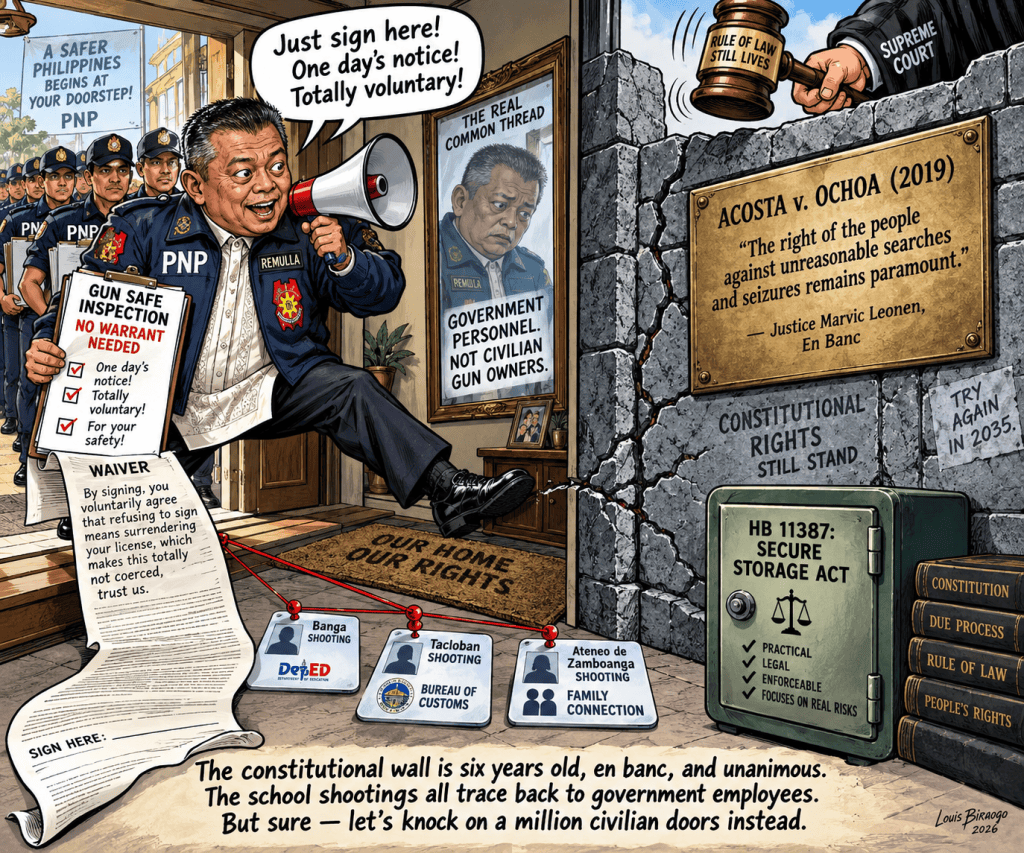
A 2019 Supreme Court Ruling Already Said No — But Remulla Wants the Court to Change Its Mind
By Louis ‘Barok‘ C. Biraogo — September 22, 2026
I. The Cause: Banga and the Pattern
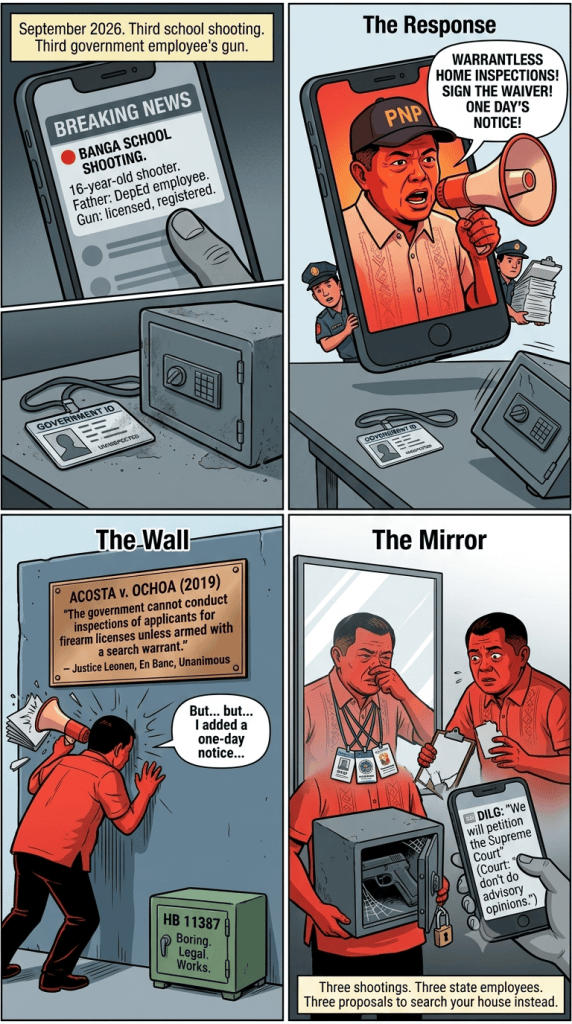
On the night of September 18, 2026, a 16-year-old student allegedly opened fire at Banga National High School in South Cotabato, killing two schoolmates, wounding several others, and then turning the gun on himself. The firearm was legally owned by his father, a Department of Education (DepEd) employee. Within a day, Interior Secretary Juanito Victor “Jonvic” Remulla was at Camp Crame proposing that police be allowed to inspect gun owners’ homes without a warrant.
Banga was the third fatal school shooting since June 2026 — after Tacloban and Ateneo de Zamboanga. In all three, the weapon traced back not to the black market but to a licensed, registered firearm entrusted to a government worker: a Bureau of Customs official in Zamboanga, a relative of the Tacloban shooter, and now a DepEd employee. The common thread is a failure of institutional safekeeping among the state’s own personnel — not the “loose firearms” trade Remulla has spent 2026 campaigning against.
Casualty figures themselves were disputed: Tribune’s original wire report said two dead and eight wounded; later corrections settled on three dead (including the shooter) and six wounded. Kweba ni Barok flags this as its own small case study in verification.
II. Four Proposals, One Whiff
Remulla’s post-Banga package resolves into four proposals of very different constitutional weight:
- Warrantless home inspections of licensed gun owners — reframed as inspection by signed waiver with one day’s notice, to be pursued through Congress and the Supreme Court.
- “Equal liability” for negligent gun owners — voiced most bluntly as “if murder is committed, then the father should also be charged with murder.”
- Metal detectors for public schools, a 2027 budget item.
- Repeal of Republic Act No. 8294 (RA 8294)’s bailability of loose-firearm possession, restoring a non-bailable, 20-year penalty.
Around these sits House Bill 11387, the “Responsible Firearm Ownership and Safe Storage Act,” filed by Speaker Faustino “Bojie” Dy III and Majority Leader Sandro Marcos hours after the shooting. It is the one piece that does not require reopening a settled constitutional question — which is precisely why it deserves the closest look.
III. The Constitutional Wall: Acosta v. Ochoa (2019)
Remulla’s inspection proposal runs directly into a six-year-old, en banc Supreme Court decision he keeps citing — usually right before proposing to work around it. Acosta v. Ochoa (G.R. No. 211559, consolidated with 211567, 212570, 215634), decided October 15, 2019 through Justice Marvic Leonen, arose from a nearly identical fact pattern: the Philippine National Police (PNP)’s 2013 Implementing Rules and Regulations (IRR) for Republic Act No. 10591 (Comprehensive Firearms and Ammunition Regulation Act) required license applicants to sign a “Consent of Voluntary Presentation for Inspection,” authorizing warrantless home inspection as a condition of registration. Licensed owners and Peaceful Responsible Owners of Guns (PROGUN) sued.
“There is no constitutional right to bear arms… The grant of license, however, is without prejudice to the inviolability of the home. The right of the people against unreasonable searches and seizures remains paramount, and the government, in the guise of regulation, cannot conduct inspections of applicants for firearm licenses unless armed with a search warrant.”
The Court struck down the consent clause as void under Article III, Section 2. Everything else in RA 10591 survived — including the PNP’s authority to inspect the commercial premises of dealers, gunsmiths, clubs, and ranges. That distinction — commercial premises versus the private home — is the load-bearing wall of the decision, and exactly the wall Remulla asks the Court to move.
IV. Will Waiver-Plus-Notice Work?
The refinement — signed waiver, one day’s notice — attempts to distinguish this from the clause Acosta already invalidated. The distinction is thinner than it looks.
Philippine jurisprudence requires consent to be unequivocal, specific, intelligently given, free of official pressure — a standard Acosta invoked when it treated the “voluntary” consent clause as coerced in substance, because refusing to sign meant forfeiting the license. A waiver folded into licensing carries the same structural coercion: decline inspection, lose the firearm you legally own. Unless the waiver is genuinely severable from licensing eligibility, it risks being the same clause in a new coat of paint.
Even a fully severable, opt-in program reaches only owners who agree — precisely those least likely to be storing firearms unsafely. The proposal’s bite depends on reaching those who decline, the population Acosta already placed out of reach absent a warrant grounded in individualized probable cause.
V. The Case for Remulla
The proposal is not frivolous, and deserves its strongest version:
- Three fatal school shootings in under four months, all traced to legally owned firearms, is a genuine and urgent state interest.
- RA 10591 already requires secure storage — a rule with no enforcement mechanism at all if no one may confirm compliance without first catching a crime in progress.
- Other state-granted privileges — driver’s licenses, business permits, professional licenses — already carry compliance inspections; a lethal instrument arguably justifies at least as much.
- A truly voluntary, revocable, narrowly scoped regime — not tied to licensing consequences, against a neutral checklist, with real advance notice — is arguably distinguishable from the coerced clause Acosta struck down.
- Metal detectors are the one uncontested piece of the package.
VI. The Case Against
The case against is considerably heavier:
- Acosta is recent, unanimous in substance, and decided en banc on essentially the same fact pattern; stare decisis gives little reason to reverse six years later absent a materially different record.
- The voluntariness problem is not a drafting defect Remulla can patch — it is the exact defect Acosta already examined and rejected.
- Scale makes it unworkable: PROGUN alone has claimed over a million sympathetic licensed owners. A stretched PNP cannot meaningfully inspect that population without the program becoming symbolic or selectively — therefore discriminatorily — enforced.
- The government’s own framing undercuts the remedy: all three shootings involved firearms inside the state’s personnel-accountability chain (DepEd, Customs), pointing to an internal command-responsibility failure — a problem civilian home inspection does not touch.
- Precedent risk: normalizing waiver-conditioned home entry for one privilege builds a template other regulators could borrow, hollowing out Article III, Section 2.
- Institutional trust: the proposal asks for expanded discretionary entry powers at a moment when the PNP’s use of force is already under scrutiny — including rights-group criticism of Remulla’s own “loose firearm” framing of a bystander’s death during a 2025 protest dispersal.
VII. “The Father Should Also Be Charged with Murder”: The Legal Gap
Remulla’s liability proposal is politically resonant and legally imprecise. Philippine criminal law runs on personal culpability: a felony is committed by dolo or culpa, and one person does not become a co-principal in another’s intentional crime merely by being careless with the instrument used — Articles 17 and 18 of Act No. 3815 (Revised Penal Code) require actual conspiracy, direct inducement, or indispensable cooperation.
What already exists is Article 365: reckless imprudence resulting in homicide. Ivler v. San Pedro treats quasi-offenses under Article 365 as a distinct class, punished for the negligence itself rather than mapped onto the resulting felony — which is why the penalty is lighter than murder and generally bailable. Article 365 does not carry the qualifying circumstances (treachery, evident premeditation) that make murder murder.
Civil liability already reaches further: Article 2180 of Republic Act No. 386 (Civil Code) makes parents vicariously liable for the acts of minor children living in their company, reinforced by Article 221 of Executive Order No. 209 (Family Code). And because the Banga shooter died at the scene, his own criminal responsibility — governed by Republic Act No. 9344 (Juvenile Justice and Welfare Act of 2006) as amended by Republic Act No. 10630 (RA 10630) (minimum age fifteen, rebuttable discernment for fifteen to eighteen) — is moot, though it explains why pressure shifts toward the adult owner.
The coherent fix is not stretching murder liability onto a negligent third party; it is a purpose-built negligence offense with its own elements and penalty — precisely what HB 11387 attempts.
VIII. HB 11387: The Cleaner Path
Filed the day of the Banga shooting, HB 11387 amends RA 10591 to require any firearm not in an authorized user’s immediate control be stored unloaded in a secure storage device, ammunition locked separately — with heightened duty where a child or unauthorized person lives in, regularly visits, or works on the premises. It creates criminally negligent unauthorized access, reaching registered owners and “accountable custodians” — expressly including public officers entrusted with government-issued firearms, closing precisely the gap the three shootings exposed. Knowingly furnishing a firearm to an unauthorized person carries prision correccional and a P300,000–P600,000 fine, escalating to the principal offender’s penalty if used in a crime. Applicants must complete a gun-safety and safe-storage course and pass a written exam, with non-compliance a ground for suspension or revocation.
This mirrors U.S. Child Access Prevention statutes — New Mexico, Utah, Missouri, New Hampshire — criminal and civil liability triggered by negligent storage where a minor predictably gains access, with no accompanying grant of routine home-entry power. HB 11387 reaches the same accountability gap through legislative amendment rather than a search-and-seizure workaround — which is why it is far less likely to be struck down.
IX. Can the Supreme Court Simply Answer?
Remulla says he will “petition the Supreme Court” for a ruling authorizing inspections. That runs into a structural problem: under Article VIII, Section 1, judicial power extends only to actual cases or controversies; the Court does not issue advisory opinions on hypothetical or not-yet-enacted rules.
Acosta illustrates the point. Of four consolidated petitions, Acosta and Dela Paz‘s was dismissed outright for failing to allege actual facts constituting a live controversy; only PROGUN’s and the dealers association’s, pointing to a concrete rule already enforced against them, proceeded to the merits. A Department of the Interior and Local Government (DILG) request for pre-clearance of a scheme that does not yet exist faces the identical threshold problem.
The realistic paths are narrower than “ask the Court for a guideline”: amend the IRR and wait for a challenge — the sequence that produced Acosta; ask the Court to adjust search-warrant procedure under its rule-making power, unlikely to be stretched into substantive reversal; or have Congress amend RA 10591 outright, still exposing the resulting IRR to a fresh Article III challenge. None produces the pre-emptive blessing the DILG seems to want.
X. Motives of Each Actor
Remulla and the DILG. A steady cadence of press-briefing announcements — August 19, 25, 27, September 11, and September 19 — positions Remulla as the administration’s visible face on gun accountability after three fatal shootings in four months. The proposals extend a broader campaign to repeal RA 8294’s bailability.
House leadership (Dy and Marcos). Filing HB 11387 within hours delivers visible, fast legislative action while staying inside Congress’s lane — regulating storage and liability rather than authorizing searches, avoiding the DILG’s constitutional exposure.
PNP leadership (Chief Nartatez). Statements stress “study” and “consultation,” with acknowledgment that privacy concerns need to be “carefully studied” — caution consistent with an institution that already lost this fight once.
Gun owners and PROGUN. A group that sustained a five-year, multi-petition campaign to win Acosta has an existential stake in preventing any home-entry precedent, and the resources to litigate again.
DepEd and the wider administration. Multi-agency optics — metal detectors, campus drills, Senate Bill 2426 (Comprehensive School Safety Act) — matter as much as any proposal’s legal durability.
Victims’ families and the public. The demand is concrete accountability for why registered, government-linked firearms keep reaching children — a demand a slower, HB 11387-style fix risks appearing to under-deliver on.
XI. Options
DILG/PNP could: fold the inspection push into HB 11387 rather than a parallel, weaker track; narrow any audit power to Type 3–5 collector licenses already subject to inspection under the IRR; expand the voluntary safekeeping-deposit program with incentives; or propose an expedited, judge-issued storage-compliance warrant — still requiring probable cause, but faster to obtain.
Congress could: advance HB 11387 and a Senate counterpart independently, and consider whether a narrowly tailored, judicially supervised inspection-warrant mechanism belongs in the same bill as a genuine middle path.
The Judiciary, if a live case arises: would need a materially new factual record — evidence that existing storage rules are so unenforceable as to be facially inadequate — to revisit Acosta, a high bar this fresh a precedent.
Civil society and the press: the more useful watchdog target may be agency-level enforcement of existing safekeeping protocols among government personnel, since that is where all three 2026 shootings originated.
XII. Likely Outcome
Most probable: HB 11387 or a merged version advances through committee, a Senate counterpart follows, and RA 10591’s storage-and-liability provisions are amended sometime in 2027. The home-inspection idea is most likely to be quietly downgraded — to a voluntary or audit-only program for higher-tier collectors, or an expedited warrant procedure keeping a judge in the loop.
Lower-probability but live: DILG proceeds with a waiver-based IRR pilot, a gun owner (plausibly backed by PROGUN) challenges it, and the case reaches the Supreme Court on a genuinely fresh record. Given how recent and firmly reasoned Acosta is, a repeat unconstitutionality ruling is the likelier outcome than reversal.
Metal detectors and campus-security measures are the least contested piece and likely proceed on their own timeline.
XIII. Impact and Implications
Constitutional doctrine: however the inspection proposal resolves, it will further calibrate Philippine “unconstitutional conditions” doctrine on privileges the state may condition on waiver of a Bill of Rights protection — with reach well beyond firearms licensing.
Compliance costs: HB 11387’s training, examination, and storage-device requirements raise the cost of legal gun ownership regardless of how the inspection debate resolves — itself a policy choice worth naming plainly.
Institutional resources and reputation: pursuing a proposal likely headed for another constitutional loss carries an opportunity cost relative to redirecting the same energy into agency-level enforcement among government personnel.
Political attention: the more durable, less dramatic legislative fix risks being crowded out by the more headline-friendly but constitutionally fragile proposals — home inspection, “charge the father with murder” — even though the legislative fix is the one likely to become law.
For Remulla personally: reinforces a public identity as the administration’s aggressive-response figure on firearms, with the upside of visible action against a genuine tragedy and the downside of adding a possible court loss to a running pattern of rebuffed executive-branch expansions of search-and-seizure power.
For the broader accountability climate this platform tracks: another instance of a security official’s first response to institutional failure being a request for expanded discretionary power, rather than enforcement of the safekeeping rules the state already has on its own books.
May the rule of law rise on the third day. 🪨
Key Citations
A. Legal & Official Sources
- The 1987 Constitution of the Republic of the Philippines. Official Gazette of the Republic of the Philippines, 1987, http://www.officialgazette.gov.ph/constitutions/1987-constitution/.
- The 1987 Constitution of the Republic of the Philippines, art. III, sec. 2. Official Gazette of the Republic of the Philippines, http://www.officialgazette.gov.ph/constitutions/the-1987-constitution-of-the-republic-of-the-philippines/the-1987-constitution-of-the-republic-of-the-philippines-article-iii/.
- The 1987 Constitution of the Republic of the Philippines, art. VIII, secs. 1 and 5(5). Official Gazette of the Republic of the Philippines, http://www.officialgazette.gov.ph/constitutions/the-1987-constitution-of-the-republic-of-the-philippines/the-1987-constitution-of-the-republic-of-the-philippines-article-viii/.
- Acosta v. Ochoa, G.R. No. 211559 (consolidated with G.R. Nos. 211567, 212570, 215634), 15 Oct. 2019. The Lawphil Project, lawphil.net/judjuris/juri2019/oct2019/gr_211559_2019.html.
- Ivler v. San Pedro, G.R. No. 172716, 17 Nov. 2010. The Lawphil Project, http://www.lawphil.net/judjuris/juri2010/nov2010/gr_172716_2010.html.
- Republic Act No. 8294. An Act Amending the Provisions of Presidential Decree No. 1866, as Amended. 6 June 1997, http://www.officialgazette.gov.ph/1997/06/06/republic-act-no-8294/.
- Republic Act No. 10591. An Act Providing for a Comprehensive Law on Firearms and Ammunition and Providing Penalties for Violations Thereof (Comprehensive Firearms and Ammunition Regulation Act). 29 May 2013, http://www.officialgazette.gov.ph/2013/05/29/republic-act-no-10591/. Also available at lawphil.net/statutes/repacts/ra2013/ra_10591_2013.html.
- Implementing Rules and Regulations of Republic Act No. 10591. Official Gazette of the Republic of the Philippines, 7 Dec. 2013, http://www.officialgazette.gov.ph/2013/12/07/implementing-rules-and-regulations-of-republic-act-no-10591/.
- Republic Act No. 11766. An Act Fixing the Validity Period of the License to Own and Possess, Registration, and Permit to Carry Firearms Outside of Residence or Place of Business, Amending for the Purpose Sections 7 and 19 of Republic Act No. 10591. 6 May 2022, http://www.officialgazette.gov.ph/2022/05/06/republic-act-no-11766/.
- Act No. 3815. The Revised Penal Code, arts. 3, 17, 18, 248, 365. 8 Dec. 1930, http://www.officialgazette.gov.ph/1930/12/08/act-no-3815-s-1930/.
- Republic Act No. 386. The Civil Code of the Philippines, art. 2180. 18 June 1949, http://www.officialgazette.gov.ph/1949/06/18/republic-act-no-386/.
- Executive Order No. 209. The Family Code of the Philippines, art. 221. 6 July 1987, http://www.officialgazette.gov.ph/1987/07/06/executive-order-no-209-s-1987/.
- Republic Act No. 9344. An Act Establishing a Comprehensive Juvenile Justice and Welfare System (Juvenile Justice and Welfare Act of 2006). 28 Apr. 2006, http://www.officialgazette.gov.ph/2006/04/28/republic-act-no-9344/.
- Republic Act No. 10630. An Act Strengthening the Juvenile Justice System in the Philippines, Amending for the Purpose Republic Act No. 9344. 3 Oct. 2013, elibrary.judiciary.gov.ph/thebookshelf/showdocsfriendly/2/67962.
- House Bill No. 11387. Responsible Firearm Ownership and Safe Storage Act. 20th Cong., filed 18 Sept. 2026.
B. News Reports
- “Philippines School Shooting Leaves at Least Three Dead, Including Gunman.” Al Jazeera, 18 Sept. 2026, https://www.aljazeera.com/news/2026/9/18/philippines-school-shooting-kills-at-least-two. Accessed 22 Sept. 2026.
- Estrada, Marie Cris. “DILG Sec. Remulla Seeks Warrantless Gun-Storage Checks After Banga Shooting.” Daily Tribune, 19 Sept. 2026, https://tribune.net.ph/2026/09/19/dilg-sec-remulla-seeks-warrantless-gun-storage-checks-after-banga-shooting. Accessed 22 Sept. 2026.
- Baroña, Franco Jose C. “DILG Seeks Authority to Monitor Gunkeeping.” The Manila Times, 20 Sept. 2026, http://www.manilatimes.net/2026/09/20/news/national/dilg-seeks-authority-to-monitor-gunkeeping/2428760.
- Quismorio, Ellson. “Home-Based Inspections? Remulla Says DILG Response to School Shootings Could Be Unpopular, but Still Necessary.” Manila Bulletin, 27 Aug. 2026, mb.com.ph/2026/08/27/home-based-inspections-remulla-says-dilg-response-to-school-shootings-could-be-unpopular-but-still-necessary.
- “Ateneo de Zamboanga Shooter Brought Guns in Father’s Car, Bypassing School Security — DILG.” GMA News Online, 19 Aug. 2026, http://www.gmanetwork.com/news/topstories/regions/999071/ateneo-de-zamboanga-shooter-brought-guns-in-father-s-car-bypassing-school-security-dilg/story/.
- Ramirez, Renalyn. “‘Bitin ang batas’: Remulla Seeks Tougher Gun Owner Accountability after Tacloban Attack.” Philstar.com, 25 June 2026, http://www.philstar.com/headlines/2026/06/25/2537745/bitin-ang-batas-remulla-seeks-tougher-gun-owner-accountability-after-tacloban-attack.
- Cantos, Joy. “‘Gun Safety Bill’ nina Dy at Marcos Tutuldukan ang School Shootings.” Pang-Masa / Philstar.com, 20 Sept. 2026, http://www.philstar.com/pang-masa/police-metro/2026/09/20/2557471/gun-safety-bill-nina-dy-marcos-tutuldukan-ang-school-shootings.
- Uson, Melanie. “Remulla Seeks Full Liability for Gun Owners, Limits on Children’s Internet Use after South Cotabato School Incident.” PhilSTAR Life, 19 Sept. 2026, philstarlife.com/news-and-views/539760-remulla-seeks-full-liability-for-gun-owners-south-cotabato-school-shooting.
- Peralta-Malonzo, Third Anne. “DILG Eyes Waiver Allowing Police Inspection of Gun Owners’ Safekeeping Facilities.” SunStar Manila, 28 Aug. 2026, http://www.sunstar.com.ph/manila/dilg-eyes-waiver-allowing-police-inspection-of-gun-owners-safekeeping-facilities.
- ₱8B BBM Pork: CCTV for Every Captain’s Kumpare?

- ₱8.9 Billion, 331 Ghost Police Stations: The TIKAS Scandal Explained

- ₱8.4 Billion, 42,000 Barangays, 1 Election: The “Bawat Barangay Makikinabang” Vote-Buying Masterclass

- ₱75 Million Heist: Cops Gone Full Bandit

- ₱6.77B Ghost Haunts Duterte: RTC Dismisses Mans Carpio’s Desperate Plea
- ₱6.7-Trillion Temptation: The Great Pork Zombie Revival and the “Collegial” Vote-Buying Circus

- ₱58.53B, Zero Receipts: The LGSF Pork Barrel Nobody Wants to Name
- ₱53 Million Man Tells ₱695-a-Day Workers to Stop Being ‘Mayabang’: The Audacity of BSP’s Remolona

- ₱3.06 Billion for Evacuation Centers—But Nobody Knows Where They’ll Stand (Or If They’ll Exist)
- ₱10B Ghost in New Clark City: Matibag’s Haunted Séance for Cayetano

- ₱1.9 Billion for 382 Units and a Rooftop Pool: Poverty Solved, Next Problem Please

- ₱1.35 Trillion for Education: Bigger Budget, Same Old Thieves’ Banquet




Leave a comment