A 24-Year-Old Fell From the 16th Floor. The Internet Blamed His Dad for Flood Control in Bulacan.
By Louis ‘Barok‘ C. Biraogo — September 21, 2026
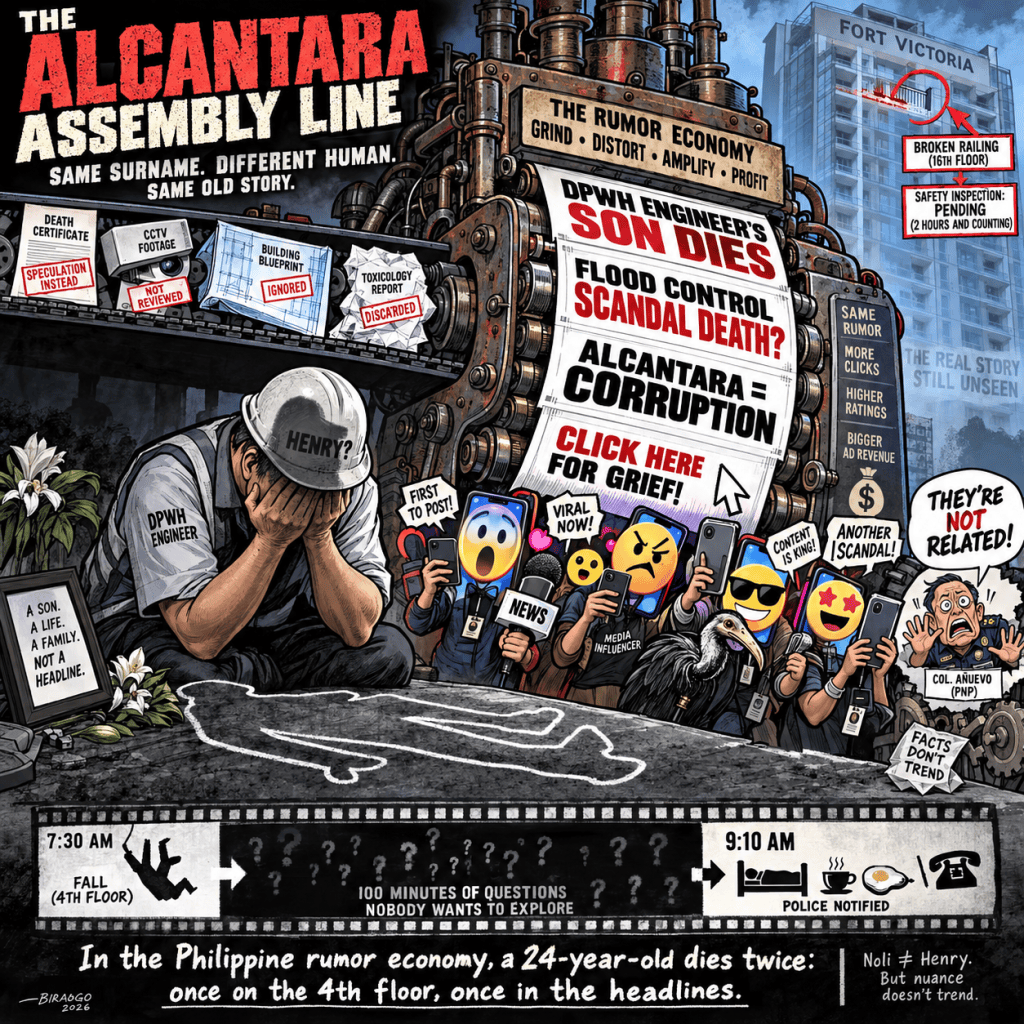
LET me get something straight right now, because the rumor mill has been working overtime and the internet’s collective IQ appears to have dropped approximately forty points in the past seventy-two hours: Noli Alcantara is not Henry Alcantara. They are not the same person. They are not related.
And if you’re one of the geniuses on Facebook who thought “Alcantara” plus “DPWH” equals “flood control corruption scandal,” congratulations, you’ve just won a lifetime supply of confirmation bias.
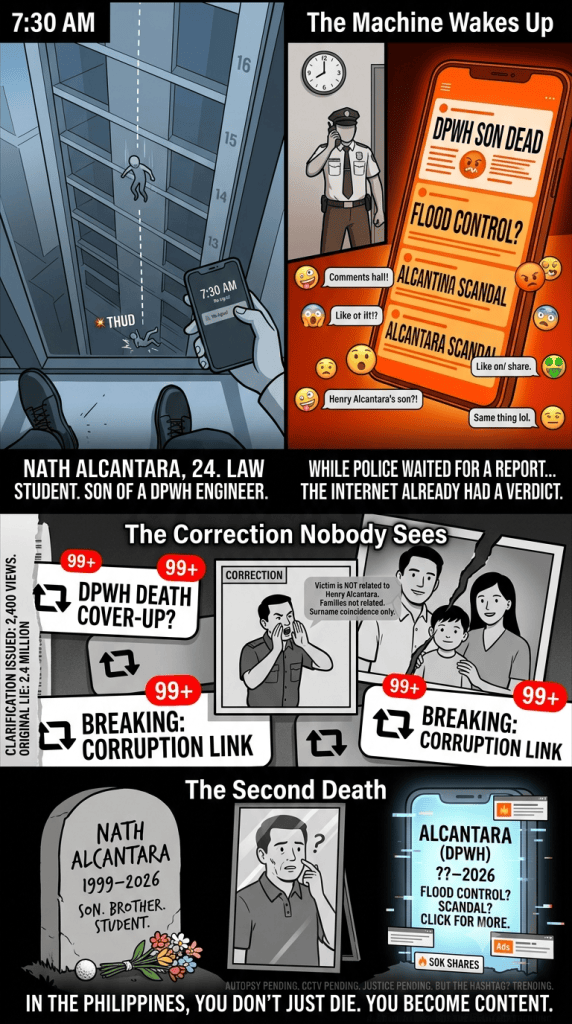
But here’s the thing about the death of Nath Alcantara: the real story isn’t the surname. It’s the way a tragedy gets processed through the Philippine rumor economy faster than the police can even secure closed-circuit television (CCTV) footage.
#Alcantara #NotHenry #RumorEconomy #PhilippineMedia #ClickbaitCulture
The Facts, Before They Get Buried Under Speculation
Nath Alcantara, 24, a first-year law student at Ateneo and a former De La Salle University (DLSU) golfer, died on September 18, 2026, after falling from the 16th floor of Fort Victoria in Bonifacio Global City (BGC). His body was found on the fourth floor. He lived on the 16th floor.
Security heard a loud thud around 7:30 a.m. The police were officially notified at 9:10 a.m. and the desk report was taken at 10:28 a.m.
That last detail—the nearly two-hour gap between the loud impact and the police report—is a question nobody seems to be asking. But we’ll get to that.
Nath was the son of Engr. Noli M. Alcantara, district engineer of the Department of Public Works and Highways (DPWH) Negros Oriental 2nd District Engineering Office. Noli Alcantara is a real official. His career includes a 2015 designation as Officer-in-Charge (OIC) Assistant District Engineer in Batangas 4th, and as of 2024, he was publicly defending road rehabilitation projects in Negros Oriental against accusations of political motivation.
Henry Alcantara, by contrast, is the dismissed DPWH Bulacan district engineer who admitted to involvement in ghost flood control projects, returned P110 million, and is now a state witness in protective custody. The Taguig police chief himself explicitly clarified that the victim is not Henry’s son, that the families are not related, and that the similarity is purely coincidental.
So why is this even a story? Because the Philippine media ecosystem cannot resist a headline that puts “DPWH” next to “death” next to “BGC.” The Police Files Tonite headline literally said “anak ng DPWH engr. sa flood control scandal,” which is journalistic malpractice so egregious it should come with a defamation lawsuit attached.
The Real Questions Nobody Is Asking
Let’s assume, for a moment, that the death was exactly what the police are investigating: a fall of undetermined manner. The official line is that they’re looking at multiple possibilities, including suicide, and awaiting autopsy results. Fine. That’s how investigations work.
But here’s what’s not being investigated in the public discourse:
- The timeline. The security briefing ended around 7:00 a.m. The impact was heard around 7:30. The police were called around 9:10. What happened in those hundred minutes? Was the scene preserved? Was CCTV immediately secured? Or did someone take a long breakfast break while evidence potentially degraded?
- The building itself. Fort Victoria is a modern BGC high-rise. If a 24-year-old fell from the 16th floor and landed on the 4th, the question of how is not just forensic—it’s architectural. Were there accessible windows? Balconies? Ledge access? Was there a known maintenance issue? The National Building Code exists precisely for these questions, and yet the public conversation has been entirely about the victim’s father rather than the building’s safety compliance.
- The alcohol angle. One unnamed source told Philstar that the victim had been drinking before the incident. That’s a single anonymous source, reported by a tabloid, and it has already been treated as established fact by the rumor ecosystem. If true, it matters for toxicology. If false, it’s character assassination dressed as investigative journalism.
The Father’s “Conflict of Interest” That Isn’t
This is where the analysis gets actually interesting, because the lazy take is “DPWH engineer’s son dies in building fall—investigate the father.”
But here’s the jurisdictional reality: Noli Alcantara has zero regulatory authority over Fort Victoria. He is a district engineer in Negros Oriental, an island province approximately 600 kilometers from Taguig. The Office of the Building Official for Taguig handles permits, occupancy certificates, and inspections for BGC buildings. The DPWH’s role, under Presidential Decree (PD) 1096 (National Building Code), is national policy and standards—not day-to-day enforcement in Taguig.
The only legitimate public-integrity question is whether Noli’s position could influence the investigation. And the answer is: it could, but only if he actually tries to intervene. If he cooperates with Taguig police, preserves evidence, and stays out of the operational side, there’s no conflict. If he starts making calls to contacts at DPWH or elsewhere to “check on things,” then we have a problem.
The police chief’s explicit clarification that the victim is not Henry Alcantara’s son suggests they’re already aware of the rumor pressure. That’s a good sign. It means someone in the chain of command understands that this case will be scrutinized for interference.
The Building Liability Nobody Wants to Discuss
Let’s play a different game. What if this wasn’t suicide? What if it was an accident caused by a building defect? What then?
Under Civil Code Article 2176, quasi-delict liability requires duty, breach, causation, and damage. If Fort Victoria had a defective railing, an improperly secured window, or a known hazard that management failed to address, the owner and property manager could face civil liability. If the defect was construction-related and within the 15-year window, Article 1723 could theoretically implicate the engineer or architect.
But here’s the catch: an unexplained fall is not proof of a defective building. The Supreme Court in Corinthian Gardens v. Tanjangco made clear that negligence requires more than an accident occurring. The plaintiff must establish that the defendant failed to exercise reasonable care under the circumstances.
So the family would need to prove: the building had a specific dangerous condition; management knew or should have known; and that condition caused the fall. That’s a high bar, especially if the autopsy and CCTV don’t support a premises-defect theory.
The Media’s Original Sin
The most disturbing element of this entire saga is how quickly a human tragedy became a content commodity. The Summit Express ran “son of DPWH engineer” in its headline. Politiko did the same. The Police Files Tonite headline was so misleading it borders on defamation.
The Philippine Journalist’s Code of Ethics is explicit: report facts, don’t sensationalize, respect the dignity of the grieving. Yet within 48 hours of Nath’s death, the internet was awash in speculation about a corruption scandal that had nothing to do with him or his father.
This isn’t just bad journalism. It’s cruel journalism. A family lost a 24-year-old son, brother, teammate, and friend. And the dominant public narrative is “DPWH engineer’s son dies”—as if his father’s job title is the most important fact about his life or death.
What Actually Matters Now
The police have the CCTV. They have the security statements. They’re awaiting the autopsy. The Taguig City Police and Southern Police District Forensic Unit are handling the investigation. That’s the process. It should be allowed to work.
The questions that should be answered:
- What does the autopsy say? Cause of death, manner of death, toxicology—this is the foundation of everything else.
- What does the CCTV show? If Fort Victoria has cameras covering the relevant areas, the footage is the single most important piece of evidence.
- Who was the last person to see Nath alive? Witness statements, not anonymous source leaks.
- What was the condition of the 16th-floor area? Was there a balcony? A window? A ledge? Was it accessible?
- Was there any prior complaint about the building’s safety?
And the question that should be asked but won’t be: Why did it take nearly two hours to call the police?
The Bottom Line
Nath Alcantara died. That’s the fact. Everything else—the DPWH angle, the surname confusion, the corruption conspiracy theories—is noise generated by a media ecosystem that prioritizes clicks over accuracy and a public that prefers narrative over evidence.
If the investigation reveals negligence by the building or its management, pursue it. If it reveals foul play, prosecute it. If it reveals suicide, respect the family’s grief and the victim’s memory.
But if the investigation reveals nothing more than an unexplained tragedy, let it be that. Don’t manufacture a scandal because the surname happens to match a more famous one. Don’t turn a dead 24-year-old into a plot device in someone else’s corruption narrative.
The Alcantara family deserves the truth. They don’t deserve to be collateral damage in the internet’s favorite new game: connect the dots between unrelated people because they share a last name.
Key Citations
A. Legal & Official Sources
- Presidential Decree No. 1096. Official Gazette of the Republic of the Philippines, 19 Feb. 1977, https://www.officialgazette.gov.ph/1977/02/19/presidential-decree-no-1096-s-1977/.
- Civil Code of the Philippines, art. 2176. Legal Resource PH, https://library.legalresource.ph/title-xvii-extra-curricular-obligations-book-iv-civil-code/.
- Civil Code of the Philippines, art. 1723. GoSupra, https://source.gosupra.com/widget/provision/2527.
- Corinthian Gardens Association, Inc. v. Spouses Tanjangco. G.R. No. 160795, 27 June 2008. The Lawphil Project, https://lawphil.net/judjuris/juri2008/jun2008/gr_160795_2008.html.
B. News Articles
- “Tragedy in BGC: DPWH District Engineer’s Son Dies After Building Fall.” Politiko, 20 Sept. 2026, https://politiko.com.ph/2026/09/20/tragedy-in-bgc-dpwh-district-engineers-son-dies-after-building-fall/headlines/. Accessed 21 Sept. 2026.
- Asajar, Cali. “Son of DPWH District Engineer Dies after Fall in BGC.” Bilyonaryo News Channel, 20 Sept. 2026, https://bnc.bilyonaryo.com/son-of-dpwh-district-engineer-dies-after-fall-in-bgc/news/.
- Bermudo, Ludy. “Ateneo Law Student Nahulog Mula 16th Floor ng Condo, Patay.” Philstar Pang-Masa, 21 Sept. 2026, https://www.philstar.com/pang-masa/police-metro/2026/09/21/2557781/ateneo-law-student-nahulog-mula-16th-floor-ng-condo-patay.
- Hicap, Jonathan. “Taguig Police Probe Death of Law Student.” Manila Bulletin, 20 Sept. 2026, https://mb.com.ph/2026/09/20/taguig-police-probe-death-of-law-student.
- Mitra, Elijah Gaven. “24-Year-Old Law Student Dies after Falling from Condominium in Taguig.” DZRH, 20 Sept. 2026, https://www.dzrh.com.ph/post/24-year-old-law-student-dies-after-falling-from-condominium-in-taguig.
- “24-Year-Old Law Student, Son of DPWH Engineer, Dies after Fall in BGC.” The Summit Express, 20 Sept. 2026, https://www.thesummitexpress.com/2026/09/nath-alcantara-law-student-dies-fall-bgc.html.
- Locus, Sundy. “Ex-DPWH Execs Bernardo, Alcantara Named State Witnesses – DOJ.” GMA News Online, 15 Jan. 2026, https://www.gmanetwork.com/news/topstories/nation/972981/ex-dpwh-execs-bernardo-alcantara-named-state-witnesses-doj/story/.
- Mangaluz, Jean. “DPWH Finds Bulacan Engineer Guilty of Grave Misconduct, Gross Neglect.” Philstar.com, 5 Sept. 2025, https://www.philstar.com/nation/2025/09/05/2470703/dpwh-finds-bulacan-engineer-guilty-grave-misconduct-gross-neglect.
- Bolledo, Jairo. “LIST: State Witnesses in Flood Control Corruption and What They Know.” Rappler, 28 Jan. 2026, https://www.rappler.com/newsbreak/iq/list-state-witnesses-flood-control-what-they-know/.
C. Official Websites
- Department of Public Works and Highways. DPWH, https://www.dpwh.gov.ph/.
- “Journalist’s Code of Ethics.” Philippine Press Institute, https://philpressinstitute.net/journalist-code-of-ethics/.
- City of Taguig. “Our Departments.” Taguig.gov.ph, https://www.taguig.gov.ph/our-departments/.
- Fort Victoria. New San Jose Builders, Inc., https://fort-victoria.com/.
- Ateneo de Manila University. Ateneo Law School, https://www.ateneo.edu/als.
- De La Salle University. DLSU, https://www.dlsu.edu.ph/.
- Police Files Tonite, https://www.policefilestonite.net/.
- POLITIKO, https://politiko.com.ph/.






Leave a Reply