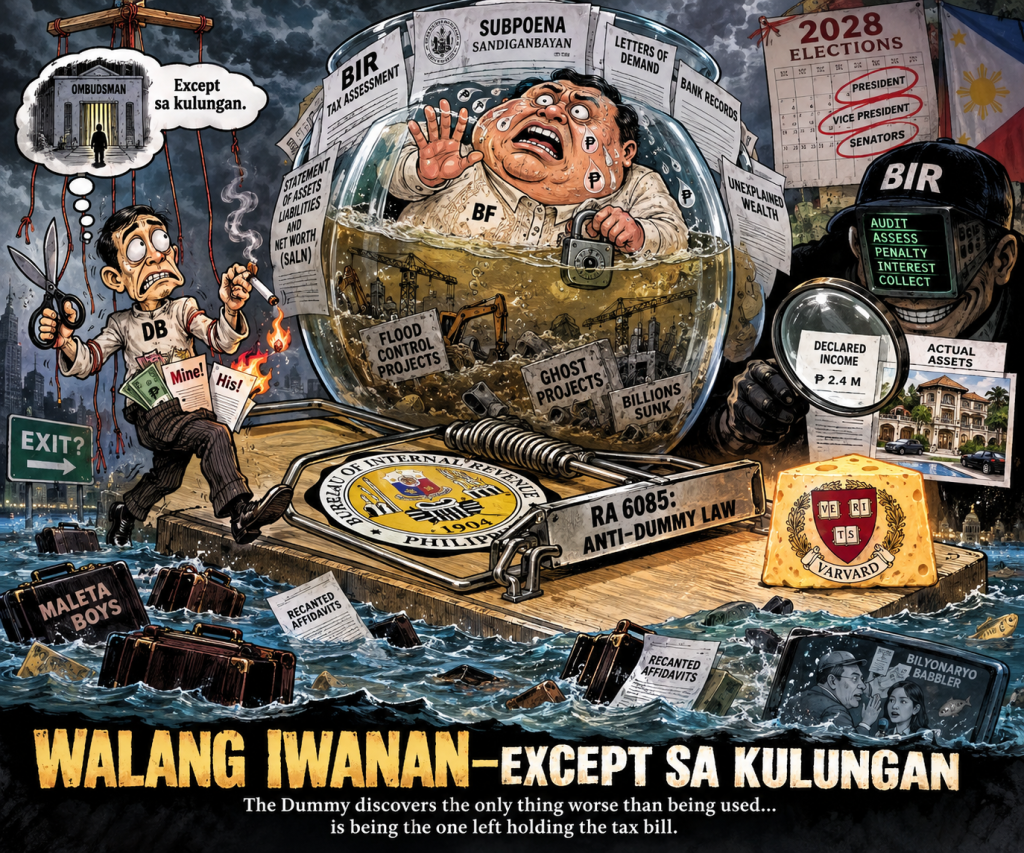
The Dummy Speaks, the Big Fish Sweats, and the BIR Sharpens Its Pencils: Inside the Financial Trap That Turns Loyalty Into Liability
By Louis ‘Barok’ C. Biraogo | September 22, 2026
LET me tell you what I love about Philippine journalism’s blind-item industrial complex. It’s not the breathless scoops. It’s not even the anonymous “Babblers” who apparently roam the corridors of power like gossipy ghosts with Bloomberg terminals. No, what I love is the grammar of it all—the way a single unnamed source can trigger a thousand knowing winks, a million “IYKYK” retweets, and exactly zero corroborating documents.
This week’s entry comes courtesy of Bilyonaryo, which reported that a “longtime dummy buddy” (DB) of a “big fish” (BF) is “reportedly ready to turn state witness” in the flood control scandal. The kicker: DB’s wife “somehow got dragged into matters surrounding BF,” and that apparently “didn’t sit well with him.”
Color me shocked. Shocked, I tell you.
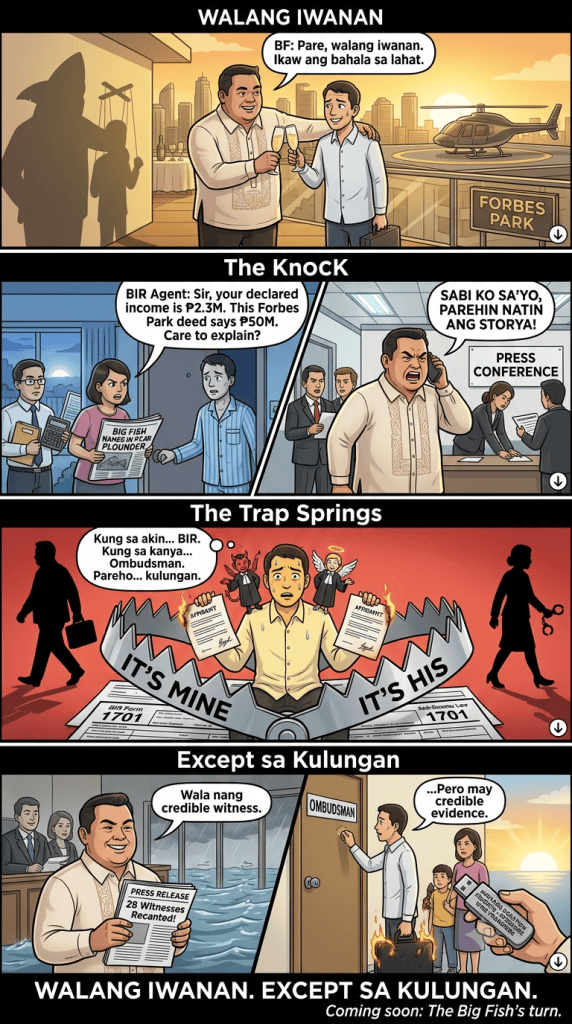
The Blind Item That Isn’t
Let’s start with the obvious. We have a BF. We have a DB. We have a Babbler. We have a Bilyonaryo staff byline. What we do not have—anywhere in the article—is a name, a document, a date, a bank transfer, or a single verifiable fact that could survive cross-examination by a first-year law student, much less a Sandiganbayan defense counsel.
But here’s the thing: we do have context.
On September 7, 2026, Ombudsman Jesus Crispin Remulla filed a ₱7.44-billion plunder case against former House Speaker Martin Romualdez, former Ako Bicol Rep. Zaldy Co, and two others. Remulla himself called Romualdez “the big fish”—not in a blind item, not in a whisper, but in a press conference, on the record, with cameras rolling. The case alleges kickbacks from flood control projects from 2022 to 2025, delivered to properties “owned by, occupied by, or associated with Romualdez”. Money allegedly used to buy houses. Money allegedly donated to Harvard.
So when Bilyonaryo whispers “BF,” and Remulla has already screamed “big fish,” and the article’s timing coincides perfectly with the plunder filing, the inference is not exactly rocket science. It’s more like Sesame Street for political junkies.
But inference is not evidence. And that distinction—the one our friends in journalism sometimes forget—is the difference between a scoop and a lawsuit.
The “Dummy Buddy” and the Tax Trap
Here’s where the story gets genuinely interesting, and where Bilyonaryo actually stumbles into a real legal point buried beneath the blind-item clickbait.
The article reports that BF has maintained that the expensive assets linked to DB were “really his buddy’s,” and that DB “had the financial means to buy them himself”. Bilyonaryo then notes—correctly, I might add—that this defense “could leave DB with a costly question from the taxman: Did his declared income and taxes match the money needed to pay for those big-ticket purchases?”
This is the kind of observation that makes you wonder if Bilyonaryo’s Babbler has a law degree. Because it’s exactly right.
If BF says the assets belong to DB, then BF is handing investigators a roadmap to DB’s financial records. And if DB’s declared income doesn’t match the ₱50-million house or the fleet of vehicles or whatever else is on the ledger, then DB has a problem. A Bureau of Internal Revenue problem. A tax evasion problem. A why-didn’t-you-report-this problem.
And if DB says the assets actually belong to BF—i.e., he was just the nominee—then DB has confessed to being a dummy. Which, under Republic Act No. 6085 (Anti-Dummy Law), is its own criminal offense. And under Republic Act No. 7080 (Anti-Plunder Act), which expressly contemplates ill-gotten wealth acquired through “dummies, nominees, agents, subordinates or business associates,” DB has just nominated himself for co-conspirator status.
It’s a beautiful trap, really. A prisoner’s dilemma constructed by the tax code and Act No. 3815 (Revised Penal Code), with BF’s own defense strategy serving as the mechanism that springs it.
No wonder DB is “reportedly” reaching out to the Ombudsman. The walls are closing in, and one of those walls has BF’s fingerprints all over it.
The State Witness Shell Game
Now, let’s talk about the phrase “turn state witness,” because this is where the Bilyonaryo report—and most media coverage of this scandal—gets sloppy.
Under Rule 119, Section 17 of the Rules of Court, a state witness discharge requires that the accused is already charged, that two or more accused are charged, that there is “absolute necessity” for the testimony, that no other direct evidence is available, and that the proposed witness is “not the most guilty.”
Under Republic Act No. 6981 (Witness Protection, Security and Benefit Act), the Witness Protection Program (WPP), a person can seek admission even before charges are filed, provided the offense is a grave felony, the testimony can be substantially corroborated, and the applicant faces threats or harm.
But here’s the catch: neither mechanism grants automatic immunity. The Ombudsman can’t just wave a magic wand and make DB’s problems disappear. The Department of Justice (DOJ) has to approve WPP admission. The Sandiganbayan has to approve a Rule 119 discharge. And even then, immunity typically covers the offenses testified about—not every tax liability, not every forfeiture action, not every civil claim the Republic might have.
So when Bilyonaryo says DB “sent feelers” about “cooperating,” that’s not the same as DB being admitted to the WPP. It’s not even the same as DB being eligible. It’s a report about a report about a possibility, filtered through an anonymous Babbler who may or may not have an agenda.
And agendas, my friends, are everywhere in this scandal.
The Recantation Problem
Consider the context that Bilyonaryo’s article conveniently omits.
In August 2026, Orly Guteza—a former security aide of Zaldy Co—recanted his testimony that he delivered cash-filled suitcases to Romualdez. Guteza claimed he was pressured by Senator Rodante Marcoleta and former lawmaker Mike Defensor to make the allegations. The Palace called for an investigation into “manipulation” of witnesses. Five of the so-called “Maleta Boys” recanted. Twenty-five other witnesses allegedly contradicted the original claims.
Romualdez’s camp seized on these recantations as proof that the case was collapsing. His lawyer, Jose “Judd” Roy III, told Bilyonaryo News Channel that they weren’t worried about former Department of Public Works and Highways (DPWH) Secretary Manuel Bonoan becoming a state witness—unless Bonoan “suddenly comes up with a new affidavit” naming Romualdez.
Translation: we’ve seen witnesses flip. We’ve seen witnesses flop. We’re not impressed by your anonymous “feelers.”
Then, in a twist that should surprise exactly no one, Bonoan—who had been charged, then excluded from the plunder case, then released—emerged as a potential witness with “insider knowledge” of DPWH transactions. Romualdez’s camp demanded due process: give us the allegations, let us respond, don’t spring new witnesses at the last minute.
So now we have two potential cooperating witnesses: Bonoan, the former DPWH secretary who knows how the department worked, and DB, the alleged longtime buddy who knows where the money went. One knows the machinery. The other knows the map.
If both flip, and if their testimony is corroborated by documents, then the plunder case against Romualdez transforms from a collection of recanting bodyguards into a financial-chain prosecution with insider testimony at its core. That’s the nightmare scenario for the defense.
If neither flips—or if their testimony is contradicted by bank records, tax filings, and property documents—then the case becomes a political circus with the Ombudsman as ringmaster.
The Real Question Nobody’s Asking
Here’s what bothers me about the Bilyonaryo report, and about the broader coverage of this scandal: everyone is obsessed with who the witnesses are and whether they’ll flip. Nobody is asking why this leak happened now.
Let’s think like investigators for a moment.
The Ombudsman filed the plunder case against Romualdez on September 7. Bilyonaryo published the blind item about DB on September 16. In between, Romualdez’s camp was making noise about recantations, demanding due process, and questioning the Ombudsman’s motives.
Who benefits from a leak about a new witness right now?
- Possibility 1: The Ombudsman’s office. A leak about a new cooperating witness could pressure Romualdez, signal to other potential witnesses that the case is strong, and shape public opinion before the defense can mount its narrative. But leaking to a business gossip site is a strange way to do that. If Remulla wanted to send a message, he’d call a press conference—he’s not exactly shy.
- Possibility 2: DB’s camp. If DB is negotiating with the Ombudsman, a leak could serve as a trial balloon. It tests public reaction, signals to investigators that DB is serious, and—crucially—makes it harder for BF to retaliate without looking like he’s obstructing justice. If DB’s wife really was “dragged into matters,” as the article claims, then public exposure might be DB’s best protection.
- Possibility 3: BF’s political rivals. The 2028 election cycle is already in the air. A leak that keeps the scandal alive, that suggests the “big fish” is about to be betrayed by his oldest friend, that paints the defense as crumbling—that’s political gold. And it costs nothing to plant.
- Possibility 4: Bilyonaryo itself. Look, business gossip sites need traffic. A blind item about a “big fish” and a “dummy buddy” is catnip for the chattering classes. The article is careful enough to avoid naming names, which limits legal exposure, while the context makes the inference obvious to anyone paying attention. It’s the journalistic equivalent of a wink and a nudge.
I don’t know which possibility is true. Neither does Bilyonaryo. Neither, probably, does its Babbler. But the question—who benefits from this leak, and why now?—is the one that should be asked every time an anonymous source whispers into a reporter’s ear.
The Bottom Line (Which Is Also a Tax Bill)
Here’s what we know, stripped of the blind-item theater:
The Ombudsman has filed a ₱7.44-billion plunder case against Romualdez and others. The case alleges kickbacks from flood control projects, delivered to properties associated with Romualdez, from 2022 to 2025. The Ombudsman says more cases are coming, including money laundering. The defense is attacking witness credibility, citing recantations and demanding due process. And now, a blind item suggests that a longtime associate—someone who knows the financial arrangements, the cash transfers, the big-ticket purchases—is considering cooperating.
If that associate is real, and if his knowledge is corroborated by documents, then the plunder case gets a financial spine. If he’s a phantom, or if his knowledge is hearsay and speculation, then he’s just another witness in a scandal that already has too many witnesses and not enough evidence.
Bilyonaryo’s contribution to this conversation is a headline that mocks the “walang iwanan” code of elite loyalty: no one left behind, except in prison. It’s a clever line. It’s also a confession: the article knows this is a story about betrayal, not about evidence. About relationships, not about records. About feelings, not about finance.
And feelings, unfortunately for the prosecution, don’t meet the threshold for plunder.
Louis ‘Barok’ C Biraogo is not a lawyer, which is precisely why he can afford to be honest about them. He writes about law, politics, and the spaces where they intersect with bad decisions. He does not have a Babbler, but he accepts tips, documents, and expressions of outrage at the usual address.
Key Citations
A. Legal & Official Sources
- Republic Act No. 6085. An Act Amending Commonwealth Act Numbered One Hundred Forty-Two Regulating the Use of Aliases. 1969, lawphil.net/statutes/repacts/ra1969/ra_6085_1969.html.
- Republic Act No. 7080. An Act Defining and Penalizing the Crime of Plunder. Official Gazette of the Republic of the Philippines, 12 July 1991, http://www.officialgazette.gov.ph/1991/07/12/republic-act-no-7080/.
- Republic Act No. 6981. An Act Providing for a Witness Protection, Security and Benefit Program and for Other Purposes. Official Gazette of the Republic of the Philippines, 24 Apr. 1991, http://www.officialgazette.gov.ph/1991/04/24/republic-act-no-6981/.
- Act No. 3815: An Act Revising the Penal Code and Other Penal Laws. Official Gazette, 8 Dec. 1930, http://www.officialgazette.gov.ph/1930/12/08/act-no-3815-s-1930/.
- Revised Rules of Criminal Procedure, Rule 119, sec. 17. The Lawphil Project, lawphil.net/courts/rules/rc_110-127_crim.html.
- Republic Act No. 8424. The National Internal Revenue Code of 1997. 1997, lawphil.net/statutes/repacts/ra1997/ra_8424_1997.html.
- Sandiganbayan. Official Website of the Sandiganbayan, sb.judiciary.gov.ph/.
- Bureau of Internal Revenue. Official Website of the Bureau of Internal Revenue, http://www.bir.gov.ph/.
B. News Reports
- Bilyonaryo Staff. “Walang Iwanan, Except sa Kulungan! Big Fish’s Longtime Buddy Reportedly Ready to Turn State Witness in Flood Control Scandal.” Bilyonaryo, 17 Sept. 2026, bilyonaryo.com/2026/09/17/walang-iwanan-except-sa-kulungan-big-fishs-longtime-buddy-reportedly-ready-to-turn-state-witness-in-flood-control-scandal/business/.
- Panti, Llanesca T. “Ombudsman Files Plunder Charges vs Martin Romualdez over Flood Control Projects.” GMA News Online, GMA Network, 7 Sept. 2026, http://www.gmanetwork.com/news/topstories/nation/1001410/ombudsman-files-plunder-charges-vs-martin-romualdez-over-flood-control-projects/story/.
- Panti, Llanesca T. “Remulla on Plunder Case vs. Martin Romualdez: He Is Big Fish.” GMA News Online, GMA Network, 7 Sept. 2026, http://www.gmanetwork.com/news/topstories/nation/1001451/remulla-on-plunder-case-vs-martin-romualdez-he-is-big-fish/story/.
- “Orly Guteza Recants Statement on Delivering Cash to Martin Romualdez.” GMA News Online, GMA Network, 19 Aug. 2026, http://www.gmanetwork.com/news/topstories/nation/999155/orly-guteza-recants-statement-on-delivering-cash-to-martin-romualdez/story/.
- “Bonoan as State Witness Can Help Pin Down Romualdez, Says Assistant Ombudsman.” Rappler, 30 June 2026, http://www.rappler.com/philippines/manuel-bonoan-state-witness-can-help-pin-down-martin-romualdez-says-ombudsman/.
- ₱9 Billion in ‘Savings’? DILG’s Fire Truck Deal Smells Like Smoke

- ₱8B BBM Pork: CCTV for Every Captain’s Kumpare?
- ₱8.9 Billion, 331 Ghost Police Stations: The TIKAS Scandal Explained

- ₱8.4 Billion, 42,000 Barangays, 1 Election: The “Bawat Barangay Makikinabang” Vote-Buying Masterclass

- ₱75 Million Heist: Cops Gone Full Bandit

- ₱6.77B Ghost Haunts Duterte: RTC Dismisses Mans Carpio’s Desperate Plea

- ₱6.77 Billion and Zero Cash: The Sara Duterte SALN Math That Doesn’t Add Up

- ₱6.7-Trillion Temptation: The Great Pork Zombie Revival and the “Collegial” Vote-Buying Circus

- ₱58.53B, Zero Receipts: The LGSF Pork Barrel Nobody Wants to Name
- ₱53 Million Man Tells ₱695-a-Day Workers to Stop Being ‘Mayabang’: The Audacity of BSP’s Remolona
- ₱4.4 Billion and a Witness Who Can’t Explain It: The Duterte Impeachment’s Most Expensive Non-Answer
- ₱3.06 Billion for Evacuation Centers—But Nobody Knows Where They’ll Stand (Or If They’ll Exist)




Leave a Reply