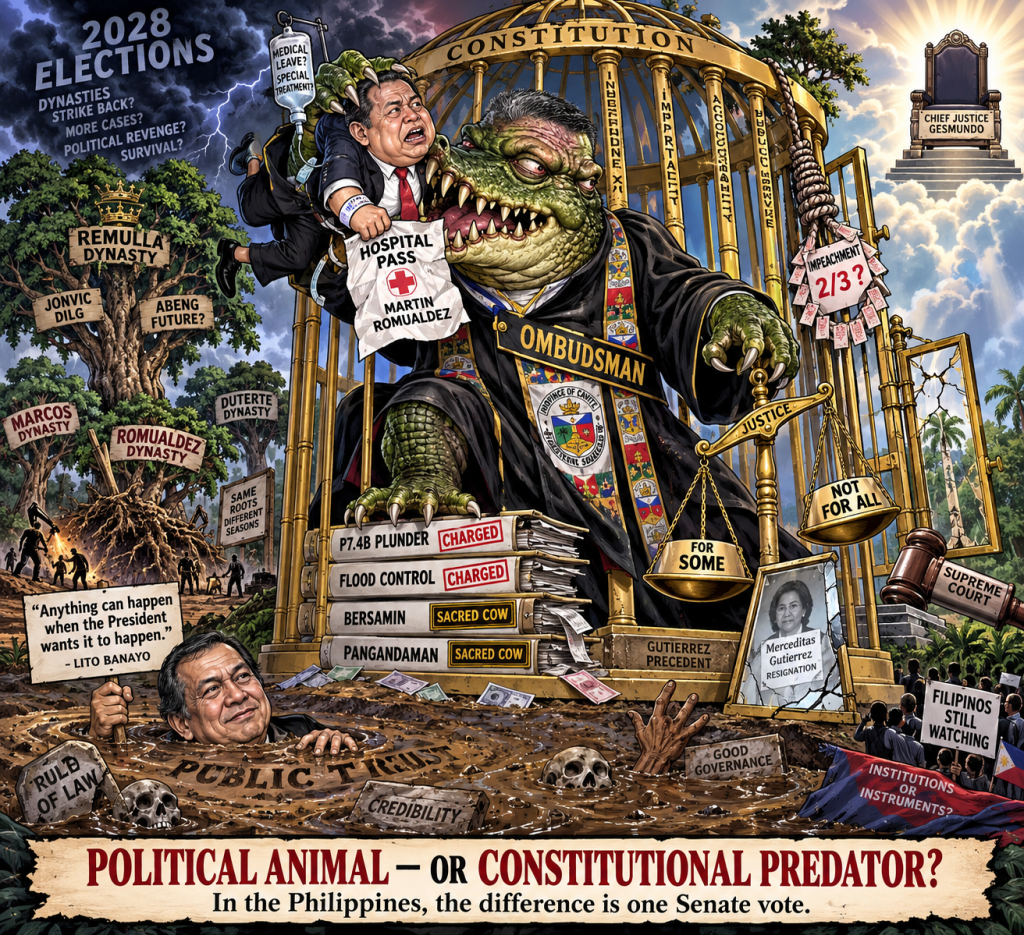
He’s prosecuting the powerful, alienating the dynasty, and betting his legacy on evidence over politics. In the Philippines, that’s either courage or suicide—and the difference may be one Senate vote.
By Louis ‘Barok‘ C. Biraogo — September 21, 2026
Lito Banayo, a man who has forgotten more about Philippine political knife-fighting than most current legislators will ever learn, dropped a quiet bomb on Politiko.com.ph on September 8. Ombudsman Jesus Crispin “Boying” Remulla, he said, could face impeachment under the next administration. He’s a “political animal,” Banayo observed. And in this country, “anything can happen when the President wants it to happen.”
Let that sink in for a moment.
The man who currently heads the Office of the Ombudsman—the constitutional body designed to be the people’s shield against government corruption—is being described by a veteran political strategist as an apex predator in the political jungle. And Banayo isn’t wrong. That’s what makes it so deliciously, terrifyingly interesting.
The Dynasty That Ate Cavite
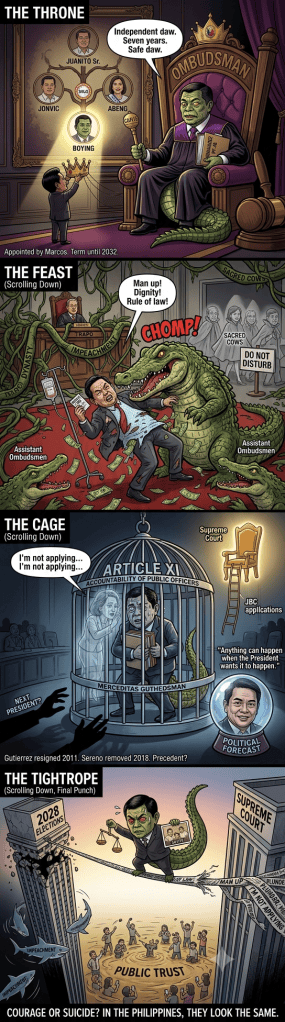
To understand why Remulla is vulnerable to the political tides he once rode, you need to understand the ecosystem that produced him. The Remullas are not merely a political family; they are the political family of Cavite, a province that has consistently delivered the kind of vote margins that make campaign strategists weep with joy.
Boying Remulla’s father, Juanito Remulla Sr., was the unquestioned kingpin of Cavite for decades—a University of the Philippines (UP) Law alumnus, Bar topnotcher, and governor from 1980 to 1995. The family has since produced governors, congressmen, and now two simultaneous Cabinet secretaries. Boying’s brother Jonvic heads the Department of the Interior and Local Government (DILG). His son Abeng is positioned for higher office. This is not a political career; it’s a political ecosystem.
And now Boying sits atop the Ombudsman’s office, a position with a seven-year term that extends to 2032—four years beyond President Marcos Jr.’s constitutional exit. The man who spent decades navigating the shark-infested waters of Cavite politics now holds the power to investigate, prosecute, and ruin virtually any public official in the country. Including, potentially, the next President.
This is either the Constitution working as intended, or a loaded gun pointed at the head of the next administration. Possibly both.
The Gutierrez Precedent: A Ghost That Haunts
Banayo’s invocation of Merceditas Gutierrez is not mere historical trivia. It’s a warning shot.
Gutierrez, appointed by Gloria Macapagal-Arroyo, found herself facing impeachment proceedings after Noynoy Aquino assumed the presidency. The complaints alleged failure to investigate corruption cases involving Arroyo and her associates. Gutierrez resigned before her Senate trial could begin.
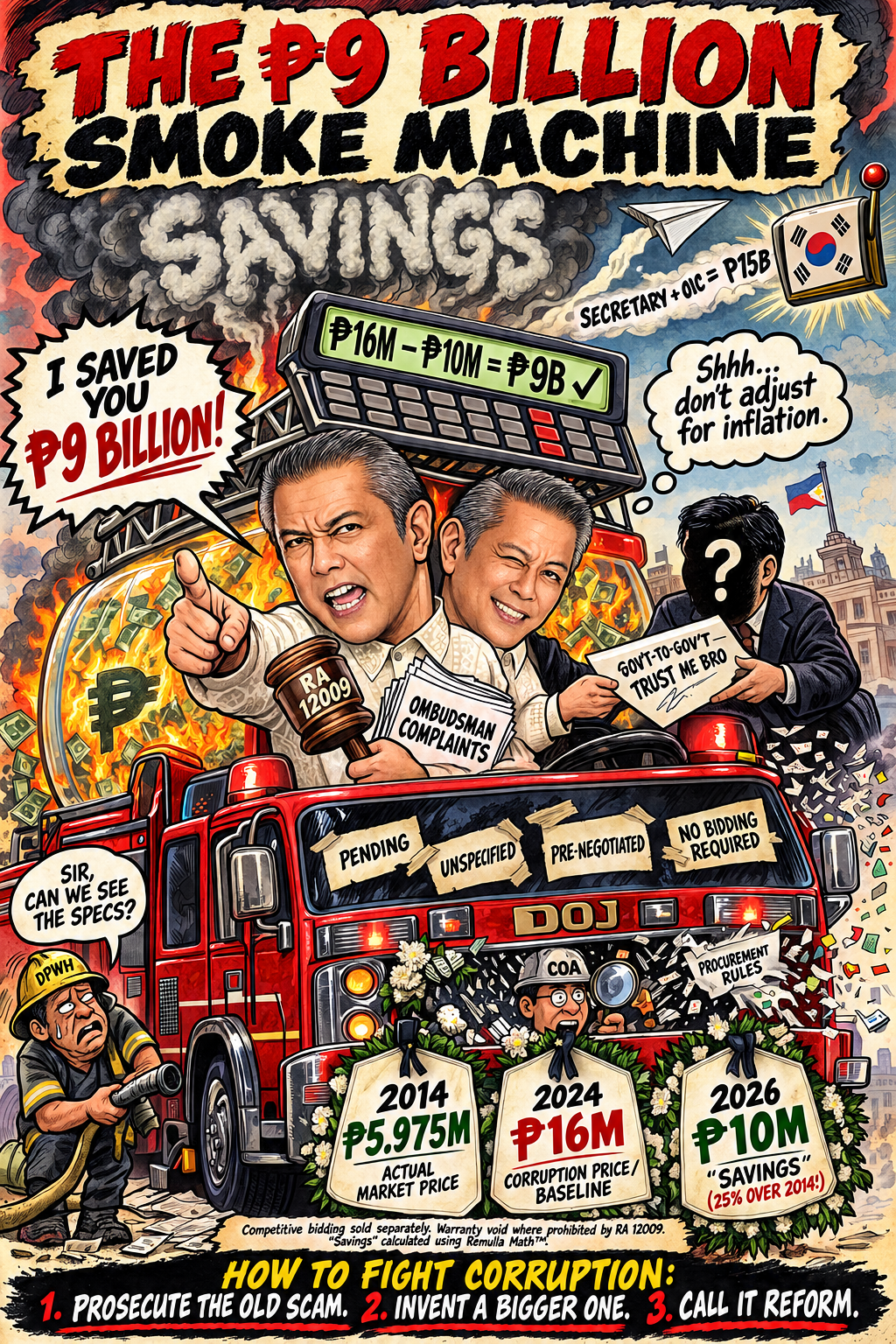
The parallel to Remulla is obvious. He was Marcos Jr.’s first Cabinet appointee at the Department of Justice (DOJ). He was appointed Ombudsman by Marcos. And he is now investigating some of the most powerful figures in the current administration’s orbit—including former Speaker Martin Romualdez, the President’s own cousin.
If the political winds shift in 2028, and a hostile administration takes Malacañang, what’s to stop a Gutierrez-style impeachment? The Constitution says the Ombudsman is impeachable. The House initiates. The Senate convicts with a two-thirds vote. All it takes is political will—or political vengeance dressed up as accountability.
But Wait—Remulla Is Actually Doing the Job
Here’s the uncomfortable part for the “he’s just a political hack” crowd: Remulla appears to be genuinely investigating powerful people.
His office has filed plunder charges against Romualdez involving P7.44 billion in alleged kickbacks from flood control projects. He’s publicly challenged Romualdez to “man up” and face the charges rather than hide behind hospital confinement. He’s investigating senators, former Cabinet secretaries, and infrastructure contractors.
When a youth group demanded transparency on the flood control cases, they named administration officials who had received “little to no scrutiny”—former Executive Secretary Lucas Bersamin, former Budget Secretary Amenah Pangandaman, and others. Bersamin had been implicated in P52 billion in budget insertions. Pangandaman faced accusations of direct knowledge of P100 billion in insertions. Both resigned. Neither has been charged. Pangandaman was later appointed to head a state-run bank. The implication: Remulla is targeting the powerful—but not the powerful closest to the President.
This is not what a purely political animal would do. A purely political animal would bury the Romualdez investigation, protect the President’s cousin, and investigate only the opposition. Instead, Remulla is doing something far more interesting—he’s behaving like the office was actually designed to function.
The Prejudgment Problem
But let’s not canonize the man just yet.
Romualdez’s lawyers have accused Remulla of a “pattern of prejudgment” that violates due process. They point to public statements suggesting a plunder case was “seriously prepared” before any formal complaint was filed. They note that an Assistant Ombudsman referred to Romualdez as a “master plunderer” before charges were even filed.
This is not a minor procedural quibble. In Philippine jurisprudence, the appearance of impartiality is not optional—it’s constitutionally required. When the Supreme Court struck down the impeachment proceedings against Vice President Sara Duterte in 2025, it emphasized that constitutional due process and fairness requirements apply throughout the impeachment process. If Remulla’s public statements have prejudged cases, any eventual conviction becomes vulnerable to legal challenge.
The Romualdez camp has also accused Remulla of using “discredited” witnesses—people the Ombudsman himself previously described as acting for “political effect.” This is either zealous prosecution that cuts corners, or a man under pressure to deliver results in politically charged cases. Neither is a comfortable look.
The Supreme Court Escape Hatch?
Banayo’s more intriguing suggestion—floated in his column before the impeachment talk—was that Remulla might be angling for a Supreme Court seat, with “reliable sources” claiming he could be appointed when Chief Justice Gesmundo retires.
Remulla has denied this, saying he wants to finish his job as Ombudsman. But the speculation is revealing. Why would a sitting Ombudsman with a seven-year term want to trade it for a Supreme Court seat? Because the Supreme Court is effectively untouchable. Justices serve until mandatory retirement at 70, and removal requires impeachment—a far higher bar than the political calculus that governs Ombudsman tenure.
If Remulla is as “political animal” as Banayo suggests, he understands this calculus perfectly. The Ombudsman serves at the pleasure of political winds. The Supreme Court serves at the pleasure of no one.
The Structural Paradox
Here is the core tension that Banayo’s comments expose: the Philippine Constitution designed the Ombudsman to be independent, but it also made the Ombudsman removable through a political process.
Article XI, Section 11 gives the Ombudsman a seven-year term without reappointment. Article XI, Section 2 makes the Ombudsman impeachable for culpable violation of the Constitution, treason, bribery, graft and corruption, other high crimes, or betrayal of public trust.
This means the Ombudsman is independent in theory but politically vulnerable in practice. The Constitution says “you cannot be fired for doing your job.” Politics says “we’ll find a reason if we want you gone.”
Banayo’s statement—”anything can happen when the President wants it to happen”—is not a legal analysis. It’s a political-science observation about how power actually operates in the Philippines. Presidents influence Congress. Congress controls impeachment. Therefore, Presidents influence whether impeachment happens.
This is not how the system is supposed to work. But it is how it has worked.
What Remulla Should Do
If Remulla wants to survive the political reckoning that may come after 2028, he needs to do three things:
- First, document everything. Every major prosecutorial decision—why charges were filed, why they were dismissed, what evidence supported each conclusion—needs to be on the record. If a future administration tries to impeach him for “betrayal of public trust,” he needs to be able to show that his decisions were evidence-based, not politically motivated.
- Second, minimize inflammatory public statements. Calling Romualdez a “mastermind” before charges were filed was politically satisfying but legally risky. The Ombudsman is not a commentator. Every word becomes potential evidence in a future proceeding.
- Third, apply uniform standards. If Remulla investigates opposition figures with vigor, he must investigate administration allies with equal vigor. The moment a pattern of selective prosecution emerges, his credibility—and his legal defense against future impeachment—collapses.
The Verdict
Banayo is right about the vulnerability. Remulla, for all his current power, sits in a constitutional cage that the next President can unlock with enough political capital. The Gutierrez precedent proves it’s possible. The Sereno case proves that creative legal mechanisms can remove even the most “independent” officials.
But Banayo may be wrong about the inevitability. Impeachment requires grounds, not just animus. If Remulla continues to build cases based on evidence—even against powerful people—he creates a record that makes purely political impeachment difficult. The Supreme Court’s 2025 Duterte decision, which struck down impeachment proceedings for procedural violations, suggests the judiciary is willing to enforce constitutional limits on the process.
The deeper question is what Remulla’s tenure says about the Philippines itself. Here is a man from a political dynasty, appointed by a political ally, investigating that ally’s own cousin. If he does it well, he proves that institutions can transcend the people who occupy them. If he fails—or if he is removed for trying—he proves the opposite.
Boying Remulla is the most interesting man in Philippine politics right now. Not because he’s the most powerful, but because he’s the test case. Can a political animal be caged by constitutional design? Or will the jungle always win?
The answer, like everything else in this country, depends on who wants it badly enough.
Louis ‘Barok’ C. Biraogo is a recovering political strategist who now writes about the people he used to help elect. His insights are frequently uncomfortable and occasionally correct.
Key Citations
A. Legal & Official Sources
- The 1987 Constitution of the Republic of the Philippines, art. XI, secs. 2, 11. Official Gazette of the Republic of the Philippines, https://www.officialgazette.gov.ph/constitutions/the-1987-constitution-of-the-republic-of-the-philippines/the-1987-constitution-of-the-republic-of-the-philippines-article-xi/.
- Office of the Ombudsman. Official Website. https://www.omb.gov.ph/.
B. News Articles
- “Could Boying Remulla Face Impeachment under the Next Admin? Anything Can Happen, Banayo Says.” Politiko, 8 Sept. 2026, https://politiko.com.ph/2026/09/08/could-boying-remulla-face-impeachment-under-the-next-admin-anything-can-happen-banayo-says/politiko-lokal/.
- “‘I’m Not Applying’: Ombudsman Boying Remulla Snubs Chief Justice Speculations.” Politiko, 3 Sept. 2026, https://politiko.com.ph/2026/09/03/im-not-applying-ombudsman-boying-remulla-snubs-chief-justice-speculations/politiko-lokal/.
- “Justice on the Move? Boying Remulla Reportedly Eyeing Chief Justice Post.” Politiko, 31 Aug. 2026, https://politiko.com.ph/2026/08/31/justice-on-the-move-boying-remulla-reportedly-eyeing-chief-justice-post/politiko-lokal/.
- “Ombudsman Files P7.4-B Plunder Raps vs Romualdez, Zaldy Co.” Manila Bulletin, 7 Sept. 2026, https://mb.com.ph/2026/09/07/ombudsman-files-p74-b-plunder-raps-vs-romualdez-zaldy-co.
- Mangaluz, Jean. “Ombudsman Remulla Tells Romualdez: Face the Charges, Man Up to It.” GMA News Online, 11 Sept. 2026, https://www.gmanetwork.com/news/topstories/nation/1002028/ombudsman-remulla-tells-romualdez-face-the-charges-man-up-to-it/story/.
- Clapano, Jose Rodel. “Martin Seeks Ombudsman Inhibition in Flood Probe.” Philstar.com, 25 Apr. 2026, https://www.philstar.com/headlines/2026/04/25/2523386/martin-seeks-ombudsman-inhibition-flood-probe.
- De Leon, Dwight. “Romualdez Accuses Remulla of Bias, Seeks to Block Ombudsman from Probing Him.” Rappler, 24 Apr. 2026, https://www.rappler.com/philippines/martin-romualdez-accuses-boying-remulla-bias-seeks-block-ombudsman-investigation/.
- “Philippines Top Court Throws Out Impeachment Complaint against VP Duterte.” Reuters, 25 July 2025, https://www.reuters.com/world/asia-pacific/philippines-top-court-throws-out-impeachment-complaint-against-vp-duterte-2025-07-25/.
- “Philippine Anti-Corruption Chief Steps Down.” BBC News, 29 Apr. 2011, https://www.bbc.com/news/world-asia-pacific-13237826.
- “President Marcos Appoints Remulla as New Ombudsman.” Philippine Information Agency, 7 Oct. 2025, https://pia.gov.ph/news/president-marcos-appoints-remulla-as-new-ombudsman/.
- Chavez, Pot. “Remulla Takes Oath as New Ombudsman.” Manila Standard, 9 Oct. 2025, https://manilastandard.net/news/314652940/remulla-takes-oath-as-new-ombudsman.html.
- “Civil Society Group: Flood Mess Probe Still Has ‘Sacred Cows.’” Inquirer Plus, 15 Feb. 2026, https://plus.inquirer.net/news/civil-society-group-flood-mess-probe-still-has-sacred-cows/.
- Bajo, Anna Felicia. “Boying Remulla Accepts DOJ Chief Offer of Incoming Marcos Admin.” GMA News Online, 23 May 2022, https://www.gmanetwork.com/news/topstories/nation/832547/boying-remulla-accepts-nomination-as-doj-chief-of-incoming-marcos-admin/story/.
C. Official Websites & Reference Works
- “Juanito Remulla.” Wikipedia, https://en.wikipedia.org/wiki/Juanito_Remulla.
- “Quo Warranto Petition against Maria Lourdes Sereno.” Wikipedia, https://en.wikipedia.org/wiki/Quo_warranto_petition_against_Maria_Lourdes_Sereno.
- “The Remullas of Cavite.” Philstar.com, 24 Oct. 2025, https://www.philstar.com/opinion/2025/10/24/2482140/remullas-cavite.
- Bilyonaryo News Channel. Official Website. https://bnc.ph/.
- “Ang Hirap Maging Mahirap”: The PAO Scandal That Proves Government Contempt Is Nothing New

- “Far-Off” My Axx: Malacañang’s Claire Castro Drowns in Her Own Legal Gaslighting
- “Forthwith” to Farce: How the Senate is Killing Impeachment—And Why Enrile’s Right (Even If You Can’t Trust Him)

- “HINDI AKO NAG-RESIGN!”

- “I Know Nothing”: Baste Duterte’s Amnesia Defense Meets ₱33M in GenCorp Contracts

- “I’m calling you from my new Globe SIM. Send load!”

- “Mahiya Naman Kayo!” Marcos’ Anti-Corruption Vow Faces a Flood of Doubt

- “Manageable” Debt, Unmanageable Lies: DBM’s ₱21 Trillion Fairy Tale

- “Meow, I’m calling you from my new Globe SIM!”

- “Natrabaho”: One Word, One Ombudsman, and a Judiciary on Trial

- “No Special Jail for Crooks!” Boying Remulla Slams VIP Perks for Flood Scammers

- “Philippine-Controlled” or Yankee Gas Station? The Davao Fuel Depot Farce Exposed




Leave a Reply