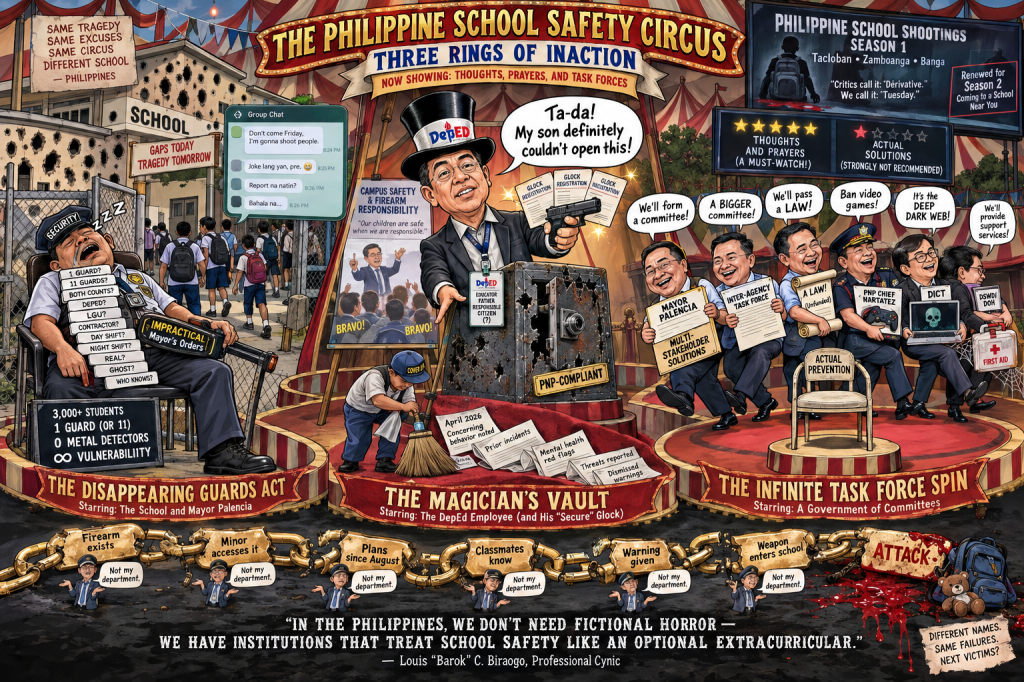
Three tragedies, recurring failures, and a familiar promise to “do something” after the shooting.
By Louis ‘Barok‘ C. Biraogo — September 21, 2026
I. THE HEADLINE THAT SHOULD HAVE BROKEN US (BUT DIDN’T)
On September 18, 2026, a 16-year-old student at Banga National High School in South Cotabato allegedly walked into campus with his father’s Glock 9mm, killed two classmates, injured eight others, then—depending on which conflicting report you believe—either shot himself in the head or was arrested. What followed was the full theatrical production of Philippine crisis response: solemn press conferences, hastily assembled task forces, senators promising legislation, and the education secretary admitting—with the candor of a man who just realized his budget didn’t cover basic security—that the system was “truly not prepared for shootings like this.”
Neither was anyone else, Secretary Angara. But here’s the thing about being unprepared: it’s not an excuse when you’ve had three school shootings in a single calendar year.
Tacloban in June. Zamboanga in August. Banga in September. If this were a Netflix series, critics would call it derivative. But this is the Philippines, where we don’t need fictional horror—we have a Department of Education (DepEd) that treats school security like an optional extracurricular.
II. THE CONVENIENT AMNESIA OF THE OFFICIAL NARRATIVE
The Shooter: A 16-year-old “achiever” in a special class. Taekwondo player. Well-behaved. Also allegedly a member of the “True Crime Community” (TCC), an online subculture the Anti-Defamation League describes as existing at the intersection of morbid fascination and potential mass violence. He allegedly planned the attack since August, initially set the date for September 3, warned classmates to “go home after lunch” on the day of the attack, and then methodically executed a shooting that would have been chillingly efficient if it weren’t so depressingly predictable.
But some reports say he was 14. Others say 16. Authorities can’t agree on the perpetrator’s age—which is only slightly less concerning than the fact that they can’t agree on how many security guards were on campus. The mayor says one. South Cotabato officials later say eleven.
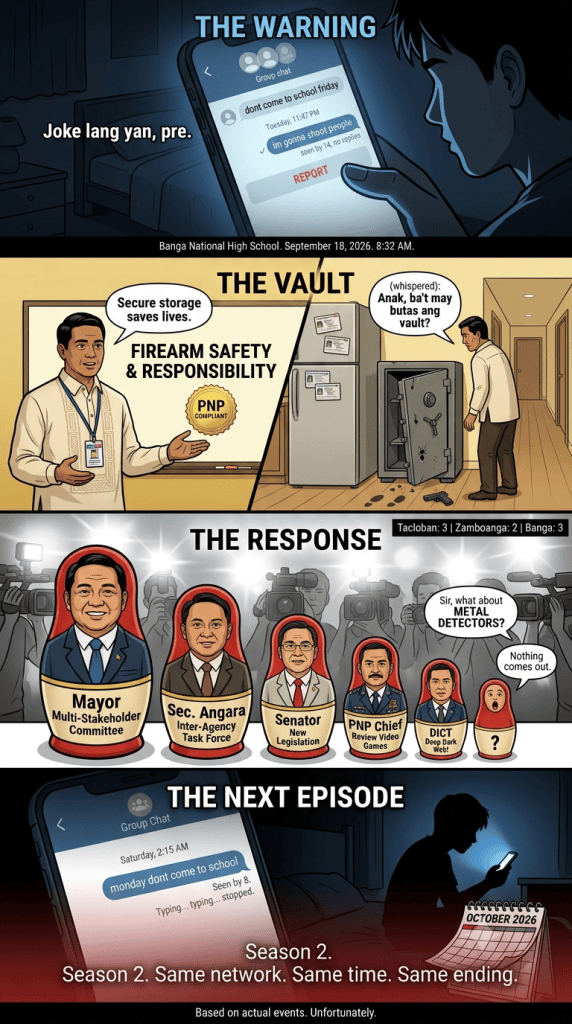
The Father: A DepEd employee. Licensed gun owner. Three registered firearms. Kept the Glock in a vault his teenage son allegedly “broke open.” In a detail so ironic it belongs in a Greek tragedy, the father had recently given a public lecture on campus safety and firearm responsibility.
The School: 3,000+ students. One security guard (or eleven, depending on which official you ask). No metal detectors because the mayor says they’re “impractical.” Gaps in fencing. No threat-reporting system anyone actually used. A student body that dismissed the shooter’s explicit warning as a “joke.”
And here’s what should make every parent furious: the warning signs were everywhere. The planning. The date-setting. The group chats. The warnings to classmates. The alleged parental discovery of concerning notes in April. The TCC membership.
If the Banga shooting were a patient, the symptoms were so obvious that even a first-year medical student would have ordered a full diagnostic workup. Instead, the system did what Philippine institutions do best: it waited for the catastrophe, then expressed shock that the catastrophe occurred.
III. THE LEGAL MINEFIELD: WHERE ACCOUNTABILITY GOES TO DIE
The Shooter: Too Young to Punish, Old Enough to Plan a Massacre
Under Republic Act No. 9344 (Juvenile Justice and Welfare Act of 2006) as amended by Republic Act No. 10630, a child above 15 but below 18 is exempt from criminal liability unless they acted with discernment—which the prosecution must prove beyond reasonable doubt. The Supreme Court, in CICL XXX v. People (G.R. No. 238798, 2023), clarified that discernment is established from the totality of circumstances: conduct before, during, and after the offense; utterances; planning; weapon used.
Apply that here:
- Before: Planned since August. Set a date. Obtained ammunition and magazines. Concealed the firearm. Warned classmates to stay home.
- During: Entered the school. Systematically fired. Changed magazines. Continued despite the consequences.
- After: Shot himself (or was arrested—again, conflicting reports).
A 16-year-old who plans a mass shooting for over a month, sets a specific date, warns people to avoid the location, and executes with methodical precision is not a child who doesn’t understand wrongfulness. He’s a child who understood it perfectly—and did it anyway.
But the shooter is dead. The criminal case is extinguished. The question shifts to: Who else is responsible?
The Father: The Accountability Question Nobody Wants to Answer
Under Republic Act No. 10591 (Comprehensive Firearms and Ammunition Regulation Act), licensed civilians may own firearms but must store them in a vault or container secured by lock and key. The critical question is not “Was the firearm in a vault?” It’s: “Was it secured in a manner reasonably sufficient to prevent access by a minor known to be living in the household?”
The father could argue: firearms were licensed; kept in a vault; the child defeated the mechanism by force; no known prior attempt; no reason to anticipate a mass shooting.
That’s plausible—if you ignore that the child allegedly broke open the vault, suggesting it wasn’t adequately secure. And if you ignore the reported parental discovery of concerning notes in April. What did they do with that information?
Prosecutors should ask: What vault? Compliant with Philippine National Police (PNP) standards? Who knew the combination? Was ammunition stored separately? Were firearms loaded? Was the vault locked? Did parents know about TCC membership?
Under Article 365 of Act No. 3815 (Revised Penal Code), reckless imprudence resulting in homicide is viable if negligence can be established. The recent Tacloban case—where authorities pursued negligence charges after a service firearm reached minors—provides a template.
But the father’s liability depends on facts we don’t yet have. And in the Philippines, facts have a way of getting lost in the shuffle of political expediency.
The School: Not an Insurer, But Not Immune Either
Amadora v. Court of Appeals (G.R. No. L-47745, 1988) held that Article 2180 of Republic Act No. 386 (Civil Code of the Philippines) applies to academic schools, recognizing a special supervisory relationship. Students are within school custody when under the school’s control.
But PSBA v. Court of Appeals recognized schools are not insurers against every danger. The standard is reasonable diligence, not omniscience.
Did the school exercise reasonable diligence? With one guard for 3,000+ students, no. With eleven guards, it depends on deployment: how many on duty? Where stationed? Were exits controlled? Were guards trained in weapons detection?
The discrepancy between “one guard” and “eleven guards” is not minor. It’s the difference between a resource problem and a deployment problem. That we don’t know which is true—days after the shooting—tells you everything about the investigation’s quality.
The reported warning is more consequential. If students received a message saying, “Don’t come to school Friday because I’m going to shoot people,” that’s not a vague joke. That’s a specific threat with location, date, and intended action. The reasonable-response threshold drops dramatically.
DepEd’s Child Protection Policy (DepEd Order No. 40, s. 2012) requires Child Protection Committees and intervention mechanisms. Did Banga have a functional threat-reporting system—and if so, why wasn’t it used?
The Online Dimension: Influence Is Not Causation
Officials say the shooter participated in an online true-crime community. The Department of the Interior and Local Government (DILG) described exposure to the “deep dark web” as an influence.
But influence is not causation. Possibilities: causal influence (online environment normalized violence); selection effect (already interested, sought communities); reinforcement (amplified existing grievance); mere correlation (consumed violent material without causal role).
Only forensic analysis can distinguish these. The government’s interest in examining the phone must be balanced against constitutional privacy protections and Republic Act No. 10173 (Data Privacy Act of 2012). The legally strongest investigation is aggressive, forensic, documented, and constitutional—anything less risks contaminating evidence.
IV. THE POLITICAL THEATER: WHERE TRAGEDY BECOMES PERFORMANCE
Within days, we had:
- Mayor Palencia briefing the public and proposing multi-stakeholder solutions (translation: “We’ll form a committee”).
- Sec. Angara admitting unpreparedness and proposing an inter-agency task force (translation: “We’ll form a bigger committee”).
- Sen. Angara proposing legislation (translation: “We’ll pass a law that may or may not be funded”).
- PNP Chief Nartatez calling for police visibility and a review of violent video games (translation: “We’ll blame video games instead of addressing firearm access”).
Notice what’s missing: any concrete, immediate action to prevent the next shooting.
The inter-agency task force—DepEd, Department of Information and Communications Technology (DICT), DILG, PNP, Department of Social Welfare and Development (DSWD), Department of Health (DOH)—is six agencies with six turfs, six budgets, six sets of incentives. The likelihood it produces anything beyond a dust-gathering report is roughly equivalent to the likelihood the next shooting is prevented by a metal detector no one has funded.
Angara says DepEd lacks funds for fencing and guards. The mayor says metal detectors are “impractical.” These aren’t solutions—they’re rationalizations. If government can find billions for intelligence funds and pork, it can secure schools. The problem isn’t resources; it’s political will.
V. THE COMPARATIVE CONTEXT: THREE SHOOTINGS, ONE PATTERN
Tacloban (June 22): Two minors allegedly participated in a shooting at San Jose National High School that killed three students.
Zamboanga (August 18): A junior-high student allegedly attacked at Ateneo de Zamboanga, killing a fellow student and himself.
Banga (September 18): A 16-year-old allegedly used his father’s firearm to kill two classmates and injure eight others.
The common denominator is not “violent internet” or “mental illness” or “video games.” It’s minor + firearm access + school vulnerability. The weapon was reportedly an adult’s firearm in all three cases. The child obtained it from the home. The school couldn’t prevent it from entering campus.
This is not coincidence. It’s a pattern. Patterns require systemic responses, not task forces that evaporate after the news cycle moves on.
VI. THE REFORM AGENDA: WHAT ACTUALLY NEEDS TO HAPPEN
A. Firearms: Strengthen mandatory child-resistant storage. Require separate ammunition storage. Periodic compliance inspections. Clear penalties for negligent access. Temporary firearm-removal mechanisms for credible imminent-risk situations.
B. Threat Assessment: Create school-level Behavioral Threat Assessment Teams—school heads, guidance personnel, child-protection officers, trained teachers, social workers, law-enforcement liaisons, mental-health professionals. Purpose: risk assessment, not punishment.
C. Anonymous Reporting: Every school should have SMS, online, and physical reporting, including anonymous options. A child should never have to decide whether a threat is “serious enough.”
D. Security: Layered security—fencing, controlled entrances, multiple trained guards, CCTV, emergency communication, appropriate screening, controlled exits, police liaison.
E. Mental Health: Implement Republic Act No. 11036 (Mental Health Act)’s school-based mental-health framework meaningfully.
F. Digital Safety: Focus on grooming, violent-threat communities, direct encouragement of violence, algorithmic amplification, self-harm content, extremist communities. Avoid converting “dark web” into blanket surveillance of every child.
VII. WHAT GOVERNMENT SHOULD NOT DO
- Don’t install metal detectors everywhere. Expensive, labor-intensive, imperfect.
- Don’t make teachers police officers. Teachers need to teach and report warning signs.
- Don’t criminalize depression. Mental illness should trigger assistance, not suspicion.
- Don’t equate gaming with violence. Evidence must establish specific causal connection.
- Don’t publicly identify minors. Child-protection and privacy require care.
- Don’t circulate the shooter’s videos. DSWD warned against secondary trauma.
- Don’t convert an unverified note into a manifesto. Authenticate first.
- Don’t declare the father guilty because the gun was his. Establish storage facts and duty.
VIII. THE BOTTOM LINE: A SYSTEM THAT FAILS FORWARD
The most consequential revelation is not that a teenager was capable of violence. It’s that the system had multiple opportunities to interrupt the chain:
A firearm existed → a minor allegedly accessed it → an attack was allegedly planned weeks in advance → classmates allegedly knew → a warning was allegedly given hours beforehand → the weapon entered a school of thousands → the attack began.
Each link needs verification. But the pattern is clear: this was not sudden, unforeseeable violence. It was a chain of preventable failures, each offering an opportunity for intervention that was missed.
The Supreme Court’s jurisprudence provides a middle ground: schools have real duties but aren’t insurers; parents and firearm owners have responsibilities but ownership alone doesn’t establish negligence; minors receive special protection but that doesn’t erase civil liability; government intervention must remain within constitutional limits.
But the legal framework is not the problem. The problem is that it’s not being enforced. RA 10591 requires secure storage—who’s checking? DepEd Order No. 40 requires Child Protection Committees—are they functional? RA 11036 requires mental-health programs—are they funded?
Banga is not a failure of law. It’s a failure of implementation. Until the Philippine government treats school safety as non-negotiable—rather than a photo opportunity and a bureaucratic checkbox—we will see the same pattern repeat.
The next shooting is already being planned. The question is whether we’ll do anything to stop it.
Based on the evidence so far, the answer is almost certainly no.
Louis “Barok” C. Biraogo is a blogger and professional cynic who has been documenting Philippine legal and political dysfunction since before it was fashionable. He welcomes tips, corrections, and evidence that the government is actually doing its job—though he won’t hold his breath.
Key Citations
A. Legal & Official Sources
- The 1987 Constitution of the Republic of the Philippines. Official Gazette of the Republic of the Philippines, 1987, http://www.officialgazette.gov.ph/constitutions/1987-constitution/.
- Republic Act No. 386. An Act to Ordain and Institute the Civil Code of the Philippines. 1949, http://www.officialgazette.gov.ph/1949/06/18/republic-act-no-386/.
- Act No. 3815: An Act Revising the Penal Code and Other Penal Laws. Official Gazette of the Republic of the Philippines, 8 Dec. 1930, http://www.officialgazette.gov.ph/1930/12/08/act-no-3815-s-1930/.
- Republic Act No. 9344. An Act Establishing a Comprehensive Juvenile Justice and Welfare System, Creating the Juvenile Justice and Welfare Council under the Department of Justice, Appropriating Funds Therefor and for Other Purposes (Juvenile Justice and Welfare Act of 2006). 2006, http://www.officialgazette.gov.ph/2006/04/28/republic-act-no-9344/.
- Republic Act No. 10173. An Act Protecting Individual Personal Information in Information and Communications Systems in the Government and the Private Sector, Creating for this Purpose a National Privacy Commission, and for Other Purposes (Data Privacy Act of 2012). 2012, http://www.officialgazette.gov.ph/2012/08/15/republic-act-no-10173/.
- Republic Act No. 10173: Data Privacy Act of 2012. National Privacy Commission, 15 Aug. 2012, privacy.gov.ph/data-privacy-act/.
- Republic Act No. 10591. An Act Providing for a Comprehensive Law on Firearms and Ammunition and Providing Penalties for Violations Thereof (Comprehensive Firearms and Ammunition Regulation Act). 2013, http://www.officialgazette.gov.ph/2013/05/29/republic-act-no-10591/.
- Republic Act No. 10630. An Act Strengthening the Juvenile Justice System in the Philippines, Amending for the Purpose Republic Act No. 9344, Otherwise Known as the “Juvenile Justice and Welfare Act of 2006” and Appropriating Funds Therefor. 2013, http://www.officialgazette.gov.ph/2013/10/03/republic-act-no-10630/.
- Republic Act No. 11036. An Act Establishing a National Mental Health Policy for the Purpose of Enhancing the Delivery of Integrated Mental Health Services, Promoting and Protecting the Rights of Persons Utilizing Psychiatric, Neurologic and Psychosocial Health Services, Appropriating Funds Therefor, and for Other Purposes (Mental Health Act). 2018, http://www.officialgazette.gov.ph/2018/06/20/republic-act-no-11036/.
- Department of Education. DepEd Order No. 40, s. 2012. DepEd Child Protection Policy. 14 May 2012, http://www.deped.gov.ph/2012/05/14/do-40-s-2012-deped-child-protection-policy/.
- Amadora v. Court of Appeals, G.R. No. L-47745, 15 Apr. 1988, http://www.lawphil.net/judjuris/juri1988/apr1988/gr_l-47745_1988.html.
- Philippine School of Business Administration v. Court of Appeals, G.R. No. 84698, 4 Feb. 1992, lawphil.net/judjuris/juri1992/feb1992/gr_84698_1992.html.
- CICL XXX v. People, G.R. No. 238798, 14 Mar. 2023, sc.judiciary.gov.ph/238798-cicl-xxx-vs-people-of-the-philippines/.
B. News Reports
- Anti-Defamation League. “The True Crime Community (TCC).” ADL, 2025, http://www.adl.org/resources/backgrounder/true-crime-community-tcc.
- Casilao, Joahna Lei. “2 Students Killed, 1 Wounded in Zamboanga School Shooting.” GMA News Online, GMA Network, 18 Aug. 2026, http://www.gmanetwork.com/news/topstories/regions/998905/2-students-dead-in-zamboanga-school-shooting/story/.
- Mangaluz, Jean. “Marcos Orders Thorough Probe into Banga High School Shooting.” GMA News Online, GMA Network, 18 Sept. 2026, http://www.gmanetwork.com/news/topstories/nation/1002887/marcos-orders-thorough-probe-into-banga-high-school-shooting/story/.
- Mantaring, Jelo Ritzhie, and Jerry Yubal Jr. “School Shooting in Tacloban: What We Know So Far.” Rappler, 22 June 2026, http://www.rappler.com/people/crimes/things-to-know-tacloban-school-shooting-june-2026/.
- Sadongdong, Martin. “Campus Tragedy Strikes Again as Shooting at South Cotabato School Leaves 3 Dead, 8 Hurt – PNP.” Manila Bulletin, 18 Sept. 2026, mb.com.ph/2026/09/18/campus-tragedy-strikes-again-as-shooting-at-south-cotabato-school-leaves-3-dead-8-hurt-pnp.
- ₱9 Billion in ‘Savings’? DILG’s Fire Truck Deal Smells Like Smoke
- ₱8B BBM Pork: CCTV for Every Captain’s Kumpare?
- ₱8.9 Billion, 331 Ghost Police Stations: The TIKAS Scandal Explained

- ₱8.4 Billion, 42,000 Barangays, 1 Election: The “Bawat Barangay Makikinabang” Vote-Buying Masterclass

- ₱75 Million Heist: Cops Gone Full Bandit

- ₱6.77B Ghost Haunts Duterte: RTC Dismisses Mans Carpio’s Desperate Plea
- ₱6.77 Billion and Zero Cash: The Sara Duterte SALN Math That Doesn’t Add Up

- ₱6.7-Trillion Temptation: The Great Pork Zombie Revival and the “Collegial” Vote-Buying Circus

- ₱58.53B, Zero Receipts: The LGSF Pork Barrel Nobody Wants to Name
- ₱53 Million Man Tells ₱695-a-Day Workers to Stop Being ‘Mayabang’: The Audacity of BSP’s Remolona

- ₱4.4 Billion and a Witness Who Can’t Explain It: The Duterte Impeachment’s Most Expensive Non-Answer
- ₱3.06 Billion for Evacuation Centers—But Nobody Knows Where They’ll Stand (Or If They’ll Exist)




Leave a Reply