
A Seven-Day Journey From ‘Denied’ to ‘Purgatory,’ With a Brief Stop at ‘I Was Wrong’
By Louis ‘Barok‘ C. Biraogo — September 23, 2026
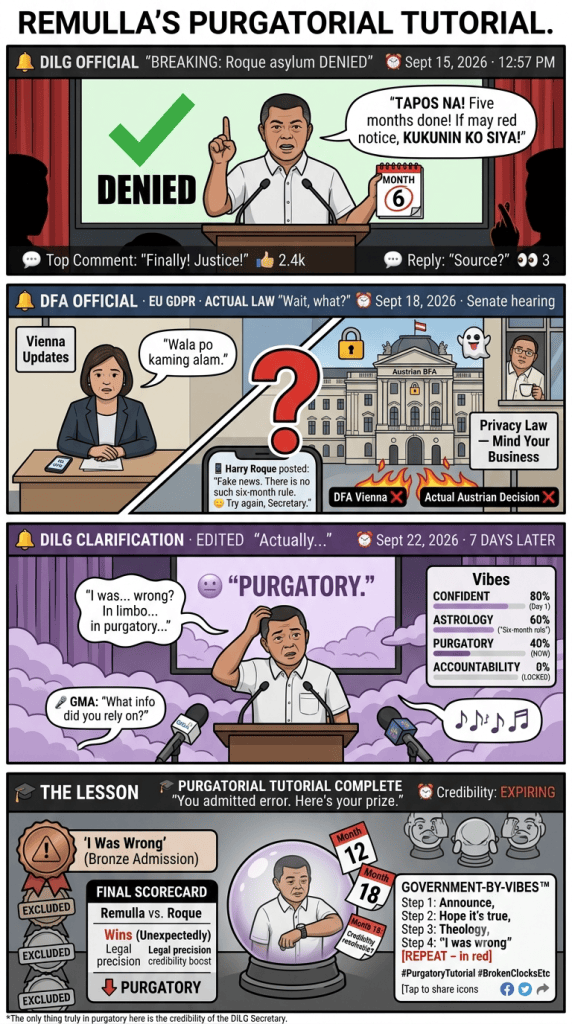
LET’S start with the obvious: Jonvic Remulla just did something that Philippine Cabinet secretaries almost never do. He said, on the record, in front of reporters, at the House of Representatives, after the Department of the Interior and Local Government (DILG) budget deliberations: “I was wrong.”
Now, before we break out the champagne and nominate him for the Profile in Courage Award, let’s examine what, precisely, he was wrong about.
On September 15, 2026, Remulla declared that Harry Roque’s asylum application in Austria had been denied. Done. Finished. The implication was clear: the legal shield was gone, and the long arm of Philippine law could now reach out and pluck Roque from whatever European café he was haunting. A Red Notice from the International Criminal Police Organization (INTERPOL) would follow. Roque would be brought home. Justice would be served.
Seven days later, Remulla clarified that he had absolutely no idea what he was talking about. The application wasn’t denied. It wasn’t approved. It was, in his newly minted legal terminology, “in limbo” and “in purgatory.”
Purgatory. A theological concept now deployed as an official status update by a Cabinet secretary. This is what passes for precision in the Marcos administration’s pursuit of a political fugitive.
But here’s the part that should make your head spin. The Department of Foreign Affairs (DFA) — the actual agency responsible for diplomatic engagement with foreign governments — had no information at all about Roque’s asylum status. DFA Secretary Tess Lazaro told the Senate, on the record, that the Philippine Embassy in Vienna had not confirmed any denial. The European Union’s (EU) strict privacy laws under Regulation (EU) 2016/679 (General Data Protection Regulation) meant that Philippine officials could ask all they wanted, and Austrian authorities would politely tell them to mind their own business.
So let’s reconstruct the information chain here. The DFA — the agency whose literal job is to know what’s happening in Vienna — had nothing. And yet the DILG Secretary, whose portfolio covers local government and the police, somehow had definitive knowledge that a foreign sovereign state had issued a formal asylum denial.
That is not how information works. That is how information works when you’re making it up.
The Six-Month Rule That Isn’t a Rule
Let’s examine Remulla’s defense of his original claim. He explained that the “normal status” for asylum applications is six months, and since Roque’s application had been pending for nine months, he assumed it had been denied.
This is not a legal analysis. This is astrology.
Austrian government materials state that under the “ordinary procedure,” the Bundesamt für Fremdenwesen und Asyl (BFA) reaches a decision within six months. But here’s the thing about administrative deadlines: they are targets, not magic spells. Missing a deadline does not automatically convert a pending application into a denial. The Austrian system provides for formal decisions (Bescheide) that are served on the applicant and appealable to the Federal Administrative Court. There is no provision — zero, none, nada — that says “if six months pass, the application is deemed denied.”
Remulla essentially looked at a calendar, saw that nine months had passed, and concluded that the absence of a decision was itself a decision. This is the kind of logic that would fail a first-year law student’s exam on administrative procedure. It is also, apparently, the kind of logic that passes for Cabinet-level analysis in the current administration.
Roque, for his part, was more precise. He pointed out that “there is no such rule that automatically converts the passage of six months into a denial” and challenged Remulla to stop spreading what he called fake news. One does not often find oneself nodding along with Harry Roque, but here we are. Broken clocks, etc.
The Pattern of Purgatorial Thinking
This is not the first time Jonvic Remulla has had difficulty distinguishing between what he wants to be true and what is actually true.
In April 2026, he set a three-week timeline for the return of fugitive Zaldy Co. That timeline came and went. Co remained in France. Remulla, presumably, moved on to his next prediction.
Now we have the Roque asylum fiasco. Same pattern: a confident public pronouncement, followed by a quiet correction when reality refuses to cooperate.
The DFA’s Lazaro offered a partial explanation: European privacy laws mean that Philippine officials are simply not given information about asylum proceedings. That’s a legitimate constraint. But it also raises an obvious question: if your own diplomats cannot verify a foreign government’s decision, why would the DILG Secretary announce that decision as fact?
The answer, I suspect, is that the announcement was never really about Austria. It was about narrative management. The government wants to project momentum. It wants to tell the Filipino public that the pursuit of Roque is progressing, that the walls are closing in, that justice is imminent. The actual legal status of the asylum application is secondary to the political message.
Except here’s the problem: when you announce a foreign government’s decision that never happened, and then have to retract it, you don’t look decisive. You look incompetent. And you hand Roque — a man facing serious human trafficking charges — a credibility boost he does not deserve.
The Roque Problem
Let’s be clear about something: none of this means Harry Roque is innocent. He faces qualified human trafficking charges under Republic Act No. 9208 (Anti-Trafficking in Persons Act of 2003), as amended, in connection with the Lucky South 99 Philippine Offshore Gaming Operator (POGO) hub. He was cited in contempt by the House Quad Committee. A non-bailable arrest warrant was issued against him. He fled the country.
Those are serious matters. If the evidence supports the charges, he should face trial.
But the government’s case against Roque is not strengthened by making up facts about his asylum status. It is weakened. Every false claim gives Roque’s lawyers another talking point, another example of government overreach, another data point for his narrative of political persecution.
And that narrative matters, because it’s the one Roque will present to Austrian asylum authorities. When he argues that the Philippine government is persecuting him politically, he can now point to a Cabinet secretary who publicly announced a nonexistent denial, presumably to pressure the asylum process. That’s not nothing.
The DFA’s Lazaro also noted that the Philippines lacks extradition treaties with EU countries under Presidential Decree No. 1069 (Philippine Extradition Law). So even if Roque’s asylum application is ultimately denied, the legal pathway to bring him home is anything but automatic. An INTERPOL Red Notice is a request, not an arrest warrant. Austria has its own legal procedures, its own courts, its own assessment of whether a request for surrender complies with European human rights standards.
The government’s actual options for securing Roque’s return are narrow, slow, and uncertain. Which makes the need for accuracy even more important. Every false claim narrows those options further.
The Purgatory of Accountability
So where does this leave us?
Remulla has admitted error. That’s something. In a political culture where officials routinely double down on demonstrably false statements, a straightforward “I was wrong” is refreshing. But an admission without explanation is just a confession without absolution.
What information did he rely on? Was it an intelligence report? A diplomatic cable? A hunch? A dream? The public has no idea.
Who advised him? Did anyone in the DILG or the broader government apparatus tell him the asylum claim was unverified? Or did no one bother to check?
What corrective measures have been taken? Is there now a protocol that requires verification before announcing foreign governments’ decisions? Or will the next prediction be issued with the same lack of rigor?
Remulla’s “I was wrong” is a start. But it is not accountability. Accountability would involve explaining how the error happened, ensuring it does not happen again, and accepting consequences if it does.
Instead, we got “purgatory” — a word that sounds profound but means nothing. It is the language of a man who wants credit for admitting error without actually examining the system that produced it.
Harry Roque’s asylum application remains pending in Austria. The Austrian authorities will decide when they decide, based on Austrian law and European human rights standards. The Philippine government can pursue Roque through lawful channels — mutual legal assistance, diplomatic engagement, and whatever mechanisms exist absent an extradition treaty.
What it cannot do is announce foreign governments’ decisions before those decisions are made, and then retreat into theological metaphors when called out. That is not governance. That is improvisation. And in a case involving serious criminal charges, a fugitive, and international legal procedures, improvisation is not just embarrassing. It is counterproductive.
The only thing truly in purgatory here is the credibility of the DILG Secretary. And unlike Roque’s asylum application, that may not be resolvable by simply waiting six more months.
Key Citations
A. Legal & Official Sources
- Republic Act No. 9208. Anti-Trafficking in Persons Act of 2003. 26 May 2003, http://www.officialgazette.gov.ph/2003/05/26/republic-act-no-9208/.
- Republic Act No. 10364. Expanded Anti-Trafficking in Persons Act of 2012. 6 Feb. 2013, http://www.officialgazette.gov.ph/2013/02/06/republic-act-no-10364/.
- Presidential Decree No. 1069. Philippine Extradition Law. 13 Jan. 1977, lawphil.net/statutes/presdecs/pd1977/pd_1069_1977.html.
- Regulation (EU) 2016/679. General Data Protection Regulation. European Parliament and Council, 27 Apr. 2016, eur-lex.europa.eu/eli/reg/2016/679/oj.
- Convention for the Protection of Human Rights and Fundamental Freedoms. Council of Europe, 1950, http://www.echr.coe.int/documents/d/echr/convention_ENG.
- “Asylum Procedure in Austria.” oesterreich.gv.at, Federal Chancellery of Austria, http://www.oesterreich.gv.at/en/themen/menschen_aus_anderen_staaten/asyl-in-oesterreich/Seite.3210002.
- “Ablauf Asylverfahren.” Bundesamt für Fremdenwesen und Asyl, http://www.bfa.gv.at/201/ablauf_asylverfahren/start.html.
- “About Red Notices.” INTERPOL, http://www.interpol.int/How-we-work/Notices/Red-Notices.
B. News Reports
- Lalu, Gabriel. “WATCH: Interior Secretary Jonvic Remulla admits being wrong about his earlier pronouncement that former presidential spokesperson Harry Roque’s asylum bid was rejected already…” INQUIRER.net, 22 Sept. 2026, http://www.facebook.com/inquirerdotnet/videos/watch-interior-secretary-jonvic-remulla-admits-being-wrong-about-his-earlier-pro/1612807070203122/.
- Mangaluz, Jean. “Harry Roque’s Asylum Request Denied, Says DILG’s Remulla.” GMA News Online, 15 Sept. 2026, http://www.gmanetwork.com/news/topstories/nation/1002418/harry-roque-s-asylum-request-denied-says-dilg-s-remulla/story/.
- Mangaluz, Jean. “Roque Slams Remulla’s Info on Asylum Denial as Fake News, DILG Chief Clarifies.” GMA News Online, 15 Sept. 2026, http://www.gmanetwork.com/news/topstories/nation/1002438/roque-slams-remulla-s-info-on-asylum-denial-as-fake-news-dilg-chief-clarifies/story/.
- “DFA Says No Info on Harry Roque’s Asylum Request.” INQUIRER.net, 18 Sept. 2026, globalnation.inquirer.net/338664/dfa-says-no-info-on-harry-roques-asylum-request.
- Abanilla, Izel. “Zaldy Co Could Be Sent Home in 1-3 Weeks – Remulla.” The Manila Times, 17 Apr. 2026, http://www.manilatimes.net/2026/04/17/news/zaldy-co-could-be-sent-home-in-1-3-weeks-remulla/2322511.
- “Court Issues Arrest Warrants vs. Harry Roque, Cassandra Ong for Alleged Trafficking.” GMA News Online, 16 May 2025, http://www.gmanetwork.com/news/topstories/nation/946279/court-issues-arrest-warrants-vs-harry-roque-cassandra-ong-for-alleged-trafficking/story/.

- ₱9 Billion in ‘Savings’? DILG’s Fire Truck Deal Smells Like Smoke

- ₱8B BBM Pork: CCTV for Every Captain’s Kumpare?

- ₱8.9 Billion, 331 Ghost Police Stations: The TIKAS Scandal Explained

- ₱8.4 Billion, 42,000 Barangays, 1 Election: The “Bawat Barangay Makikinabang” Vote-Buying Masterclass

- ₱75 Million Heist: Cops Gone Full Bandit

- ₱6.77B Ghost Haunts Duterte: RTC Dismisses Mans Carpio’s Desperate Plea

- ₱6.77 Billion and Zero Cash: The Sara Duterte SALN Math That Doesn’t Add Up

- ₱6.7-Trillion Temptation: The Great Pork Zombie Revival and the “Collegial” Vote-Buying Circus

- ₱58.53B, Zero Receipts: The LGSF Pork Barrel Nobody Wants to Name

- ₱53 Million Man Tells ₱695-a-Day Workers to Stop Being ‘Mayabang’: The Audacity of BSP’s Remolona

- ₱4.4 Billion and a Witness Who Can’t Explain It: The Duterte Impeachment’s Most Expensive Non-Answer
- ₱3.06 Billion for Evacuation Centers—But Nobody Knows Where They’ll Stand (Or If They’ll Exist)








Leave a Reply