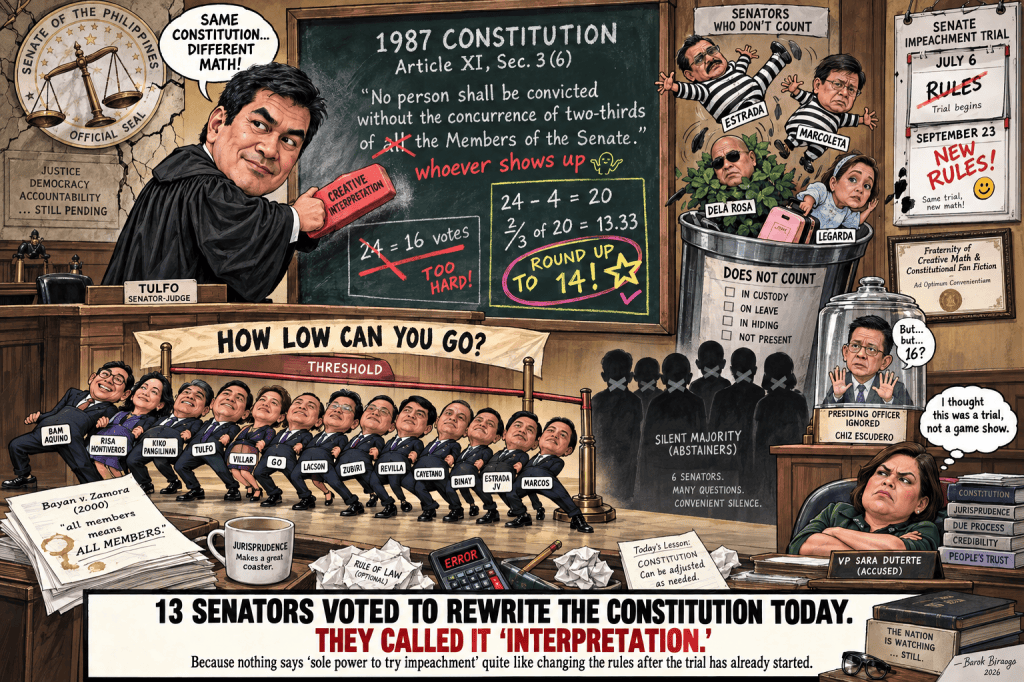
Because nothing says ‘sole power to try impeachment’ quite like changing the rules after the trial has already started
By Louis ‘Barok’ C. Biraogo — September 24, 2026
LET’S play a game.
You’re a senator-judge in the impeachment trial of Vice President Sara Duterte. The 1987 Constitution of the Republic of the Philippines (1987 Constitution) says conviction requires “two-thirds of all the Members of the Senate.” That’s 16 out of 24. Simple arithmetic. The kind of math that doesn’t require a calculator, just a basic understanding of the English language.
But wait.
Four senators aren’t showing up. One is detained for plunder. Another is detained for plunder. A third is hiding from the International Criminal Court (ICC). A fourth is abroad on medical leave. The Senate’s impeachment court has now announced, with the solemnity of a constitutional convention and the intellectual rigor of a drunk fraternity, that the threshold is actually 14.
Fourteen votes. In a chamber of 24. To convict the Vice President of the Philippines.
This is not constitutional interpretation. This is arithmetic gymnastics performed by people who clearly failed math but somehow passed law school. And it deserves to be called out for what it is: an attempt to change the rules mid-trial because the original rules are inconvenient for the prosecution.
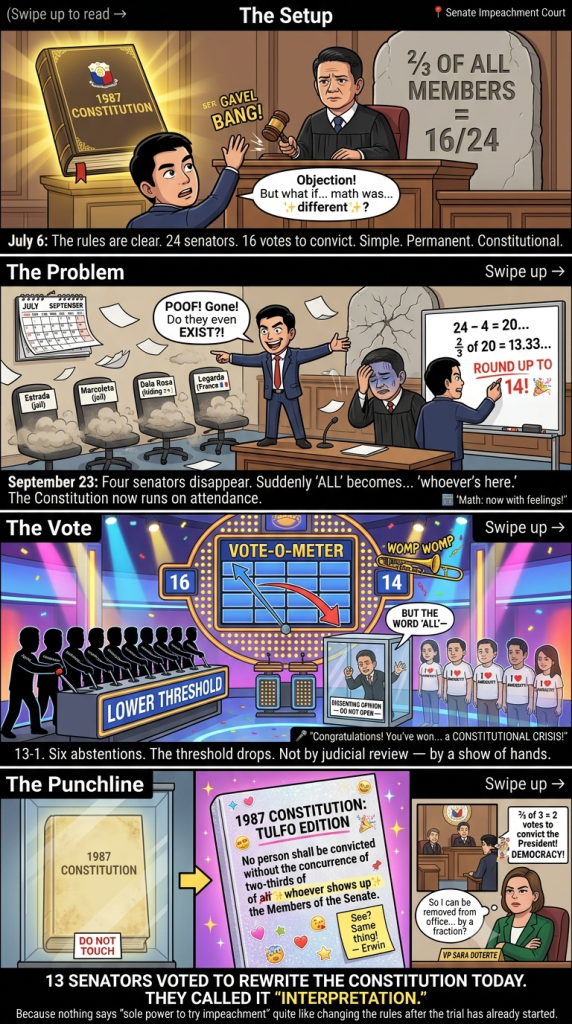
The Math That Shouldn’t Math
Here’s the Senate’s logic, as adopted on September 23, 2026:
- There are 24 senators.
- Four are “unable to participate” due to detention, fugitive status, or medical leave.
- Therefore, 20 senator-judges remain.
- Two-thirds of 20 is 13.33.
- Round up to 14.
Notice what just happened. The Senate has quietly redefined “all the Members of the Senate” to mean “whoever bothers to show up, minus whoever we decide can’t.”
The vote was 13-1, with six senator-judges abstaining. Thirteen senators voted to change the constitutional threshold. Thirteen. That’s not a two-thirds majority of anything except the number of senators who felt like participating in a procedural vote.
If this were a law school exam, the professor would hand it back with a red F and a note: “Please see me after class. Bring a dictionary. Look up ‘all.’”
But this isn’t a law school exam. This is the impeachment trial of the second-highest official in the land, and the stakes couldn’t be higher.
The Constitutional Text Is Not Ambiguous
Article XI, Section 3(6) of the 1987 Constitution states:
“No person shall be convicted without the concurrence of two-thirds of all the Members of the Senate.”
Not “two-thirds of those present.” Not “two-thirds of those voting.” Not “two-thirds of those who feel like showing up today.”
All the Members.
The Constitution’s framers deliberately chose this language. As Escudero himself noted when he made his original ruling in July, the Supreme Court of the Philippines (Supreme Court) has already interpreted similar language in Bayan v. Zamora (G.R. No. 138570), holding that “two-thirds of all the members” meant 16 out of 24—even when only 23 senators were actually incumbent at the time.
The logic was simple: the Senate is constitutionally composed of 24 members. Two-thirds of 24 is 16. The Constitution doesn’t care about your attendance problems.
But now, apparently, it does.
The Senate’s new rule says the basis for conviction votes “shall only cover senators who remain legally and factually capable of taking part in the impeachment proceedings at the time of voting”. That’s a fancy way of saying: if you’re in jail, on the run, or in a hospital in France, you don’t count.
Convenient, isn’t it?
The “Absent Senator” Argument Is Sophistry
Senator Erwin Tulfo, who initiated this whole mess, claims he’s not trying to make conviction easier. He just wants “clarification” on whether absent senators should be counted.
Let’s take him at his word. Let’s assume Tulfo genuinely believes that senators who can’t participate shouldn’t count toward the denominator.
Fine. But then explain why the answer is 14.
If the logic is that only senators who can actually participate should count, then the denominator should be 20 (24 minus the four absent senators). Two-thirds of 20 is 13.33, which rounds up to 14. Okay, that math works.
But wait. What about Senator Francis Escudero? He’s the presiding officer. He ruled on the original 16-vote threshold in July. He took exception to the new ruling. He voted against it. And he recused himself from the procedural vote on his own ruling.
If he’s not participating in the vote, shouldn’t he be excluded from the denominator too?
If the denominator is 19 (24 minus four absent minus Escudero), two-thirds of 19 is 12.67, which rounds up to 13. Still not 14.
And if you exclude the six senators who abstained from the procedural vote—Senator Alan Peter Cayetano, Senator Pia Cayetano, Senator Bong Go, Senator Robin Padilla, Senator Imee Marcos, and Senator Camille Villar—then the denominator drops even further.
So where does 14 come from?
It comes from a completely arbitrary decision about who counts and who doesn’t. The Senate has invented a new constitutional category: “senators we acknowledge exist for voting purposes.”
This isn’t constitutional law. This is constitutional fan fiction.
The Procedural Sleight of Hand
Here’s what’s really happening, stripped of the legal jargon:
- The Senate has a constitutional requirement of 16 votes to convict.
- The prosecution doesn’t have 16 votes.
- So the prosecution’s allies in the Senate want to lower the threshold.
- To do that, they’re using a procedural motion that requires only a simple majority.
- Once that motion passes, they’ll argue that the new threshold is whatever they say it is.
This is not how constitutional interpretation works. This is how you rig a game.
And the timing is suspicious. Escudero made his 16-vote ruling on July 6. No one objected at the time. The prosecution didn’t challenge it. The defense was fine with it. The ruling stood as the judgment of the court.
But now, after the trial has proceeded, after evidence has been presented, after the political arithmetic has become clear, suddenly the threshold is up for debate.
If you didn’t object then, you shouldn’t get to object now. That’s not a legal principle. That’s just basic fairness.
The Amici Curiae Are a Fig Leaf
To give this whole exercise an aura of legitimacy, the Senate invited four retired Supreme Court justices to serve as amici curiae—friends of the court.
On paper, this sounds dignified. In practice, it’s a delaying tactic designed to give the appearance of careful deliberation while the real decision has already been made behind closed doors.
The justices—Hilario Davide Jr., Artemio Panganiban, Reynato Puno, and Adolfo Azcuna—are distinguished jurists. Davide and Azcuna even helped draft the 1987 Constitution. Their opinions should matter.
But here’s the thing: the Senate isn’t bound by anything they say. The amici can advise, but they can’t decide. And if the Senate ignores their advice—which it almost certainly will if they say “16 votes”—then their participation is just theater.
And the amici themselves couldn’t even agree. Davide, Panganiban, and Puno reportedly favored a functional interpretation. Azcuna, a framer of the Constitution, took the opposing view: “all members” means all 24, period.
When even the framers can’t agree on what they wrote, you know you’re in trouble.
Sara Duterte seems to understand this. When asked about the amici, she said: “That threshold was decided in the first place to follow the Constitution. So, it means that now that the conversation has changed, it means they will change it. Why are we still talking about it if it is not going to be changed?”
She’s right. If the Senate were genuinely committed to following the Constitution, there would be nothing to discuss. The Constitution says 16. The Senate should require 16. End of story.
The fact that we’re having this conversation at all is evidence that the fix is in.
The Dangerous Precedent
Let’s set aside the specifics of this case for a moment and think about what this means for the future.
If the Senate can lower the conviction threshold through a simple majority vote, then the threshold is meaningless. Any future Senate, at any time, can change the rules to suit its political needs.
Imagine a future impeachment trial where the accused is a president from the opposing party. The Senate majority wants conviction. They look at the numbers. They realize they can’t get 16 votes. So they hold a procedural vote, lower the threshold to 12, and convict.
Would that be constitutional? Of course not. But if this precedent stands, it would be precedent.
The 16-vote requirement exists for a reason. Impeachment is not supposed to be easy. The framers deliberately set a high bar because removing an elected official—someone who received a mandate from the people—is a grave act. It should require broad consensus, not a narrow majority.
Lowering the threshold doesn’t just make conviction easier in this case. It makes conviction easier in every case, forever. And that’s a door that should never be opened.
The Real Question
The real question isn’t whether 13 votes can overturn Escudero’s ruling. Procedurally, they probably can. The Senate makes its own rules, and a simple majority can change those rules.
The real question is whether the Senate can, through a procedural vote, effectively amend the Constitution.
The answer is no. It cannot.
The Constitution is not a suggestion. It’s not a guideline. It’s not something you follow when it’s convenient and ignore when it’s not.
Article XI, Section 3(6) says what it says. Two-thirds of all the Members of the Senate. That means 16 votes.
If the Senate doesn’t like that, it can propose a constitutional amendment. It can’t just pretend the words mean something different because the math is inconvenient.
What Should Happen
Former Senate President Franklin Drilon has suggested that the Supreme Court should settle this issue before the trial proceeds further. He’s right.
The Court has already demonstrated its willingness to intervene in impeachment matters. In January, it upheld its ruling that the 2025 impeachment complaint against Duterte was unconstitutional, and it did so with finality. The Court has made clear that impeachment is not a purely political question beyond judicial review.
The threshold issue is a constitutional question. It should be decided by the constitutional body—the Supreme Court—not by 13 senators engaging in creative math.
If the Court rules that 16 votes are required, then 16 votes are required. If it rules that the denominator can be adjusted based on actual participation, then we’ll have a new rule. But at least the rule will come from the institution charged with interpreting the Constitution, not from a parliamentary maneuver designed to achieve a predetermined outcome.
The defense has already signaled it may bring the issue to the Supreme Court. Good. Let’s see if the justices have more respect for the Constitution than the senators do.
The Bottom Line
The Senate’s “14 votes” scheme is not constitutional interpretation. It’s constitutional evasion.
It’s an attempt to change the rules of the game after the game has started, because the original rules are making it hard for the prosecution to win.
And the worst part? It might work.
If 13 senators vote to overturn Escudero’s ruling, the threshold drops. If the threshold drops, conviction becomes more likely. If conviction happens, it will be tainted by the procedural chicanery that made it possible.
Vice President Duterte may be guilty of the charges against her. She may deserve to be removed from office. But if she is removed, it should be through a process that respects the Constitution, not one that treats the Constitution as an obstacle to be circumvented.
The Senate should follow the Constitution. It should require 16 votes. And if the prosecution can’t get 16 votes, then the prosecution should lose.
That’s not a political judgment. That’s just what the document says.
And in a constitutional democracy, the document is supposed to matter.
Key Citations
A. Legal & Official Sources
- The 1987 Constitution of the Republic of the Philippines. Official Gazette of the Republic of the Philippines, 1987, http://www.officialgazette.gov.ph/constitutions/1987-constitution/.
- The 1987 Constitution of the Republic of the Philippines. Art. XI, sec. 3(6). Official Gazette of the Republic of the Philippines, http://www.officialgazette.gov.ph/constitutions/the-1987-constitution-of-the-republic-of-the-philippines/the-1987-constitution-of-the-republic-of-the-philippines-article-xi/.
- Bayan v. Zamora. G.R. No. 138570, 10 Oct. 2000, Supreme Court of the Philippines, http://www.lawphil.net/judjuris/juri2000/oct2000/gr_138570_2000.html.
B. News Reports
- “Philippine Senate Impeachment Court Revises Conviction-Vote Calculation Rule for VP Sara Duterte.” Xinhua, 23 Sept. 2026, english.news.cn/20260923/6f2ffb8fd44a4acf93ab0e59cbe7c951/c.html.
- “Philippine Senate Commences Impeachment Trial against VP Sara Duterte.” Xinhua, 6 July 2026, english.news.cn/20260706/dfe8b3d0baa84c4c9342e9222b994b3d/c.html.
- Ombay, Giselle. “Senate Impeachment Court Sets Sept. 23 for Oral Arguments on Voting Threshold.” GMA News Online, GMA Network, 8 Sept. 2026, http://www.gmanetwork.com/news/topstories/nation/1001583/senate-impeachment-court-sets-sept-23-for-oral-arguments-on-voting-threshold/story/.
- Casilao, Joahna Lei, and Llanesca T. Panti. “Senators Vote: Threshold Based on Participating Judges.” GMA News Online, GMA Network, 23 Sept. 2026, http://www.gmanetwork.com/news/topstories/nation/1003366/impeachment-court-lowers-voting-threshold-to-convict-impeached-official/story/.
- “Sara Duterte: Voting Threshold for Impeachment Already Set in Constitution.” GMA News Online, GMA Network, 11 Sept. 2026, http://www.gmanetwork.com/news/topstories/nation/1002017/sara-duterte-voting-threshold-for-impeachment-already-set-in-constitution/story/.
- Panti, Llanesca T. “Sara Duterte Impeachment Trial Day 26: 3 Ex-SC Chief Justices Say 16-Vote Threshold Can Be Changed.” GMA News Online, GMA Network, 16 Sept. 2026, http://www.gmanetwork.com/news/topstories/nation/1002650/sara-duterte-impeachment-trial-day-26-3-ex-sc-chief-justices-say-16-vote-threshold-can-be-changed/story/.
- Casilao, Joahna Lei. “SC Upholds Ruling Voiding Sara Duterte Impeachment Articles.” GMA News Online, GMA Network, 29 Jan. 2026, http://www.gmanetwork.com/news/topstories/nation/974596/sc-upholds-ruling-voiding-sara-duterte-impeachment-articles/story/.
- ₱9 Billion in ‘Savings’? DILG’s Fire Truck Deal Smells Like Smoke

- ₱8B BBM Pork: CCTV for Every Captain’s Kumpare?

- ₱8.9 Billion, 331 Ghost Police Stations: The TIKAS Scandal Explained

- ₱8.4 Billion, 42,000 Barangays, 1 Election: The “Bawat Barangay Makikinabang” Vote-Buying Masterclass

- ₱75 Million Heist: Cops Gone Full Bandit

- ₱6.77B Ghost Haunts Duterte: RTC Dismisses Mans Carpio’s Desperate Plea

- ₱6.77 Billion and Zero Cash: The Sara Duterte SALN Math That Doesn’t Add Up

- ₱6.7-Trillion Temptation: The Great Pork Zombie Revival and the “Collegial” Vote-Buying Circus

- ₱58.53B, Zero Receipts: The LGSF Pork Barrel Nobody Wants to Name

- ₱53 Million Man Tells ₱695-a-Day Workers to Stop Being ‘Mayabang’: The Audacity of BSP’s Remolona

- ₱4.4 Billion and a Witness Who Can’t Explain It: The Duterte Impeachment’s Most Expensive Non-Answer

- ₱3.06 Billion for Evacuation Centers—But Nobody Knows Where They’ll Stand (Or If They’ll Exist)










Leave a Reply