Ad Cautelam, Rule 65, and the 14-Vote Trap: The Defense’s Blueprint to Stop a Conviction
By Louis ‘Barok’ C. Biraogo — September 25, 2026
MGA ka-kweba, gather ‘round the flickering screen of constitutional carnage, because the Philippine Senate just did something so brazen, so delightfully audacious, that even the framers of The 1987 Constitution of the Republic of the Philippines are probably spinning in their graves with a mixture of horror and admiration for the sheer chutzpah.
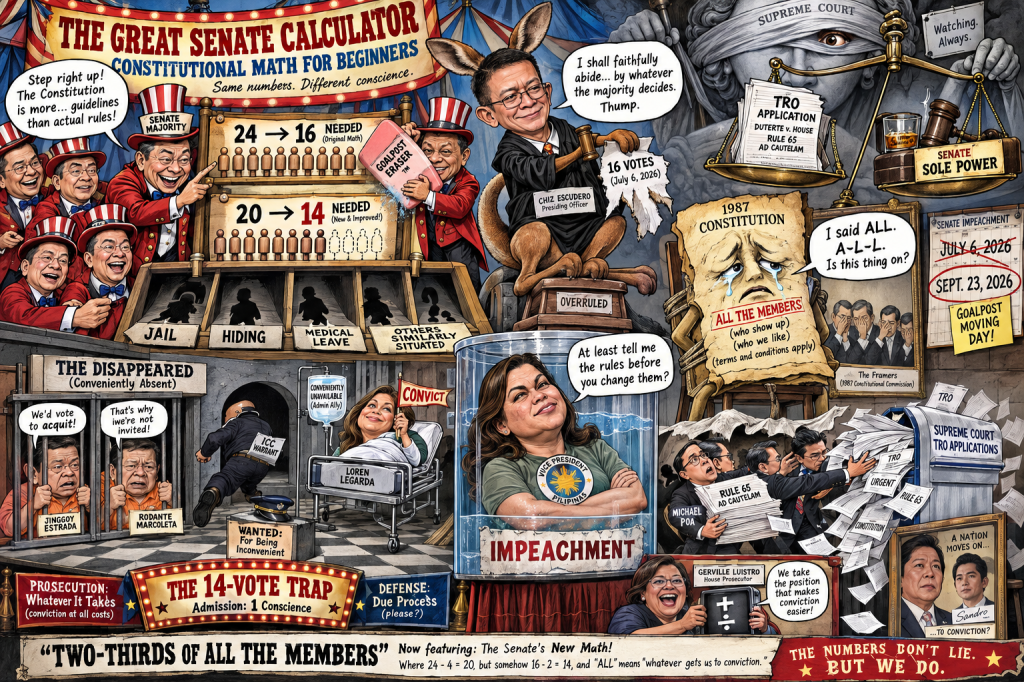
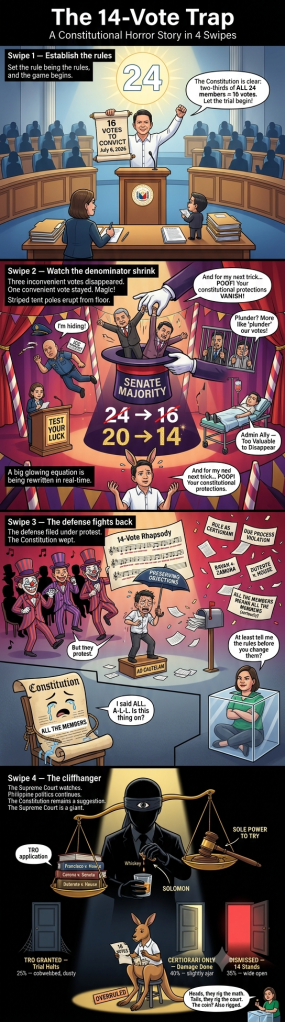
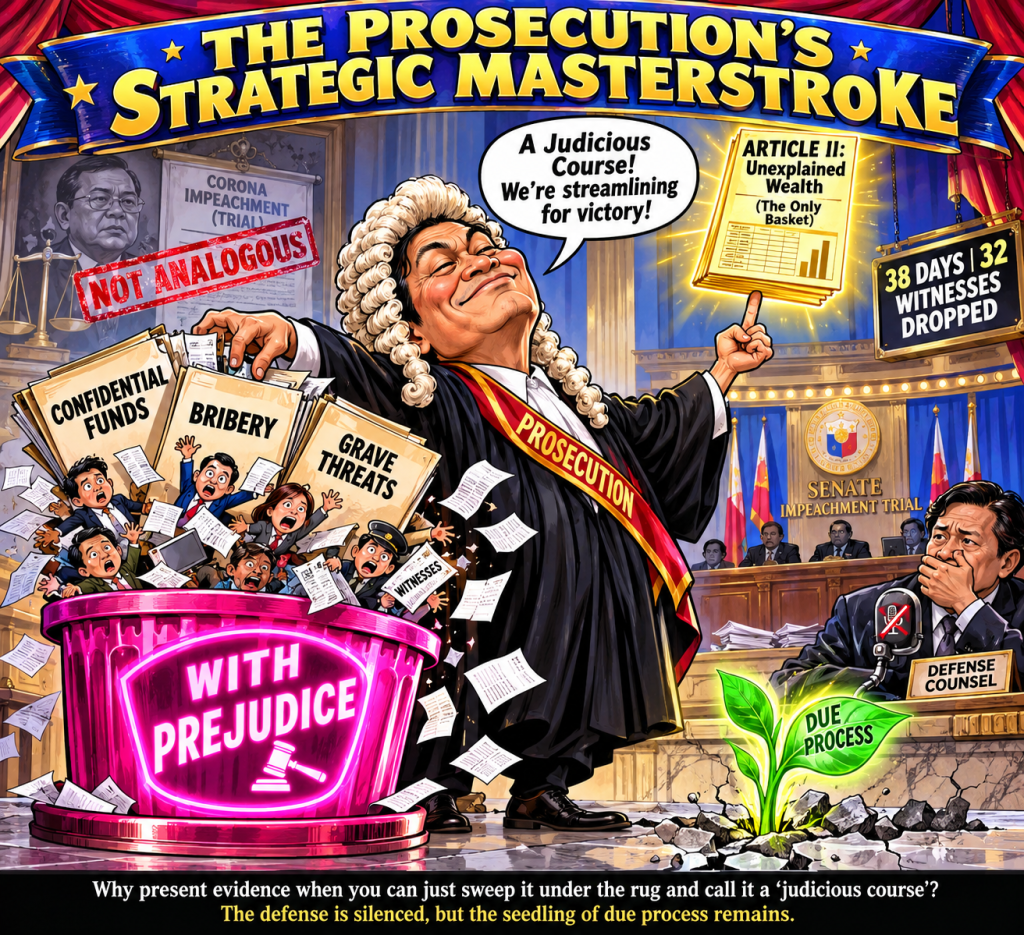
On September 23, 2026, the Senate impeachment court voted 13-1 to reinterpret the phrase “two-thirds of all the Members of the Senate” to mean “two-thirds of whoever happens to be legally and factually capable of showing up.” The threshold dropped from 16 votes to 14. Presiding Officer Chiz Escudero, who had previously ruled that 16 was the magic number, was overruled by his own court and then gracefully accepted defeat like a man who just realized he was presiding over a kangaroo court and decided to be the kangaroo.
Let that sink in.
The Constitution says “all the Members of the Senate.” The Senate now says “all the Members of the Senate who are not in jail, not in hiding, not on medical leave abroad, and not otherwise inconvenient to the prosecution.” That’s not constitutional interpretation. That’s constitutional fan fiction.
But here’s the delicious part: the defense is now considering a Temporary Restraining Order (TRO) from the Supreme Court to stop this circus before it produces a conviction under a rule that was invented mid-trial, like a referee changing the number of points needed to win at halftime because his team is losing.
The Math of Desperation
Let’s do the arithmetic that the Senate majority apparently hopes nobody notices.
Four senators cannot participate: Bato dela Rosa (hiding from an International Criminal Court (ICC) arrest warrant, which is a euphemism for “running from the law”), Jinggoy Estrada and Rodante Marcoleta (both detained on non-bailable plunder charges, which is a euphemism for “allegedly stole too much”), and Loren Legarda (abroad on extended medical leave, which is a euphemism for “conveniently unavailable”).
Three of those four are Duterte allies or likely acquittal votes. Dela Rosa, Estrada, and Marcoleta would almost certainly vote to acquit. Legarda, an administration ally, would likely vote to convict.
So the Senate’s new math does something beautifully perverse: it removes two likely acquittal votes from the denominator while keeping one likely conviction vote in the pool. The prosecution now needs 14 votes from a pool of 20, rather than 16 from a pool of 24. The proportional hurdle barely changed—70 percent versus 67 percent. But the absolute number of votes the prosecution needs to flip dropped by two.
In a trial where the vote was reportedly 13-1 on the threshold ruling itself, that two-vote swing is not a rounding error. It’s the difference between acquittal and political execution.
The defense’s legal team, led by Michael Poa, has been refreshingly honest about the stakes. They’re participating ad cautelam—under protest—preserving every objection, signaling to the Supreme Court that they have not waived a single right. Poa’s careful public statements (“We don’t want to cast any aspersions against the impeachment court”) are textbook defensive lawyering: don’t insult the tribunal you’re about to ask to save your client.
The Constitutional Text Is Not Ambiguous, and That’s the Problem
Article XI, Section 3(6) of the 1987 Constitution states:
“No person shall be convicted without the concurrence of two-thirds of all the Members of the Senate.”
Not “two-thirds of the Members present.”
Not “two-thirds of the Members capable of participating.”
Not “two-thirds of the Members we feel like counting today.”
All. The. Members.
The framers knew how to write a participation-based denominator. The U.S. Constitution, which the Filipino framers studied extensively, says “two-thirds of the Members present” for impeachment convictions. The Philippine Constitution deliberately chose different language. That choice was not accidental. It was structural.
And here’s the kicker: the Supreme Court itself has already interpreted nearly identical language in Bayan v. Zamora (G.R. No. 138570), holding that “two-thirds of all the Members of the Senate” in the treaty-concurrence context means the full constitutional membership, not just those who happen to show up. The Senate’s attempt to distinguish treaty concurrence from impeachment is legally plausible but constitutionally thin—the text is the same, and the text is what matters.
The defense’s strongest argument is not that the Senate got the math wrong. It’s that the Senate is adding words to the Constitution and calling it interpretation. “All the Members” does not mean “all the Members who are convenient.” If the framers wanted a functional denominator, they would have written one.
The Due Process Time Bomb
Here’s where it gets really interesting.
On July 6, 2026—more than two months before the September ruling—Presiding Officer Escudero announced that the threshold was 16 votes. The defense proceeded under that understanding. Evidence was presented. Witnesses were examined. The trial moved forward with both sides operating on the assumption that 16 votes were needed to convict.
Then, on September 23, the Senate majority woke up and decided: Actually, never mind. Let’s make it 14.
This is not just a constitutional interpretation problem. It’s a due process problem. The defense is entitled to know the rules of the game before the game is played. Changing the conviction threshold mid-trial—after the respondent has already structured her defense around the original rule—is the procedural equivalent of moving the goalposts after the kicker has already taken his run-up.
And here’s the Supreme Court precedent that makes this argument terrifying for the Senate: In Sara Duterte v. House of Representatives (G.R. Nos. 278353/278359, July 25, 2025), the Supreme Court held that impeachment is not purely political and that due process applies throughout the impeachment process. The Court explicitly rejected the notion that impeachment proceedings are immune from judicial review.
That decision was a double-edged sword. It was a major victory for Duterte at the time, striking down the prior impeachment complaint on one-year-bar grounds. Now it may become the legal foundation for her defense against the Senate’s mid-trial rule change.
The irony is so thick you could slice it with a senator’s gavel.
The Senate’s “Functional” Argument: A Beautiful Lie
The Senate majority’s core argument is seductive: How can senators who cannot participate meaningfully decide the case? How can a senator in jail “concur” in a conviction? How can a senator in hiding cast a vote?
This is a legitimate policy concern. But it is not a constitutional argument.
The Constitution does not say “two-thirds of the Members capable of rendering informed judgments.” It says “all the Members.” The framers chose an absolute threshold precisely because impeachment is the most drastic remedy in the constitutional arsenal—the removal of an elected official by a legislative body acting as a court. A high, fixed threshold was designed to be difficult to meet. It was designed to require broad consensus. It was designed to prevent exactly what the Senate majority is now doing: lowering the bar when conviction becomes politically convenient.
The Senate’s “functional” interpretation also creates a dangerous precedent. What happens in a future impeachment where the Senate is evenly divided and the ruling party wants to convict the opposition? Just find a few senators to declare “medically incapacitated” or “legally restrained,” and the denominator shrinks. The threshold becomes a political variable, not a constitutional constant.
Escudero’s ruling even includes a catch-all category: “others similarly situated.” That’s not a legal standard. That’s a blank check.
The Supreme Court’s Dilemma: Judicial Review vs. Institutional Suicide
The Supreme Court now faces a choice that would make Solomon reach for the whiskey.
On one hand, the Court has established—in Francisco v. House of Representatives (G.R. No. 160261, 2003), Corona v. Senate (G.R. No. 200242, 2012), and now Duterte v. House (2025)—that it has the power to review impeachment proceedings for constitutional violations. The 1987 Constitution’s expanded judicial review clause (Article VIII, Section 1) explicitly empowers the Court to check “grave abuse of discretion” by any government branch.
On the other hand, the Senate has “sole power to try and decide all cases of impeachment” (Article XI, Section 3(6)). If the Court issues a TRO stopping the Senate’s impeachment trial, it will be the first time in Philippine history that the judiciary has directly halted an impeachment proceeding. The institutional tension would be unprecedented.
The Court’s likely path is narrow: it may not issue a TRO immediately, instead requiring the Senate to file a comment and allowing the trial to proceed while the constitutional question is litigated. This is what happened in April 2026, when the Court declined to issue a TRO against the ongoing impeachment proceedings but required comments from respondents.
But the legal landscape has changed since April. The Senate has now issued a concrete ruling—not a preliminary procedural decision, but a substantive reinterpretation of the constitutional conviction threshold. That ruling is ripe for review. The question is no longer whether the Court can intervene, but whether it must to prevent an unconstitutional conviction.
The defense’s Rule 65 certiorari petition would argue that the Senate exceeded its constitutional authority by redefining “all the Members” to exclude members who are legally and factually incapable of participating. The defense would frame this not as an “error of judgment” (which Rule 65 does not reach) but as an “error of jurisdiction”—the Senate exercising a power it does not have, namely the power to amend the Constitution by majority vote.
That framing is legally sound. The Constitution gives the Senate the power to try impeachments. It does not give the Senate the power to rewrite the Constitution’s voting requirements. If the Court accepts this framing, the threshold ruling falls, and the trial must proceed under the original 16-vote requirement.
The Political Subtext: A Trial in Search of a Conviction
Let’s not pretend this is a purely legal dispute. The Senate majority did not suddenly discover a constitutional epiphany on September 23. They did the math, realized they might not have 16 votes, and changed the math.
The prosecution’s own statements are revealing. House prosecutor Gerville Luistro openly acknowledged that the prosecution would take the position that makes conviction easier to achieve. That’s not legal analysis. That’s a confession of strategic intent.
And the broader political context is impossible to ignore. President Marcos has publicly denied involvement in the impeachment, but the administration’s fingerprints are everywhere. Sara Duterte is the leading opposition figure for 2028. Convicting her—and permanently disqualifying her from office—would eliminate the most formidable political threat to the administration’s continuation.
The Senate’s threshold ruling is not a neutral procedural adjustment. It is a tactical maneuver in a political war, dressed up in constitutional language and ratified by a majority vote.
What Happens Next: Three Scenarios
Scenario One: The Court Issues a TRO. The impeachment trial grinds to a halt. The Senate howls about judicial overreach. The Court buys time to decide the constitutional question. The defense gets its delay, and possibly its acquittal. Probability: 25 percent.
Scenario Two: The Court Declines the TRO but Grants Certiorari. The trial continues under the 14-vote rule. If Duterte is convicted, the Court can still review the threshold ruling on final judgment. But by then, the political damage is done. Probability: 40 percent.
Scenario Three: The Court Dismisses the Petition. The Court defers to the Senate’s “sole power to try” and refuses to second-guess the threshold interpretation. The 14-vote rule stands. Conviction becomes substantially more likely. Probability: 35 percent.
The defense’s best hope is that the Court sees this not as a political question but as a constitutional boundary violation—the Senate exercising a power (constitutional amendment by majority vote) that it simply does not possess.
The defense’s worst fear is that the Court, wary of institutional conflict and eager to avoid another political firestorm, chooses restraint over constitutional fidelity.
The Verdict
The Senate’s threshold ruling is constitutionally indefensible. “All the Members” means all the Members. The framers chose those words deliberately. They chose a fixed, high bar for conviction because impeachment is a grave act that should require broad consensus. The Senate majority has now replaced that constitutional command with a convenient formula that shrinks the denominator when it suits their political purposes.
Whether the Supreme Court has the courage to say so is another question entirely.
But here’s what the defense should do: File the TRO. Immediately. Not because it will necessarily succeed, but because the constitutional argument is strong, the due process violation is real, and the institutional stakes are enormous. The Court needs to confront this question now, before the Senate invents more constitutional amendments and before a conviction is rendered under a rule that was never in the Constitution.
The Senate wants to convict Sara Duterte. They may succeed. But they should have to do it under the Constitution’s rules, not rules they wrote for themselves in the middle of the game.
The Court should grant the TRO, restore the 16-vote threshold, and remind the Senate that “sole power to try” does not mean “sole power to rewrite the supreme law of the land.”
But then again, this is Philippine politics. The Constitution is often treated as a suggestion, and the Supreme Court as an inconvenience. We’ll see if that changes.
Louis ‘Barok’ C. Biraogo is the author of Kweba ni Barok, a blog dedicated to “KWEntuhan at BAlitaktakan.” He has been described as “a voice in the wilderness” by people who have never actually read his blog.
Key Citations
A. Legal & Official Sources
- The 1987 Constitution of the Republic of the Philippines. Official Gazette of the Republic of the Philippines, 1987, http://www.officialgazette.gov.ph/constitutions/1987-constitution/.
- The 1987 Constitution of the Republic of the Philippines, art. XI, sec. 3(6). Official Gazette of the Republic of the Philippines, http://www.officialgazette.gov.ph/constitutions/the-1987-constitution-of-the-republic-of-the-philippines/the-1987-constitution-of-the-republic-of-the-philippines-article-xi/.
- The 1987 Constitution of the Republic of the Philippines, art. VIII, sec. 1. Official Gazette of the Republic of the Philippines, http://www.officialgazette.gov.ph/constitutions/the-1987-constitution-of-the-republic-of-the-philippines/the-1987-constitution-of-the-republic-of-the-philippines-article-viii/.
- U.S. Constitution. art. I, sec. 3, cl. 6. Constitution Annotated, constitution.congress.gov/constitution/article-1/#article-1-section-3.
- Bayan v. Zamora, G.R. No. 138570. Supreme Court of the Philippines, 10 Oct. 2000, http://www.lawphil.net/judjuris/juri2000/oct2000/gr_138570_2000.html.
- Francisco, Jr. v. House of Representatives, G.R. No. 160261. Supreme Court of the Philippines, 10 Nov. 2003, lawphil.net/judjuris/juri2003/nov2003/gr_160261_2003.html.
- Corona v. Senate of the Philippines, G.R. No. 200242. Supreme Court of the Philippines, 17 July 2012, http://www.lawphil.net/judjuris/juri2012/jul2012/gr_200242_2012.html.
- Duterte v. House of Representatives, G.R. Nos. 278353 and 278359. Supreme Court of the Philippines, 25 July 2025, lawphil.net/judjuris/juri2025/jul2025/gr_278353_2025.html.
- Rules of Court, Rule 65. The Lawphil Project, lawphil.net/courts/supreme/rc/rc_1-71_civil.html.
B. News Reports
- Chi, Cristina. “Voting 13-1, Senate Court Lowers Threshold to Convict VP Sara Duterte.” Philstar.com, 22 Sept. 2026, http://www.philstar.com/headlines/2026/09/22/2558345/senate-court-lowers-threshold-convict-vp-sara-duterte.
- De Leon, Dwight. “Escudero Settles Threshold: 16 Votes to Convict Sara Duterte.” Rappler, 6 July 2026, http://www.rappler.com/philippines/escudero-settles-conviction-threshold-debate-16-needed-remove-sara-duterte/.
- De Leon, Dwight. “Sara Duterte Fails to Get Reprieve from SC, Impeachment Hearing to Proceed.” Rappler, 8 Apr. 2026, http://www.rappler.com/philippines/sara-duterte-fails-get-tro-supreme-court-impeachment-hearing-proceeds/.
- Hernando-Malipot, Merlina. “Duterte Camp Flags ‘Dangers’ of Lowering 16-Vote Impeachment Threshold.” Manila Bulletin, 23 Sept. 2026, mb.com.ph/2026/09/23/duterte-camp-flags-dangers-of-lowering-16-vote-impeachment-threshold.
- “Marcos Denies Hand on Sara Duterte Impeachment.” GMA News Online, GMA Network, http://www.gmanetwork.com/news/topstories/nation/935420/marcos-denies-hand-on-sara-duterte-impeachment/story/.
- “Philippine Supreme Court Rejects Bid to Block Arrest of Senator Wanted by ICC.” Reuters, 20 May 2026, http://www.reuters.com/world/philippine-supreme-court-denies-senators-bid-prevent-arrest-icc-case-2026-05-20/.
- “Prosecutors’ Goal: VP’s Conviction Regardless of Vote Limit.” Inquirer.net, 23 June 2026, newsinfo.inquirer.net/2250799/prosecutors-goal-vps-conviction-regardless-of-vote-limit.
- “Impeachment Court Amends Threshold Ruling to Convict Sara Duterte.” Inquirer.net, 23 Sept. 2026, newsinfo.inquirer.net/2310048/senate-impeachment-court-reduces-conviction-threshold.
- ₱9 Billion in ‘Savings’? DILG’s Fire Truck Deal Smells Like Smoke

- ₱8B BBM Pork: CCTV for Every Captain’s Kumpare?

- ₱8.9 Billion, 331 Ghost Police Stations: The TIKAS Scandal Explained

- ₱8.4 Billion, 42,000 Barangays, 1 Election: The “Bawat Barangay Makikinabang” Vote-Buying Masterclass

- ₱75 Million Heist: Cops Gone Full Bandit

- ₱6.77B Ghost Haunts Duterte: RTC Dismisses Mans Carpio’s Desperate Plea

- ₱6.77 Billion and Zero Cash: The Sara Duterte SALN Math That Doesn’t Add Up

- ₱6.7-Trillion Temptation: The Great Pork Zombie Revival and the “Collegial” Vote-Buying Circus

- ₱58.53B, Zero Receipts: The LGSF Pork Barrel Nobody Wants to Name

- ₱53 Million Man Tells ₱695-a-Day Workers to Stop Being ‘Mayabang’: The Audacity of BSP’s Remolona

- ₱4.4 Billion and a Witness Who Can’t Explain It: The Duterte Impeachment’s Most Expensive Non-Answer
- ₱3.06 Billion for Evacuation Centers—But Nobody Knows Where They’ll Stand (Or If They’ll Exist)








Leave a Reply