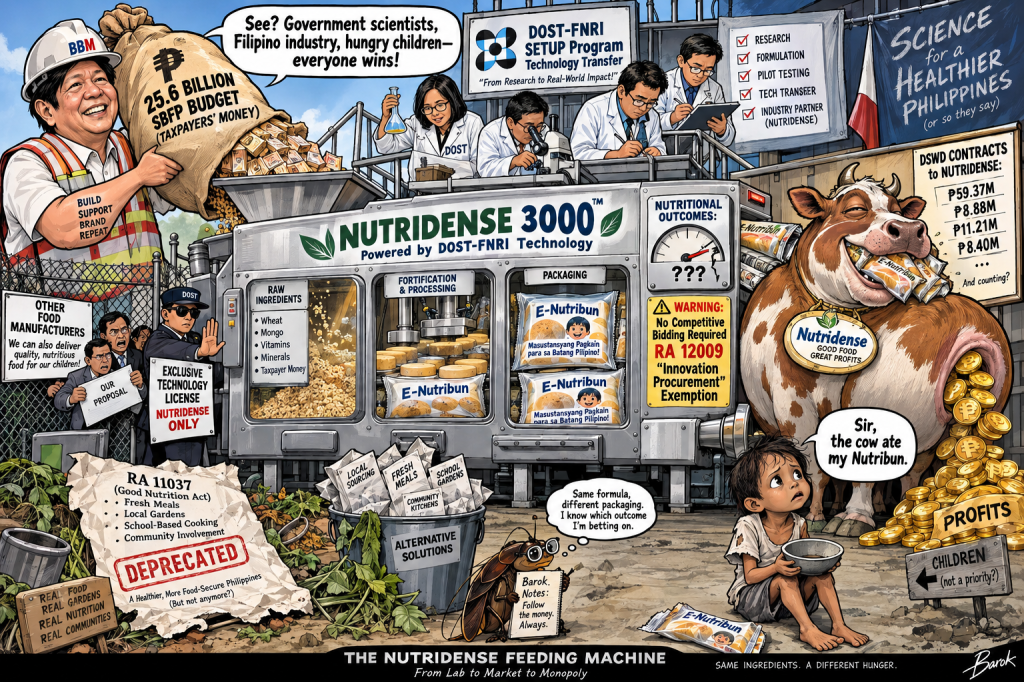
The Government Built the Factory, Wrote the Menu, and Bought the Food—Now Ask Who Eats
By Louis ‘Barok‘ C. Biraogo — September 24, 2026
LET me get something out of the way immediately: I am for feeding hungry children. I am for using government-funded science to solve real problems. I am for Filipino companies manufacturing nutritious food that actually reaches schoolchildren instead of rotting in a laboratory.
What I am not for is a government that accidentally—or perhaps not so accidentally—builds a multibillion-peso feeding program around a single private supplier while calling it “technology transfer.”
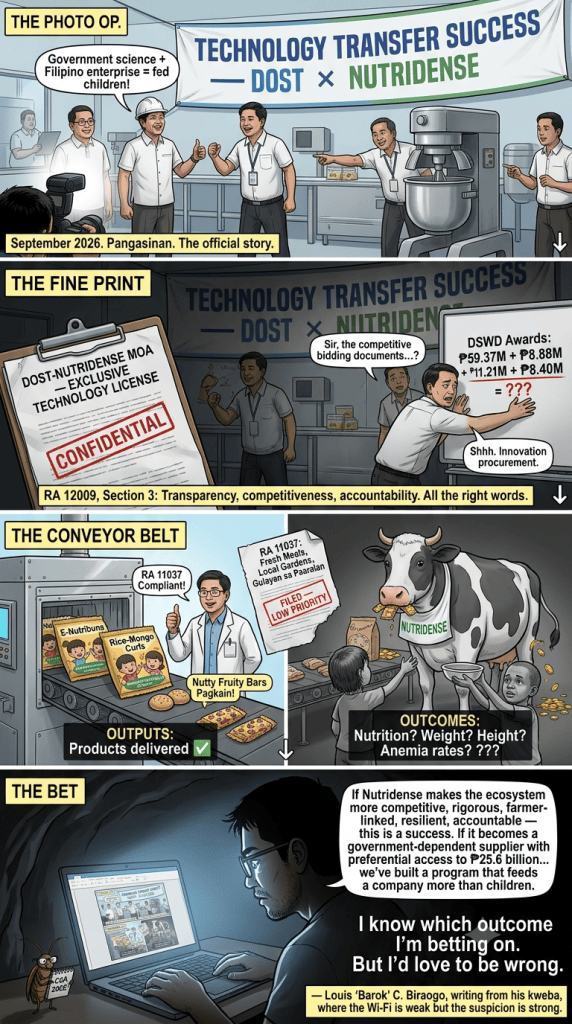
President Ferdinand Marcos Jr.’s September 2026 visit to Nutridense Food Manufacturing Corporation, complete with Department of Science and Technology (DOST) assistance for research and development (R&D) and machine acquisition, is being sold as a triumphant convergence of science, industry, and social welfare. The Palace narrative writes itself: government scientists invent fortified food, a Filipino company scales it up, hungry children get fed. Everyone wins.
Except that’s not quite the whole story.
The Setup: A Legitimate Policy Proposition With a Massive Blind Spot
Here’s what the administration gets right. The Philippines has a genuine “laboratory-to-market” problem. Department of Science and Technology–Food and Nutrition Research Institute (DOST-FNRI) researchers develop excellent food technologies—iron-fortified rice, complementary foods, nutrient-enhanced products—and those technologies routinely languish because no manufacturer wants to invest in production capacity for uncertain markets.
Republic Act No. 10055 (Philippine Technology Transfer Act) explicitly encourages the commercialization of government-funded research. SETUP, DOST’s Small Enterprise Technology Upgrading Program, is designed to help Micro, Small, and Medium Enterprises (MSMEs) acquire equipment and upgrade their operations. Nutridense’s relationship with DOST-FNRI and SETUP predates the Marcos administration by years. This is not a case of a president inventing a company out of thin air.
So far, so defensible.
But here’s where the analytical knife needs to cut deeper. The policy question isn’t whether government should help Nutridense scale up. It’s whether government assistance, presidential endorsement, and a captive procurement market can be combined around a single private entity without creating institutional lock-in that undermines competition, accountability, and ultimately the nutritional goals the program claims to serve.
That question is not being asked loudly enough.
The Procurement Elephant in the Room
Let’s talk about Republic Act No. 12009 (New Government Procurement Act), which replaced the old Republic Act No. 9184 (Government Procurement Reform Act) framework. The law’s Section 3 is a beautiful piece of legislative prose: transparency, competitiveness, efficiency, proportionality, accountability, participatory procurement, sustainability, professionalism. All the right words.
The law even creates a special category for “science, technology and innovation procurement,” which sounds tailor-made for exactly this kind of situation. Innovative products shouldn’t be treated like ordinary commodities. Fair enough.
But here’s what I want to know: Was there a competitive process for the DOST assistance itself?
The Palace announcement mentions “DOST assistance for research and development and machine acquisition.” What does that mean in practice? Was there an open call for qualified food manufacturers? Was there a published memorandum of agreement? Were the terms of the technology transfer—licensing fees, royalty arrangements, exclusivity clauses—made public?
If Nutridense is receiving government-funded machines and R&D support, taxpayers have a right to know the terms. If the technology being transferred is non-exclusive, then other manufacturers should be able to access it on similar terms. If it’s exclusive, then we need to understand why one company was chosen over all others.
The absence of these answers isn’t proof of wrongdoing. But it’s a vacuum that patronage thrives in.
The “Government-Created Captive Market” Problem
Here’s where the analysis gets uncomfortable for the administration’s cheerleaders.
Department of Social Welfare and Development (DSWD) Field Office VII records from 2026 show Nutridense receiving three lots of ready-to-eat food items for the Bohol Supplementary Feeding Program, with listed amounts of approximately ₱8.88 million, ₱11.21 million, and ₱8.40 million. DSWD Field Office X reported a 2025 award to Nutridense worth approximately ₱59.37 million for ready-to-eat food products under its supplementary feeding program.
These aren’t small numbers. And they’re happening before the President’s public endorsement of expanded operations.
Now, I’m not alleging anything improper about these specific contracts. Nutridense has apparently participated in formal procurement processes. That’s good. But here’s the systemic concern: as the School-Based Feeding Program (SBFP) expands toward a ₱25.6 billion budget reaching 4.6 million learners, how much of that market will be supplied by Nutridense?
If the answer is “a significant and growing share,” we have a concentration problem. Not necessarily a corruption problem—a concentration problem. Government becomes dependent on one supplier. That supplier gains enormous bargaining power. Other potential manufacturers, seeing that Nutridense has presidential endorsement and DOST backing, rationally decide not to compete.
The result is a de facto monopoly created not by illegal acts but by the accumulation of advantages that government itself conferred.
RA 11037’s Vision vs. the Nutridense Model
Republic Act No. 11037 (Masustansyang Pagkain para sa Batang Pilipino Act) is not a “fortified snack distribution law.” Read Section 4. The statute mandates a comprehensive program: supplemental feeding, school-based feeding, milk feeding, micronutrient supplements, health examination, vaccination, deworming, Gulayan sa Paaralan, Water, Sanitation, and Hygiene (WASH), and integrated nutrition education.
The law explicitly contemplates locally sourced, freshly prepared meals. It encourages school gardens. It integrates fresh milk from local dairy farmers. It envisions feeding programs that connect children to food systems, not just deliver calories.
The Nutridense model—centralized manufacturing of shelf-stable fortified products—isn’t inherently incompatible with RA 11037. Processed foods can be part of a cycle menu. The Department of Education’s (DepEd) own sample menu includes E-Nutribun, Rice-Mongo Curls, and Nutty Fruity Bars.
But there’s a difference between “part of the menu” and “the backbone of the system.” If the economics of centralized production push feeding programs toward replacing local hot meals with packaged products, we’ve shifted from a nutrition intervention to a food industry subsidy with nutrition branding.
Marcos himself acknowledged this tension when he said merely having something to eat is insufficient and nutritional balance matters. Good. Then the evaluation framework should measure dietary outcomes, not just product delivery.
The COA Time Bomb
Here’s a prediction: within two to three years, the Commission on Audit (COA) will publish findings about the expanded Nutridense-related feeding programs.
Why do I say that? Because COA has already flagged serious lapses in DepEd’s School-Based Feeding Program—delays in regular and milk feeding components, failure to abide by technical requirements, non-programming of unutilized funds. The 2023 SBFP, with a ₱5.69 billion budget, was flagged for delays and non-delivery of nutritious food products and pasteurized milk in several regions.
These findings suggest that the infrastructure for accountable feeding program implementation is weak. Adding a major private supplier expansion to a weak accountability ecosystem doesn’t strengthen the ecosystem. It creates more opportunities for the same problems to recur at larger scale.
What Would Actually Build Trust
The administration can defuse most of these concerns with a handful of disclosures and procedural commitments.
Publish the DOST-Nutridense agreements. Full text. Technology licensing terms. Equipment assistance details. Repayment or royalty arrangements. If there’s nothing to hide, hiding nothing is the best strategy.
Commit to competitive procurement for all feeding program supply. If Nutridense is genuinely the best value, it will win contracts on the merits. If it’s not, the government shouldn’t be buying from it regardless of how much DOST helped it scale.
Open the technology to multiple qualified manufacturers. If DOST-FNRI technology is the public asset here, make it available on non-exclusive terms to any Filipino company that meets quality and safety standards. Let them compete. Let the feeding program benefit from that competition.
Publish unit-cost benchmarks. How much does Nutridense charge per fortified meal compared to alternatives? Is government getting value for money? This should be public, machine-readable, updated regularly.
Measure outcomes, not just outputs. Weight, height, anemia rates, school attendance, learning indicators. If the products work, prove it. If they don’t, stop buying them.
The Real Test
The Nutridense controversy—if it becomes one—won’t be about whether Marcos visited a factory. It won’t be about whether DOST helped a company. Both of those things happened, and both are defensible in isolation.
The real test is whether the Philippine nutrition ecosystem becomes more competitive, more scientifically rigorous, more farmer-linked, more resilient, and more accountable because Nutridense got bigger.
If the answer is yes, this is a model of successful public-to-private technology transfer. If the answer is no—if Nutridense becomes a government-dependent private supplier with preferential access to a multibillion-peso market—then we’ve built a feeding program that feeds a company more reliably than it feeds children.
I know which outcome I’m betting on. But I’d love to be wrong.
Louis ‘Barok’ C. Biraogo is a policy analyst, professional skeptic, and unlicensed auditor of government press releases. He writes from his kweba, where the Wi-Fi is weak but the suspicion is strong. He owns no shares in any food company—a gap in his portfolio he blames entirely on the Commission on Audit.
Key Citations
A. Legal & Official Sources
- Republic Act No. 10055. An Act Providing the Framework and Support System for the Ownership, Management, Use, and Commercialization of Intellectual Property Generated from Research and Development Funded by Government and for Other Purposes (Philippine Technology Transfer Act of 2009). 23 Mar. 2010, lawphil.net/statutes/repacts/ra2010/ra_10055_2010.html.
- Republic Act No. 9184. An Act Providing for the Modernization, Standardization and Regulation of the Procurement Activities of the Government and for Other Purposes (Government Procurement Reform Act). 10 Jan. 2003, http://www.lawphil.net/statutes/repacts/ra2003/ra_9184_2003.html.
- Republic Act No. 11037. An Act Institutionalizing a National Feeding Program for Undernourished Children in Public Day Care, Kindergarten and Elementary Schools to Combat Hunger and Undernutrition among Filipino Children and Appropriating Funds Therefor (Masustansyang Pagkain para sa Batang Pilipino Act). Official Gazette of the Republic of the Philippines, 20 June 2018, http://www.officialgazette.gov.ph/2018/06/20/republic-act-no-11037/.
- Republic Act No. 12009. An Act Revising Republic Act No. 9184, Otherwise Known as the “Government Procurement Reform Act”, and for Other Purposes (New Government Procurement Act). 20 July 2024, lawphil.net/statutes/repacts/ra2024/ra_12009_2024.html.
- Department of Science and Technology. “Small Enterprise Technology Upgrading Program.” DOST-NCR, ncr.dost.gov.ph/small-enterprise-technology-upgrading-program/.
- Department of Social Welfare and Development Field Office VII. “Procurement Opportunities.” fo7.dswd.gov.ph/downloads-2/procurement-opportunities/opportunities/.
- Department of Social Welfare and Development Field Office X. “Notice of Award.” fo10.dswd.gov.ph/opportunities/notice-of-award/.
B. News Reports
- Esguerra, Darryl John. “Marcos Pushes Science-to-Market Partnerships for Food Security.” Philippine News Agency, 17 Sept. 2026, http://www.pna.gov.ph/articles/1284234.
- Presidential Communications Office. “President Marcos Inspects Pangasinan Firm Transformed into Technology-Driven Food Manufacturer.” Philippine Information Agency, 17 Sept. 2026, pia.gov.ph/news/president-marcos-inspects-pangasinan-firm-transformed-into-technology-driven-food-manufacturer/.
- Rappler.com. “DepEd’s P5.69-B Feeding Program: Undelivered Milk, Expired Nutribuns in 2023.” Rappler, 2 Sept. 2024, http://www.rappler.com/philippines/deped-feeding-program-undelivered-milk-expired-bread-nutribun-2023/.
- Untalan, Sherylin. “DepEd Earmarks Record P25.6B for School Feeding Program, Targets 4.6M Learners.” GMA News Online, GMA Network, 24 Mar. 2026, http://www.gmanetwork.com/news/topstories/nation/981221/deped-earmarks-record-p25-6b-for-school-feeding-program-targets-4-6m-learners/story/.

- “Ang Hirap Maging Mahirap”: The PAO Scandal That Proves Government Contempt Is Nothing New
- “Far-Off” My Axx: Malacañang’s Claire Castro Drowns in Her Own Legal Gaslighting
- “Forthwith” to Farce: How the Senate is Killing Impeachment—And Why Enrile’s Right (Even If You Can’t Trust Him)
- “HINDI AKO NAG-RESIGN!”

- “I Know Nothing”: Baste Duterte’s Amnesia Defense Meets ₱33M in GenCorp Contracts
- “I’m calling you from my new Globe SIM. Send load!”

- “Mahiya Naman Kayo!” Marcos’ Anti-Corruption Vow Faces a Flood of Doubt

- “Manageable” Debt, Unmanageable Lies: DBM’s ₱21 Trillion Fairy Tale
- “Meow, I’m calling you from my new Globe SIM!”

- “Natrabaho”: One Word, One Ombudsman, and a Judiciary on Trial
- “No Special Jail for Crooks!” Boying Remulla Slams VIP Perks for Flood Scammers
- “Philippine-Controlled” or Yankee Gas Station? The Davao Fuel Depot Farce Exposed






Leave a Reply