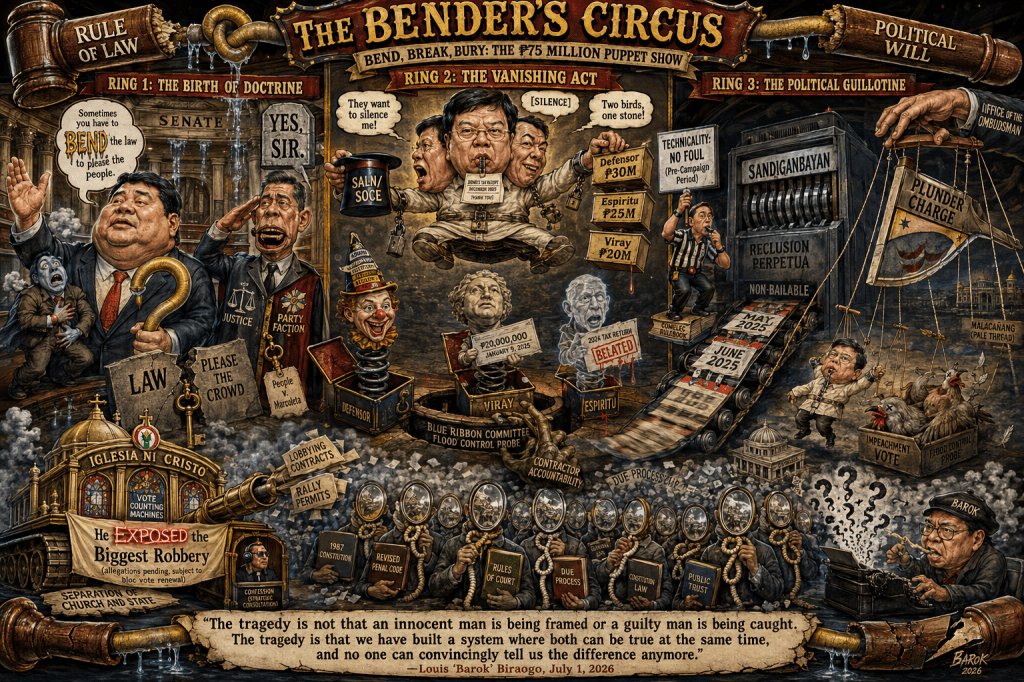
Remulla’s “Yes, Sir” moment turns private cash into a non-bailable political death sentence
By Louis ‘Barok‘ C. Biraogo — July 1, 2026
Let the gavel fall where it may. This is Kweba ni Barok.
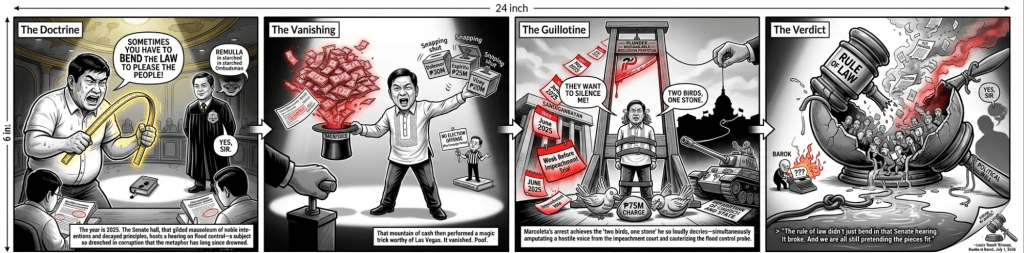
STEP into the theater of the absurd — that unforgettable Senate hearing where “bending the law” became official doctrine. The year is 2025. The Senate hall, that gilded mausoleum of noble intentions and decayed principles, hosts a hearing on flood control—a subject so drenched in the fetid waters of corruption that the metaphor has long since drowned. At the podium stands Senator Erwin Tulfo, a man whose instinct for legal nuance rivals a sledgehammer’s. “Sometimes,” Tulfo muses aloud, in a moment of unscripted honesty that must have sent his handlers into cardiac arrest, “you have to bend the law in order to please the people.”
A hush. Then, the camera pans. It lands on then-Justice Secretary, now-Ombudsman, Jesus Crispin “Boying” Remulla. He is asked, with the directness of a firing squad, if this jurisprudential atrocity is correct. His reply, immortalized in the congressional record and now etched into the tombstone of prosecutorial impartiality: “Yes, sir.”
Ladies and gentlemen of the court of public opinion, you may now gasp. You may clutch your pearls, your pocket 1987 Constitution of the Republic of the Philippines, your dog-eared copies of the Revised Penal Code (Act No. 3815). Because in that single, crystalline moment of intellectual abdication, the master key to the case of People v. Marcoleta was forged. We were handed the Rosetta Stone for translating the Ombudsman’s press releases. We were told, by the chief anti-corruption prosecutor himself, that the law is not a sword but a rubber hose—to be bent, twisted, and, when necessary, used to bludgeon a political enemy into silence in the name of pleasing the crowd.
Welcome to the plunder case against Senator Rodante Marcoleta. It is, by any measure, a masterpiece of strategic ambiguity.
Act I: The Vanishing ₱75 Million and the Paper Trail That Screamed “Curative Compliance”
Let us first genuflect at the altar of the prosecution’s strongest argument, because even a broken clock is right twice a day, and and even the Ombudsman, in the thick of factional theater, can stumble upon a violation that doesn’t need stage lighting. The facts are not in dispute, and this is where Marcoleta’s narrative of pure persecution begins to leak like a DPWH-funded flood control dike. The good Senator received ₱75 million. Not in public funds, mind you, but in private campaign donations from a trinity of benefactors—Michael Defensor, Aristotle Viray, and Joseph Espiritu—whose collective timing, a four-day cash bonanza in January 2025, has the faint but distinct aroma of a structured transaction rather than grassroots democratic fervor.
That mountain of cash then performed a magic trick worthy of Las Vegas. It vanished. Poof. It did not appear in Marcoleta’s Statement of Contributions and Expenditures (SOCE), a document mandated by Republic Act No. 7166 (An Act Providing for Synchronized National and Local Elections and for Other Purposes). It did not appear in his Statement of Assets, Liabilities, and Net Worth (SALN), the sworn disclosure required by Republic Act No. 6713 (The Code of Conduct and Ethical Standards for Public Officials and Employees). The donor’s tax, that quaint little receipt of civic duty, was paid nearly a year late in December 2025—a timeline that screams “curative compliance” louder than a defense lawyer’s objection.
The Commission on Elections (COMELEC), in its infinite but narrow wisdom, cleared him of an election offense because the cash drop occurred before the official campaign period. Fine. But a clearance from the COMELEC on an election-technicality is not a plenary indulgence from the Ombudsman for all sins pecuniary. The dual non-disclosure is, at a bare minimum, the textbook definition of a violation of Presidential Decree No. 46 (Making it Punishable for Public Officials and Employees to Receive, and for Private Persons to Give, Gifts on Any Occasion, Including Christmas), the fossilized but still-breathing gift ban that asks only, “Did you receive a gift by reason of your office?” No quid pro quo needed. No corrupt intent to prove. Just the gifting and the receiving. On this narrow, unglamorous charge, the prosecution’s case is not just strong; it’s boringly solid.
Act II: Plunder as Political Guillotine — The “Bend the Law” Doctrine Goes Nuclear
But here, in the Kweba ni Barok, we do not stop at the surface. We drill. And what we find in the bedrock of this case is not a straightforward corruption bust. It is a political execution, dressed in the robes of a Sandiganbayan information.
The decision to lead with plunder—the maximum-severity, non-bailable, reclusion perpetua-facing nuclear option under Republic Act No. 7080 (An Act Defining and Penalizing the Crime of Plunder)—is where the “bend the law” doctrine springs to life. To make plunder stick, the prosecution must prove Marcoleta amassed “ill-gotten wealth” through a “combination or series of overt or criminal acts” as described in Section 1(d). They are leaning heavily on subsection 6, the catch-all “undue advantage of official position.” Their argument, stripped of legalese, is this: the donations were so large they couldn’t possibly have been legitimate, and therefore, they were corrupt.
This is a theory that, if validated by the Sandiganbayan, would effectively criminalize every major campaign fundraiser in the Republic and leave the Estrada v. Sandiganbayan precedent on “pattern” stretched thinner than the Ombudsman’s budget. It conflates the regulatory regime of campaign finance with the criminal law of plunder. It is a doctrinal leap of faith, and the Ombudsman took it not on the first day, or the hundredth day, but precisely in the week before the Duterte impeachment trial. The timing is not a coincidence; it is the lingua franca of the Marcos-Duterte political war.
Marcoleta, you see, is not just any senator. He is a Duterte ally, a key vote and a procedural guerilla in the coming trial of Vice President Sara Duterte. He was also, inconveniently for some, the chair of the Blue Ribbon Committee digging into flood control anomalies—an investigation that, like a horror movie monster, kept threatening to drag politically connected contractors into the light. Marcoleta’s arrest achieves the “two birds, one stone” he so loudly decries, simultaneously amputating a hostile voice from the impeachment court and cauterizing the flood control probe. The Ombudsman’s office will say the procedural calendar demanded it. The FIB complaint had been pending since May 2025. The counter-affidavits were just in. It was simply time. This is the judicial equivalent of an airline claiming your flight’s cancellation is due to “weather” when a hurricane has been parked over the runway for a week. Legally sufficient, contextually absurd.
Act III: The Holy Hand Grenade Enters the Chat
And into this morass of legal weaponization wades the Iglesia ni Cristo, a bloc-voting monolith whose political theology is more predictable than a Pasig River tide. The INC has thrown its institutional weight behind Marcoleta. We are thus treated to the spectacle of a religious institution arguing that a senator should be shielded from criminal process, not on the legal merits, but because he “exposed the biggest robbery.” This is not a defense; it is a lobbying firm with a cathedral facade, trading the moral authority of the pulpit for the transactional currency of the political rally. It is the holy hand grenade of Philippine politics, pulled out when a favored son is cornered.
The public record, as it stands on this sweltering July day, compels us to hold two searing truths in our smoke-filled lungs. First, Rodante Marcoleta has some serious explaining to do. The ₱75 million paper trail doesn’t lie, and the PD 46 violation is hanging over his head like the sword of Damocles, if Damocles’ sword were made of an easily provable statutory gift ban. The wailing of persecution, however loud, does not muffle the silent scream of an un-filed SALN.
Second, and just as damning, the Ombudsman’s choice to escalate this to a theatrical, non-bailable plunder charge in this specific political window is the kind of move that erodes whatever fragile trust remains in our accountability institutions. It is selective, it is strategically timed, and it carries the unmistakable cologne of Ombudsman Remulla’s own stated willingness to “bend the law.” We are left not with a confident verdict, but with the queasy feeling that we have just watched the justice system be used not to serve the law, but to serve a faction.
The Kweba Verdict: Two Truths and a System Pretending the Pieces Still Fit
The recommendations are, by now, a worn-out prayer.
For the Sandiganbayan: disentangle the law from the politics. Rule on the PD 46 evidence. Clarify whether private campaign donations can constitute the plunder predicate without a transactional quid pro quo.
For the Ombudsman: release the full timeline proving your impartiality, or resign yourself to the reputation of a political axeman. For the Senate: find a way to do your constitutional duty without making a mockery of the rules of court.
And for us, the public: demand an accountability that is even-handed, not an accountability that is a cudgel wielded only against the enemies of the palace.
What we are witnessing is not a war on corruption. It is a war by corruption, using the weapons of law. The tragedy is not that an innocent man is being framed or a guilty man is being caught. The tragedy is that we have built a system where both can be true at the same time, and no one—not the INC, not the Ombudsman, not the senators in their gilded hall—can convincingly tell us the difference anymore. The rule of law didn’t just bend in that Senate hearing. It broke. And we are all still pretending the pieces fit.
Key Citations
A. Legal & Official Sources
- Republic Act No. 7166. An Act Providing for Synchronized National and Local Elections and for Other Purposes. 26 Nov. 1991. Lawphil, lawphil.net/statutes/repacts/ra1991/ra_7166_1991.html.
- Republic Act No. 6713. An Act Establishing a Code of Conduct and Ethical Standards for Public Officials and Employees. 20 Feb. 1989. Lawphil, lawphil.net/statutes/repacts/ra1989/ra_6713_1989.html.
- Presidential Decree No. 46. Making It Punishable for Public Officials and Employees to Receive, and for Private Persons to Give, Gifts on Any Occasion, Including Christmas. 10 Nov. 1972. Official Gazette of the Republic of the Philippines, http://www.officialgazette.gov.ph/1972/11/10/presidential-decree-no-46-s-1972/.
- Republic Act No. 7080. An Act Defining and Penalizing the Crime of Plunder. 12 July 1991. Lawphil, lawphil.net/statutes/repacts/ra1991/ra_7080_1991.html.
- Estrada v. Sandiganbayan. G.R. No. 148560. Supreme Court of the Philippines, 19 Nov. 2001. Lawphil, lawphil.net/judjuris/juri2001/nov2001/gr_148560_2001.html.
- The 1987 Constitution of the Republic of the Philippines. Official Gazette of the Republic of the Philippines, 1987, http://www.officialgazette.gov.ph/constitutions/1987-constitution/.
- Act No. 3815. The Revised Penal Code of the Philippines. 8 Dec. 1930. Official Gazette of the Republic of the Philippines, http://www.officialgazette.gov.ph/1930/12/08/act-no-3815-s-1930/.
B. News Reports
- “Marcoleta on possible plunder charges: They want to silence me.” GMA News Online, GMA Network, 30 June 2026, http://www.gmanetwork.com/news/topstories/nation/993153/marcoleta-on-possible-plunder-charges-they-want-to-silence-me/story/.
- GMA Integrated News. “Erwin Tulfo, Robin Padilla Debate ‘Bending the Law’ Amid Flood Control Projects Probe.” GMA News Online, GMA Network, 24 Sept. 2025, http://www.gmanetwork.com/news/topstories/nation/960106/erwin-tulfo-robin-padilla-bend-the-law-flood-control-projects-witness-protection/story/.
- GMA News. “Timeline: The Plunder Case vs. Rodante Marcoleta over P75M Campaign Contributions.” GMA News Online, GMA Network, 30 June 2026, http://www.gmanetwork.com/news/topstories/nation/993233/timeline-the-plunder-case-vs-rodante-marcoleta-over-p75m-campaign-contributions/story/.
- GMA News. “Ombudsman: Marcoleta Unjustly Enriched Self Through P75-M Gift.” GMA News Online, GMA Network, 26 May 2026, http://www.gmanetwork.com/news/topstories/nation/988982/ombudsman-marcoleta-unjustly-enriched-self-through-p75-m-gift/story/.
- Villanueva, Gillian. “COMELEC Clears Marcoleta; ‘It Defies Logic,’ Says Poll Watchdog.” Inquirer.net, INQUIRER.net, 19 Mar. 2026, newsinfo.inquirer.net/2198048/comelec-clears-marcoleta-it-defies-logic-says-poll-watchdog.
- Bilyonaryo News Channel. “‘Hitting 2 Birds with 1 Stone’: Marcoleta…” YouTube, 30 June 2026, http://www.youtube.com/watch?v=40L9HxocbNo.
- “Ang Hirap Maging Mahirap”: The PAO Scandal That Proves Government Contempt Is Nothing New
- “Far-Off” My Axx: Malacañang’s Claire Castro Drowns in Her Own Legal Gaslighting
- “Forthwith” to Farce: How the Senate is Killing Impeachment—And Why Enrile’s Right (Even If You Can’t Trust Him)
- “HINDI AKO NAG-RESIGN!”

- “I Know Nothing”: Baste Duterte’s Amnesia Defense Meets ₱33M in GenCorp Contracts

- “I’m calling you from my new Globe SIM. Send load!”

- “Mahiya Naman Kayo!” Marcos’ Anti-Corruption Vow Faces a Flood of Doubt

- “Manageable” Debt, Unmanageable Lies: DBM’s ₱21 Trillion Fairy Tale
- “Meow, I’m calling you from my new Globe SIM!”

- “Natrabaho”: One Word, One Ombudsman, and a Judiciary on Trial
- “No Special Jail for Crooks!” Boying Remulla Slams VIP Perks for Flood Scammers
- “Philippine-Controlled” or Yankee Gas Station? The Davao Fuel Depot Farce Exposed





Leave a Reply