By Louis ‘Barok‘ C. Biraogo — June 30, 2026
SOME families pass down heirlooms. The Marcoses pass down budgets—each more swollen than the last, each a monument to the principle that when the house is on fire, you reach for the checkbook and hope the flames consume the evidence.
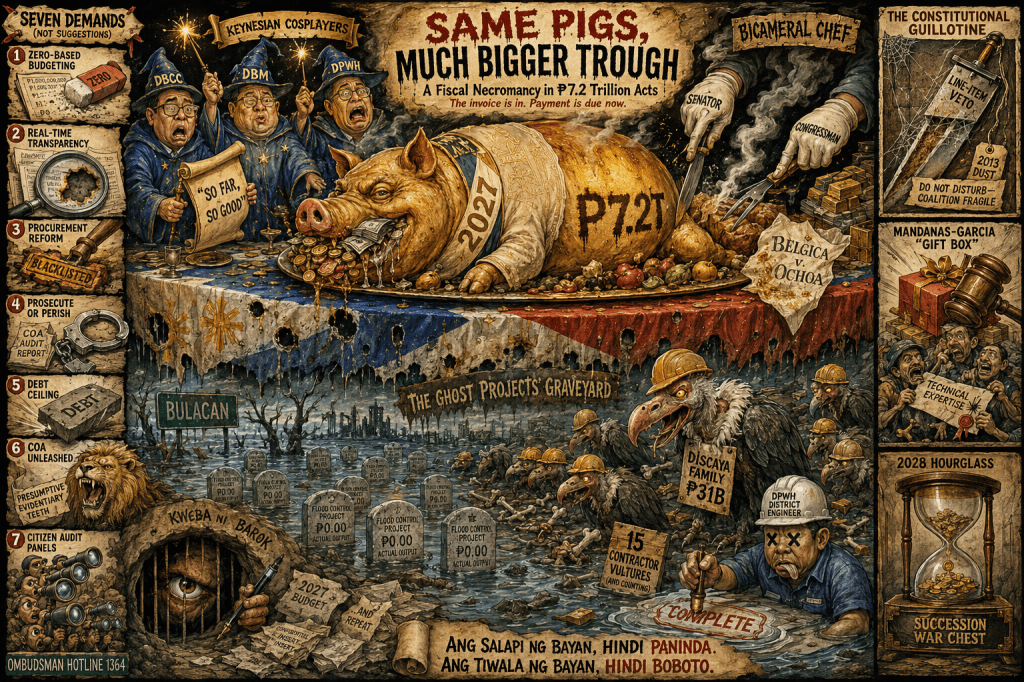
The proposed ₱7.2-trillion national budget for Fiscal Year 2027 is not a fiscal plan. It is a 21.7% of Gross Domestic Product (GDP) exercise in financial necromancy. Acting Budget Secretary Kim Robert C. De Leon frames this as a response to “geopolitical conflict and domestic spending scandals.” Translation: the US and Iran are blowing up ships, and our officials are blowing up the procurement process, so naturally the solution is to hand everyone more money and look away.

Inside the ₱7.2T budget necromancy.
THE “BAWAL ANG PASAWAY” BUDGET: KEYNESIAN COSPLAY
The administration wants you to believe this is counter-cyclical stimulus. This is Keynesianism as performed by a tribute band that hasn’t practiced. Real counter-cyclical spending requires fiscal space to borrow when times are bad and discipline to save when times are good. The Marcos administration has demonstrated neither.
The numbers tell the story. The 2026 growth target has been hurled from 5-6% down to 3.5-4.5%. Inflation, once promised at 2-4%, is now projected at 6-7% this year before “easing” to 4-5% in 2027. The peso is expected to trade at ₱60-62 to the dollar—a doomsday range unthinkable three years ago. And the response? A budget ₱407 billion larger, a deficit of ₱1.69 trillion, and disbursements of ₱6.90 trillion against revenues of just ₱5.205 trillion. The gap between spending and earning is not a “fiscal shortfall.” It is a confession.
The Development Budget Coordination Committee (DBCC) assures us the deficit-to-GDP ratio will decline to 3.5% by 2030. This is the macroeconomic equivalent of a man falling from a building shouting “so far, so good” as he passes each floor. By 2030, the Marcos Jr. term will be a memory, and creditors will be knocking on someone else’s door.
Then there is the ₱1.32 trillion in National Tax Allotments—an 11% increase constitutionally mandated under the Mandanas-Garcia ruling (G.R. Nos. 199802 & 208488, July 3, 2018). The administration presents this as a generous gift from Malacañang. You cannot take credit for what the Supreme Court forced you to give. When roughly 80% of the budget is pre-committed to debt service, personnel costs, and automatic appropriations, what remains is theater.
THE CORRUPTION SYNDICATE: SAME PIGS, BIGGER TROUGH
The 2027 budget cannot be understood without the 2025 flood control scandal—a heist so comprehensive it makes the Priority Development Assistance Fund (PDAF) scandals look like petty shoplifting.
Between July 2022 and May 2025, the government poured ₱545 billion into flood control projects. The UP Center for Integrative and Development Studies documented a “two-pronged infrastructure of plunder”: budget inflation through legislative insertions—9,855 projects, 6,021 lacking basic details—and a rigged bidding system where 25-30% kickbacks became normalized. The Commission on Audit (COA) found ₱44 billion in ghost projects in Bulacan alone. Fifteen contractors bagged ₱100 billion. The Discaya family cornered ₱31 billion. Eighteen members of Congress were linked to contracting firms.
And into this system, the administration now proposes pouring an additional ₱7.2 trillion.
President Marcos Jr. promises “no repeat.” This is the same President whose Department of Public Works and Highways (DPWH) Secretary presided over the catastrophe, whose Department of Budget and Management (DBM) Secretary enabled the releases, and whose legislative allies inserted the projects. Believing this budget will be different requires a form of amnesia worthy of neurological study.
The motivations are transparent. Marcos Jr. faces 2028—the constitutional guillotine. The 2027 budget is his final opportunity to dispense patronage on an industrial scale, to reward allies, to build war chests for the chosen successor. Every peso is a chit in the coming succession poker game.
Congress views the budget as a menu. Senator Lacson flagged ₱100 billion in insertions in the 2025 General Appropriations Act (GAA). The bicameral conference committee—that smoke-filled room where the real budget is written—remains the preferred venue for converting public funds into private profit. The Belgica v. Ochoa ruling (G.R. Nos. 208566, 208493 & 209251, November 19, 2013) declared PDAF unconstitutional, so legislators simply moved their intervention upstream. Same contractors, same kickbacks, different paperwork.
THE CONSTITUTION’S BROKEN PROMISES: VETO RUSTING IN ITS SCABBARD
The 1987 Constitution of the Republic of the Philippines is clear: no money shall be paid from the Treasury except by law, Congress cannot increase presidential appropriations, and the President wields the line-item veto. Then came Belgica in 2013, declaring pork barrel unconstitutional.
What we got was innovation. Insertions migrated to the bicameral conference committee. The President’s line-item veto—the Constitution’s strongest anti-corruption tool—sits unused, a sword rusting in its scabbard. Marcos Jr. could excise every irregular insertion, but doing so would eviscerate his congressional coalition. The legislators who inserted those items protect the administration from investigation and will shepherd its successor in 2028. So the plunder proceeds.
The Mandanas-Garcia ruling expanded Local Government Unit (LGU) shares, but here is the truth no one speaks: many LGUs are fiscal black holes. Fifth- and sixth-class municipalities lack absorptive capacity, technical expertise, and in too many cases, basic honesty. Autonomy without accountability is not devolution—it is abandonment in constitutional language.
THE ENDGAME: A MENU OF POISON
Five resolutions, each more nauseating than the last. The Fairy Tale—a clean budget with minimal insertions—is about as realistic as every DPWH district engineer suddenly refusing to sign completion certificates for projects that exist only on paper. The Veto Theater (30% probability) involves selective line-item vetoes targeting safe items while leaving corrupt insertions untouched. Constitutional Purgatory (15%) means deadlock and a reenacted budget, inviting credit downgrades. The Scandal-Triggered Reformation (20%) requires public outrage—I am being charitable to the point of self-deception. The Grand Bargain (10%) trades budget flexibility for 2028 succession support, making the budget currency for dynastic perpetuation. This scenario haunts my sleep.
THE BITTER INHERITANCE: GROWTH ON A VENTILATOR, DEBT FOR THE UNBORN
Economic growth will underwhelm because an economy built on government spending rather than productivity is a patient on a fiscal ventilator. Inflation will persist because flooding the economy with deficit-funded pesos while supply chains remain disrupted is masochism. The peso will weaken because international investors can read a budget as well as I can.
Intergenerational equity will be sacrificed. The debt we accumulate will be serviced by taxpayers not yet born, for projects they will never see, built by contractors long dead, prosecuted in cases never resolved. The gap between Makati and Maguindanao will widen because the budget treats inequality as a condition to manage rather than a wound to heal.
And corruption? The scandal will recur under a different name—”climate resilience infrastructure” or “disaster risk reduction facilities.” The contractors will change corporate registrations. The legislators will find new bicameral tricks. By 2035, when the Sandiganbayan finally schedules hearings, we will be debating a ₱9-trillion budget for 2031.
THE CAVE’S SEVEN DEMANDS: REFORM OR PERISH
First: Zero-Based Budgeting. Every line item justified from scratch. No rolling over prior appropriations. If an agency cannot demonstrate measurable outcomes, its budget should be zero.
Second: Real-Time Transparency. Every contract, disbursement, and audit finding published in machine-readable format within 48 hours—not summaries, actual documents. Let civil society scrape the data and connect the dots.
Third: Procurement Reform That Bites. Amend Republic Act No. 9184 (Government Procurement Reform Act) to mandate automatic blacklisting for contractors with pending graft cases—not convictions, cases. The presumption of innocence is a criminal law principle, not a procurement entitlement.
Fourth: Prosecute or Perish. Every DPWH district engineer who signed a ghost project completion certificate must be charged with malversation and graft. Every Bids and Awards Committee (BAC) member who rigged bidding. Every contractor who submitted fake performance bonds. The Department of Justice (DOJ) must create a special task force to indict and convict before 2028.
Fifth: Constitutional Fiscal Responsibility. Impose a statutory debt ceiling, a balanced budget requirement, and an absolute prohibition on congressional insertions in the bicameral conference committee.
Sixth: COA Unleashed. Give the Commission on Audit prosecutorial powers. Let its findings have presumptive evidentiary weight. Let its commissioners serve fixed, non-renewable terms with ironclad protection from executive removal.
Seventh: Citizen Audit Panels. Every congressional district should have a citizen audit panel—accountants, engineers, civil society representatives—with access to all procurement documents, project sites, and liquidation reports. Pay them, protect them, and give them a hotline to the Ombudsman.
FINAL VERDICT: THE INVOICE IS IN. PAYMENT IS DUE NOW.
The ₱7.2-trillion budget is a test. It will reveal whether the Philippine government serves the Filipino people or feeds the apparatus that feeds on them. It will reveal whether the Constitution’s fiscal provisions are binding law or decorative prose.
I am not optimistic. The contractors are preparing their bids. The legislators are drafting their insertions. The DPWH district engineers are measuring nonexistent sites where nonexistent projects will be certified complete.
But I am also not silent. The invoice has been delivered. Someone must pay. If this budget passes as expected—a bloated, corrupted, constitutionally suspect monument to the marriage of incompetence and avarice—the only appropriate response is accountability. Not tomorrow. Not after 2028. Now.
Louis ‘Barok’ C. Biraogo is the proprietor of Kweba ni Barok, a cave of fiscal outrage and constitutional commentary. He has been writing about Philippine budgets since the PDAF era and has yet to see a clean one.
Key Citations
A. Legal & Official Sources
- The 1987 Constitution of the Republic of the Philippines. Official Gazette of the Republic of the Philippines, 1987, http://www.officialgazette.gov.ph/constitutions/1987-constitution/.
- Belgica v. Ochoa. G.R. Nos. 208566, 208493 & 209251. Supreme Court of the Philippines, 19 Nov. 2013. lawphil.net/judjuris/juri2013/nov2013/gr_208566_2013.html.
- Mandanas v. Ochoa. G.R. No. 199802. Supreme Court of the Philippines, 3 July 2018. lawphil.net/judjuris/juri2018/jul2018/gr_199802_2018.html.
- Republic Act No. 9184. An Act Providing for the Modernization, Standardization and Regulation of the Procurement Activities of the Government and for Other Purposes. 10 Jan. 2003. lawphil.net/statutes/repacts/ra2003/ra_9184_2003.html.
B. News Reports
- Rosal, Derco. “Marcos admin proposes ₱7.2-trillion budget for 2027 to revive growth.” Manila Bulletin, 26 June 2026, mb.com.ph/2026/06/26/marcos-admin-proposes-72-trillion-budget-for-2027-to-revive-growth.
- Latoza, Guinevere. “5 Reveals from the Flood-Control Data.” PCIJ, Philippine Center for Investigative Journalism, 31 Aug. 2025, pcij.org/2025/08/31/5-reveals-from-the-flood-control-data/.
- Gera, Weena. “Flood-Control Fiasco: A Policy Reckoning for Accountability in the Philippines.” UP Center for Integrative and Development Studies, 2 Oct. 2025, cids.up.edu.ph/flood-control-fiasco-a-policy-reckoning-for-accountability-in-the-philippines/.
- “Ang Hirap Maging Mahirap”: The PAO Scandal That Proves Government Contempt Is Nothing New
- “Far-Off” My Axx: Malacañang’s Claire Castro Drowns in Her Own Legal Gaslighting
- “Forthwith” to Farce: How the Senate is Killing Impeachment—And Why Enrile’s Right (Even If You Can’t Trust Him)
- “HINDI AKO NAG-RESIGN!”

- “I Know Nothing”: Baste Duterte’s Amnesia Defense Meets ₱33M in GenCorp Contracts
- “I’m calling you from my new Globe SIM. Send load!”

- “Mahiya Naman Kayo!” Marcos’ Anti-Corruption Vow Faces a Flood of Doubt

- “Manageable” Debt, Unmanageable Lies: DBM’s ₱21 Trillion Fairy Tale
- “Meow, I’m calling you from my new Globe SIM!”

- “Natrabaho”: One Word, One Ombudsman, and a Judiciary on Trial
- “No Special Jail for Crooks!” Boying Remulla Slams VIP Perks for Flood Scammers
- “Philippine-Controlled” or Yankee Gas Station? The Davao Fuel Depot Farce Exposed



Leave a Reply