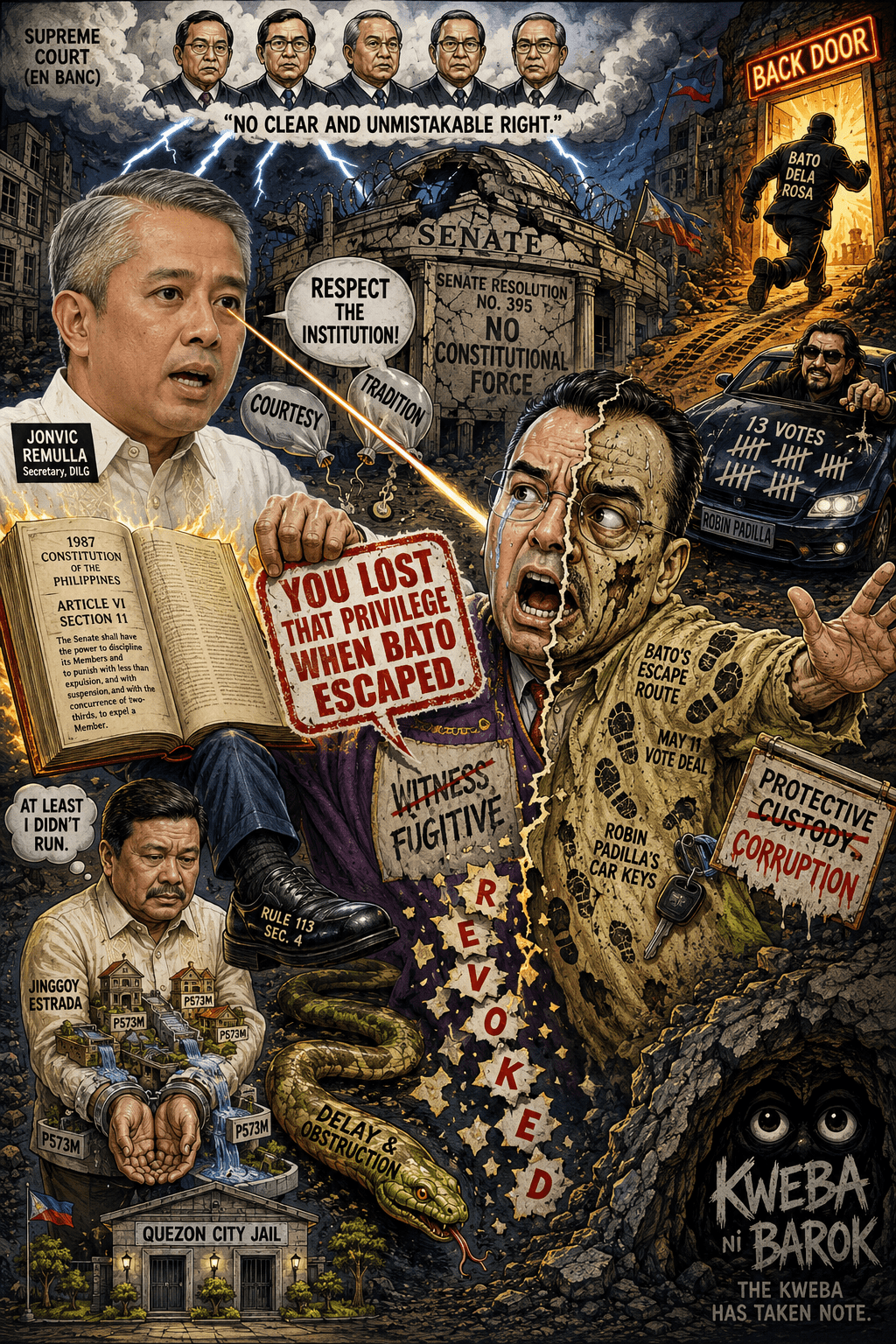
“Respect the Institution” — Unless It’s Harboring Fugitives, Apparently
By Louis ‘Barok‘ C. Biraogo — June 2, 2026
ON June 1, 2026, Interior Secretary Jonvic Remulla did not storm the Senate like some vengeful conquistador. He arrived to execute a valid Sandiganbayan warrant for plunder against Senator Jinggoy Estrada — a non-bailable charge carrying reclusion perpetua for an alleged P573 million in kickbacks from rigged flood-control projects. Estrada himself had already declared he would not hide behind the Senate. He surrendered peacefully, Miranda rights read, lawyer present. The only person turning the chamber into a battlefield was Senate President Alan Peter Cayetano, physically interposing himself and demanding that the arrest happen “outside” because “this was never done” and “Respect the institution!”
Remulla’s reply was surgical: “Sir, I’m sorry. You lost that privilege when Bato escaped.”
That single sentence is the entire case. Everything else is noise.
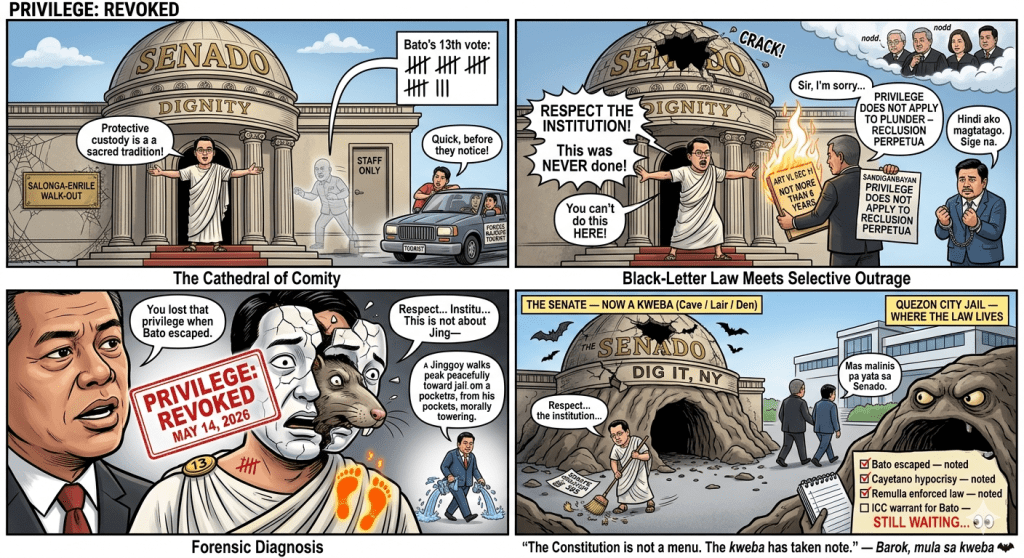
The Constitutional Fortress Stands: Remulla Enforces Black-Letter Law
Article VI, Section 11 of the 1987 Constitution of the Republic of the Philippines is not ambiguous poetry. It states, with surgical precision: “A senator or member of the House of Representatives shall, in all offenses punishable by not more than six years’ imprisonment, be privileged from arrest while the Congress is in session.”
Two conditions. Only two. The offense must be punishable by not more than six years. And Congress must be in session. Plunder under Republic Act No. 7080 (The Anti-Plunder Act), as amended, when the amount exceeds P50 million, is punishable by reclusion perpetua. Estrada’s alleged P573 million haul does not merely exceed the threshold — it obliterates it. Therefore, no privilege exists. None. Zero. Black-letter law, not a policy debate.
The Supreme Court has already gutted any broader reading. In People v. Jalosjos (G.R. Nos. 132875-76, 2000), the Court declared that election to Congress confers no special privilege to be above the law for serious offenses. In Jalosjos v. Commission on Elections (COMELEC) (G.R. No. 192474, 2010), it reaffirmed that the arrest privilege is strictly limited to minor offenses. Most recently, in the May 25, 2026 en banc denial of Senator Ronald “Bato” dela Rosa’s petition for a temporary restraining order (G.R. No. 278747), the Court held that Dela Rosa failed to show any “clear and unmistakable right” to Senate protection. The Senate’s “protective custody” was treated as a courtesy without constitutional force — exactly as five senators had already admitted in Senate Resolution No. 395.
A Sandiganbayan warrant is not a political request. It is a judicial command issued under Article XI and Republic Act No. 8249. Rule 113 of the Rules of Court requires its execution within ten days. There is no carve-out for legislative carpet. Remulla was not aggressing against a co-equal branch. He was obeying judicial supremacy. That is not optional. That is the Constitution working as designed.
The Comity Con Crumbles: Bato’s Escape Exposes Cayetano’s Hollow Claim
Cayetano’s entire performance rested on a tradition — the Salonga-Enrile walk-out during the Cory era — dressed up as constitutional right. It was never a right. It was a courtesy extended in a rebellion case under a different political reality. Traditions are not law. They survive only so long as both sides honor them. When one side converts the Senate into a safehouse for a fugitive wanted by the International Criminal Court (ICC) for crimes against humanity, then uses that same fugitive’s vote to seize the Senate presidency on May 11, 2026, the courtesy is dead. Cayetano killed it himself.
The timeline is damning and undisputed. Dela Rosa resurfaced on May 11 solely to deliver the 13th vote that installed Cayetano. In exchange, the new Senate President publicly promised “protective custody.” Three days later, in the early hours of May 14, Dela Rosa slipped out of the building with Senator Robin Padilla and vanished again. The Senate under Cayetano did not merely fail to produce him — it facilitated his second escape. Remulla’s line was not rhetoric. It was forensic diagnosis: “You lost that privilege when Bato escaped.”
Cayetano’s cry of “Respect the institution! This is not about Jinggoy!” is therefore grotesque theater. The institution’s dignity was not violated by Remulla serving a warrant on a senator who had already chosen to surrender. It was violated when Cayetano turned the Senate into the functional equivalent of a witness-protection program for a political ally accused of the most serious crimes imaginable. Estrada declined the shield. Cayetano tried to force it on him anyway. That is not institutional defense. That is partisan obstruction wearing a toga.
The Verdict: Remulla Is Legally and Morally Right; Cayetano’s Indignation Is Selective Theater
Remulla’s position is legally unassailable, morally necessary, ethically clean, and historically consistent with every Supreme Court pronouncement on legislative privilege since the 1987 Constitution took effect. The Senate is not the Vatican. It enjoys no extraterritorial immunity from valid judicial warrants for heinous crimes. Plunder is not a parking ticket. When the amount reaches half a billion pesos in alleged kickbacks from public works, the constitutional privilege simply does not apply. Period.
Cayetano’s position collapses under the weight of its own hypocrisy. He was not defending separation of powers. He was defending a political debt — Estrada voted for him — and an impeachment-court arithmetic that suddenly looks shakier with one less reliable vote in detention. His selective indignation would be comical if it were not so dangerous. He demands respect for the Senate while his own leadership record includes enabling a fugitive’s flight. Republic Act No. 6713 (The Code of Conduct and Ethical Standards for Public Officials and Employees) requires every public officer to uphold the Constitution and act with professionalism and commitment to public interest. A Senate President who physically positions himself between law enforcement and the execution of a valid warrant against a political ally fails that test on its face.
Protocols Over Pretend Sanctuaries: What Senate and Executive Must Do Now
The Senate must immediately draft and adopt a formal, written protocol for the service of judicial warrants on its members. Advance notice to the Senate President is reasonable comity. A designated external handover point can be negotiated in good faith. What cannot be negotiated is delay, obstruction, or the revival of “protective custody” as a legally baseless and politically toxic fiction. The next time a senator faces a Sandiganbayan or regular court warrant for a serious offense, the institution must facilitate, not frustrate, the rule of law.
The Executive, for its part, must explain — with clarity and principle, not convenience — why domestic Sandiganbayan warrants receive aggressive enforcement while the ICC warrant against Dela Rosa has been handled with conspicuous ambiguity. The rule of law cannot be a selective weapon deployed against one political bloc while another fugitive enjoys de facto sanctuary. Consistency is not optional. It is the only thing that separates accountability from vendetta.
Jinggoy Estrada did the one honorable thing in this entire episode: he refused the Senate’s poisoned shield and surrendered. He now sits in Quezon City jail awaiting his day before the Sandiganbayan. The rest of the actors — the man who tried to block a lawful arrest to protect a political investment, and the administration that still must square its domestic zeal with its international inaction — have far more explaining to do.
The Constitution is not a menu from which powerful men may pick the privileges they like and discard the duties they dislike. Article VI, Section 11 means what it says. The Supreme Court has said it repeatedly. Remulla simply enforced what the law and the Court have already settled.
Cayetano’s cathedral of comity was hollow from the moment Bato walked out its back door. Remulla did not desecrate it. He merely refused to pretend the roof was still intact.
The kweba has taken note.
— Barok, mula sa kweba
kwebanibarok.com | “Where corruption goes to die.”
Key Citations
A. Legal & Official Sources
- The 1987 Constitution of the Republic of the Philippines. Official Gazette of the Republic of the Philippines, 1987, www.officialgazette.gov.ph/constitutions/1987-constitution/.
- Philippines, Congress. Republic Act No. 7080: An Act Defining and Penalizing the Crime of Plunder. Official Gazette of the Republic of the Philippines, 12 July 1991, www.officialgazette.gov.ph/1991/07/12/republic-act-no-7080/.
- Philippines, Congress. Republic Act No. 8249: An Act Further Defining the Jurisdiction of the Sandiganbayan, Amending for the Purpose Presidential Decree No. 1606, as Amended, Providing Funds Therefor, and for Other Purposes. Supreme Court E-Library, 5 Feb. 1997, elibrary.judiciary.gov.ph/thebookshelf/showdocs/2/4520.
- Philippines, Congress. Republic Act No. 6713: An Act Establishing a Code of Conduct and Ethical Standards for Public Officials and Employees. Official Gazette of the Republic of the Philippines, 20 Feb. 1989, https://www.officialgazette.gov.ph/1989/02/20/republic-act-no-06713/.
- Philippines, Supreme Court. Revised Rules of Criminal Procedure (Rules of Court). Rule 113, Section 4, 1 December 2000, lawphil.net/courts/rules/rc_110-127_crim.html.
- Philippines, Supreme Court. People v. Jalosjos. G.R. Nos. 132875-76, 3 Feb. 2000. LawPhil, lawphil.net/judjuris/juri2000/feb2000/gr_132875_2000.html.
- Philippines, Supreme Court. Jalosjos v. Commission on Elections. G.R. No. 192474, 26 June 2012. LawPhil, lawphil.net/judjuris/juri2012/jun2012/gr_192474_2012.html.
- Philippines, Senate. Urging Senator Ronald “Bato” M. Dela Rosa to Voluntarily Surrender to the Proper Authorities and Seek Judicial Remedies in Accordance with the Constitution and Applicable Laws and Rules. Senate Resolution No. 395, 19th Congress, 12 May 2026, senate.gov.ph/legislative-documents/resolutions.
- Philippines, Supreme Court. Rodrigo Roa Duterte and Senator Ronald “Bato” M. Dela Rosa v. Hon. Lucas Bersamin, et al. G.R. No. 278747. 20 May 2026, sc.judiciary.gov.ph/?p=166639.
B. News Reports
- Locus, Sundy. “Tension Flares Between Cayetano, Remulla During Jinggoy Arrest.” GMA News Online, GMA Network, 1 June 2026, www.gmanetwork.com/news/topstories/nation/989795/cayetano-jonvic-remulla-figure-in-heated-exchange-amid-jinggoy-s-senate-arrest/story/.
- “SP Cayetano Tried but Failed to Block Arrest of Jinggoy – Remulla Says.” Manila Bulletin, 1 June 2026, mb.com.ph/2026/06/01/sp-cayetano-tried-but-failed-to-block-arrest-of-jinggoy-remulla-says.
- Bacelonia, Wilnard. “Resolution Rejects Senate Protective Custody for Dela Rosa.” Philippine News Agency, 12 May 2026, http://www.pna.gov.ph/articles/1274888.

- “Ang Hirap Maging Mahirap”: The PAO Scandal That Proves Government Contempt Is Nothing New

- “Far-Off” My Axx: Malacañang’s Claire Castro Drowns in Her Own Legal Gaslighting
- “Forthwith” to Farce: How the Senate is Killing Impeachment—And Why Enrile’s Right (Even If You Can’t Trust Him)
- “HINDI AKO NAG-RESIGN!”

- “I Know Nothing”: Baste Duterte’s Amnesia Defense Meets ₱33M in GenCorp Contracts

- “I’m calling you from my new Globe SIM. Send load!”

- “Mahiya Naman Kayo!” Marcos’ Anti-Corruption Vow Faces a Flood of Doubt

- “Manageable” Debt, Unmanageable Lies: DBM’s ₱21 Trillion Fairy Tale

- “Meow, I’m calling you from my new Globe SIM!”

- “Natrabaho”: One Word, One Ombudsman, and a Judiciary on Trial
- “No Special Jail for Crooks!” Boying Remulla Slams VIP Perks for Flood Scammers

- “Philippine-Controlled” or Yankee Gas Station? The Davao Fuel Depot Farce Exposed








Leave a Reply