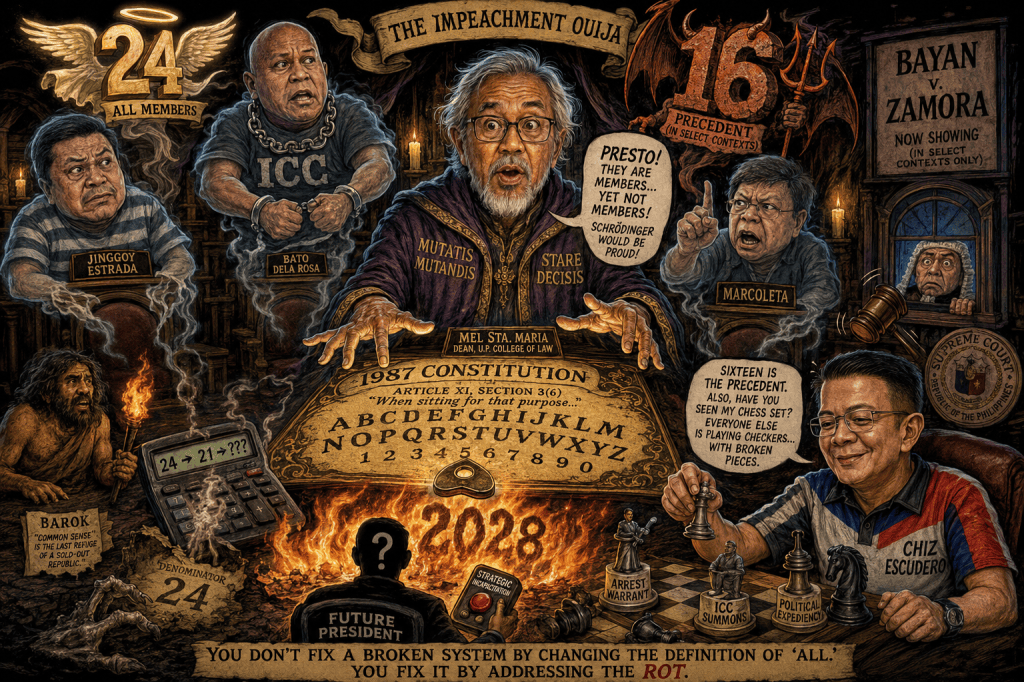
Inside Dean Mel Sta. Maria’s Dangerous Math: How Ghosts, Fugitives, and Detainees Could Rewrite the Impeachment Rules
By Louis ‘Barok‘ C. Biraogo — September 2, 2026
MY dear denizens of the Kweba, gather around the flickering light of constitutional scrutiny. We are not here to discuss the mundane. We are here to dissect a masterpiece of legal necromancy, a séance where the ghosts of absent senators are summoned not to testify, but to vanish from the mathematical denominator of justice.
The Republic is currently gripped by a legal thriller that makes the Da Vinci Code look like a nursery rhyme. At the heart of this theater of the absurd is a question so esoteric, so drenched in interpretive arcana, that it makes the Medieval debates on the number of angels dancing on a pinhead look like a simple arithmetic quiz.
The question: Does “two-thirds of all Members of the Senate” mean two-thirds of 24, or two-thirds of whoever bothers to show up?
Dean Mel Sta. Maria, a legal scholar of considerable repute, has pulled back the curtain to reveal a wizardry of constitutional interpretation. He posits that the denominator is not fixed. It is, to borrow from quantum physics, fundamentally uncertain until observed. We are told that the Senate, that hallowed hall of the nation’s finest, transforms into a “Senate sitting as an impeachment court,” and that this transformation—this mystical transubstantiation—only occurs when senators take an oath. Therefore, senators who are detained, on the lam from the International Criminal Court (ICC), or perhaps merely stuck in traffic on EDSA, cease to be counted. Presto! The threshold drops from 16 to 14.
It is a breathtakingly audacious argument. And in the grand tradition of Philippine legal and political theater, it is utterly devoid of concern for the logical consequences. Let us investigate, shall we?
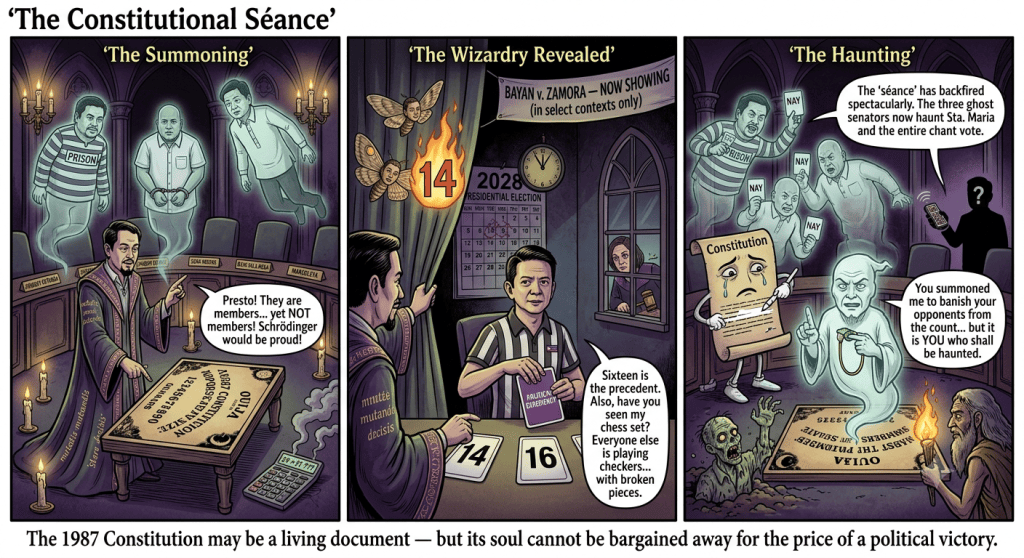
The Séance of the “Sitting” Senators
The Dean’s argument rests on a single, shimmering phrase in Article XI, Section 3(6) of the 1987 Constitution of the Republic of the Philippines (1987 Constitution): “When sitting for that purpose, the Senators shall be on oath or affirmation.” From this linguistic acorn, he grows a mighty, writhing vine of interpretation that chokes off the unqualified phrase “two-thirds of all the Members of the Senate.” The words “all the Members” are, in Sta. Maria’s universe, mere suggestions, like a traffic enforcer’s whistle in a storm.
One is reminded of the infamous line from Ghostbusters: “You are a poor scientist, Dr. Venkman, but a brilliant performer.” The Dean’s performance is indeed brilliant. He dresses up the simple, earthy language of the 1987 Constitution in the shimmering robes of a “transformative mechanism.” He speaks of “functional integrity” and “constitutional effectiveness” with the solemnity of a high priest.
But let us use a bit of common sense, which, as we all know, is a superpower in the legal profession.
The 1987 Constitution, in its infinite, oft-trampled wisdom, chose its words carefully. Elsewhere, when it means “members present,” it says so. The sacred document is not a sloppy love letter; it is the blueprint for a nation of laws. The argument that a senator who is physically absent or legally detained is no longer a “Member of the Senate” is not just a legal fiction; it is a denial of reality. The seat is not vacant. The nameplate is still there. The ghost of their political debt still haunts the chamber.
Senator Jinggoy Estrada is detained. Is he no longer a Member of the Senate? Is his vote on, say, a national budget suddenly irrelevant? Of course not. The 1987 Constitution does not create a class of Schrödinger’s Senators—simultaneously a member and not a member depending on whether they can raise their right hand and swear an oath.
The Dean’s theory, if adopted, would be a legislative time bomb. It would codify the dark art of strategic incapacitation. Imagine the precedent, my dear Kweba dwellers. A faction facing an unfavorable impeachment vote could simply arrange for the “legal incapacity” of a few of their opponents. An arrest warrant here, a tempting international junket there. The denominator shrinks. The threshold is achieved. Conviction! All under the guise of a “functional” interpretation.
The danger is not hypothetical. We are talking about a political landscape where senators hide from the ICC as if it were a game of taguan, where arrests on plunder charges are seen by partisans as political weapons. The “dynamic denominator” theory is not a solution; it is the ultimate cheat code for the bloodsport of Philippine politics.
Bayan v. Zamora: The Ghost of Precedents Past
Enter the ghost of jurisprudence. Bayan (Bagong Alyansang Makabayan) v. Executive Secretary Ronaldo Zamora (Bayan v. Zamora), a 2000 Supreme Court case, looms over this entire circus. The Court then said, with the clarity of a slap in the face, that the Senate is composed of 24 members, even if there are only 23 incumbent. Two-thirds is 16. Full stop.
Sta. Maria’s response? A lawyerly pirouette. He distinguishes the case. He says, “Ah, but Bayan v. Zamora was about treaties. This is about impeachment! There is a different mood, a different vibe!”
This is not legal reasoning; it is an aesthetic judgment. It is the legal equivalent of saying a traffic law against speeding shouldn’t apply to red cars because red is a more aggressive color. The principle in Bayan v. Zamora was not about treaties; it was about the constitutional definition of the Senate. The Court made it clear: the institution is fixed, the number is static. The Dean’s attempt to carve out an impeachment exception is an act of intellectual desperation masked as scholarship.
He has done a tremendous service, however. He has exposed a deep and uncomfortable truth about the current system: the 1987 Constitution, under a simplistic reading, can be defeated by the simple act of a defendant’s allies being judicially or extra-judicially unavailable. This is the core of his argument, and it is not without merit. The Marcos v. Duterte political war has resulted in the bizarre spectacle of a Vice President on trial while three senators with ties to her family are detained, suspended, or on the run. The system is being stress-tested to a breaking point.
The Political Calculus of the Living
Let us be brutally cynical for a moment. This entire interpretive dance is not about constitutional fidelity. It is about the cold, hard arithmetic of power.
Senate President Chiz Escudero, that master of political ambivalence, has ruled for 16 votes. It is the position supported by precedent, and conveniently, it makes conviction harder. This pleases the Duterte camp, who need nine votes to acquit. It preserves Escudero’s image as a neutral arbiter while potentially currying favor with a still-potent political bloc. He is playing chess while everyone else is playing checkers with broken pieces.
The House Prosecutors, hungry for a scalp, are drawn to Sta. Maria’s theory like moths to a flame. Fourteen votes is a much shorter climb than sixteen. They are not arguing for textual purity; they are arguing for a path to victory.
And what of the Supreme Court? They are the proverbial man in the middle, sitting on a bench made of dynamite. Do they intervene and risk being branded as political actors? Or do they hide behind the doctrine of the “political question” and let the Senate sort out its own mess? The cases cited in my research show a Court that is willing to step in when “grave abuse” occurs. But they know that ruling on this issue would be like trying to referee a knife fight. They will likely avoid it until it is absolutely unavoidable, hoping the political branches will find a settlement in the smoke-filled backrooms.
The truth is, this novel legal theory is not being debated in a vacuum. It is being debated in the shadow of the 2028 presidential election. This is not about impeaching Sara Duterte. It is about disqualifying her. A conviction is a political death sentence. Every vote, every ruling, every legal interpretation is a move in a grand, brutal campaign to reshape the nation’s future.
The Verdict of the Cave
So where does this leave us, the beleaguered citizens of this Republic?
Dean Mel Sta. Maria has not uncovered a hidden truth in the 1987 Constitution. He has constructed a very sophisticated, very plausible, and deeply flawed argument for a mobile denominator. It is constitutional law as performance art, designed to achieve a political outcome under the guise of academic rigor.
The “two-thirds of all Members” rule is not a bug; it is a feature. It requires a broad, sweeping consensus to remove a democratically elected official. It is supposed to be hard. The fact that it might be too hard, due to the suspicious unavailability of three senators, is not a reason to change the denominator. It is a reason to question the circumstances of that unavailability.
The actual solution is not legal gymnastics. It is the hard, grinding work of ensuring all senators can and do participate. If a senator is in hiding, bring him out of hiding. If a senator is detained, fight for his right to participate or ensure he is truly ineligible. You do not fix a broken system by changing the definition of the word “all.” You fix it by addressing the rot that is keeping people out of the chamber.
To adopt the Sta. Maria doctrine is to hand a permanent, devastating weapon to every future political faction. It would enshrine a principle that the supermajority required to remove a tyrant can be reduced by the simple expedient of jailing or frightening the tyrant’s supporters. It would turn the 1987 Constitution into a document that can be edited by the tactical filing of charges and the strategic issuance of ICC warrants.
The Dean’s interpretation is an invitation to a constitutional coup. It is a séance where the living, in their desperate hunger for a favorable result, seek to banish the ghosts of their opponents from the count. But in the end, it is they who would be haunted—haunted by the precedent of a Constitution that was twisted, not for justice, but for political expediency. The Senate must not fall for this spectral logic. The 1987 Constitution may be a living document, but its soul cannot be bargained away for the price of a political victory.
Key Citations
A. Legal & Official Sources
- The 1987 Constitution of the Republic of the Philippines. Official Gazette of the Republic of the Philippines, 1987, http://www.officialgazette.gov.ph/constitutions/1987-constitution/.
- The 1987 Constitution of the Republic of the Philippines – Article XI. Official Gazette of the Republic of the Philippines, http://www.officialgazette.gov.ph/constitutions/the-1987-constitution-of-the-republic-of-the-philippines/the-1987-constitution-of-the-republic-of-the-philippines-article-xi/.
- Bayan (Bagong Alyansang Makabayan) v. Executive Secretary Ronaldo Zamora. G.R. No. 138570, 10 Oct. 2000, Supreme Court of the Philippines, http://www.lawphil.net/judjuris/juri2000/oct2000/gr_138570_2000.html.
- Rome Statute of the International Criminal Court. United Nations, 17 July 1998, http://www.icc-cpi.int/.
B. News Reports
- De Leon, Dwight. “Escudero Settles Threshold: 16 Votes to Convict Sara Duterte.” Rappler, 6 July 2026, http://www.rappler.com/philippines/escudero-settles-conviction-threshold-debate-16-needed-remove-sara-duterte/.
- De Leon, Dwight. “What’s the Legal Basis for Escudero’s 16-Vote Threshold in Impeachment Trial?” Rappler, 10 July 2026, http://www.rappler.com/philippines/legal-basis-chiz-escudero-16-vote-threshold-impeachment-trial/.
- “Sara Duterte Impeachment Trial: Everything You Need to Know.” Inquirer.net, 17 July 2026, newsinfo.inquirer.net/2257487/sara-duterte-impeachment-trial-everything-you-need-to-know.
- “[Newsstand] The Strongest Argument for Determining Two-Thirds Impeachment Vote.” Rappler, 31 Aug. 2026, http://www.rappler.com/voices/thought-leaders/newsstand-strongest-argument-determining-two-thirds-vote-impeachment-trial-sara-duterte/.
- Peralta-Malonzo, Third Anne. “Escudero Reiterates: 16 Votes Needed to Impeach Sara Duterte.” SunStar Manila, 8 July 2026, http://www.sunstar.com.ph/manila/escudero-reiterates-16-votes-needed-to-impeach-sara-duterte.
- ₱9 Billion in ‘Savings’? DILG’s Fire Truck Deal Smells Like Smoke

- ₱8B BBM Pork: CCTV for Every Captain’s Kumpare?

- ₱8.9 Billion, 331 Ghost Police Stations: The TIKAS Scandal Explained

- ₱8.4 Billion, 42,000 Barangays, 1 Election: The “Bawat Barangay Makikinabang” Vote-Buying Masterclass

- ₱75 Million Heist: Cops Gone Full Bandit

- ₱6.77B Ghost Haunts Duterte: RTC Dismisses Mans Carpio’s Desperate Plea
- ₱6.77 Billion and Zero Cash: The Sara Duterte SALN Math That Doesn’t Add Up

- ₱6.7-Trillion Temptation: The Great Pork Zombie Revival and the “Collegial” Vote-Buying Circus

- ₱58.53B, Zero Receipts: The LGSF Pork Barrel Nobody Wants to Name

- ₱53 Million Man Tells ₱695-a-Day Workers to Stop Being ‘Mayabang’: The Audacity of BSP’s Remolona

- ₱4.4 Billion and a Witness Who Can’t Explain It: The Duterte Impeachment’s Most Expensive Non-Answer
- ₱3.06 Billion for Evacuation Centers—But Nobody Knows Where They’ll Stand (Or If They’ll Exist)







Leave a Reply