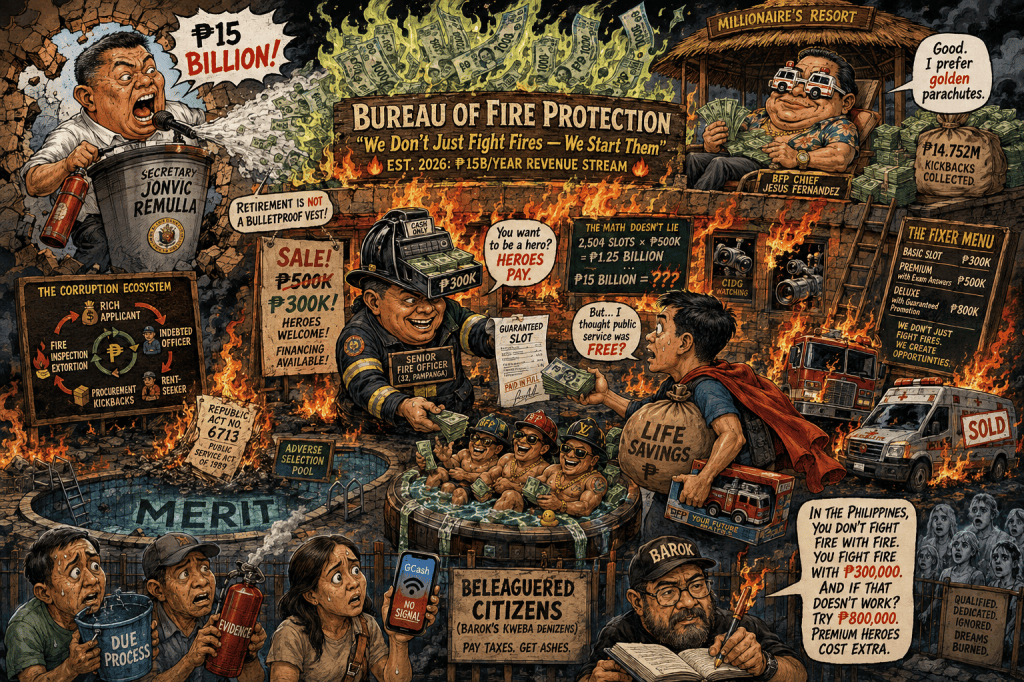
The Art of the Deal: How ₱300K Can Turn a Hopeful Applicant into a “Hero” (and a Criminal)
By Louis ‘Barok‘ C. Biraogo — September 2, 2026
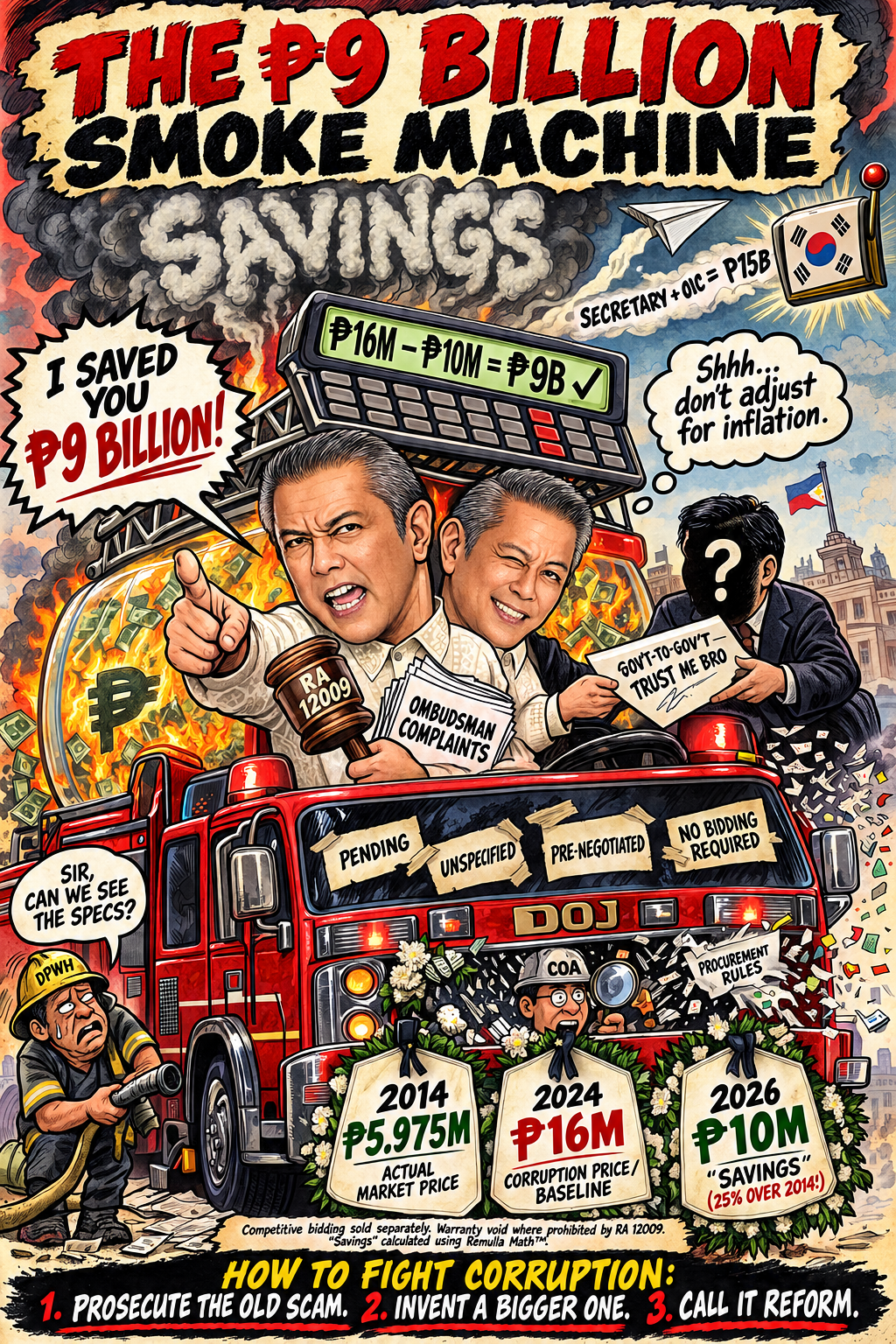
MABUHAY! Welcome to the Philippines, where the only thing more flammable than a squatter’s shanty in summer is the stench of institutionalized corruption. Gather ‘round the bin fire, dear readers, because the Bureau of Fire Protection isn’t just in the business of extinguishing flames anymore. According to the Secretary of the Interior, they’ve been igniting a ₱15-billion-a-year conflagration of graft, and the smoke is finally choking out the rats.
Forget “a few bad apples.” This is a cartel. This is a legacy system. This is the BFP operating less like a hallowed public safety institution and more like an exclusive country club where the membership fee is your life savings and the dress code is a fire-resistant coat of lies.
Let us sift through the ashes of this reputational firestorm, shall we? We are told that a 32-year-old “Senior Fire Officer” in Pampanga was collared in a classic Criminal Investigation and Detection Group (CIDG) entrapment operation. The price tag for a guaranteed job? A measly ₱300,000, apparently “discounted” from a ₱500,000 asking price. How generous. A bargain basement price for a taxpayer-funded badge. If you think ₱300,000 is steep, you haven’t seen the premium rates. If you believe the chatter from the Department of the Interior and Local Government (DILG), in the past, the “slots” went for up to ₱800,000.
Yes, you read that right. ₱800,000. For the privilege of serving the public. The irony is so thick you could cut it with a fire axe.
The Economics of “Adverse Selection”
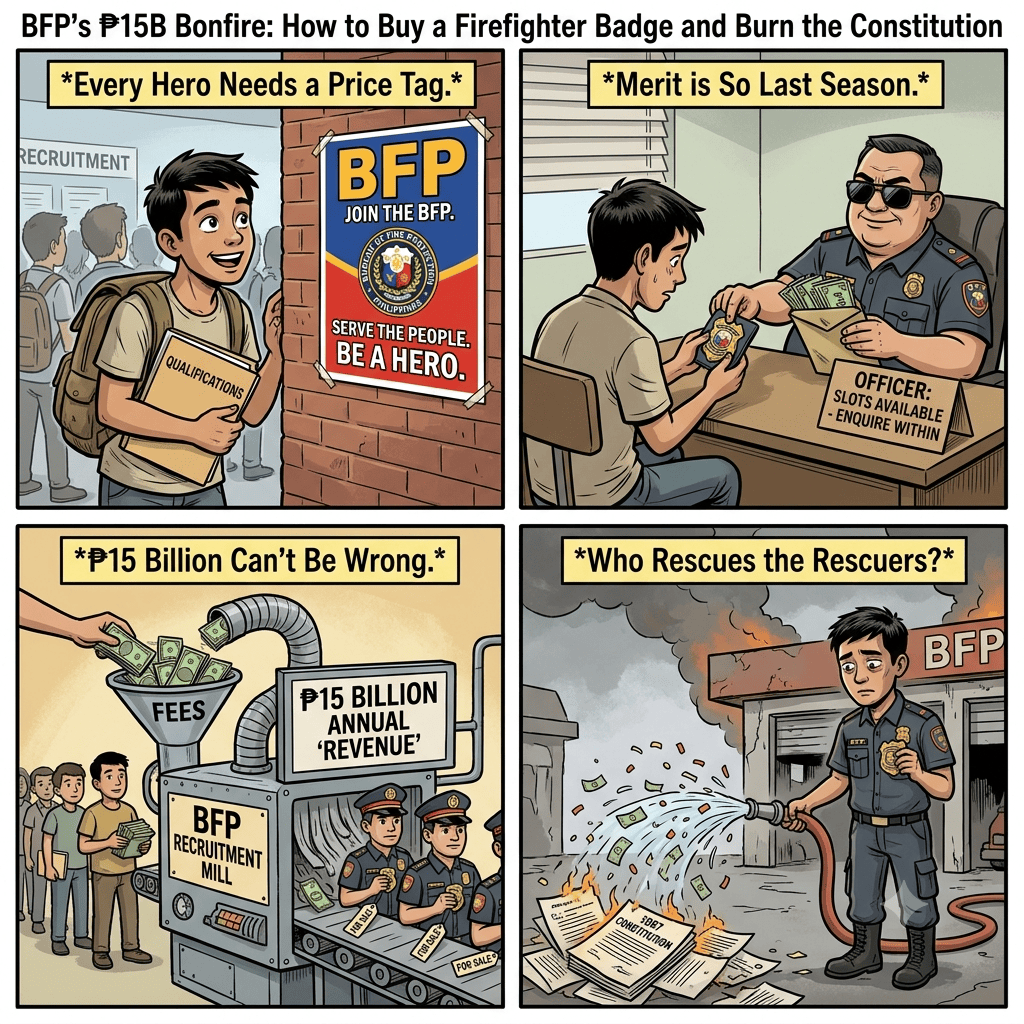
This is not petty bribery; it is systemic rent-seeking of the highest order. We have a principal-agent problem that would make Milton Friedman weep into his free-market cereal. The Principal—the Filipino taxpayer—delegates authority to the Agent—the BFP hierarchy—to hire the most competent individuals to run into burning buildings. But somewhere along the line, the Agent realized that the scarcity of jobs (2,504 slots vs. 23,000 dreamers) wasn’t a public service challenge; it was a business model.
The mechanism is as beautiful as it is insidious. You don’t need to sell the best job; you just need to sell the scarcity. If the exam is passable, the corruption allegedly happens at the “human intervention” stage. This is where the Law of Adverse Selection kicks in. When the currency of selection shifts from “merit” to “money,” you don’t get the bravest; you get the richest—or the most indebted. You get fire officers who enter the service with a ₱500,000 financial hole to climb out of. And how does a poorly paid bureaucrat recoup a half-million-peso investment? By becoming a rent-seeker themselves. They are not just hiring firefighters; they are cloning grifters. The corruption is viral, self-replicating, and it compromises the very physics of firefighting: when the bell rings, you want the guy who passed the physical because he was strong, not the guy who passed because his daddy had a fat wallet.
The Jurisprudence of Greed
Let’s not mince words. If these allegations hold water, the BFP isn’t just violating Republic Act No. 6713 (the Code of Conduct and Ethical Standards for Public Officials and Employees); they are dancing on its grave. Section 7(d) is explicit: public officials shall not accept anything of monetary value. But don’t take my word for it; look at the Supreme Court. In Mangulabnan v. People, the Court laid out the anatomy of direct bribery under Article 210 of Act No. 3815 (the Revised Penal Code). It’s a simple equation: Public Officer + Money + Official Act = Jail. If this Senior Fire Officer accepted ₱300,000 to “facilitate” an appointment, that isn’t a “transaction fee.” That’s a crime.
And what of the behemoth, Republic Act No. 3019 (Anti-Graft and Corrupt Practices Act)? Section 3(e)—the catch-all for corruption—is a beautiful piece of legislation. It punishes any public official who gives unwarranted benefits to private parties through “manifest partiality, evident bad faith, or gross inexcusable negligence.” Selling a job to an unqualified or less-qualified candidate isn’t just evident bad faith; it is a deliberate, malicious arson of the civil service system. It is “Negligence” with a capital “N” and a felony with a capital “F.”
The government has a crucial tool here: Republic Act No. 11032 (Ease of Doing Business and Efficient Government Service Delivery Act), which explicitly defines and criminalizes “Fixers.” The BFP isn’t a bureau anymore; if Remulla is to be believed, it’s a syndicate of overpriced fixers with hoses.
The Fifteen Billion Dollar Question
Ah, the number. ₱15 billion. It rolls off the tongue, doesn’t it? It sounds monstrous. It sounds like a legitimate estimate. Except, as I crunched the numbers in the Batcave, something didn’t add up. If the alleged recruitment haul for the 2,504 vacancies is, at max, ₱1.25 billion (2,504 x ₱500k), how in the name of the Holy Trinity does the DILG arrive at ₱15 billion per annum? Either the Secretary has a calculator that runs on political ambition, or the corruption extends far beyond selling slots to 23-year-olds with hero complexes.
The math suggests Secretary Jonvic Remulla is trying to tell us something without telling us. If recruitment is only 8% of the alleged corruption economy, where is the other 92%? Procurement. Fire safety inspections. Extortion for “forced fire extinguisher sales.” The ₱15 billion figure is a political bomb thrown into the public square to wake us up to the reality that the BFP isn’t a service organization; it’s an extortion racket with a shiny red truck.
And what of the “Bureau Chief,” Jesus Fernandez? Already accused of taking ₱14.752 million in ambulance kickbacks and living in a “millionaire’s resort,” this man is supposedly at the helm of an organization where regional directors are allegedly fleecing kids who just want to save lives. The optics are dreadful. The leadership is either complicit, catastrophically blind, or busy counting their own share of the spoils. Remulla says retirement is “not a bulletproof vest.” Good. Because it shouldn’t be a golden parachute for arsonists of public trust.
The Entrapment Theater and The Presumption of Innocence
Let us inject a dose of due process into this inferno, if only to prove we are not simply a lynch mob with a blog. The arrest in Pampanga smells of textbook entrapment, which is perfectly legal. You cannot dangle a bribe in front of a saint and call him a sinner; but if a sinner is already hawking sins, you can set up a camera. If the officer demanded the money before the CIDG got involved, she’s toast. She can’t claim “instigation” just because the cops were there to watch her greed manifest.
However—and this is a massive “however”—the phrase “over 200 personnel under investigation” must be treated with paranoid skepticism. “Under investigation” is not synonymous with “guilty.” It is synonymous with “the DILG has a list.” In a country where political purges are often disguised as anti-corruption campaigns, we must demand evidence. We must demand charge sheets. We must demand the digital forensics—the GCash trails, the WhatsApp messages, the bank deposits. If Remulla wants to “clean up” the BFP, fine. But let us not confuse a publicity tour of “shock and awe” with the slow, boring machinery of justice.
We stand at a crossroads. We can either buy the narrative that this is a massive, evil syndicate—which is likely true—or we can demand that the narrative be proven in a Sandiganbayan courtroom rather than a press conference.
My verdict? The fire is real. The smoke is thick. But until we see the financial statements and the affidavits, we are watching a pyre of reputation being built. Let us hope the innocent don’t burn along with the guilty. And to the corrupt? Grab a bucket. The public is finally bringing the water.
Key Citations
A. Legal & Official Sources
- Act No. 3815. An Act Revising the Penal Code and Other Penal Laws (The Revised Penal Code). 8 Dec. 1930, http://www.officialgazette.gov.ph/1930/12/08/act-no-3815-s-1930/.
- Mangulabnan v. People. G.R. No. 236848, Supreme Court of the Philippines, 8 June 2020, lawphil.net/judjuris/juri2020/jun2020/gr_236848_2020.html.
- Republic Act No. 3019. Anti-Graft and Corrupt Practices Act. 17 Aug. 1960, http://www.officialgazette.gov.ph/1960/08/17/republic-act-no-3019/.
- Republic Act No. 6713. An Act Establishing a Code of Conduct and Ethical Standards for Public Officials and Employees, to Uphold the Time-Honored Principle of Public Office being a Public Trust, Granting Incentives and Rewards for Exemplary Service, Enumerating Prohibited Acts and Transactions and Providing Penalties for Violations Thereof and for Other Purposes. 20 Feb. 1989, http://www.officialgazette.gov.ph/1989/02/20/republic-act-no-06713/.
- Republic Act No. 11032. An Act Promoting Ease of Doing Business and Efficient Delivery of Government Services, Amending for the Purpose Republic Act No. 9485, Otherwise Known as the Anti-Red Tape Act of 2007, and for Other Purposes. 28 May 2018, http://www.officialgazette.gov.ph/2018/05/28/republic-act-no-11032/.
B. News Reports
- Abanilla, Izel. “Remulla: BFP ‘Slot for Sale’ Allegedly Costs up to P800K.” The Manila Times, 28 Aug. 2026, http://www.manilatimes.net/2026/08/28/news/remulla-bfp-slot-for-sale-allegedly-costs-up-to-p800k/2414149.
- Cabuenas, Jon Viktor D. “DILG: Over 200 BFP Personnel under Probe over ‘Slot-for-Sale’ Recruitment Scheme.” GMA News Online, GMA Network, 28 Aug. 2026, http://www.gmanetwork.com/news/topstories/nation/1000189/dilg-over-200-bfp-personnel-under-probe-over-slot-for-sale-recruitment-scheme/story/.
- Cruz, James Patrick. “How BFP Chief Allegedly Got P14.75-M Kickback from Ambulance Deal.” Rappler, 6 Mar. 2026, http://www.rappler.com/philippines/bureau-fire-protection-chief-alleged-kickback-ambulance-deal/.
- “DILG Cracks Down on Recruitment Racket in Fire Protection Bureau.” The Manila Times, 29 Aug. 2026, http://www.manilatimes.net/2026/08/29/news/national/dilg-cracks-down-on-recruitment-racket-in-fire-protection-bureau/2414289.
- Rita, Joviland. “BFP Personnel Arrested in Pampanga over Alleged ‘Slots for Sale’ Recruitment Scheme.” GMA News Online, GMA Network, 26 Aug. 2026, http://www.gmanetwork.com/news/topstories/regions/999914/bfp-personnel-arrested-in-pampanga-over-alleged-slots-for-sale-recruitment-scheme/story/.

- ₱9 Billion in ‘Savings’? DILG’s Fire Truck Deal Smells Like Smoke

- ₱8B BBM Pork: CCTV for Every Captain’s Kumpare?
- ₱8.9 Billion, 331 Ghost Police Stations: The TIKAS Scandal Explained

- ₱8.4 Billion, 42,000 Barangays, 1 Election: The “Bawat Barangay Makikinabang” Vote-Buying Masterclass

- ₱75 Million Heist: Cops Gone Full Bandit

- ₱6.77B Ghost Haunts Duterte: RTC Dismisses Mans Carpio’s Desperate Plea

- ₱6.77 Billion and Zero Cash: The Sara Duterte SALN Math That Doesn’t Add Up

- ₱6.7-Trillion Temptation: The Great Pork Zombie Revival and the “Collegial” Vote-Buying Circus

- ₱58.53B, Zero Receipts: The LGSF Pork Barrel Nobody Wants to Name
- ₱53 Million Man Tells ₱695-a-Day Workers to Stop Being ‘Mayabang’: The Audacity of BSP’s Remolona

- ₱4.4 Billion and a Witness Who Can’t Explain It: The Duterte Impeachment’s Most Expensive Non-Answer
- ₱3.06 Billion for Evacuation Centers—But Nobody Knows Where They’ll Stand (Or If They’ll Exist)



Leave a Reply