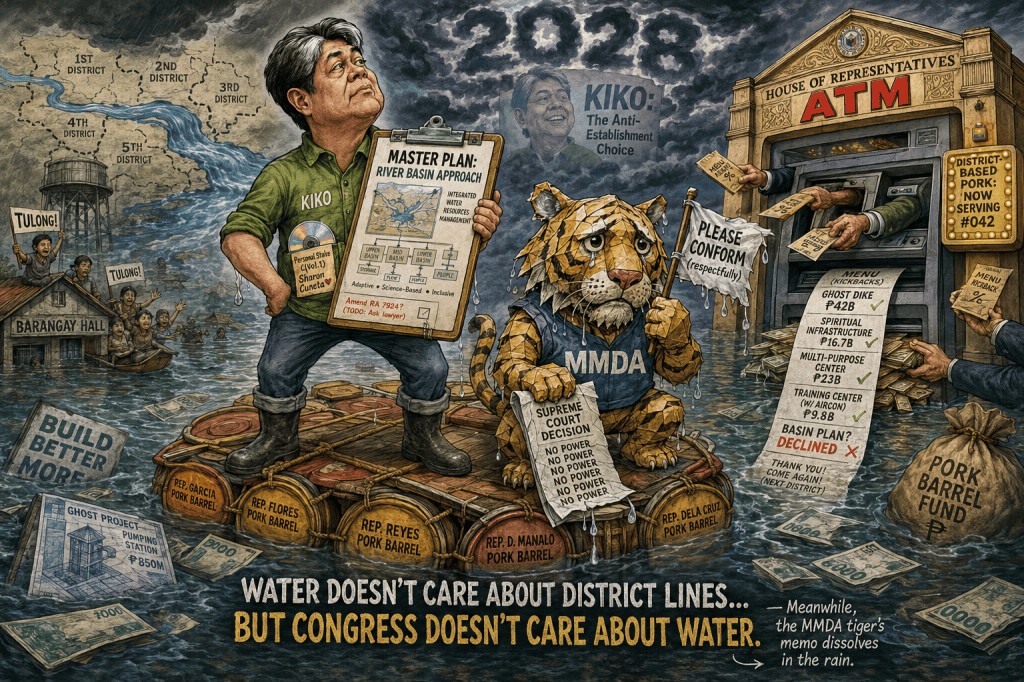
The MMDA Illusion: Putting a Paper Tiger in Charge of a Real Flood
By Louis ‘Barok‘ C. Biraogo — September 2, 2026
Well, well, well—September in Manila. The ‘ber’ months are here. The air is thick with the scent of impending Christmas carols and, inevitably, the stench of overflowing esteros and submerged subdivisions. It is against this backdrop of perennial aquatic misery that our dear Senator Francis “Kiko” Pangilinan has emerged, clipboard in hand, not to wade through the floodwaters to save a damsel in distress, but to save the entire bureaucratic apparatus from drowning in its own incompetence and, allegedly, its sticky fingers.
Here at the Kweba, we have dusted off the flood maps, cross-referenced Act No. 3815 (Revised Penal Code) with Presidential Decree No. 1067 (Water Code), and listened to the whispers in the Senate hallways. The result? An investigation into whether Pangilinan is proposing a genuine Noah’s Ark of reform or merely rearranging the deck chairs on the Titanic.
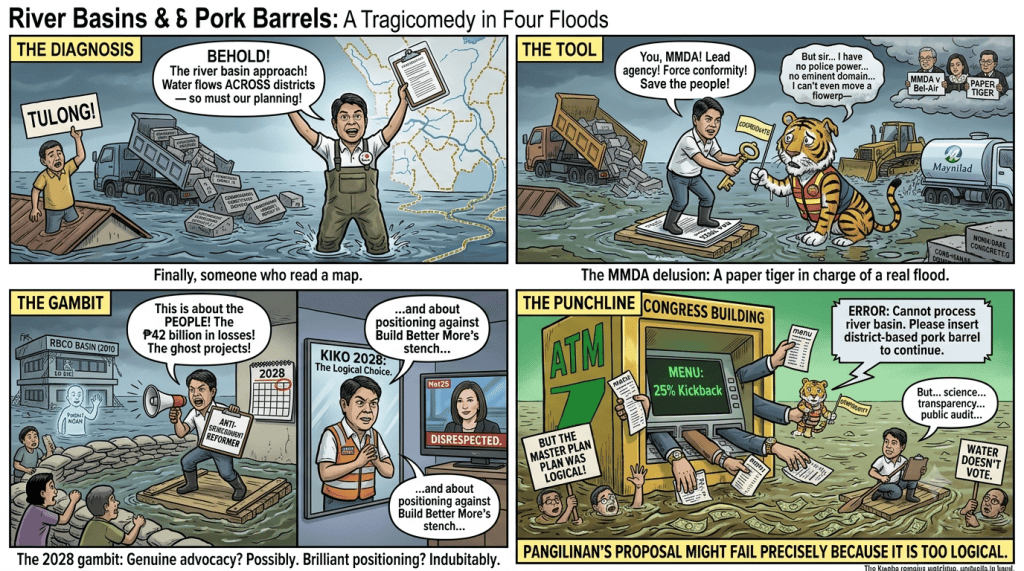
The Diagnosis: Finally, Someone Who Read a Map
Let us give credit where credit is due. Pangilinan’s proposal to plan flood control based on river basins rather than congressional districts is so intellectually superior to the status quo that it feels like it was beamed in from a country with functioning governance. For decades, the Department of Public Works and Highways (DPWH) has treated the nation’s hydrology like a politician’s checkbook: fragmented, easily pocketed, and geographically bound to the next election cycle.
Pangilinan correctly argues that water does not care if you are a voter in Pampanga or a congressman in Bulacan. It flows. It rises. It kills. Therefore, planning by hydrological boundaries is not just a “good idea”; it is a logical tautology. To argue against it is to argue that the earth is flat or that a ghost project is simply a “spiritual” infrastructure investment.
The Senator’s call for a scientific basis—using hazard maps, climate projections, and the ghost of Project NOAH (Nationwide Operational Assessment of Hazards)—is a direct, surgical strike at the heart of the political pork barrel. When you replace political whim with a Master Plan, you do not just improve drainage; you drain the swamp of discretionary funds. The proposal to make every contractor, budget, and specification public isn’t transparency; it is a declaration of war against the “menu system” of kickbacks that we have been reading about in the East Asia Forum. It is, dare I say, reasonable.
The Flaw: The MMDA Delusion
However, the Kweba is not a fanboy club. We are skeptics. And Pangilinan’s proposal contains a fatal flaw that betrays either a lack of legal research or a deliberate appeal to populist simplicity: handing the keys to the Metropolitan Manila Development Authority (MMDA).
Let us consult the dusty tomes of jurisprudence, shall we?
The Supreme Court, in cases like MMDA v. Bel-Air Village Association and MMDA v. Diamond Motor Corp., has been exhaustively clear: The MMDA is a paper tiger. It is a “development authority” with no police power, no legislative power, and, critically, no power of eminent domain. It cannot compel a barangay captain to move a flowerpot, let alone force a water concessionaire or the DPWH to fall in line with a master plan.
Pangilinan’s proposal to make the MMDA the “lead agency” with the power to force “conformity” is legally dead on arrival. It is a zombie statute. Unless Pangilinan is secretly drafting a bill to amend Republic Act No. 7924 (MMDA Law) to give the MMDA the powers of a pre-martial law strongman, this aspect of the proposal is pure theater. It sounds good on a soundbite— “Let the MMDA handle it!”—but it ignores the reality that the MMDA can barely handle the morning coding scheme. It is an agency tasked with solving traffic, garbage, and floods, but only given the authority to wave flags and issue memos.
The Suspicious Motivation: The 2028 Gambit
Here at the Kweba, we don’t do feel-good headlines—we do forensics. So the question screams: Why now, Kiko? Why this flood, and not the last ten?
The scene before us is unmistakable: a man crawling out of the electoral desert, thirsty for relevance. After losing the 2022 Vice Presidential race, Pangilinan hosted talk shows and likely contemplated the view from his farm. He returns to the Senate in 2026 just as the flood control corruption scandal detonates—a scandal involving ₱42 billion in annual losses, “ghost projects,” and a “menu” of kickbacks that would make a mob boss blush.
His wife, Sharon Cuneta, was dragged into the Net25 mess, which gives him a personal stake. But deeper than that, this proposal positions him as the “anti-establishment” reformer against the Marcos administration’s “Build Better More” program, which is now tainted with the stench of these allegations. Is this genuine advocacy? Possibly. Is it brilliant political positioning for a rumored 2028 run? Indubitably.
Is it suspicious? You bet. It is the classic move of the opposition senator: find the admin’s biggest weakness, and hammer it with a proposal so structurally sound that the administration can neither ignore it nor easily implement it without ceding political credit.
The Irony: Reinventing the Wheel (Badly)
Here is the punchline that the mainstream media missed. The Philippines already has a River Basin Control Office (RBCO) under the Department of Environment and Natural Resources (DENR), established way back in 2010 by Executive Order No. 816, s. 2009 (Executive Order 816). We have Presidential Decree No. 1067 (Water Code). We have a Climate Change Act. We have a 2012 Master Plan that cost ₱352 billion and promised exactly what Pangilinan is promising.
So, what is Pangilinan actually proposing? A new law? A new agency? Or is he just screaming into the void? The truth is, the machinery already exists. The problem isn’t the absence of a plan; it is the capture of that plan by the DPWH-Contractor-Congressman nexus.
By proposing to centralize everything under “one chain of accountability,” Pangilinan risks committing the classic authoritarian fallacy. If you give one entity absolute control over planning, procurement, and implementation, you do not eliminate corruption; you just assign it a single point of contact. You are not creating a solution; you are creating a monopoly. And as any economist will tell you, monopolies are inefficient and ripe for exploitation.
The Fair Verdict
It is a mixed bag, folks.
Pangilinan is 100% right on the substance: Science-based, basin-wide, publicly audited flood control is the only way to stop the annual drowning of Luzon. The concept of auditing projects not just for “Did we build it?” but “Did it actually stop the flood?” is revolutionary for this bureaucracy.
But he is wrong—or perhaps just lazy—on the structure. The MMDA is a tool without teeth. Shifting responsibility to an agency that cannot legally exercise power is a recipe for blaming the next guy when the floods inevitably come.
And his politics are transparent. He is using the legitimate anger of the flood victims to sharpen his knives for a higher office. Is that wrong? No. That’s politics. But let’s not pretend this is purely altruism.
The final irony? Pangilinan’s proposal might fail precisely because it is too logical. The Congress has no interest in basin-based planning because you cannot extract a 25% kickback from a river basin.
The Kweba remains watching, umbrella in hand.
Key Citations
A. Legal & Official Sources
- Act No. 3815. An Act Revising the Penal Code and Other Penal Laws. 1930, http://www.officialgazette.gov.ph/1930/12/08/act-no-3815-s-1930/.
- Presidential Decree No. 1067. A Decree Instituting a Water Code, Thereby Revising and Consolidating the Laws Governing the Ownership, Appropriation, Utilization, Exploitation, Development, Conservation and Protection of Water Resources. 1976, lawphil.net/statutes/presdecs/pd1976/pd_1067_1976.html.
- Republic Act No. 7924. An Act Creating the Metropolitan Manila Development Authority, Defining Its Powers and Functions, Providing Funds Therefor and for Other Purposes. 1995, lawphil.net/statutes/repacts/ra1995/ra_7924_1995.html.
- Republic Act No. 9729. An Act Mainstreaming Climate Change into Government Policy Formulations, Establishing the Framework Strategy and Program on Climate Change, Creating for This Purpose the Climate Change Commission, and for Other Purposes. 2009, http://www.officialgazette.gov.ph/2009/10/23/republic-act-no-9729/.
- Executive Order No. 816, s. 2009. Declaring the River Basin Control Office under the Department of Environment and Natural Resources as the Lead Government Agency for the Integrated Planning, Management, Rehabilitation and Development of the Country’s River Basins. 6 July 2009, http://www.officialgazette.gov.ph/2009/07/06/executive-order-no-816-s-2009/.
- Presidential Decree No. 1067: A Decree Instituting a Water Code, Thereby Revising and Consolidating the Laws Governing the Ownership, Appropriation, Utilization, Exploitation, Development, Conservation and Protection of Water Resources. 31 Dec. 1976. The Lawphil Project, Arellano Law Foundation, http://www.lawphil.net/statutes/presdecs/pd1976/pd_1067_1976.html. Accessed 2 Sept. 2026.
- Metropolitan Manila Development Authority v. Bel-Air Village Association, Inc. G.R. No. 135962, Supreme Court of the Philippines, 27 Mar. 2000, lawphil.net/judjuris/juri2000/mar2000/gr_135962_2000.html.
- Metropolitan Manila Development Authority v. Diamond Motor Corporation. G.R. No. 203386, Supreme Court of the Philippines, 11 Oct. 2023, lawphil.net/judjuris/juri2023/oct2023/gr_203386_2023.html.
- “About Project NOAH.” Official Gazette of the Republic of the Philippines, http://www.officialgazette.gov.ph/programs/about-project-noah/.
B. News Reports
- Abasola, Leonel. “Pangilinan Seeks Single Agency, River-Basin Approach to Flood Control.” Philippine News Agency, 1 Sept. 2026, http://www.pna.gov.ph/articles/1283084. Accessed 2 Sept. 2026.
- “Accountability Washed Away in Philippine Flood Control Corruption.” East Asia Forum, 2 Dec. 2025, eastasiaforum.org/2025/12/02/accountability-washed-away-in-philippine-flood-control-corruption/.
- “2025 Recap: The Numbers That Staggered a Nation.” Inquirer.net, 29 Dec. 2025, newsinfo.inquirer.net/2160066/2025-recap-the-numbers-that-staggered-a-nation.
- “Flood Control Projects Scandal in the Philippines.” Wikipedia, en.wikipedia.org/wiki/Flood_control_projects_scandal_in_the_Philippines.
- “Build Better More.” Wikipedia, Wikimedia Foundation, 11 June 2026, en.wikipedia.org/wiki/Build_Better_More. Accessed 2 Sept. 2026.
- Servallos, Neil Jayson. “Kiko Blasts TV Network for ‘Disrespecting’ Sharon.” Philstar.com, The Philippine Star, 3 Sept. 2025, http://www.philstar.com/nation/2025/09/03/2470025/kiko-blasts-tv-network-disrespecting-sharon

- “Ang Hirap Maging Mahirap”: The PAO Scandal That Proves Government Contempt Is Nothing New

- “Far-Off” My Axx: Malacañang’s Claire Castro Drowns in Her Own Legal Gaslighting
- “Forthwith” to Farce: How the Senate is Killing Impeachment—And Why Enrile’s Right (Even If You Can’t Trust Him)

- “HINDI AKO NAG-RESIGN!”

- “I Know Nothing”: Baste Duterte’s Amnesia Defense Meets ₱33M in GenCorp Contracts

- “I’m calling you from my new Globe SIM. Send load!”

- “Mahiya Naman Kayo!” Marcos’ Anti-Corruption Vow Faces a Flood of Doubt

- “Manageable” Debt, Unmanageable Lies: DBM’s ₱21 Trillion Fairy Tale

- “Meow, I’m calling you from my new Globe SIM!”

- “Natrabaho”: One Word, One Ombudsman, and a Judiciary on Trial

- “No Special Jail for Crooks!” Boying Remulla Slams VIP Perks for Flood Scammers

- “Philippine-Controlled” or Yankee Gas Station? The Davao Fuel Depot Farce Exposed






Leave a Reply