
The Séance, The Subpoena, and The Sibling Defense Squad
By Louis “Barok” C. Biraogo — July 23, 2026
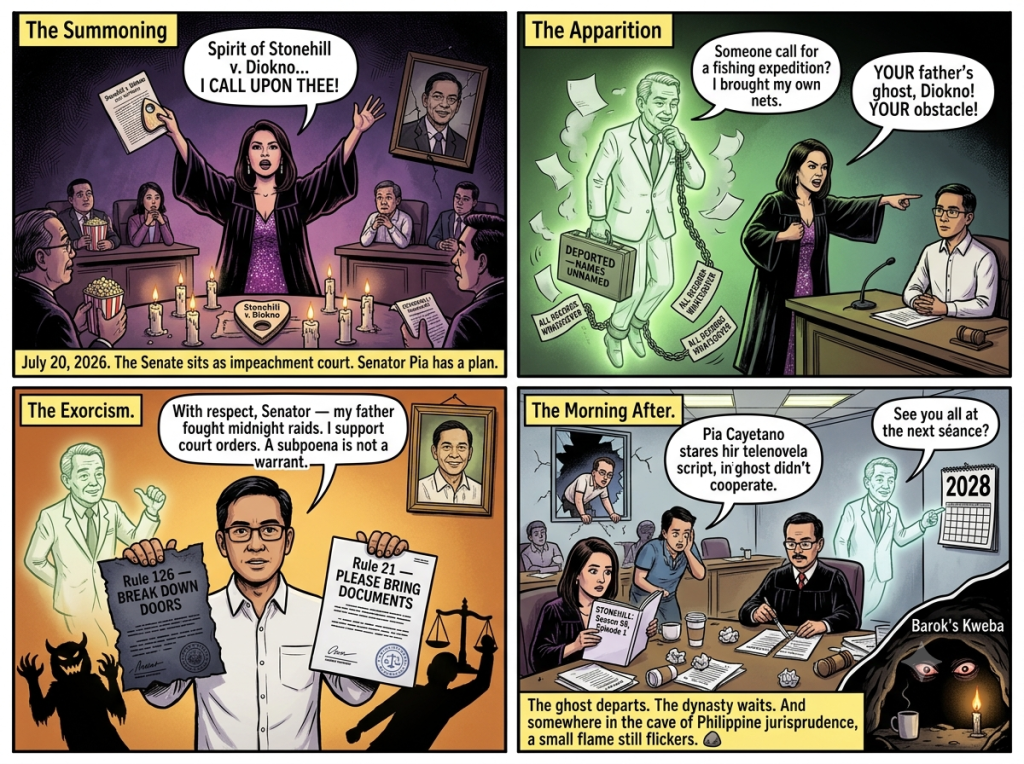
MGA ka-kweba, gather around the cave. Barok has been up all night—fueled by bad coffee, worse news, and the magnificent absurdity that is Philippine impeachment jurisprudence. What we witnessed on July 20, 2026, was not merely a legal argument. It was a séance. The ghost of Harry Stonehill—that long-dead American businessman whose deportation scandalized a nation—was summoned to the Senate chamber, rattling its chains at the descendants of both its persecutors and its defenders.
And the irony? Chef’s kiss. The son of the man who was respondent in that landmark case now stands as prosecutor, while a senator whose family has danced the political tango with the respondent’s dynasty invokes the very precedent that humiliated his father. Philippine politics, my friends, is not a spectator sport. It is theater of the absurd, directed by telenovela writers, with the Constitution as a prop that everyone waves but few have read.
Let us dismantle this farce—and its deadly serious undertones—brick by constitutional brick.
I. The Séance Begins: What Cayetano Actually Argued
Senator Pia Cayetano, armed with Stonehill v. Diokno, stood before the impeachment court and argued—with the gravitas of a constitutional law professor—that subpoenaing Sara Duterte’s financial records was functionally equivalent to an unconstitutional search. Her syllogism, stripped of legalese, ran thus:
- Premise One: Stonehill prohibits general warrants—state fishing expeditions through private papers.
- Premise Two: A subpoena for eighteen years of bank records, spanning multiple institutions, corporate entities, and a spouse’s accounts, is a fishing expedition dressed in procedural drag.
- Conclusion: Therefore, the subpoenas violate the Constitution, and their fruits must be excluded as poisonous.
It sounds reasonable, doesn’t it? The Constitution does protect against unreasonable searches. Stonehill did establish the exclusionary rule. And the subpoenas are breathtaking in scope—2007 to 2025, covering accounts joint and separate, nineteen corporations, Bureau of Internal Revenue (BIR) records, and Anti-Money Laundering Council (AMLC) suspicious transaction reports.
But here’s where Cayetano’s argument collapses like a sampaguita vendor in a typhoon: a subpoena is not a warrant.
Let Barok explain this slowly, for the benefit of any senator-judges who may have skipped Remedial Law class.
A search warrant under Rule 126 of the Rules of Criminal Procedure authorizes the state to break down your door, ransack your drawers, and seize your property. It requires probable cause determined personally by a judge, a particular description of the place to be searched, and a particular description of the things to be seized. Stonehill enforced these requirements because the warrants in that case authorized the seizure of “books of account, receipts, vouchers, correspondence, and all other records” without specifying which books, which receipts, or which correspondence. Those were general warrants—the very evil the Bill of Rights was written to prevent.
A subpoena duces tecum under Rule 21 of the Rules of Civil Procedure, adopted by the Impeachment Rules, is an entirely different creature. It says: “Dear Bank/BIR/AMLC, please bring these specific documents to court on this specific date. If you think this request is unreasonable, you may move to quash. We are not breaking down your door. We are asking politely—with the force of law.”
The constitutional standard for a subpoena is not probable cause. It is relevance and materiality to a matter properly before the tribunal. And the tribunal here is not some fishing enthusiast with a rod and reel—it is the Senate of the Republic, sitting as an impeachment court under Article XI, Section 3 of the 1987 Constitution, with the express constitutional mandate to try and decide all impeachment cases.
Stonehill has never—never—been applied by the Supreme Court to invalidate a subpoena. Not in 1967. Not in the fifty-nine years since. Not in the Corona impeachment of 2012, where the defense also invoked Stonehill and lost. Cayetano knows this. Or she should.
So why invoke it?
II. The Functional-Equivalence Gambit: When Labels Become Distractions
Cayetano’s deeper argument—steelmanned for fairness—is that we should look past labels to substance. A subpoena that demands eighteen years of financial data is, functionally, a search. And if the Constitution prohibits unreasonable searches, shouldn’t it prohibit unreasonable subpoenas?
This argument has surface appeal. Philippine constitutional jurisprudence has occasionally recognized that the Bill of Rights protects substance over form. In Social Justice Society v. Dangerous Drugs Board (2008), the Supreme Court struck down mandatory drug testing of candidates for public office, reasoning that the constitutional right to privacy cannot be circumvented by relabeling a search as a “regulatory requirement.”
But Cayetano’s functional-equivalence argument fails for three reasons.
First, it conflates two distinct constitutional values. Stonehill protects the right against unreasonable searches and seizures under Article III, Section 2. The subpoena dispute implicates the right to information privacy—a penumbral right recognized under Article III, Section 3 (privacy of communication) and the Civil Code’s provisions on human relations. These are different rights with different standards. The fact that both involve “privacy” does not make them identical any more than the fact that both involve “property” makes a search warrant and an assessment notice interchangeable.
Second, the Senate’s subpoena did satisfy the functional test of particularity. Escudero’s ruling granted subpoenas for specifically identified bank accounts, specifically named corporations, and specifically described types of records (transaction histories, not “all documents whatsoever”). Two corporations were excluded precisely because the prosecution could not establish a prima facie link to Duterte. Foreign currency deposits were excluded under the stricter protections of Republic Act No. 6426 (Foreign Currency Deposits Act). This was not a general warrant by any stretch—it was a surgical subpoena, limited in scope, with built-in safeguards for in-camera review.
Third, Cayetano’s argument proves too much. If a broad subpoena is functionally a search, then every comprehensive discovery order in civil litigation would be unconstitutional. Every congressional investigation demanding voluminous corporate records would violate Article III. The Supreme Court has repeatedly upheld such subpoenas against constitutional challenges, most recently in Sabio v. Gordon (2006), where the Court held that statutory confidentiality provisions cannot defeat Congress’s subpoena power.
The functional-equivalence argument, my friends, is a rhetorical shell game. It sounds sophisticated. It collapses under scrutiny.
III. The “Fruit of the Poisonous Tree” and the AMLC Leak Problem
Cayetano’s second gambit was cleverer. She argued that even if the subpoenas are valid, the evidence they seek is tainted by an earlier constitutional violation: the House of Representatives’ public disclosure of AMLC suspicious transaction data during its April 2026 clarificatory hearings.
The facts are not in dispute. AMLC Executive Director Ronel Buenaventura appeared before the House Committee on Justice and confirmed—on live television, no less—that AMLC had flagged ₱6.77 billion in covered and suspicious transactions linked to Duterte and her husband from 2006 to 2025. This disclosure was, on its face, a violation of Section 8-A of Republic Act No. 9160 (Anti-Money Laundering Act), as amended by Republic Act No. 11521, which states in no uncertain terms:
“The AMLC and its Secretariat shall not in any way disclose any information relating to covered and suspicious transaction reports.”
Carpio has filed criminal complaints against AMLC, Bangko Sentral ng Pilipinas (BSP), and House officials over this disclosure. If the April 2026 disclosure was unlawful, Cayetano argues, then everything the prosecution built on it—including its probable cause for the subpoenas—is “fruit of the poisonous tree” under Stonehill, and must be excluded.
This is Cayetano’s strongest legal argument. And it still fails.
The exclusionary rule, as adopted in Stonehill and constitutionalized in Article III, Section 3, applies to evidence obtained through a violation of the right against unreasonable searches and seizures. It does not automatically apply to every statutory violation, however serious.
More fundamentally, the AMLC disclosure was made in response to a congressional subpoena. Under Sabio v. Gordon, a legislative body’s subpoena power overrides statutory confidentiality provisions. The Supreme Court held there that the enabling law of the Presidential Commission on Good Government (PCGG) could not be read to defeat Congress’s constitutional power to conduct investigations in aid of legislation. The same reasoning applies to the Anti-Money Laundering Act. If the House subpoenaed the AMLC data, and AMLC complied pursuant to a lawful subpoena, there was no unlawful disclosure at all—there was compliance with compulsory process.
Now, whether the House should have aired the data live rather than receiving it in executive session is a separate question of political judgment and institutional decorum. But it is not a constitutional violation that taints every subsequent use of the data. The impeachment court, in its July 20 ruling, explicitly ordered in-camera submission of AMLC materials to the Clerk of Court, precisely to avoid repeating the House’s mistake while preserving the evidence’s availability.
Cayetano’s poisonous tree, it turns out, bears untainted fruit after all.
IV. The Incumbency Gambit: Alan Peter’s Obiter Dicta
While Pia fought on the Stonehill front, her brother Alan Peter opened a second theater of war: the Supreme Court’s 2025 decision in Duterte v. House of Representatives, which nullified Sara Duterte’s first impeachment.
Alan Peter seized on language in Justice Marvic Leonen’s ponencia stating that impeachable charges must be based on conduct “committed in relation to their office and during the current term.” If this is a binding holding, Cayetano argued, then subpoenaing records from Duterte’s Davao years (2007-2022) is constitutionally prohibited—you cannot impeach a vice president for acts committed as a mayor.
Diokno’s response was legally precise and, Barok submits, correct: that language was obiter dictum—judicial commentary not necessary to the decision. The actual ratio decidendi of Duterte v. House rested on two narrower grounds: (1) the one-year bar under Article XI, Section 3(5), and (2) procedural due process violations in the complaint’s certification.
The distinction between ratio and obiter is not a technical quibble for law review articles. It is the mechanism by which the doctrine of precedent operates. Only the ratio binds lower courts and future litigants. Obiter dicta may be persuasive, but it is not authoritative. The impeachment court’s compromise—permitting pre-2022 records to establish a “financial baseline” but not as independent grounds for impeachment—was a Solomonic split that effectively acknowledged the legal uncertainty while preserving the prosecution’s evidentiary access.
Alan Peter knows this. His invocation of Duterte v. House was not primarily a legal argument. It was a political signal—a reminder to his fellow senator-judges, many of whom are eyeing 2028, that the Supreme Court has already expressed discomfort with expansive readings of impeachment power, and that any conviction resting on pre-2022 evidence risks being overturned on certiorari.
V. The Diokno Legacy: Sins of the Father, Subpoenas of the Son
Now we arrive at the human heart of this legal drama—the part no procedural analysis can capture.
Jose “Ka Pepe” Diokno was Secretary of Justice in 1962 when the National Bureau of Investigation (NBI), acting under his authority, executed forty-two search warrants against Harry Stonehill’s business empire. The Supreme Court, in 1967, declared those warrants unconstitutional general warrants. Ka Pepe lost the case—his name is literally on the losing side of the caption: Stonehill v. Diokno.
Ka Pepe would later oppose the Macapagal administration’s decision to deport Stonehill rather than prosecute him, asking: “How can the government now prosecute the corrupted when it allowed the corrupter to go?” He learned of his own removal as Justice Secretary from newspaper headlines—a humiliation that, rather than breaking him, launched him into a legendary career as a human-rights lawyer, constitutional convention delegate, and martial-law resistance figure.
Now, fifty-nine years later, his son Chel stands as a House prosecutor in the impeachment trial of a vice president. He argues—correctly—that Stonehill does not apply to subpoenas. But the symbolic weight is inescapable: the son of the man whose warrants were struck down now argues for the state’s power to compel disclosure of private financial records.
Pia Cayetano did not miss this irony. Her invocation of Stonehill was not merely doctrinal—it was personal. She was, in effect, saying to Chel Diokno: Your father’s greatest professional defeat is now your legal obstacle.
And Chel, to his credit, did not flinch. His response was calm, technical, and lawyerly: a subpoena is not a warrant, the standards are different, and the prosecution has met them. He did not invoke his father’s legacy. He did not need to.
But Barok cannot help but note the deeper irony: Ka Pepe Diokno spent his career resisting state overreach. Chel Diokno, in this case, is arguing for the state’s power to compel disclosure. Is there a contradiction?
Not necessarily. The father fought general warrants—unparticularized, dragnet searches that gave the state unfettered access to private papers. The son supports particularized subpoenas—specifically identified documents, sought through compulsory process, subject to in-camera review and judicial oversight, limited to records relevant to a properly pleaded charge.
The difference between a warrant and a subpoena is not merely procedural. It is the difference between a midnight raid and a court order. Between unchecked executive power and the rule of law. Ka Pepe would have understood this distinction. And I suspect he would have approved.
VI. The Political Calculus: Dynasty Survival and 2028
Let us strip away the legal veneer and speak plainly. This impeachment trial is not primarily about the rule of law. It is about whether the Duterte political dynasty survives to contest 2028.
Sara Duterte has already declared her presidential candidacy. Her father, Rodrigo Duterte, remains a formidable political force despite—or perhaps because of—his international reputation. The Duterte brand of strongman populism has dominated Philippine politics since 2016. A conviction in this impeachment trial ends that brand as a national electoral force. An acquittal supercharges it.
The Cayetano siblings—Alan Peter, freshly defenestrated from the Senate presidency and now licking his wounds as Minority Leader, and Pia, the more doctrinally exacting of the two—have a history with the Dutertes that can only be described as a telenovela script with commitment issues. Alan Peter ran as Rodrigo Duterte’s running mate in 2016, fell out spectacularly with Sara’s camp over the 2020 House speakership fight, and by May 2026 had apparently realigned enough with Duterte-aligned senators to grasp the Senate presidency—only to lose it thirty-seven days later in a coup led by Sherwin Gatchalian. If there is a lesson in this whiplash, it is that political alliances in the Philippines have the shelf life of fresh fish.
And yet, here he was on July 20, 2026—a man who had just been stripped of the gavel by a rival bloc—interpellating a prosecutor on the constitutional sanctity of due process. The irony is so thick you could bottle it and sell it as artisanal vinegar.
His due-process advocacy for Duterte at this trial is simultaneously (a) a legally colorable argument, (b) a political lifeline to a powerful ally whose support he may need for his next act, and (c) positioning for his own possible national ambitions in 2028. None of this makes his arguments wrong. But it does mean they should be evaluated with the clear-eyed recognition that every senator-judge in that chamber is simultaneously a juror, a politician, and—in most cases—a potential candidate for higher office.
Pia Cayetano, for her part, operates with greater doctrinal discipline. Her Stonehill invocation was paired with her own separate line of questioning of National Bureau of Investigation (NBI) Director Melvin Matibag over an unrelated 2019 Southeast Asian (SEA) Games sports-complex funding controversy on Day 6—a reminder that senator-judges are simultaneously running their own oversight and political agendas alongside the trial itself. Her invocation of Stonehill carried a pointed subtext: the case’s respondent was the father of the very prosecutor she was questioning. Rappler’s trial coverage highlighted this exact dynamic, describing the citation of the case as a ‘nasty jab’ that reminded Diokno his own father had lost that very ruling. Whether this was constitutional lawyering or psychological warfare is a question best left to armchair Freudians.
The “political first, judicial second” character of the impeachment court is not an accident. It is a design feature of the 1987 Constitution that assigns the trial of impeachments to a political body precisely because impeachment is, at bottom, a political remedy for political offenses. The question is whether the Senate can rise above its political character to render a verdict based on evidence and law rather than coalition arithmetic.
On the evidence of July 20, the answer is a cautious “maybe.” Escudero’s ruling was genuinely balanced—granting the subpoenas but with significant limitations, preserving both the prosecution’s access to evidence and the defense’s grounds for appeal. It was the work of an institution trying, however imperfectly, to be a court.
But let no one mistake the stakes. The Duterte dynasty’s survival is not merely a matter of one family’s political fortune. It is a test of whether Philippine democratic institutions can hold the powerful to account—or whether they remain, as they have so often been, arenas for elite bargaining dressed in constitutional robes.
The ghost of Harry Stonehill, deported before he could name names, watches from the shadows. Ka Pepe Diokno’s question echoes across six decades: How can the government now prosecute the corrupted when it allowed the corrupter to go?
The Senate must decide whether to answer that question—or to prove it prophetic once more.
VII. The Missing Analysis: What the Senate Did Not Decide
The July 20 ruling resolved the subpoena question. It did not resolve—and could not have resolved—the deeper legal questions that will shape the trial’s outcome.
First, the temporal scope question. How far back can an impeachment court look? Duterte v. House suggested—in obiter—that only current-term conduct is impeachable. The Senate’s “financial baseline” compromise punts this question to the verdict stage. If the final vote turns on pre-2022 evidence, expect a certiorari petition before the Supreme Court within days of conviction.
Second, the AMLA text question. Republic Act No. 1405 (Bank Secrecy Law) contains an explicit exception for impeachment cases. Republic Act No. 9160 does not. Under the canon of expressio unius est exclusio alterius—the mention of one thing implies the exclusion of another—this statutory difference suggests Congress deliberately chose not to exempt impeachment from AMLA’s confidentiality requirements. The Senate’s reliance on Republic v. Sandiganbayan (which involved a court’s subpoena, not an impeachment tribunal’s) and Sabio v. Gordon (which involved a legislative investigation, not a trial) leaves this textual argument unresolved. A future Supreme Court may well find that AMLA’s silence on impeachment is constitutionally significant.
Third, the marital property question. The subpoena reaches Manases Carpio’s accounts on the theory that, under the absolute community of property regime, Duterte’s net worth cannot be determined without examining her husband’s assets. This is clever lawyering, but it raises an uncomfortable question: if a spouse who holds no public office can have their financial records subpoenaed because they are married to an impeachable official, where does that principle stop? What if the spouse is a private citizen who has never sought public office, never filed a Statement of Assets, Liabilities, and Net Worth (SALN), and never consented to public scrutiny of their finances? The marital property rationale is legally sound under the Family Code. It is also, in its implications, genuinely troubling from a privacy perspective.
VIII. Recommendations: What an Impartial Impeachment Court Would Do
Barok is not merely a critic. He is a patriot. And so, with the full force of my constitutional conscience, I offer these recommendations to the Senate sitting as an impeachment court:
- Resolve the Temporal Scope Question Now, Not Later
The Senate should issue an interlocutory ruling clarifying whether—and for what purpose—pre-2022 evidence may be considered. Deferring this question to the verdict stage invites a post-conviction nullification that would damage the Senate’s institutional credibility far more than an unfavorable ruling now. Better to lose on a legal question honestly resolved than to win on a verdict later overturned. - Adopt Clear Evidentiary Standards for Financial Records
The July 20 ruling applied a “twin test” of relevance and materiality to the subpoena requests. The same rigor should apply to the admissibility of the documents produced. The prosecution should not be permitted to introduce volumes of transaction records and invite the Senate to find wrongdoing somewhere in the data. Each piece of evidence must be tied to a specific allegation in Article II. - Maintain In-Camera Protections for AMLC Data
The House’s live-televised disclosure of AMLC data was a disgrace—a violation of statutory confidentiality that served no legitimate investigative purpose. The Senate must ensure that AMLC materials are reviewed in camera, with only redacted or summarized versions presented in open court where necessary to protect the respondent’s rights while respecting legal confidentiality requirements. - Hold Senator-Judges to Their Judicial Oath
Senator-judges who use the proceedings to grandstand, air unrelated grievances, or advance personal political agendas are violating their oath to do impartial justice. The Presiding Officer should enforce decorum strictly. Senators who cannot distinguish between their roles as legislators and their roles as judges should recuse themselves. - Prepare for Supreme Court Review
Any conviction will be challenged on certiorari. The Senate should build a record that can survive that challenge: clear factual findings, explicit legal reasoning, and scrupulous adherence to due process. A verdict that rests on political arithmetic rather than evidence and law will not survive judicial scrutiny—and should not.
IX. A Call to the Better Angels of Our Republic
My dear readers, Barok is tired. Tired of watching impeachment trials that are more about dynasty survival than constitutional accountability. Tired of watching senator-judges who cannot decide whether they are jurors, politicians, or campaign strategists. Tired of legal arguments that are simultaneously brilliant and disingenuous—brilliant in their construction, disingenuous in their motivation.
But Barok is not hopeless.
The July 20 ruling, for all its compromises and ambiguities, was not a rubber stamp. It was not a whitewash. It was the work of an institution struggling—imperfectly, haltingly, but genuinely—to be something more than a political theater. The subpoenas were granted, but with limits. The prosecution gained access to evidence, but the defense preserved its objections. The rule of law was not fully vindicated—but neither was it wholly abandoned.
The ghost of Harry Stonehill will continue to haunt this trial. The legacy of Ka Pepe Diokno will continue to inspire and complicate. The Duterte dynasty will fight for its survival with every procedural tool and political alliance at its disposal.
But somewhere in the cave of Philippine jurisprudence, a small flame still flickers. It is the flame of Stonehill v. Diokno—not the case’s specific holding about warrants, but its deeper principle: that the state, however powerful, must follow the law; that the Constitution, however inconvenient, must be obeyed; that no person, however mighty, is above the rule of law.
That flame was lit in 1967 by a Supreme Court that had the courage to tell the executive branch: Your warrants are unconstitutional. Your evidence is excluded. The Bill of Rights means what it says.
Fifty-nine years later, it falls to the Senate of the Republic to decide whether that flame still burns—or whether it has been extinguished by the winds of political convenience.
Barok will be watching. The youth of this nation will be watching. History will be watching.
May the rule of law rise on the third day. 🪨
Key Citations
A. Legal & Official Sources
- The 1987 Constitution of the Republic of the Philippines. Official Gazette of the Republic of the Philippines, 1987, http://www.officialgazette.gov.ph/constitutions/1987-constitution/.
- Republic Act No. 1405. An Act Prohibiting Disclosure of or Inquiry Into, Deposits with Any Banking Institution and Providing Penalty Therefor. 1955, lawphil.net/statutes/repacts/ra1955/ra_1405_1955.html.
- Republic Act No. 6426. An Act Instituting Foreign Currency Deposit System in the Philippines, and for Other Purposes. 1972, lawphil.net/statutes/repacts/ra1972/ra_6426_1972.html.
- Republic Act No. 9160. Anti-Money Laundering Act of 2001. 2001, lawphil.net/statutes/repacts/ra2001/ra_9160_2001.html.
- Republic Act No. 11521. An Act Further Strengthening the Anti-Money Laundering Law. 2021, lawphil.net/statutes/repacts/ra2021/ra_11521_2021.html.
- Supreme Court of the Philippines. Revised Rules of Criminal Procedure. 2000. The LawPhil Project, lawphil.net/courts/rules/rc_110-127_crim.html. Accessed 23 July 2026.
- Supreme Court of the Philippines. “Rule 21: Subpoena.” 1997 Rules of Civil Procedure, The LawPhil Project, lawphil.net/courts/rules/rc_1-71_civil.html.
- Sara Z. Duterte v. House of Representatives. G.R. No. 278353. Supreme Court of the Philippines, 25 July 2025. LawPhil, lawphil.net/judjuris/juri2025/jul2025/gr_278353_2025.html.
- Republic v. Sandiganbayan, G.R. No. 152154. Supreme Court of the Philippines, 18 Nov. 2003, lawphil.net/judjuris/juri2003/nov2003/gr_152154_2003.html.
- Sabio v. Gordon, G.R. No. 174340. Supreme Court of the Philippines, 17 Oct. 2006, lawphil.net/judjuris/juri2006/oct2006/gr_174340_2006.html.
- Social Justice Society v. Dangerous Drugs Board, G.R. No. 157870. Supreme Court of the Philippines, 3 Nov. 2008, https://lawphil.net/judjuris/juri2008/nov2008/gr_157870_2008.html.
- Stonehill v. Diokno, G.R. No. L-19550. Supreme Court of the Philippines, 19 Jun. 1967, lawphil.net/judjuris/juri1967/jun1967/gr_l-19550_1967.html.
B. News Reports
- Daguno-Bersamina, Kristine. “Stonehill vs. Diokno: Why Search Warrants, Subpoenas Became an Issue in Duterte’s Impeachment Trial.” Philstar.com, 22 July 2026, http://www.philstar.com/headlines/2026/07/22/2543881/stonehill-vs-diokno-why-search-warrants-subpoenas-became-issue-dutertes-impeachment-trial.
- Gloria, Glenda M. “Sara Duterte Impeachment Trial: Chel Diokno Arguments Please the ‘Cheldren’.” Rappler, 21 July 2026, http://www.rappler.com/newsbreak/inside-track/sara-duterte-impeachment-trial-chel-diokno-legal-arguments/.

- “Ang Hirap Maging Mahirap”: The PAO Scandal That Proves Government Contempt Is Nothing New

- “Far-Off” My Axx: Malacañang’s Claire Castro Drowns in Her Own Legal Gaslighting

- “Forthwith” to Farce: How the Senate is Killing Impeachment—And Why Enrile’s Right (Even If You Can’t Trust Him)

- “HINDI AKO NAG-RESIGN!”

- “I Know Nothing”: Baste Duterte’s Amnesia Defense Meets ₱33M in GenCorp Contracts

- “I’m calling you from my new Globe SIM. Send load!”

- “Mahiya Naman Kayo!” Marcos’ Anti-Corruption Vow Faces a Flood of Doubt

- “Manageable” Debt, Unmanageable Lies: DBM’s ₱21 Trillion Fairy Tale

- “Meow, I’m calling you from my new Globe SIM!”

- “Natrabaho”: One Word, One Ombudsman, and a Judiciary on Trial

- “No Special Jail for Crooks!” Boying Remulla Slams VIP Perks for Flood Scammers

- “Philippine-Controlled” or Yankee Gas Station? The Davao Fuel Depot Farce Exposed







Leave a Reply