
A Legal Doctrine So Elastic It Could Stretch Around the National Budget and Snap Back Without a Scratch
By Louis ‘Barok‘ C. Biraogo — July 16, 2026
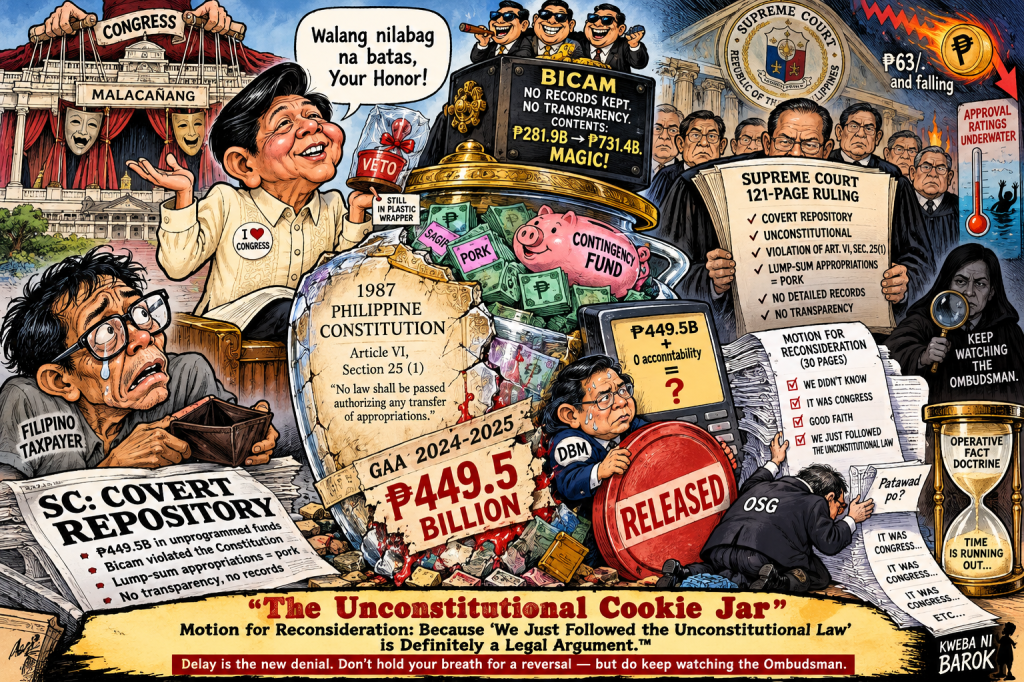
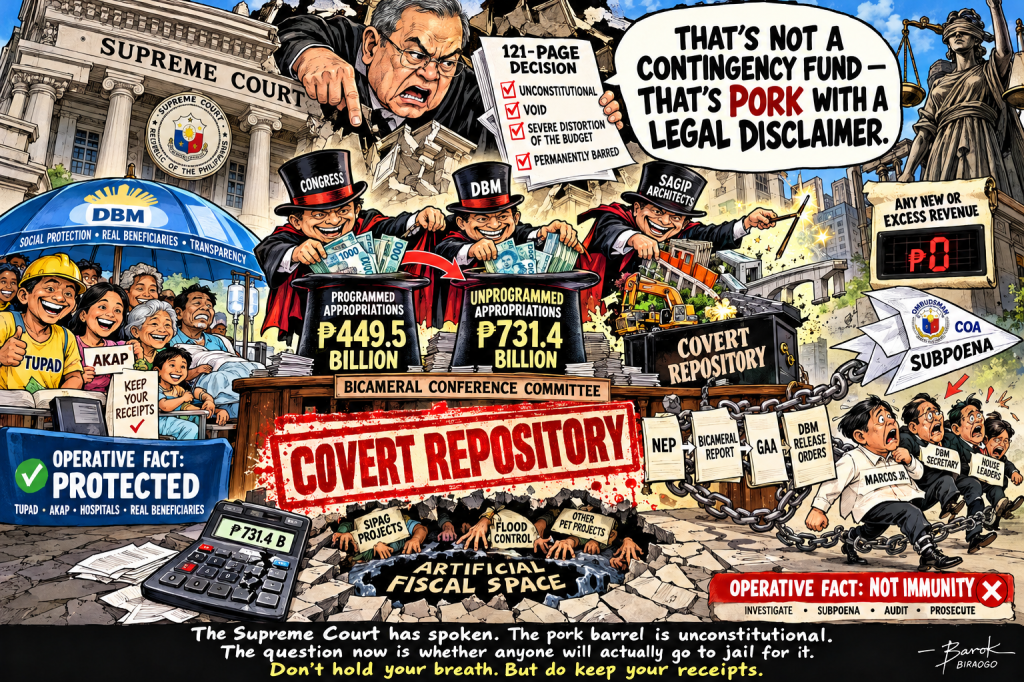
THE Office of the Solicitor General (OSG) has finally answered the Supreme Court’s most basic, most devastating question: Where are the records for the ₱449.5 billion Congress inserted into the 2024 budget at the bicameral stage? According to Solicitor General Darlene Marie Berberabe, channeling the disembodied voice of the Legislature, the answer is a shrug dressed in a legal filing: Congress says there are no records. None. Nada. For a sum larger than the entire budget of the Department of Health, the paper trail is a ghost.
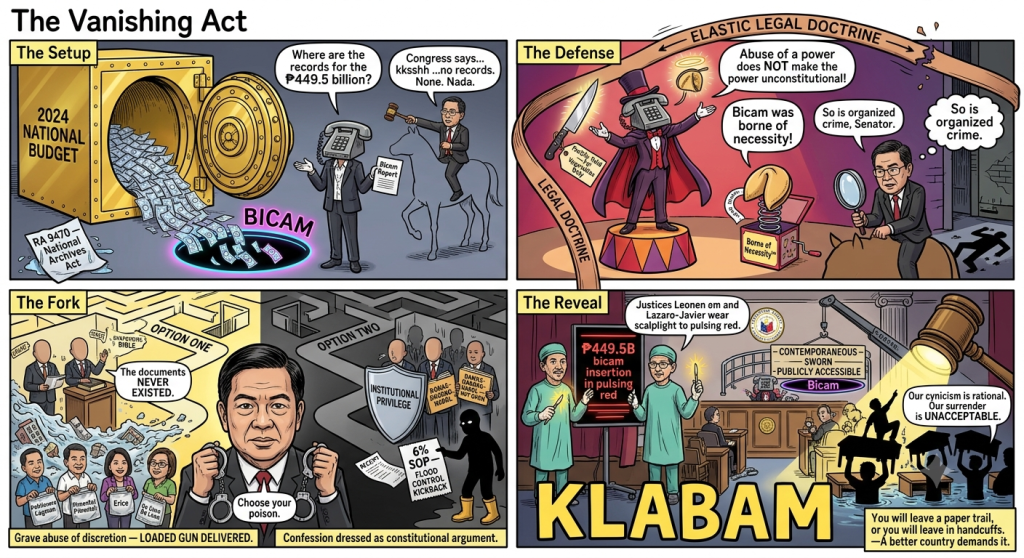
Let that sink in. The People’s House moved nearly half a trillion pesos—funds that would build hospitals, classrooms, and flood control systems that don’t collapse—and the institutional answer, relayed through the Republic’s chief lawyer, is a collective amnesia worthy of a crime family. But the real scandal here isn’t just a Congress addicted to opacity; it’s the OSG’s willing transformation from the Republic’s constitutional defender into Congress’s messenger boy. Justice Alfredo Benjamin Caguioa didn’t want to hear secondhand whispers. He demanded the truth “from the horse’s mouth.” And the OSG, by not demanding that the horse speak under oath itself, revealed precisely whose mouth it is. This isn’t legal representation; it’s an institutional dereliction of duty.
The OSG’s defense, as articulated by Berberabe, is a structurally orthodox but morally bankrupt tautology: abuse of a power does not make the power unconstitutional. She argues that the Unprogrammed Appropriations (UA) mechanism is facially valid, and that the Court should police only for “grave abuse of discretion.” This is the legal equivalent of arguing that because a kitchen knife is designed to slice vegetables, you can’t convict someone for wielding it in a dark alley. It conveniently ignores the Constitution’s unequivocal command: Article VI, Section 25(1) of the 1987 Constitution of the Republic of the Philippines declares Congress “may not increase the appropriations recommended by the President.” Not “may increase them if it’s called UA.” Not “may increase them if it forgets to write anything down.”
The OSG’s job, under the Code of Professional Responsibility and Accountability (CPRA), is not to dress up legislative legerdemain in fancy jurisprudential garb; it is to defend the Constitution. The Republic’s interests are not served by a lawyer who uncritically accepts a client’s claim that a half-trillion-peso transaction left zero documentary fingerprints, especially when that client is the subject of a parallel Ombudsman plunder investigation. By refusing to independently verify, Berberabe’s OSG has placed itself in the dock alongside Congress.
The sheer absurdity of the “no records” claim has now birthed a magnificent legal fork, courtesy of Justice Caguioa’s demand for sworn compliance. Congress must now choose its poison.
- Option One: It swears under oath that the documents never existed. This transforms the budget process from a deliberative democratic function into a magical act where billions materialize from incantation. It hands the Petitioners—Lagman, Pimentel, Erice, de Lima—a loaded gun, providing circumstantial evidence of arbitrariness so extreme it constitutes the very “grave abuse of discretion” that Article VIII, Section 1 of the 1987 Constitution of the Republic of the Philippines commands this Court to strike down.
- Option Two: Congress admits the records exist but withholds them on grounds of “institutional privilege.” This would mean the Legislature deliberately concealed evidence of the “bawas-dagdag-habol” scheme—the infamous insertion mechanics where programmed items are slashed, new pork is stuffed in, and release is pursued—while witnesses testify about 6% “SOP” kickbacks in the flood-control scandal. It’s a confession dressed as a constitutional argument.
The jurisprudence is a rope tightening around Congress’s neck. The Belgica v. Ochoa ruling was supposed to have exorcised the demon of the Pork Barrel. But as the Court’s own December 2025 PhilHealth decision proved—where the majority struck down a special provision for being an ungermane rider and the great Justice Marvic Leonen argued the entire 2024 GAA should be voided—the demon just mutated. It fled the line-item PDAF and found a new host in the bicameral conference committee, a shadowy “Third Chamber” that exists nowhere in the Constitution. As former Senate President Franklin Drilon, now an amicus curiae, admitted with a straight face, bicam was “borne out of necessity.” So is organized crime, Senator. Necessity is not a synonym for legality, and it is certainly not a license for a small group of legislators to convene in secret, gut the President’s proposed budget, and produce a final act that neither the House nor Senate floor ever actually deliberated.
This opacity is the lubrication for systemic graft. When the Congressional Policy and Budget Research Department records a ₱449.5 billion swing without a single feasibility study, project profile, or implementation-readiness assessment—documents the General Appropriations Act (GAA) itself presumes exist—we are not watching governance. We are watching a heist. And the absence of records is not a glitch; it is a feature of the “budol” system described by whistleblowers, where the lack of a paper trail makes kickbacks untraceable. This directly violates the anti-graft provisions of Republic Act No. 3019 (The Anti-Graft and Corrupt Practices Act) and the transparent governance mandates of Republic Act No. 9470 (National Archives of the Philippines Act of 2007).
The solution is not for this Court to cower behind a “presumption of constitutionality” that treats criminal opacity as a mere procedural hiccup. The high priests of fiscal discipline, Justices Leonen and Amy Lazaro-Javier, gave the roadmap in the PhilHealth case: surgical invalidation of the defective provisions and an order to return the loot. That scalpel must cut deeper here.
The Supreme Court must draw an adverse inference from the missing records and rule that this silence is not golden; it is the sound of grave abuse of discretion. The specific ₱449.5 billion bicam insertion in the 2024 GAA must be voided. Furthermore, the Court must erect permanent constitutional guardrails, mandating that every peso inserted in bicam be supported by a contemporaneous, sworn, and publicly accessible certification of implementation readiness. And let us be clear: the OSG must be held accountable. The Court should direct the Integrated Bar of the Philippines (IBP) to investigate whether Berberabe’s uncritical relaying of Congress’s “no records” charade violates the CPRA’s mandates of candor and independent judgment.
We demand prosecutions. We demand that those who ran this sprawling, unaccountable “SOP” factory—from the committee chairs to the Speaker and the Senate President whose names are scrawled on the smoking gun of Zaldy Co’s letter—face the full force of Republic Act 3019. To the youth watching this circus of unaccountable billions while they wade through floods and endure overcrowded classrooms: your cynicism is rational, but your surrender is unacceptable. This constitutional clash is proof that the bulwark of an independent judiciary, when wielded by jurists with a spine, can still discipline the feral appetites of power. The Court must make the invisible hand of the bicameral thief suddenly, terrifyingly visible. Let justice be blind to dynasty and patronage, but let it have twenty-twenty vision for the paperless plunder of the Philippine Republic. A better country demands a verdict that reminds every politician in this archipelago: you will leave a paper trail, or you will leave in handcuffs.
Key Citations
A. Legal & Official Sources
- The 1987 Constitution of the Republic of the Philippines. Official Gazette of the Republic of the Philippines, 1987, http://www.officialgazette.gov.ph/constitutions/1987-constitution/.
- Republic Act No. 3019. Anti-Graft and Corrupt Practices Act. Official Gazette of the Republic of the Philippines, 17 Aug. 1960, http://www.officialgazette.gov.ph/1960/08/17/republic-act-no-3019/.
- Republic Act No. 9470. An Act to Strengthen the System of Management and Administration of Archival Records, Establishing for the Purpose the National Archives of the Philippines, and for Other Purposes. 21 May 2007, http://www.officialgazette.gov.ph/2007/05/21/republic-act-no-9470/.
- Belgica v. Ochoa. G.R. No. 208566. Supreme Court of the Philippines, 19 November 2013, https://lawphil.net/judjuris/juri2013/nov2013/gr_208566_2013.html.
- Code of Professional Responsibility and Accountability. A.M. No. 22-09-01-SC. Supreme Court of the Philippines, 11 April 2023.
- Supreme Court of the Philippines. Aquilino Pimentel III et al. v. House of Representatives et al. (consolidated petitions concerning PhilHealth excess reserve funds and 2024 GAA Special Provision 1(d)). 3 December 2025.
B. News Reports
- Casilao, Joahna Lei. “Congress Has No Bicam Records Sought by SC — OSG.” GMA News Online, GMA Network, 14 July 2026, http://www.gmanetwork.com/news/topstories/nation/994790/congress-has-no-bicam-records-sought-by-sc-osg/story/.
- Panaligan, Rey G. “SC Orders Return to PhilHealth of P60-B Excess Funds Transferred to National Treasury.” Manila Bulletin, 5 Dec. 2025, mb.com.ph/2025/12/05/sc-orders-return-to-philhealth-of-p60-b-excess-funds-transferred-to-national-treasury.
- “Ang Hirap Maging Mahirap”: The PAO Scandal That Proves Government Contempt Is Nothing New
- “Far-Off” My Axx: Malacañang’s Claire Castro Drowns in Her Own Legal Gaslighting
- “Forthwith” to Farce: How the Senate is Killing Impeachment—And Why Enrile’s Right (Even If You Can’t Trust Him)
- “HINDI AKO NAG-RESIGN!”

- “I Know Nothing”: Baste Duterte’s Amnesia Defense Meets ₱33M in GenCorp Contracts

- “I’m calling you from my new Globe SIM. Send load!”

- “Mahiya Naman Kayo!” Marcos’ Anti-Corruption Vow Faces a Flood of Doubt

- “Manageable” Debt, Unmanageable Lies: DBM’s ₱21 Trillion Fairy Tale
- “Meow, I’m calling you from my new Globe SIM!”

- “Natrabaho”: One Word, One Ombudsman, and a Judiciary on Trial
- “No Special Jail for Crooks!” Boying Remulla Slams VIP Perks for Flood Scammers

- “Philippine-Controlled” or Yankee Gas Station? The Davao Fuel Depot Farce Exposed





Leave a Reply