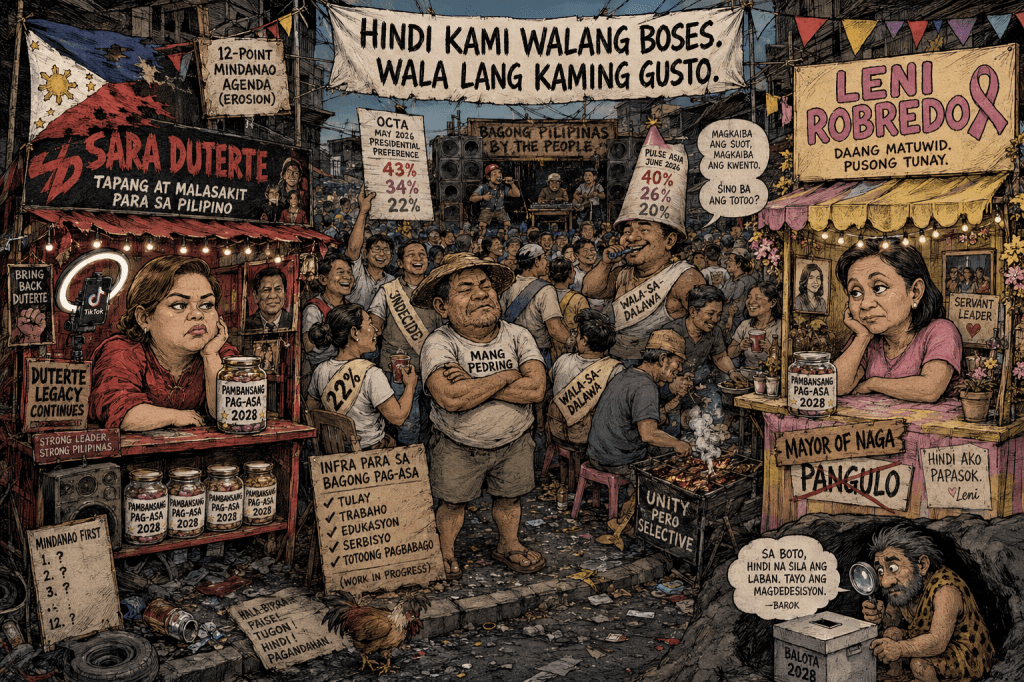
Sara Drops, Leni Flatlines, and the Undecided Just Threw a Block Party in NCR
By Louis ‘Barok‘ C. Biraogo — August 6, 2026
THE latest OCTA Research survey on the 2028 presidential race arrived last week with the solemnity of a weather report announcing an approaching storm. Vice President Sara Duterte leads Naga City Mayor Leni Robredo, 43 percent to 34 percent, with 22 percent undecided, choosing neither, or declining to answer. The margin has narrowed from 11 points to nine since the first quarter. Cue the predictable partisan spasms: Duterte’s camp trumpets resilience, Robredo’s allies whisper momentum, and the chattering classes dissect a three-point shift that OCTA itself admits sits comfortably inside the ±4.2-point combined margin of error.
Let me translate what that means in plain language: the national movement everyone is hyperventilating about may not exist. It is statistical vapor. And yet, buried beneath the topline noise is something genuinely consequential—not who’s winning, but who’s leaving.
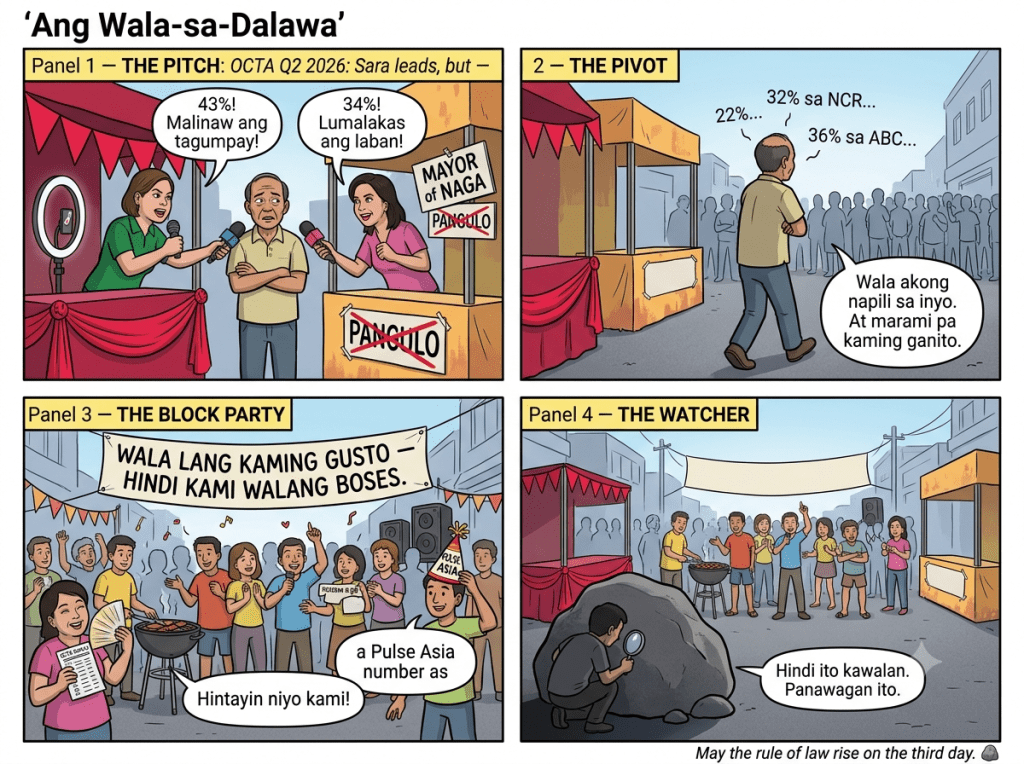
The Fastest-Growing Constituency
The 22 percent undecided bloc is now the fastest-growing constituency in Philippine politics. It grew from 19 percent in the first quarter. In the National Capital Region, it exploded to 32 percent. Among the wealthiest Class ABC, a staggering 36 percent refuse to commit to either dynastic brand. These are not apathetic citizens tuning out. These are observant, politically attentive Filipinos who have looked at the two frontrunners and decided: neither. That is not a void. It is a verdict—and potentially the seed of a democratic renewal this country desperately needs.
OCTA Research and Its Baggage
But first, let us dissect the survey itself, because the messenger here carries its own baggage. OCTA Research—born from University of the Philippines academics, baptized in the COVID-19 pandemic’s projection wars—has a credibility problem it cannot seem to shake. In 2020, House lawmakers dragged its leadership before a committee hearing, accusing the group of stepping beyond data into unaccountable “commentary” that unsettled markets. More recently, the firm has been forced to repeatedly disown fabricated surveys falsely attributed to it, including a fake February 2025 poll showing Duterte outperforming President Marcos. When a polling firm must spend as much energy denying counterfeit numbers as publishing real ones, every release arrives pre-tarnished.
The methodology here is defensible—face-to-face interviews, 1,200 probability-sampled adults, ±3 percent margin of error—and certainly more rigorous than the gamified mobile-app panels some competitors deploy. But the question design is a straitjacket. A forced binary matchup between Duterte and Robredo tells you nothing about how either would perform in a multi-candidate field, with running mates, party labels, and an actual campaign. Pulse Asia’s survey, fielded in the same window, found Duterte at 49 percent in a six-way race—a 23-point lead that makes OCTA’s nine-point gap look like a rounding error. Same electorate, same week, a 14-point divergence. Which survey is “right”? Both. Neither. Welcome to the hall of mirrors that is Philippine pre-election polling, where every camp can cherry-pick the numbers that flatter its preferred narrative.
A Nation Voting in Parallel Universes
The demographic breakdowns, however, are where the survey transcends its methodological limitations and becomes a genuine X-ray of the national psyche. The age split is a chasm. Duterte crushes among 25- to 34-year-olds, 61 percent to Robredo’s 14 percent—a generation that came of political age under her father’s law-and-order populism, baptized in strongman rhetoric and TikTok virality. Robredo dominates the elderly: 61 percent among those 75 and above, a cohort whose formative memory runs through the EDSA revolution, the elder Aquino’s assassination, and the Marcos dictatorship’s body count. This is not a polling divergence. This is a nation that has not reconciled its past, voting in two parallel universes.
And then there is National Capital Region, the true earthquake in this data. In the first quarter, Robredo led NCR by 20 points. Now? A dead heat, 34-34, with undecideds surging to 32 percent. The critical nuance OCTA itself flagged: Duterte did not gain. Robredo’s support simply evaporated into uncertainty. This is not a story of Duterte’s appeal expanding. It is a story of the opposition’s coalition softening—likely a consequence of Robredo’s repeated, emphatic declarations that she will not seek national office, preferring to remain Naga City’s mayor. You cannot blame supporters for drifting away when the candidate herself keeps telling them she isn’t coming.
Timing, Impeachment, and Blind Spots
The timing compounds the interpretive chaos. The survey was fielded July 4 to 11—the very week Duterte’s impeachment trial opened in the Senate, with NBI testimony on her alleged assassination threats against the First Family and the procedural battle over subpoenaing her financial records. OCTA properly disclaims any causal link. But the coincidence is politically radioactive. Every senator-judge now knows that 22 percent of the electorate is watching, uncommitted, waiting to see whether the trial delivers accountability or acquittal as performance art.
And what of the survey’s structural blind spots? The hypothetical matchup excludes the possibility of a third candidate entirely—a curious omission in a country where Raffy Tulfo consistently polls competitively and where the flood-control corruption scandal has created an appetite for a genuine anti-corruption crusader. The undecided are lumped together with “neither” and “refused to answer,” masking the difference between genuine indecision and active rejection of both choices. And the regional quotas, while representative, flatten the intensity of local dynamics: Duterte’s 76 percent in Mindanao is still overwhelming, but it is down 12 points from the first quarter. That erosion, in her family’s ancestral stronghold, deserves far more scrutiny than the topline national noise.
What Filipinos Should Do With This Survey
So what should Filipinos do with this survey? Treat it as a snapshot, not a prophecy. Polls measure opinion, not destiny. They are useful for tracking trends and surfacing issues, but they are also vulnerable to timing, question design, and the agendas of those who commission them. Verify the methodology. Check who paid for the survey. Never surrender your judgment to a percentage point.
The deeper call here is not about polling literacy. It is about the quality of the democracy these numbers purport to measure. The 22 percent undecided are not waiting to be seduced by a better TikTok strategy. They are waiting for a reason to believe that Philippine governance can be something other than a relay race between dynastic brands—Marcos, Duterte, and the next name that inherits power as though it were family property. They are waiting for candidates who run on character, competence, and proven integrity rather than name recall and viral clapbacks. They are waiting for a politics worthy of the country’s promise.
That means demanding specific, structural reforms now—before the 2028 campaign consumes everything. A genuine anti-political dynasty law, not the “weak” version that protects incumbents. The Freedom of Information Act, so citizens can verify what candidates claim. Procurement reform, so the next ₱180 billion flood-control heist becomes harder to execute. Campaign finance transparency, so we know whose interests are really being served when a candidate opens their mouth.
The 22 percent undecided are not a problem to be solved by better messaging. They are a demand—observant, skeptical, and strategically positioned to decide whether 2028 becomes a referendum on Duterte-era impunity or a rejection of the entire dynastic carousel. That is not a void at the center of Philippine democracy. It is an opening. The only question is whether anyone—candidate, party, or movement—will prove worthy of filling it.
Key Citations
A. Reports & Studies
- OCTA Research. “Tugon ng Masa Survey, Q2 2026.” Reported in Inquirer.net, 5 Aug. 2026, https://newsinfo.inquirer.net/2277769/duterte-tops-robredo-in-hypothetical-2028-presidential-race-says-octa.
- Pulse Asia Research. “Ulat ng Bayan Survey, June–July 2026.” Reported in Inquirer.net, 22 July 2026, https://newsinfo.inquirer.net/2268388/sara-duterte-bong-go-top-bets-for-president-vp-in-2028-survey-says.
B. News Articles
- “Duterte tops Robredo in hypothetical 2028 presidential race, says Octa.” Inquirer.net, 5 Aug. 2026, https://newsinfo.inquirer.net/2277769/duterte-tops-robredo-in-hypothetical-2028-presidential-race-says-octa.
- “Sara’s lead over Leni narrows in hypothetical matchup – OCTA.” Philstar.com, 6 Aug. 2026, https://www.philstar.com/headlines/2026/08/06/2547272/saras-lead-over-leni-narrows-hypothetical-matchup-octa.
- “Higher ratings for VP? Fake news, says OCTA.” Philstar.com, 18 Feb. 2025, https://www.philstar.com/headlines/2025/02/18/2422289/higher-ratings-vp-fake-news-says-octa.
- “Witness: VP Sara Duterte capable of carrying out threats.” Inquirer.net, 15 July 2026, https://newsinfo.inquirer.net/2263837/witness-vp-sara-duterte-capable-of-carrying-out-threats.
- “What billions look like: Visualizing the staggering scale of flood control corruption.” Inquirer.net, 1 Oct. 2025, https://newsinfo.inquirer.net/2118008/what-billions-look-like-visualizing-the-staggering-scale-of-flood-control-corruption.
C. Official Websites & Background
- “OCTA Research.” Wikipedia, https://en.wikipedia.org/wiki/OCTA_Research.
- “Anti-Political Dynasty Bill.” Wikipedia, https://en.wikipedia.org/wiki/Anti-Political_Dynasty_Bill.
- Biraogo, Louis “Barok” C. Kweba ni Barok, https://kwebanibarok.com/.
- “Ang Hirap Maging Mahirap”: The PAO Scandal That Proves Government Contempt Is Nothing New

- “Far-Off” My Axx: Malacañang’s Claire Castro Drowns in Her Own Legal Gaslighting
- “Forthwith” to Farce: How the Senate is Killing Impeachment—And Why Enrile’s Right (Even If You Can’t Trust Him)

- “HINDI AKO NAG-RESIGN!”

- “I Know Nothing”: Baste Duterte’s Amnesia Defense Meets ₱33M in GenCorp Contracts

- “I’m calling you from my new Globe SIM. Send load!”

- “Mahiya Naman Kayo!” Marcos’ Anti-Corruption Vow Faces a Flood of Doubt

- “Manageable” Debt, Unmanageable Lies: DBM’s ₱21 Trillion Fairy Tale
- “Meow, I’m calling you from my new Globe SIM!”

- “Natrabaho”: One Word, One Ombudsman, and a Judiciary on Trial

- “No Special Jail for Crooks!” Boying Remulla Slams VIP Perks for Flood Scammers

- “Philippine-Controlled” or Yankee Gas Station? The Davao Fuel Depot Farce Exposed





Leave a Reply