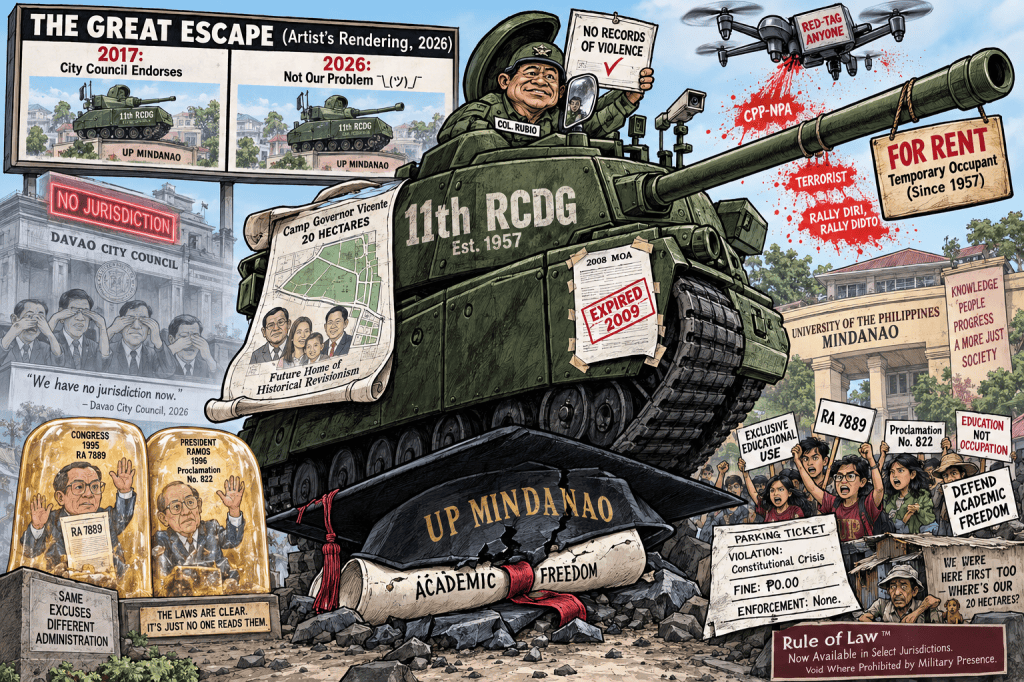
Because nothing says ‘rule of law’ like a city council that endorses military expansion in 2017 and pleads ‘no jurisdiction’ in 2026
By Louis ‘Barok’ C. Biraogo — September 17, 2026
WELL, that was anticlimactic.
After years of posturing, red-tagging, student mobilizations, and a military expansion request that somehow managed to name-drop a dead governor, the Davao City Council has officially announced that the land dispute between the University of the Philippines (UP) Mindanao and the 11th Regional Community Defense Group (RCDG) is… not their problem.
Committee chair Diosdado Mahipus Jr. declared that the city council has “no legal jurisdiction” over the matter, terminating Item No. 772 Series of 2026 and effectively telling both parties: figure it out yourselves.
The Council cannot adjudicate property rights between UP and the Army, cannot compel UP to allocate land, and cannot declare a military reservation.
In other words, they looked at the legal architecture and realized they were trying to use a parking ticket to resolve a constitutional crisis.
But let’s not mistake a jurisdictional retreat for a resolution. The underlying question remains: how did a military unit end up squatting inside the Philippines’ premier state university, and why has it taken nearly seven decades to address?
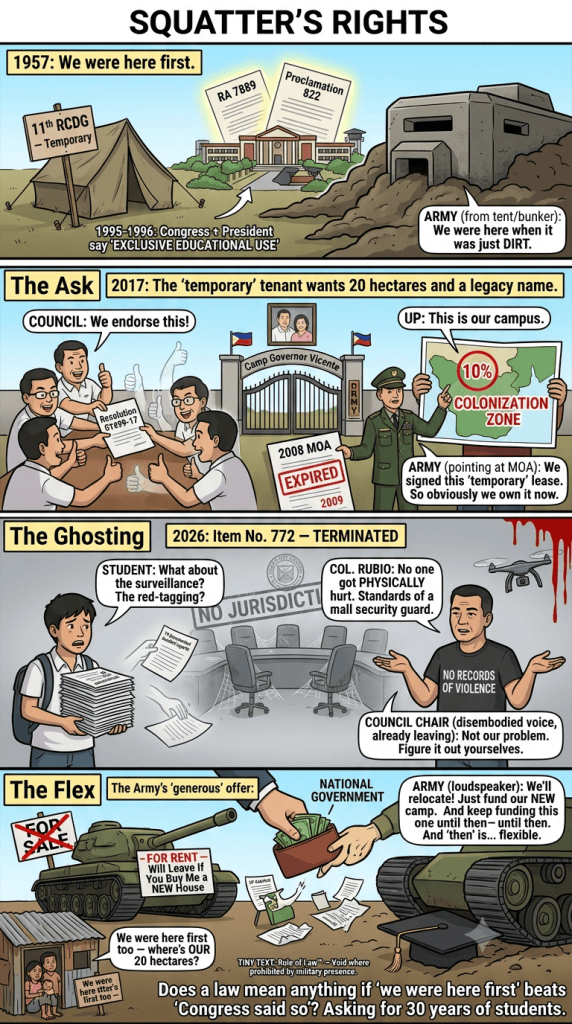
The 1957 Problem: When “We Were Here First” Is Legally Irrelevant
The Army’s primary defense is chronological: the 11th RCDG has been in the area since 1957, predating UP Mindanao’s establishment in 1995. This is presented as if temporal priority creates property rights by default. It does not.
If it did, every squatter on every government lot in the country would have a valid title claim.
Here’s what actually happened: in 1957, the military occupied a portion of an unused government reservation. In 1995, Congress enacted Republic Act (RA) No. 7889, establishing UP Mindanao and mandating that its campus be sited specifically in the Bago Oshiro reservation.
The law could not be clearer: the campus “shall be utilized exclusively for educational purposes and for such other activities related to research and training activities of the University of the Philippines in Mindanao”.
Then, in 1996, President Fidel Ramos issued Proclamation No. 822, segregating approximately 204 hectares—2,044,312 square meters, to be precise—for UP Mindanao’s exclusive use. The proclamation used the same operative language: “exclusively for educational purposes”.
So here’s the legal reality: the Army’s presence may have predated UP Mindanao, but the land’s legal character changed in 1995 and 1996. What was once an ambiguous government reservation became, by act of Congress and presidential proclamation, a university campus.
The military’s continued occupation was no longer a historical accident—it was an ongoing legal problem.
The Army’s argument is essentially: “We were here when it was just dirt. Therefore, we get to stay even after it became a university.” That’s not a legal argument. That’s an adverse possession fantasy that the Civil Code does not recognize against the State.
The 20-Hectare Heist: From “Temporary Occupant” to “Permanent Neighbor”
Let’s talk about the 2017 request, because this is where the mask slips.
The 11th RCDG currently occupies about 6.5 hectares inside the UP Mindanao campus. In 2017, it requested not confirmation of its existing footprint, but 20 hectares for a military reservation to be named “Camp Governor Vicente”—after Rodrigo Duterte’s father.
This was not a modest request for continued accommodation. This was a demand to convert ten percent of the university’s entire landholding into a permanent military installation, complete with a name that tied the expansion to the sitting president’s family legacy.
The Davao City Council at the time dutifully endorsed the request through Resolution No. 01499-17.
UP Mindanao rejected it. The request went to the Office of the President and, mercifully, died there. But the fact that it was made at all reveals the institutional ambition: not coexistence, but colonization.
The Paper Trail the Army Would Rather You Ignore
Here’s what makes the Army’s position legally untenable: its own prior admissions.
According to records published in the UP Gazette, a 2008 memorandum of agreement (MOA) between UP Mindanao and the 11th RCDG contained language that should end the debate.
The Army unit “recognized UP’s ownership and possession” of the property. It requested permission to remain “temporarily.” It promised to transfer to another location by December 31, 2009. And UP permitted continued occupation “for a limited period, subject to renewal or extension at UP’s discretion.”
Let that sink in. The 11th RCDG, through its own signature, acknowledged that UP owned the land, that its presence was temporary, and that UP retained discretion over whether it could stay.
This is not a case of adverse possession. This is a case of a tenant who signed a lease acknowledging the landlord’s title and then, years later, started acting like they owned the building.
The MindaNews report also references a 1997 memorandum of agreement involving UPMin and government agencies occupying portions of the property, which “contemplated the eventual surrender and turnover of the affected areas”. The Army’s own historical agreements contradict its current posture.
The Jurisdictional Shell Game
The Davao City Council’s withdrawal is legally defensible. Under Republic Act No. 7160, the Local Government Code, city councils do not have authority to adjudicate property disputes between national government agencies, transfer national property, or create military reservations.
The committee report correctly noted that the Council “cannot adjudicate the respective property rights of UP Mindanao and the 11th RCDG, compel UP Mindanao to allocate a specific portion of its property to the military, or itself declare or segregate land as a military reservation”.
But here’s the uncomfortable question: why did the Council endorse the request in 2017 in the first place? Resolution No. 01499-17 was passed without, apparently, a basic legal review of whether the Council had any authority to endorse the transfer of land that Congress had specifically reserved for educational purposes.
The 2026 withdrawal is an admission that the 2017 endorsement was, at best, legally meaningless and, at worst, a political favor dressed up as governance. The Council is now hoping everyone forgets that it spent years lending institutional legitimacy to a land grab it had no power to authorize.
The Army’s “Willingness to Relocate” Is Not Altruism
The committee report notes that the 11th RCDG “does not necessarily insist upon retaining or expanding from its present location and is amenable to relocation to another suitable area, provided that sufficient land is made available for its operational requirements and appropriate arrangements are undertaken”.
How generous. The Army is willing to leave—if someone else pays for a new camp.
This is the institutional equivalent of a houseguest saying, “I’ll move out, but you need to buy me a new house first.” It converts a legal obligation (vacating land the Army has acknowledged belongs to UP) into a negotiation over relocation costs. The Army’s “flexibility” is contingent on the government funding its departure from property it should never have claimed as permanent.
And to be fair, there is a legitimate operational question here. The Reserve Force has statutory functions under Republic Act No. 7077. The 11th RCDG performs disaster response and reserve training.
The question is not whether the Army needs a facility somewhere in Davao. The question is whether that facility must be inside a university campus that Congress explicitly reserved for educational purposes.
The answer, legally and logically, is no.
What the Students Documented While the Adults Were “Negotiating”
While the City Council was passing resolutions and the Army was requesting expansions, UP Mindanao students were documenting what military presence actually looked like on the ground.
According to records compiled by Himati, the UPMin student publication, there were at least 19 documented cases of military activities inside campus from 2019 to July 2025.
These included a drone hovering above campus during a student leaders’ event, military maneuvers by uniformed personnel inside the Cultural Complex in October 2024, and at least five instances of red-tagging targeting UPMin students and student leaders.
The 2024 Supreme Court decision in Deduro v. Vinoya declared that “red-tagging, vilification, labelling, and guilt by association threaten a person’s right to life, liberty, or security”. The military activities documented by students occurred in the same period.
Col. Reandrew Rubio, director of the 11th RCDG, told a Davao press forum that there are “no records of violence committed by his troops inside campus”. This is a carefully worded defense.
It does not deny the surveillance. It does not deny the red-tagging. It simply says no one has been physically harmed.
That is not a legal defense. That is a standard that would embarrass a mall security guard.
The Duterte Legacy Connection
We cannot ignore the political context. The proposed “Camp Governor Vicente” was a 2017 initiative during the Duterte administration, endorsed by a City Council that included Duterte-aligned officials. The naming after Rodrigo Duterte’s father was not subtle. It was a legacy project dressed up as a military necessity.
The 2026 withdrawal comes years after Duterte left office, during a period of political realignment in Davao. The Council’s sudden discovery of jurisdictional limits is legally correct but politically convenient.
It allows local officials to extricate themselves from a dispute that once carried the imprimatur of the previous administration without having to explicitly repudiate that administration’s position.
The Army’s request, meanwhile, remains pending before the Office of the President, where it has apparently languished since 2017. No presidential proclamation has been issued. No formal military reservation has been created. The 11th RCDG remains what it has always been: an occupant without a legal right to permanence.
What Happens Now?
The City Council’s withdrawal transfers the dispute to the proper venues: UP’s Board of Regents, the Office of the President, the Department of National Defense, and potentially Congress or the courts.
UP Mindanao has the stronger legal position. RA 7889 and Proclamation No. 822 are explicit about exclusive educational use. RA 9500, the 2008 UP Charter, confirms UP’s “absolute ownership” of landholdings ceded to it by law and grants the Board of Regents exclusive control over property disposition. The 2008 MOA documented the Army’s recognition of UP’s ownership.
The Army has operational needs but no legal title. Its strongest argument is practical: relocation costs money and takes time. Its weakest argument is “we were here first,” which is legally irrelevant when Congress and the President subsequently reserved the land for a different purpose.
The most likely outcome is a negotiated relocation, with the government funding a new facility for the 11th RCDG somewhere else in Davao. This is what the Army says it is amenable to. It is what UP wants. It is what students have demanded. It is what the City Council now says is not its job to facilitate.
The question is who will actually make it happen—and whether the government will treat the Army’s departure as a legal obligation to be enforced or a favor to be purchased.
The Real Scandal
The deepest scandal here is not that the Army wants to stay. Institutions always want to stay. The scandal is that for nearly three decades, the government allowed a legally untenable arrangement to persist because no one wanted to force the issue.
Congress passed a law. The President issued a proclamation. UP got its title. And yet, year after year, the Army remained, first as a tolerated occupant, then as a tenant who signed agreements acknowledging UP’s ownership, then as an aspiring permanent resident demanding 20 hectares and a name change.
The Davao City Council’s withdrawal is an admission that the local government was never the proper forum for this dispute. It is also a tacit acknowledgment that the 2017 endorsement should never have happened. But it does not resolve the underlying question.
That question is simple: does a law establishing a university campus mean anything if a military unit can occupy it indefinitely because it was there before the law was passed?
The answer, if the rule of law means anything, is no.
Now someone in the national government needs to have the courage to say so.
Key Citations
A. Legal & Official Sources
- Republic of the Philippines. Republic Act No. 7889: An Act Establishing the University of the Philippines in Mindanao, Appropriating Funds Therefor, and for Other Purposes. 20 Feb. 1995, https://lawphil.net/statutes/repacts/ra1995/ra_7889_1995.html.
- Ramos, Fidel V. Proclamation No. 822: Reserving for the University of the Philippines in Mindanao Certain Parcels of Land of the Public Domain Located at the Bureau of Plant Industry Reservation in Bago Oshiro. 3 July 1996, https://lawphil.net/executive/proc/proc1996/proc_822_1996.html.
- Republic of the Philippines. Republic Act No. 7160: The Local Government Code of 1991. 10 Oct. 1991, https://www.lawphil.net/statutes/repacts/ra1991/ra_7160_1991.html.
- Republic of the Philippines. Republic Act No. 7077: Citizen Armed Forces of the Philippines Reservist Act. 27 June 1991, https://www.officialgazette.gov.ph/1991/06/27/republic-act-no-7077/.
- Republic of the Philippines. Republic Act No. 9500: The University of the Philippines Charter of 2008. 29 Apr. 2008, https://chanrobles.com/republicactno9500.html.
- Supreme Court of the Philippines. Deduro v. Vinoya, G.R. No. 254753, 4 July 2023. Supreme Court of the Philippines, https://sc.judiciary.gov.ph/sc-red-tagging-threatens-right-to-life-liberty-and-security/.
B. News Articles
- Ocampo, Yas D. “Davao City Council Backs Out of UPMin-Army Land Dispute.” MindaNews, Mindanao Institute of Journalism, 12 Sept. 2026, https://mindanews.com/top-stories/2026/09/davao-city-council-backs-out-of-upmin-army-land-dispute/. Accessed 16 Sept. 2026.
- “Army Reservists Ask for 20 Hectares in UP-Mindanao.” SunStar Davao, 5 June 2017, https://www.sunstar.com.ph/more-articles/army-reservists-ask-for-20-hectares-in-up-mindanao-.
- Teman, Razl EJ. “Relocation of Military Camp from UPMin Urged.” MindaNews, 13 Aug. 2025, https://mindanews.com/top-stories/2025/08/relocation-of-military-camp-from-upmin-urged/.
- Saron, Rhoda Grace. “11th RCDG Says No Militarization as It Camps near UP Mindanao.” Mindanao Times, 24 July 2025, https://www.mindanaotimes.com.ph/11th-rcdg-says-no-militarization-as-it-camps-near-up-mindanao/.
- “Students Denounce Campus Militarization.” Bulatlat, 21 Feb. 2026, https://www.bulatlat.com/2026/02/21/students-denounce-campus-militarization/.
C. Official Websites
- University of the Philippines Mindanao. Official Website. https://www.upmin.edu.ph/.
- Office of the Sangguniang Panlungsod of Davao City. Official Website. https://sp.davaocity.gov.ph/.
- 11th Regional Community Defense Group. Official Website. https://www.11rcdg.com/.
- University of the Philippines. “The UP Charter.” University of the Philippines, https://up.edu.ph/the-up-charter/.
- Office of the Secretary of the University. U.P. Gazette. University of the Philippines, https://osu.up.edu.ph/.
- Himati. Official Student Publication of UP Mindanao. https://www.facebook.com/himati.
- ₱8B BBM Pork: CCTV for Every Captain’s Kumpare?

- ₱8.9 Billion, 331 Ghost Police Stations: The TIKAS Scandal Explained

- ₱8.4 Billion, 42,000 Barangays, 1 Election: The “Bawat Barangay Makikinabang” Vote-Buying Masterclass

- ₱75 Million Heist: Cops Gone Full Bandit

- ₱6.77B Ghost Haunts Duterte: RTC Dismisses Mans Carpio’s Desperate Plea
- ₱6.77 Billion and Zero Cash: The Sara Duterte SALN Math That Doesn’t Add Up

- ₱6.7-Trillion Temptation: The Great Pork Zombie Revival and the “Collegial” Vote-Buying Circus

- ₱58.53B, Zero Receipts: The LGSF Pork Barrel Nobody Wants to Name
- ₱53 Million Man Tells ₱695-a-Day Workers to Stop Being ‘Mayabang’: The Audacity of BSP’s Remolona

- ₱4.4 Billion and a Witness Who Can’t Explain It: The Duterte Impeachment’s Most Expensive Non-Answer
- ₱3.06 Billion for Evacuation Centers—But Nobody Knows Where They’ll Stand (Or If They’ll Exist)
- ₱16 Billion, 280 Accounts, 8 Helicopters: Boying Remulla’s Case Against the Yaps Is Not a Drill








Leave a comment