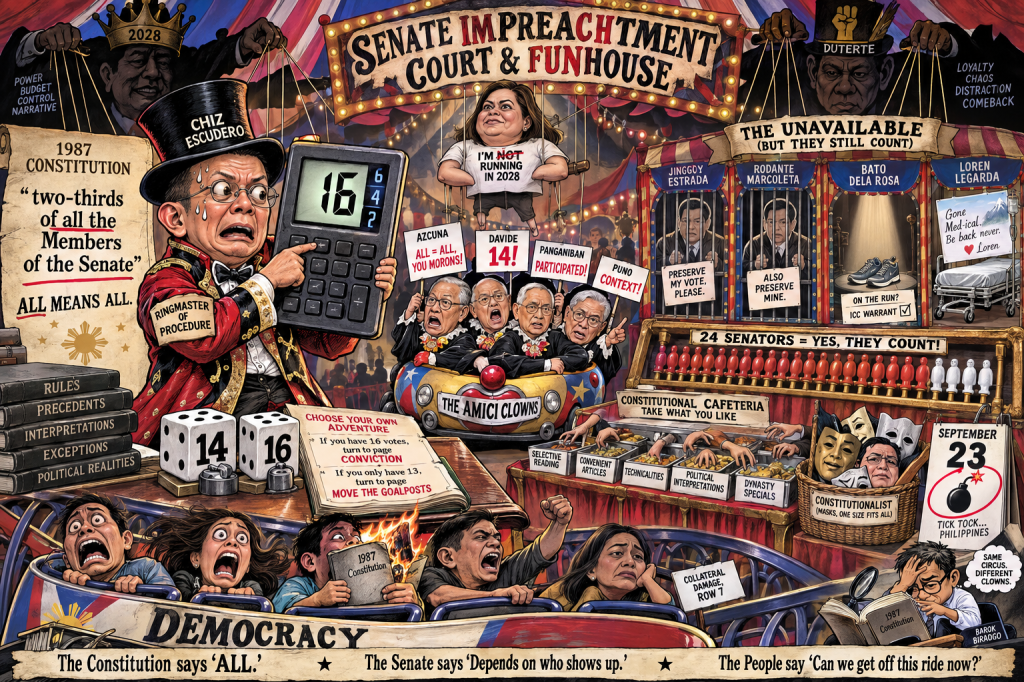
The Constitution Says ‘All.’ The Senate Says ‘Depends on Who Shows Up
By Louis ‘Barok‘ C. Biraogo — September 17, 2026
LET’S get one thing straight: I have no dog in this dynastic deathmatch. Sara Duterte is not my president, not my vice president, and certainly not my moral compass. But I am a student of the Constitution who has spent far too many years reading Supreme Court decisions for fun, and I have a pathological allergy to people treating the 1987 Constitution of the Republic of the Philippines (1987 Constitution) like a buffet where you take what you like and leave the rest.
The current controversy over the impeachment voting threshold—whether conviction requires 16 votes out of 24 senators, or some floating number based on who bothered to show up—is not a “legal debate.” It is a shell game. And the people playing it are not constitutional scholars. They are political operatives wearing robes they haven’t earned.
Let me explain.
The Numbers Game
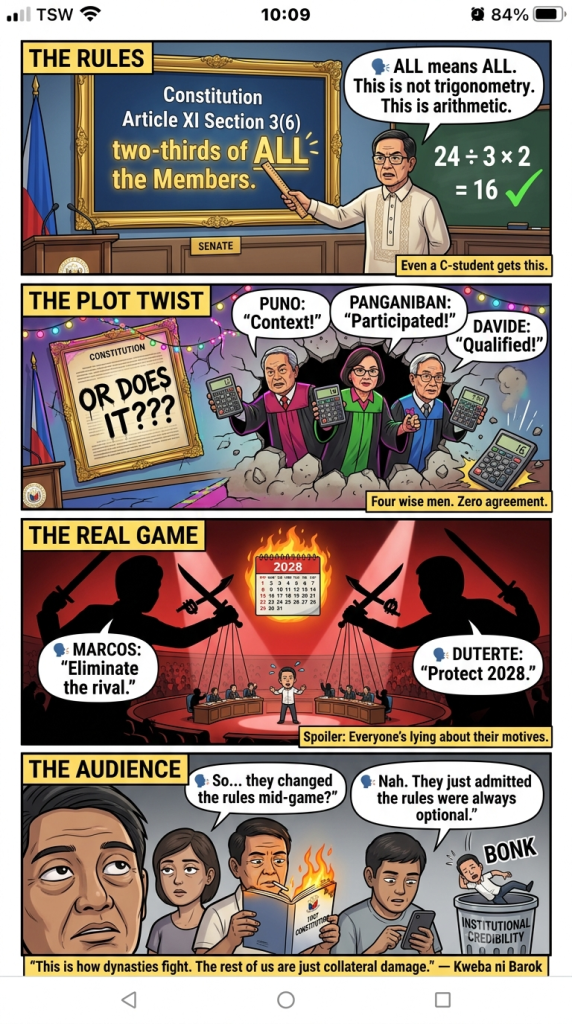
Article XI, Section 3(6) of the 1987 Constitution says, with the kind of clarity that usually ends arguments:
“No person shall be convicted without the concurrence of two-thirds of all the Members of the Senate.”
Two-thirds of 24 is 16. This is not trigonometry. This is arithmetic that a C-student in remedial math could handle.
But now, because four senators are unavailable—two detained on plunder charges, one hiding from the International Criminal Court (ICC), and one conveniently on medical leave abroad—suddenly the “all” in “all the Members” has become a matter of interpretation. The Senate impeachment court is scheduled to vote on September 23 whether to maintain Presiding Officer Chiz Escudero’s July 6 ruling that the denominator remains 24, or to adopt a flexible, participation-based calculation that could lower the conviction threshold to 14 or even 13 votes.
Let me translate: they are debating whether to change the rules mid-trial because they might not have the votes.
This is not constitutional law. This is a hostage negotiation.
The Amici Split: Four Wise Men, Four Opinions, Zero Agreement
The Senate, apparently recognizing that this is a question best answered by people who have actually read the Constitution, convened four retired Supreme Court justices as amici curiae. Surely, you might think, four former magistrates could agree on what “all” means.
You would be wrong.
Retired Justice Adolfo Azcuna, who was actually a framer of the 1987 Constitution—meaning he was in the room when they wrote this thing—said, with the exasperation of a man who cannot believe he has to explain basic English: “‘As long as they are members of the Senate, they constitute the denominator in computing the threshold of two-thirds, because all means all’”.
This is not a sophisticated legal argument. This is a kindergarten teacher explaining that “everyone” includes the kid who is absent.
But retired Chief Justice Reynato Puno countered that the Constitution “should not be interpreted narrowly or pedantically, for the prescriptions therein are not mathematical formulas”. Retired Chief Justice Artemio Panganiban focused on whether a senator had “sufficiently participated” to independently evaluate evidence. And retired Chief Justice Hilario Davide Jr. argued that the denominator should consist only of senators “legally qualified to vote”.
So the score is: Azcuna says 24, Davide says “qualified,” Panganiban says “participated,” Puno says “context.” If you put all four opinions together, you get a Choose Your Own Adventure novel where the ending depends on which page you turn to.
The defense team, sensing an opportunity, promptly declared their participation in the September 23 oral arguments would be “ad cautelam”—out of an abundance of caution—preserving their right to run to the Supreme Court if things don’t go their way.
Translation: “We’ll play your game, but if we lose, we’re telling on you.”
The “Acquittal by Default” Canard
Senator Erwin Tulfo, who apparently discovered constitutional law last week, raised the threshold issue by warning of an “acquittal by default”—the idea that requiring 16 votes when only 20 senators can participate means the defense needs only five votes to block conviction.
This sounds compelling until you remember that this is how supermajorities work. The entire point of requiring two-thirds is to make conviction difficult. The framers did not accidentally create a high bar. They deliberately created a high bar to prevent exactly what we are witnessing now: a factional majority trying to remove an elected official through a procedurally manipulated legislative process.
If you cannot get 16 votes, you do not get to change the number. You get to lose.
The “acquittal by default” argument is like complaining that a jury cannot convict because two jurors are hospitalized. The answer is not to lower the threshold to eleven. The answer is to wait, or to accept that the prosecution failed to meet its burden.
The Marcos-Shaped Shadow
I am not naive enough to pretend this is purely a legal dispute. This is the latest chapter in the Marcos-Duterte dynastic war, and everyone involved is lying about their motivations.
The Duterte defense claims they are defending constitutional fidelity. They are defending Sara’s 2028 presidential ambitions.
The prosecution claims they are seeking accountability. They are seeking to eliminate a political rival.
The Senate claims it is grappling with an unprecedented constitutional question. The Senate is doing what it always does: protecting its own institutional power while trying to avoid blame for whatever happens next.
And President Marcos? He is maintaining a discreet silence while his allies in the House push for conviction and his appointees on the Supreme Court await the inevitable petition.
The beauty of this whole mess is that everyone can claim to be a constitutionalist. The defense says the text is clear. The prosecution says the text must adapt to reality. The Senate says it has “sole power.” The Supreme Court says it can review grave abuse of discretion.
Everyone is right. Everyone is wrong. And the Constitution, that sacred document we all pretend to venerate, is being used as a prop in a political theater production that would embarrass a high school drama club.
The Real Question Nobody Is Asking
Here is what the amici, the senators, the defense, the prosecution, and the legion of constitutional law professors opining on social media are all dancing around:
Does the Senate impeachment court have the constitutional authority to change the voting threshold in the middle of a trial?
The answer is almost certainly no.
The threshold is not a procedural rule like the order of witnesses or the time allotted for cross-examination. It is a substantive constitutional requirement that determines the outcome of the proceeding. Changing it mid-trial is not “adapting to circumstances.” It is altering the legal framework governing the respondent’s potential removal after the trial has already begun.
If the Senate can change the threshold now, it can change it again tomorrow. And the day after. And the day after that. There is no principle that limits the manipulation. There is only power.
The amici, for all their disagreements, apparently agreed on one thing: changing the threshold would not necessarily constitute a due process violation. This is technically true but morally obtuse. Due process is not just about notice and hearing. It is about fundamental fairness. And there is nothing fair about changing the rules of the game while the game is being played.
What Happens Next
On September 23, the Senate will vote on whether to uphold Escudero’s 16-vote ruling. Eleven votes are needed to overturn it, assuming 20 senators participate.
The defense will participate “ad cautelam.” The prosecution will say they will “sink or swim” on the evidence regardless of the threshold. The amici will file their opinions. And everyone will wait to see whether the Supreme Court gets dragged into this mess.
If the Senate lowers the threshold and Duterte is convicted with, say, 14 votes, the defense will run to the Supreme Court. If the Supreme Court upholds the lower threshold, the conviction stands. If the Supreme Court strikes it down, we have a constitutional crisis.
If the Senate maintains 16 votes and Duterte is acquitted because the prosecution cannot reach the threshold, the prosecution will cry foul. The “acquittal by default” narrative will be deployed. The Duterte camp will claim vindication. And the 2028 presidential campaign will begin in earnest.
Either way, someone will be angry. Either way, the Constitution will have been stretched, bent, and possibly broken. And either way, the Filipino people will be told that this is how democracy works.
It is not. This is how dynasties fight. And the rest of us are just collateral damage.
Louis ‘Barok’ C. Biraogo is a student of the Constitution, a writer, and a recovering idealist who blogs at Kweba ni Barok. He is currently rereading the 1987 Constitution and wondering why the framers bothered to write it down if the Senate was just going to make up the rules as it went along.
Key Citations
A. Legal & Official Sources
- The 1987 Constitution of the Republic of the Philippines. Official Gazette of the Republic of the Philippines, 1987, http://www.officialgazette.gov.ph/constitutions/1987-constitution/.
- The 1987 Constitution of the Republic of the Philippines, art. XI, sec. 3(6). Official Gazette of the Republic of the Philippines, http://www.officialgazette.gov.ph/constitutions/the-1987-constitution-of-the-republic-of-the-philippines/the-1987-constitution-of-the-republic-of-the-philippines-article-xi/.
- The 1987 Constitution of the Republic of the Philippines, art. III, sec. 1. Official Gazette of the Republic of the Philippines, http://www.officialgazette.gov.ph/constitutions/the-1987-constitution-of-the-republic-of-the-philippines/the-1987-constitution-of-the-republic-of-the-philippines-article-iii/.
- Rome Statute of the International Criminal Court. International Criminal Court, 17 July 1998, http://www.icc-cpi.int/.
B. News Reports
- Ombay, Giselle. “Chiz Escudero Says 16 Votes Needed to Convict Sara Duterte in Impeachment Trial.” GMA News Online, GMA Network, 6 July 2026, http://www.gmanetwork.com/news/topstories/nation/993902/chiz-escudero-says-16-votes-needed-to-convict-sara-duterte-in-impeachment-trial/story/.
- Ombay, Giselle. “Senate Impeachment Court Sets Sept. 23 for Oral Arguments on Voting Threshold.” GMA News Online, GMA Network, 8 Sept. 2026, http://www.gmanetwork.com/news/topstories/nation/1001583/senate-impeachment-court-sets-sept-23-for-oral-arguments-on-voting-threshold/story/.
- Panti, Llanesca T. “Amici Curiae Panganiban, Davide, Puno: 16 Votes Not the Required Conviction Threshold.” GMA News Online, GMA Network, 16 Sept. 2026, http://www.gmanetwork.com/news/topstories/nation/1002549/amici-curiae-panganiban-davide-16-votes-not-the-required-conviction-threshold/story/.
- Panti, Llanesca T. “Sara Duterte Impeachment Trial Day 26: 3 Ex-SC Chief Justices Say 16-Vote Threshold Can Be Changed.” GMA News Online, GMA Network, 16 Sept. 2026, http://www.gmanetwork.com/news/topstories/nation/1002650/sara-duterte-impeachment-trial-day-26-3-ex-sc-chief-justices-say-16-vote-threshold-can-be-changed/story/.
- “What Amici Curiae Said about the Two-Thirds Vote to Convict an Impeachable Official.” GMA News Online, GMA Network, 16 Sept. 2026, http://www.gmanetwork.com/news/topstories/nation/1002577/what-amici-curiae-said-about-the-two-thirds-vote-to-convict-an-impeachable-offiicial/story/.
- “Sara Duterte Trial Recap, Sept. 16: Friends of the Court.” Philstar.com, The Philippine Star, 16 Sept. 2026, http://www.philstar.com/headlines/2026/09/16/2556715/sara-duterte-trial-recap-sept-16-friends-court.
- Cayabyab, Marc Jayson. “Defense May Question Voting Threshold Rule before SC.” Philstar.com, The Philippine Star, 17 Sept. 2026, http://www.philstar.com/headlines/2026/09/17/2556889/defense-may-question-voting-threshold-rule-sc.
- Mordeno, H. Marcos C. “Senator Erwin Tulfo Asks Court to Resolve Vote Threshold Issue.” MindaNews, 8 Sept. 2026, mindanews.com/top-stories/2026/09/senator-erwin-tulfo-asks-court-to-resolve-vote-threshold-issue/.
- Galvez, Daphne. “‘Prosecution Focused on Solid Impeach Case, Not Threshold.’” Philstar.com, The Philippine Star, 6 Sept. 2026, http://www.philstar.com/headlines/2026/09/06/2554331/prosecution-focused-solid-impeach-case-not-threshold.
- ₱9 Billion in ‘Savings’? DILG’s Fire Truck Deal Smells Like Smoke

- ₱8B BBM Pork: CCTV for Every Captain’s Kumpare?

- ₱8.9 Billion, 331 Ghost Police Stations: The TIKAS Scandal Explained

- ₱8.4 Billion, 42,000 Barangays, 1 Election: The “Bawat Barangay Makikinabang” Vote-Buying Masterclass

- ₱75 Million Heist: Cops Gone Full Bandit

- ₱63 to the Dollar: The Only Thing Falling Faster Than the Peso Is the Government’s Credibility

- ₱6.77B Ghost Haunts Duterte: RTC Dismisses Mans Carpio’s Desperate Plea

- ₱6.77 Billion and Zero Cash: The Sara Duterte SALN Math That Doesn’t Add Up

- ₱6.7-Trillion Temptation: The Great Pork Zombie Revival and the “Collegial” Vote-Buying Circus

- ₱58.53B, Zero Receipts: The LGSF Pork Barrel Nobody Wants to Name

- ₱53 Million Man Tells ₱695-a-Day Workers to Stop Being ‘Mayabang’: The Audacity of BSP’s Remolona

- ₱4.4 Billion and a Witness Who Can’t Explain It: The Duterte Impeachment’s Most Expensive Non-Answer









Leave a Reply