
How to Pass an Anti-Dynasty Law Without Actually Prohibiting Any Dynasties
By Louis “Barok” C. Biraogo — September 18, 2026
I HAVE a confession to make: I was the guy who sued the Commission on Elections (COMELEC) in 2012, asking the Supreme Court to force the commission to ban political dynasties without an enabling law. I lost. The Court told me the constitutional provision in Article II, Section 26 of the 1987 Constitution of the Republic of the Philippines (1987 Constitution) was “not self-executing” and needed an enabling law from Congress. I was told, in essence, to go pound sand and wait for the legislature to do its job.
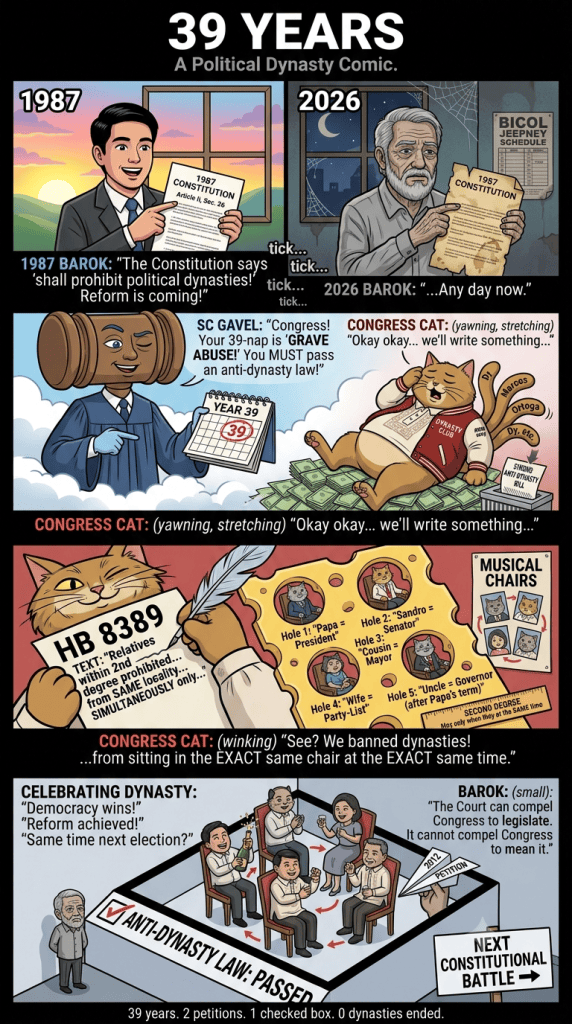
Waiting for a Jeepney at Midnight in Bicol
Fourteen years later, the Supreme Court has finally decided that waiting for Congress is like waiting for a jeepney at midnight in Bicol—it might come, but you’ll be dead by then. In a unanimous August 26, 2026 ruling, the Court declared that Congress’s 39-year failure to pass an anti-dynasty law constitutes “grave abuse of discretion.” Congress, the Court says, must legislate. “With utmost urgency.”
And I’m sitting here wondering: What the hell changed?
The Court Did Not Ban Dynasties. It Banned Waiting.
Let’s be clear about what actually happened. The Supreme Court did not ban political dynasties. It did not disqualify anyone. It did not even define what a dynasty is. It simply told a co-equal branch of government to do its job—after nearly four decades of that branch happily doing everything else except its job.
The Court’s logic is elegant, if constitutionally precarious: “Shall” means mandatory. “As may be defined by law” grants Congress discretion over the content of the prohibition, not the existence of one. Therefore, refusing to legislate for 39 years isn’t just lazy—it’s unconstitutional.
A Doctrinal Reversal With No Warning Label
This is a doctrinal reversal so dramatic it should come with a warning label. In 2012 and 2013, the Court said the opposite—twice. Biraogo v. COMELEC (G.R. No. 203603) established that the provision was non-self-executing. Guingona, Jr.. v. Congress (G.R. No. 203759, 2013) and Penson v. Congress (G.R. No. 205133, 2013) held that mandamus couldn’t compel Congress to legislate because that would violate separation of powers. The Court was very clear: We can’t make Congress do anything.
Now the Court says: Actually, we can, when the inaction becomes grave enough. When exactly does that line get crossed? Thirty-nine years, apparently. Not thirty-eight. Not forty. Thirty-nine. There’s no formula. Just a vibe, and the vibe is “we’re tired of waiting.”
Can You Review a Non-Decision?
The Court’s defenders will say: “But the 1987 Constitution expanded judicial power! Article VIII, Section 1 allows courts to review ‘grave abuse of discretion’ by any branch!” True. But that provision was designed to check actions, not inactions. You can review a decision. Can you review a non-decision? Can you mandamus a coordinate branch into exercising its core constitutional function—legislating—when the text of the provision itself says the definition comes “by law”?
This is the part where my inner skeptic starts twitching.
HB 8389: Musical Chairs With a Constitutional Alibi
The House of Representatives passed House Bill No. 8389 (HB 8389) on June 3, 2026, before the Court ruled. It was authored by Speaker Faustino “Bojie” Dy III and Majority Leader Ferdinand Alexander “Sandro” Marcos. The bill defines a political dynasty as “spouses or relatives within the second degree of consanguinity or affinity” simultaneously holding elective positions within the same locality.
- Second degree.
- Same locality.
- Simultaneous only.
That’s it. That’s the grand reform. Your father can be governor and you can be congressman in the same province—as long as you’re not simultaneously holding elective positions in the exact same jurisdiction. Your uncle can be mayor of one town while your cousin is mayor of the next town over. Your family can rotate offices like a well-oiled game of musical chairs, and as long as nobody’s sitting on the same chair at the same time, you’re golden.
Deputy Speaker Paolo Ortega called it “the most realistic” approach. Translation: “This is the weakest law we could write while still calling it an anti-dynasty law.”
Authored by the People Who Need It Least
And here’s the kicker: the bill was authored by the son of the sitting President and the Speaker from one of the country’s most entrenched political families. I’m sure their motives are pure. I’m sure the “most realistic” version just happens to preserve the exact political configurations that benefit them and their allies.
The Pulse Asia survey from March 2026 shows 64% of Filipinos support banning political dynasties. 76% of those want it to cover both national and local positions. The House version covers both—but only if you’re in the same locality. A father-son national-local combination? Perfectly legal. Party-list seats? The bill says nothing meaningful about them. Succession? The bill is silent.
The Court says Congress has discretion over “definition and scope.” Congress is using that discretion to define “dynasty” so narrowly that most of them probably qualify as non-dynastic.
Plausible Deniability in a Robe
The real genius of this ruling—if you want to call it genius—is that it gives the Supreme Court plausible deniability. The Court didn’t write the law. It didn’t say what the definition should be. It just said: “Congress, do something.” And Congress did something. Something weak. Something that technically checks the constitutional box while functionally preserving the status quo.
What’s the Court going to do now? Strike down the very law it compelled Congress to pass? That would be the judicial overreach of the century. Accept it? Then Article II, Section 26 becomes a constitutional promise fulfilled by a law that prohibits almost nothing.
The Court has maneuvered itself into a corner of its own making. It spent 39 years deferring to legislative discretion. Now it’s discovered that legislative discretion, exercised by people who benefit directly from the absence of regulation, produces laws designed to look like regulation while being the opposite.
I’d say I’m shocked, but I sued these people in 2012. I know exactly what Congress is capable of. The only surprise is that the Supreme Court finally noticed.
The Dynasty Continues. The Box Is Checked.
The ruling is being celebrated as a victory for democracy. I’m not so sure. What we have here is a judicial mandate for legislative action, met by a legislative response designed to satisfy the mandate without changing anything that matters. The Court has forced Congress to act. Congress has acted. The dynasty continues.
The Supreme Court can compel Congress to legislate. It cannot compel Congress to mean it.
That’s the constitutional law lesson for the ages. And it only took 39 years, two rejected petitions, and one glaringly obvious observation: You can’t reform a system from within by the people who benefit from the system remaining unreformed.
The Court has opened a door. Congress has walked through it, looked around, and decided to redecorate while leaving the structural foundation untouched.
Welcome to the Next Constitutional Battle
Welcome to the next constitutional battle: Is a weak anti-dynasty law still an anti-dynasty law?
My bet? The Court will find a way to say yes. Because the alternative—admitting that mandamus can force the act of legislation but not the substance—is an admission that judicial review has limits in the face of legislative self-preservation.
And that’s a truth the Court, like Congress, would rather not confront.
Louis “Barok” C. Biraogo is the author of the Kweba ni Barok blog. He has been writing critically about Philippine politics and governance since 2008 and was the petitioner in Biraogo v. COMELEC (G.R. No. 203603), the 2012 case that unsuccessfully sought to compel COMELEC to enforce the constitutional ban on political dynasties without an enabling law.
Key Citations
A. Legal & Official Sources
- The 1987 Constitution of the Republic of the Philippines. Official Gazette of the Republic of the Philippines, 1987, http://www.officialgazette.gov.ph/constitutions/1987-constitution/.
- Article II, Section 26. The 1987 Constitution of the Republic of the Philippines. Official Gazette of the Republic of the Philippines, http://www.officialgazette.gov.ph/constitutions/the-1987-constitution-of-the-republic-of-the-philippines/the-1987-constitution-of-the-republic-of-the-philippines-article-ii/.
- Article VIII, Section 1. The 1987 Constitution of the Republic of the Philippines. Official Gazette of the Republic of the Philippines, http://www.officialgazette.gov.ph/constitutions/the-1987-constitution-of-the-republic-of-the-philippines/the-1987-constitution-of-the-republic-of-the-philippines-article-viii/.
- Biraogo v. Commission on Elections. G.R. No. 203603, Supreme Court of the Philippines, 13 Nov. 2012 and 8 Jan. 2013, http://www.digest.ph/decisions/biraogo-v-commission-on-elections.
- Guingona, Jr., et al. v. House of Congress and Senate of the Republic of the Philippines. G.R. No. 203759, Supreme Court of the Philippines, 5 Feb. 2013.
- Penson v. Senate of the Philippines and House of Representatives. G.R. No. 205133, Supreme Court of the Philippines, 5 Feb. 2013.
- Supreme Court of the Philippines. Decision directing Congress to enact an anti-political dynasty law. Promulgated 26 Aug. 2026, announced 16 Sept. 2026.
- House Bill No. 8389. Anti-Political Dynasty Act. House of Representatives of the Philippines, passed on third reading 3 June 2026.
B. News Reports
- Casilao, Joahna Lei. “SC tells Congress: Enact anti-political dynasty law.” GMA News Online, GMA Network, 16 Sept. 2026, http://www.gmanetwork.com/news/topstories/nation/1002555/sc-tells-congress-enact-anti-political-dynasty-law/story/.
- Galvez, Daphne. “SC directs Congress: Pass anti-dynasty law.” Philstar.com, The Philippine Star, 17 Sept. 2026, http://www.philstar.com/headlines/2026/09/17/2556896/sc-directs-congress-pass-anti-dynasty-law.
- Reganit, Jose Cielito. “House passes anti-political dynasty bill on final reading.” Philippine News Agency, 3 June 2026, http://www.pna.gov.ph/articles/1276504.
- Panti, Llanesca T. “House passes anti-political dynasty bill on final reading.” GMA News Online, GMA Network, 3 June 2026, http://www.gmanetwork.com/news/topstories/nation/990094/house-dynasty-bill-historic-final-reading/story/.
- Mendoza, Red. “House anti-dynasty bill ‘most realistic,’ lawmaker says.” The Manila Times, 21 June 2026, http://www.manilatimes.net/2026/06/21/news/national/house-anti-dynasty-bill-most-realistic-lawmaker-says/2369516.
- Cabato, Luisa. “Pulse Asia: 64% of Filipinos back bill banning political dynasties.” Inquirer.net, 13 Mar. 2026, newsinfo.inquirer.net/2195151/pulse-asia-64-of-filipinos-back-bill-banning-political-dynasties.
- Merueñas, Mark. “It’s final: SC won’t compel Congress to enact anti-political dynasty law.” GMA News Online, GMA Network, 5 Mar. 2013, http://www.gmanetwork.com/news/topstories/nation/297800/it-s-final-sc-won-t-compel-congress-to-enact-anti-political-dynasty-law/story/.

- ₱8B BBM Pork: CCTV for Every Captain’s Kumpare?

- ₱8.9 Billion, 331 Ghost Police Stations: The TIKAS Scandal Explained

- ₱8.4 Billion, 42,000 Barangays, 1 Election: The “Bawat Barangay Makikinabang” Vote-Buying Masterclass

- ₱75 Million Heist: Cops Gone Full Bandit

- ₱6.77B Ghost Haunts Duterte: RTC Dismisses Mans Carpio’s Desperate Plea

- ₱6.77 Billion and Zero Cash: The Sara Duterte SALN Math That Doesn’t Add Up

- ₱6.7-Trillion Temptation: The Great Pork Zombie Revival and the “Collegial” Vote-Buying Circus

- ₱58.53B, Zero Receipts: The LGSF Pork Barrel Nobody Wants to Name
- ₱53 Million Man Tells ₱695-a-Day Workers to Stop Being ‘Mayabang’: The Audacity of BSP’s Remolona

- ₱4.4 Billion and a Witness Who Can’t Explain It: The Duterte Impeachment’s Most Expensive Non-Answer

- ₱3.06 Billion for Evacuation Centers—But Nobody Knows Where They’ll Stand (Or If They’ll Exist)

- ₱16 Billion, 280 Accounts, 8 Helicopters: Boying Remulla’s Case Against the Yaps Is Not a Drill








Leave a comment