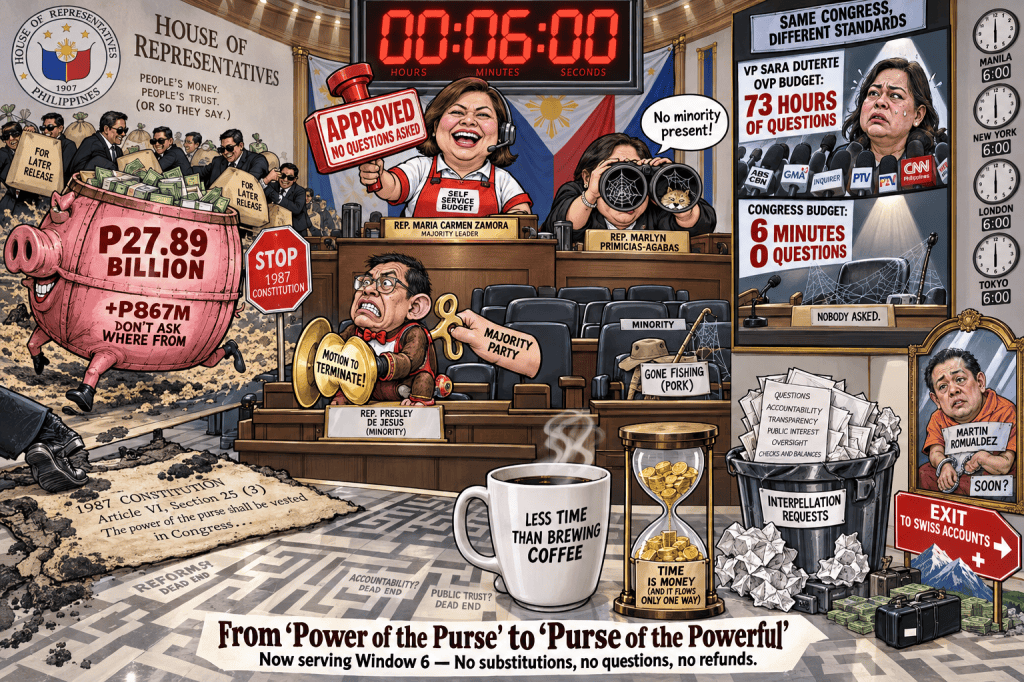
From “Power of the Purse” to “Purse of the Powerful”: A Six-Minute Masterclass in Self-Exemption
By Louis ‘Barok‘ C. Biraogo — September 18, 2026
IN A development that should surprise no one paying attention to Philippine politics, the House of Representatives has once again demonstrated that “checks and balances” is best understood as a suggestion rather than a mandate.
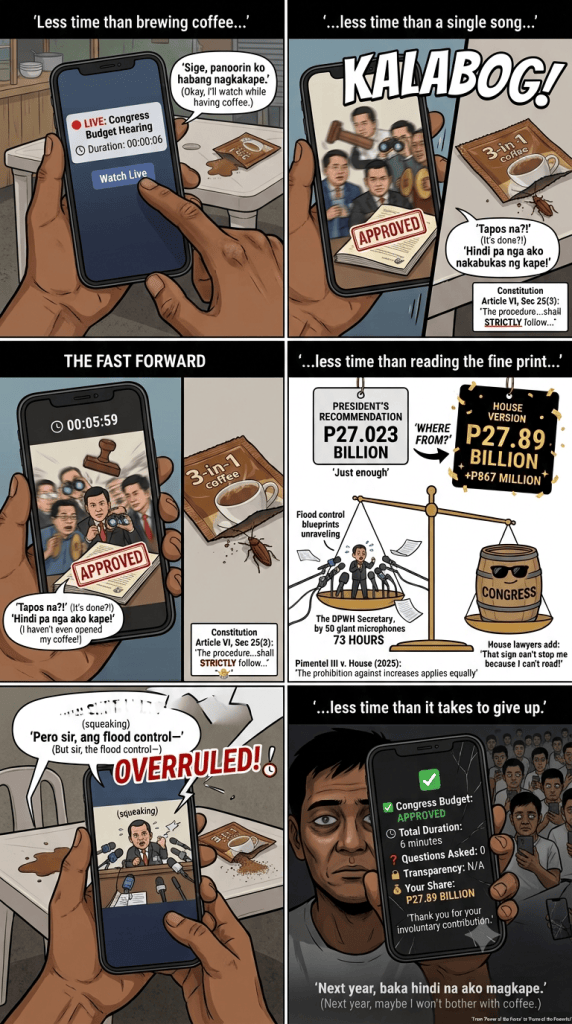
On September 17, 2026, the House terminated plenary deliberations on its own P27.89-billion budget for fiscal year 2027 without a single interpellation. The entire proceeding lasted approximately six minutes. That’s less time than it takes to brew a decent cup of coffee.
The details are almost too perfect to be satire. Davao de Oro Rep. Maria Carmen Zamora sponsored the budget. Pangasinan Rep. Marlyn Primicias-Agabas helpfully observed that no minority members were present to raise questions. Philreca party-list Rep. Presley de Jesus—a minority-side legislator—then moved to terminate the interpellation period. The motion was seconded by the majority, and Misamis Oriental Rep. Yevgeny Emano, presiding, asked if there were any objections. There were none. Because of course there weren’t.
The Constitutional Argument That Isn’t
The House did not just approve a budget without debate—it approved its own budget without debate. This is the institutional equivalent of a student grading his own exam, declaring a perfect score, and refusing to show the answer sheet.
Article VI, Section 25(3) of the 1987 Constitution of the Republic of the Philippines provides a rather inconvenient mandate:
“The procedure in approving appropriations for the Congress shall strictly follow the procedure for approving appropriations for other departments and agencies.”
The word “strictly” is doing a lot of work here, and the House has effectively decided it’s decorative.
When executive agencies face the appropriations committee, they endure hours—sometimes days—of questioning. The Department of Public Works and Highways (DPWH), for instance, is currently facing intense scrutiny over its proposed P643.95-billion budget and P107.4 billion for flood control projects, with concerns about insertions and For Later Release mechanisms.
But when the House considers its own budget? Six minutes. No questions. No objections. No problem.
The Math That Should Raise Eyebrows
The P27.89-billion figure deserves context. According to the Department of Budget and Management’s (DBM) FY2027 National Expenditure Program (NEP), the recommended Congress allocation was P27.023 billion. The House version is approximately P867 million higher than the President’s recommendation.
Article VI, Section 25(1) states:
“The Congress may not increase the appropriations recommended by the President for the operation of the Government as specified in the budget.”
This is the constitutional ceiling principle, and it’s fairly straightforward.
The Supreme Court’s December 2025 decision in Pimentel III v. House of Representatives addressed this exact limitation. Justice Caguioa’s separate opinion argued forcefully that the prohibition against increases applies equally to appropriations specified in the NEP, which “incontrovertibly serves as the ‘basis’ for the general appropriations bill itself.” The majority, however, focused on whether the violation occurred at the aggregate level.
The House will undoubtedly argue that any increase in its own allocation was offset elsewhere. But without interpellation, we don’t actually know. We don’t know where the extra P867 million came from. We don’t know what it’s for. We don’t know if it was offset by cuts elsewhere or if it pushed the total beyond constitutional limits. The six-minute approval ensures these questions remain unanswered.
The Minority’s Convenient Absence
Rep. Primicias-Agabas’s observation that “there were no minority members to raise questions” is presented as a neutral fact, but it raises more questions than it answers. Why were no minority members present? Was this a coordinated boycott? A scheduling conflict? Were they simply not interested in scrutinizing a budget that funds their own institution?
The most charitable interpretation is that the minority chose not to interpellate because committee-level scrutiny had been sufficient. The least charitable is that the majority deliberately scheduled the deliberation when minority members would be absent, or that minority members were discouraged from attending.
What complicates the narrative is that the motion to terminate came from Rep. Presley de Jesus, a minority-side legislator. It’s harder to argue the majority shut down the minority when a minority member himself moved to terminate. But it also raises a different question: why would a minority legislator cut off debate on his own institution’s budget? Was he protecting the institution? Protecting himself? Protecting colleagues from uncomfortable questions?
The Context That Makes This Worse
This six-minute approval did not happen in a vacuum. It happened against the backdrop of the most significant corruption scandal in recent Philippine history.
Former House Speaker Martin Romualdez—the President’s cousin—was arrested in September 2026 on charges of receiving P7.44 billion in kickbacks from flood control and infrastructure projects. The Office of the Ombudsman described him as “the central figure in a scheme built on the diversion of public funds meant for flood control projects.”
The scandal has implicated dozens of lawmakers, contractors, and local officials. A July 2026 Pulse Asia survey showed only 29% approval for the President, with 51% expressing distrust.
In this context, the House’s decision to approve its own budget without a single question is not merely a procedural irregularity. It is an act of institutional self-preservation at a moment when public scrutiny of congressional spending has never been more justified.
The “Parliamentary Courtesy” Canard
Defenders will invoke “parliamentary courtesy,” the practice of treating certain budgets—the Office of the President, the Office of the Vice President (OVP), and now apparently Congress itself—with minimal scrutiny as a gesture of institutional respect.
But parliamentary courtesy has limits. When the OVP faced budget deliberations, lawmakers grilled Vice President Sara Duterte over her confidential funds and budget utilization. The House even reduced the OVP’s budget as an apparent punishment for non-cooperation.
The contrast is stark. When scrutinizing a political adversary, the House is relentless. When scrutinizing itself, it is expedient.
The Pork Barrel That Refuses to Die
The six-minute approval also obscures the persistence of congressional insertions. Despite Belgica v. Ochoa declaring the Priority Development Assistance Fund (PDAF) unconstitutional, pork has merely evolved.
Rep. Antonio Tinio warned in August 2026 that the DPWH’s proposed budget would open the floodgates to congressional insertions, with projects not originally in the NEP being added and then held under For Later Release mechanisms. The Senate eClips reported that the House version of the 2026 budget contained at least P230 billion in pork barrel and patronage-based projects.
The six-minute approval of the Congress budget means that any similar insertions in that allocation—if they exist—remain hidden from public view.
What the Supreme Court Might Say
If challenged, the House will argue the absence of interpellation is an internal procedural matter, non-justiciable under the political question doctrine. They’ll cite Joker P. Arroyo v. Jose De Venecia (Arroyo v. De Venecia) and similar cases establishing judicial restraint on legislative proceedings.
But Article VI, Section 25(3) is not an internal rule—it’s a constitutional command. The word “strictly” is not advisory. And the Supreme Court has shown willingness to intervene when congressional actions violate constitutional fiscal requirements, as demonstrated in the PhilHealth fund transfer case and the Pimentel III v. House of Representatives decision.
In Belgica v. Ochoa, the Court held that appropriations must identify a determinate amount for a particular public purpose. A six-minute approval without interpellation produces zero public record of what the P27.89 billion is actually for. That’s not just bad governance—it’s a constitutional abdication.
The Institution That Cannot Govern Itself
Here’s the uncomfortable truth: Congress is currently demanding rigorous scrutiny of every executive agency’s budget. Lawmakers are poring over the DPWH’s flood control allocations, questioning the OVP’s confidential funds, and threatening budget cuts for agencies that can’t justify their expenditures.
Meanwhile, the institution doing the scrutinizing has exempted itself from scrutiny entirely.
This is not a partisan observation. It is a structural critique. The House is simultaneously the appropriator, the beneficiary, the scrutinizer, and the subject of the appropriation. This creates an inherent conflict of interest that demands heightened transparency, not diminished transparency.
Instead, the House chose the path of least resistance and maximum insulation. Six minutes. No questions. No objections. Approved.
What Should Happen Next
The Senate will eventually review the Congress budget as part of the bicameral process. The Senate Finance Committee could subject the allocation to the scrutiny the House denied. But institutional comity may prevent aggressive challenges to the House’s own budget, especially when the Senate’s allocation is part of the same package.
The Commission on Audit (COA) will eventually audit actual expenditures. But post-audit accountability is no substitute for pre-appropriation deliberation. By the time COA finds irregularities, the money has already been spent.
Civil society organizations and taxpayer groups could file a certiorari petition challenging the constitutionality of the process. The Belgica v. Ochoa precedent provides standing for citizens to challenge unconstitutional appropriations. But litigation is slow, and by the time the Supreme Court rules, the 2027 budget will likely have been executed.
The Real Question
The six-minute approval of the Congress budget is not an isolated incident. It is the logical culmination of a political culture in which accountability is something demanded of others but never applied to oneself.
The House of Representatives has determined that its own spending deserves less scrutiny than the agencies it oversees. It has decided that the constitutional mandate of “strict” procedural parity is expendable when the subject is Congress itself.
This is not efficiency. It is not parliamentary courtesy. It is not institutional self-respect.
It is the institution that wrote the rules deciding that the rules don’t apply to it.
And that, more than any single budget allocation, is the problem.
Key Citations
A. Legal & Official Sources
- The 1987 Constitution of the Republic of the Philippines. Official Gazette of the Republic of the Philippines, 1987, http://www.officialgazette.gov.ph/constitutions/the-1987-constitution-of-the-republic-of-the-philippines/the-1987-constitution-of-the-republic-of-the-philippines-article-vi/.
- National Expenditure Program Volume I FY 2027. Department of Budget and Management, 11 Aug. 2026, http://www.dbm.gov.ph/index.php?view=article&id=4137:national-expenditure-program-volume-i-fy-2027&catid=446.
- Aquilino Pimentel III et al. v. House of Representatives et al. G.R. Nos. 274778, 275405 and 276233. Supreme Court of the Philippines, 3 Dec. 2025, sc.judiciary.gov.ph/press-briefer-december-05-2025/.
- Caguioa, Alfredo Benjamin S. Concurring Opinion. Aquilino Pimentel III et al. v. House of Representatives et al., G.R. Nos. 274778, 275405 and 276233, Supreme Court of the Philippines, 3 Dec. 2025, sc.judiciary.gov.ph/wp-content/uploads/2025/12/274778-CAGUIOA.pdf.
- Greco Antonious Beda B. Belgica v. Honorable Executive Secretary Paquito N. Ochoa, Jr. G.R. No. 208566. Supreme Court of the Philippines, 19 Nov. 2013, lawphil.net/judjuris/juri2013/nov2013/gr_208566_2013.html.
- Joker P. Arroyo v. Jose De Venecia. G.R. No. 127255. Supreme Court of the Philippines, 14 Aug. 1997, lawphil.net/judjuris/juri1997/aug1997/gr_127255_1997.html.
B. News Reports
- Cruz, James Patrick. “DPWH Seeks P644-Billion Budget for 2027. How Does It Plan to Spend It?” Rappler, 17 Aug. 2026, http://www.rappler.com/philippines/dpwh-proposed-budget-2027/.
- Untalan, Sherylin. “₱107.4B Earmarked for Flood Control Projects in Proposed 2027 Budget.” GMA News Online, GMA Network, 11 Aug. 2026, http://www.gmanetwork.com/news/topstories/nation/998109/107-4b-earmarked-for-flood-control-projects-in-proposed-2027-budget/story/.
- Panti, Llanesca T. “Ombudsman Files Plunder Charges vs Martin Romualdez over Flood Control Projects.” GMA News Online, GMA Network, 7 Sept. 2026, http://www.gmanetwork.com/news/topstories/nation/1001410/ombudsman-files-plunder-charges-vs-martin-romualdez-over-flood-control-projects/story/.
- “Pulse Asia: Marcos Trust Rating Drops to 28%; Sara Duterte Steady at 58%.” GMA News Online, GMA Network, 20 July 2026, http://www.gmanetwork.com/news/topstories/nation/995468/pulse-asia-marcos-trust-rating-drops-to-28-sara-duterte-steady-at-58/story/.
- Panti, Llanesca T. “House Cuts OVP’s 2026 Budget to P733M.” GMA News Online, GMA Network, 2025, http://www.gmanetwork.com/news/topstories/nation/961983/house-cuts-ovp-s-2026-budget-to-p733m/story/.
- “P230-B ‘Pork’ in House Version of 2026 Budget.” Philippine Daily Inquirer, 8 Oct. 2025, newsinfo.inquirer.net/2121189/p230-b-pork-in-house-version-of-2026-budget.

- “Ang Hirap Maging Mahirap”: The PAO Scandal That Proves Government Contempt Is Nothing New
- “Far-Off” My Axx: Malacañang’s Claire Castro Drowns in Her Own Legal Gaslighting
- “Forthwith” to Farce: How the Senate is Killing Impeachment—And Why Enrile’s Right (Even If You Can’t Trust Him)
- “HINDI AKO NAG-RESIGN!”

- “I Know Nothing”: Baste Duterte’s Amnesia Defense Meets ₱33M in GenCorp Contracts

- “I’m calling you from my new Globe SIM. Send load!”

- “Mahiya Naman Kayo!” Marcos’ Anti-Corruption Vow Faces a Flood of Doubt

- “Manageable” Debt, Unmanageable Lies: DBM’s ₱21 Trillion Fairy Tale
- “Meow, I’m calling you from my new Globe SIM!”

- “Natrabaho”: One Word, One Ombudsman, and a Judiciary on Trial
- “No Special Jail for Crooks!” Boying Remulla Slams VIP Perks for Flood Scammers

- “Philippine-Controlled” or Yankee Gas Station? The Davao Fuel Depot Farce Exposed





Leave a comment