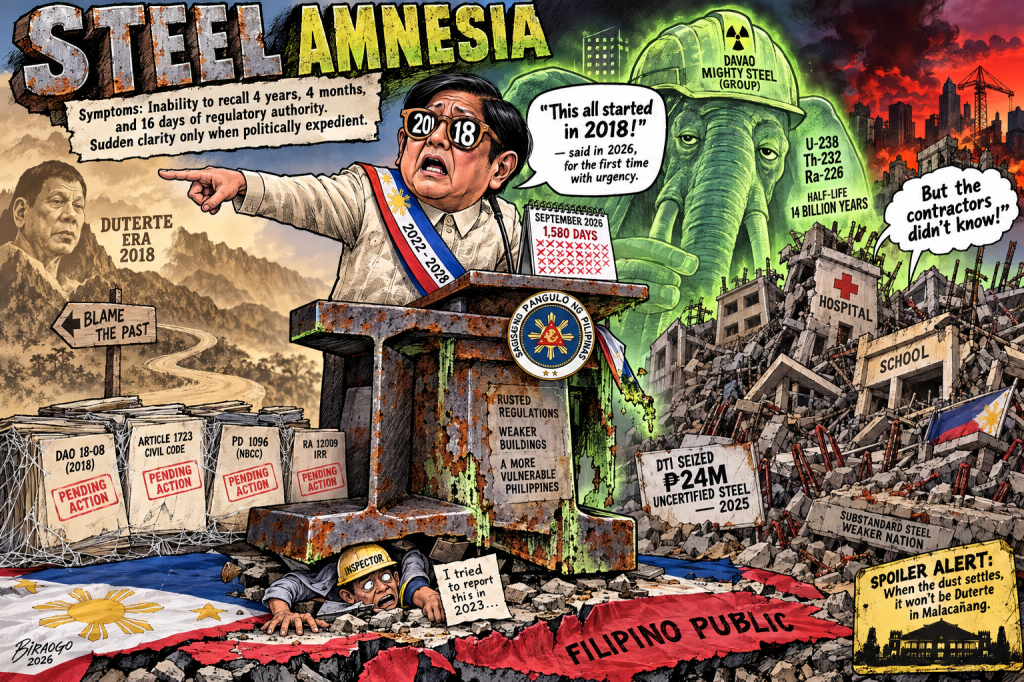
Four Years, Zero Action: How Malacañang Discovered a Crisis It Was Already Sitting On
By Louis “Barok” C. Biraogo — September 16, 2026
MALACAÑANG, Philippines — President Ferdinand “Bongbong” Marcos Jr. recently stood before the nation and, with the grave solemnity of a man who has just discovered fire, announced that the substandard steel trade “proliferated as early as 2018,” comparing it to the Philippine Offshore Gaming Operators (POGO) scourge and pointing a trembling finger at the Duterte years.
It was, we are told, a moment of presidential clarity. A reckoning. A leader finally exposing the rot inherited from his predecessor.
There is only one small problem. It requires the audience to forget that Bongbong Marcos has been President since June 30, 2022. That is four years, four months, and roughly sixteen days of regulatory authority that the current occupant of Malacañang seems to have misplaced somewhere between his last junket and his next YouTube vlog.
Let us do the math, because the Marcos communications team apparently hopes nobody will.
The President says the problem “started in 2018” under Rodrigo Duterte. Fine. We accept the premise. The Department of Trade and Industry (DTI) was indeed investigating substandard steel as early as 2018, when Department Administrative Order (DAO) 18-08 mandated certification for deformed steel bars. The Philippine Iron and Steel Institute (PISI) was sounding alarms.
But here is the question Malacañang’s press releases conveniently omit: What did Bongbong Marcos do about it from 2022 to 2026?
The answer, based on available evidence, appears to be: precisely nothing of consequence until an National Bureau of Investigation (NBI) raid in August 2026 uncovered radioactive materials in a Davao steel plant and suddenly made substandard steel the hottest political commodity since Sara Duterte’s confidential funds.
The President now exonerates contractors wholesale, declaring they “may not be aware” and “generally followed approved plans.” He blames inspectors instead—simultaneously protecting the construction industry (whose campaign contributions flow generously to both sides) while scapegoating the bureaucratic layer least capable of mounting a political counterattack.
Under Article 1723 of the Civil Code, the contractor is liable if a building collapses within fifteen years because of defective construction or inferior materials he furnished; the engineer or architect who prepared the plans is likewise liable for collapse caused by defective plans or ground conditions, and is solidarily liable with the contractor if he supervised the work. Presidential Decree (PD) 1096 requires construction to meet Code standards and approved specifications and obliges the owner to engage a licensed architect or civil engineer for full-time inspection and supervision, including recording of tests. Under Republic Act (RA) 12009, the New Government Procurement Act, the Implementing Rules and Regulations (IRR) specifically distinguishes liability among contractors, consultants, and procuring-entity representatives based on where the structural failure originated.
The law does not say: “Contractor good, inspector bad.” The law says: “Who knew what, when did they know it, what duty did they have, and what did they do about it?”
Marcos’s simplistic narrative collapses under the weight of its own legal illiteracy. But then again, this is a man who once promised to “look into” the flood control scandal and then promptly forgot it existed until the next flood.
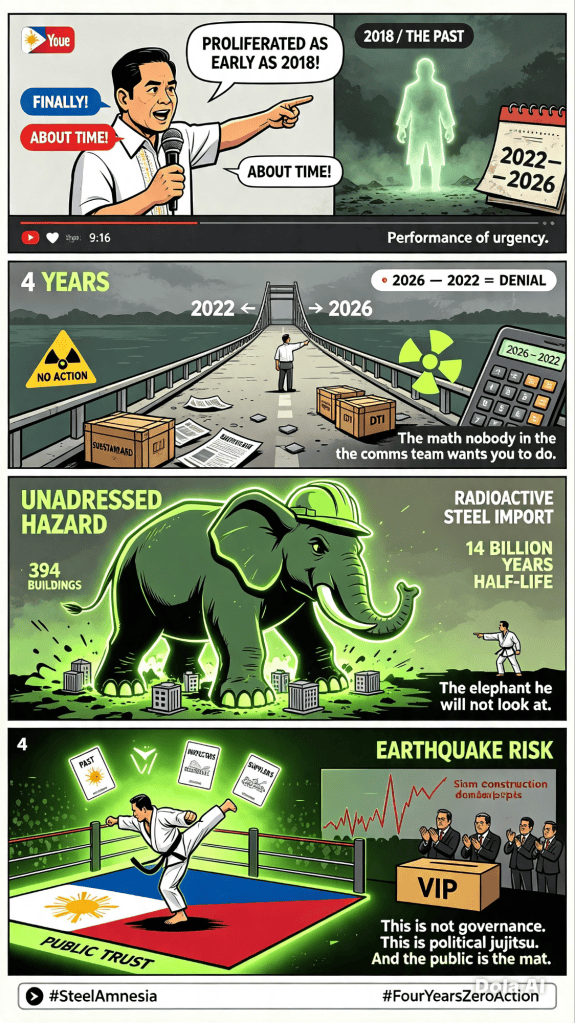
The Radioactive Elephant in the Room
Let us now address the detail that should terrify every Filipino but has been buried beneath the political horse-racing: the radioactive materials found at Davao Mighty Steel.
We are not talking about trace contamination. We are talking about uranium, thorium, and radium isotopes—elements with no business in a commercial steel plant, let alone in reinforcing bars destined for schools, hospitals, and residential buildings.
The international metal recycling industry has documented this nightmare for decades. When orphan radioactive sources—discarded medical equipment, industrial gauges, forgotten nuclear materials—enter the scrap metal stream, they can contaminate entire production batches. Thorium-232, once purified, has a half-life of 14 billion years. It does not “go away.” It sits inside the steel, emitting alpha and gamma radiation, slowly accumulating decay products that increase exposure over time. Inhaled thorium dust can remain in the lungs for years, increasing cancer risk.
The Philippine Nuclear Research Institute (PNRI) reportedly determined that Davao Mighty Steel did not possess the necessary authorization to handle these materials. This is not a regulatory oversight. This is a radiological incident with national security implications.
And yet the President’s public statements focus on the political blame game. The radioactive contamination—the detail that transforms this from a construction safety story into a public health emergency—receives a passing mention at best.
Why? Because radioactive steel is not a partisan issue. It does not fit neatly into the “Duterte bad, Marcos good” narrative. It implicates the entire regulatory state—PNRI, DTI, Customs, Department of Environment and Natural Resources (DENR), the local government of Davao—across multiple administrations. It demands systemic reform, not political theater.
And systemic reform is not what Bongbong Marcos does.
The Bully Pulpit and the Art of Political Distraction
There is a term for what the President is doing: abuse of the bully pulpit.
The Philippine presidency comes with a virtually monopolistic platform for shaping public discourse. When the President speaks, the media reports. When he frames an issue, that framing dominates the national conversation. This platform can be used to define the issues of any controversy involving public interest—or to deflect, distract, and blame-shift.
Marcos is using the bully pulpit not to solve the steel crisis, but to weaponize it. By anchoring the narrative in 2018, he accomplishes three political objectives:
- First, he distances himself from the problem. If the steel trade “started under Duterte,” then Marcos is the reformer cleaning up his predecessor’s mess. Never mind that his own DTI seized P24 million worth of uncertified steel bars in 2025—acknowledging the problem existed on his watch.
- Second, he targets Davao. Davao Mighty Steel is located in Davao City—Rodrigo Duterte’s political fortress. The raid, the arrests, the radioactive revelations—all carry symbolic weight in the ongoing Marcos-Duterte cold war. The message: “I can reach into your stronghold and find your skeletons.”
- Third, he protects his business allies. By exonerating contractors, Marcos shields the construction industry—a sector with deep political connections and generous campaign donations—from accountability. The scapegoats are “inspectors,” a diffuse category of mid-level bureaucrats who lack the resources to mount an effective political defense.
This is not governance. This is political jujitsu. And the Filipino public, as usual, is the mat.
The Duterte Counter-Narrative That Marcos Cannot Escape
The Duterte camp has a devastating response available, and it is only a matter of time before they deploy it:
“If the problem was known since 2018, and you have been President since 2022, why did it take you four years to act?”
This question has no good answer. The Marcos administration cannot claim ignorance—the DTI under his watch was already seizing uncertified steel. They cannot claim lack of authority—the regulatory framework was extensive. They cannot claim lack of resources—the NBI and Presidential Anti-Organized Crime Commission (PAOCC) conducted raids across twenty plants in 2026 with apparent ease.
What they can claim is lack of political will until the political calculus changed. Until Sara Duterte’s impeachment trial created an opportunity to damage the Duterte brand. Until the radioactive revelations transformed steel from a regulatory footnote into a national security story.
The steel crisis is not a story of Duterte-era corruption. It is a story of institutional failure across multiple administrations, exploited by the current occupant of Malacañang for partisan advantage.
What Real Accountability Would Look Like
If President Marcos were serious—rather than merely using the crisis as a political cudgel—he would:
- First, establish an independent investigative body with subpoena power, forensic accounting capabilities, and authority to follow the evidence wherever it leads—including into Malacañang’s own procurement records.
- Second, publish the chain of custody. The NBI reportedly linked Davao Mighty Steel to 394 damaged buildings. But correlation is not causation. The government must release raw data: sample sizes, testing methodologies, structural engineering findings, seismic intensity measurements, construction dates, concrete strength results. Without this, “70%” is a political statistic, not a scientific finding.
- Third, address the radioactive contamination as the emergency it is. Every worker at Davao Mighty Steel must receive comprehensive medical screening. Every building containing suspect steel must undergo radiological testing. The surrounding community must be assessed. This is the minimum obligation of a government that claims to care about public safety.
- Fourth, reform the regulatory architecture. The current system fragments responsibility across DTI-Bureau of Philippine Standards (BPS), Department of Public Works and Highways (DPWH), Local Government Units (LGUs), PNRI, Customs, and the Ombudsman. This creates accountability gaps where each agency blames the others. The Philippines needs a consolidated steel safety regime with clear lines of responsibility and real penalties.
- Fifth, stop playing politics with public safety. The Filipino people do not care which political dynasty created the problem. They care whether the buildings they live in, work in, and send their children to will survive the next earthquake.
The Bottom Line
President Marcos’s assertions about the substandard steel trade are partially factual, politically motivated, and legally incomplete. The 2018 timeline is supported by evidence. The Duterte-era proliferation is plausible. But the President’s attempt to frame this as a simple story of inherited corruption ignores the inconvenient reality that he has been the steward of the regulatory state for over four years.
The steel crisis is not a Duterte scandal. It is not a Marcos scandal. It is a Philippine governance scandal—a story of overlapping jurisdictions, captured regulators, incentivized corruption, and a political class that treats public safety as a bargaining chip in elite power struggles.
The radioactive materials found in Davao Mighty Steel are a warning. They tell us that the consequences of regulatory failure do not respect political timelines. They will sit in the walls of hospitals, schools, and homes for decades, waiting.
Bongbong Marcos can blame Rodrigo Duterte. He can blame the inspectors. He can blame the contractors. He can blame anyone except the one person who has had the power to fix it since 2022.
But when the next earthquake hits, and the buildings crumble, and the radioactive dust settles—the Philippines will remember who was in Malacañang when the warnings were loudest and the action was weakest.
Spoiler alert: It won’t be Rodrigo Duterte.
Louis “Barok” C. Biraogo runs Kweba ni Barok, where Philippine politics gets the autopsy it deserves. Davao-born, UP Diliman-educated, and permanently allergic to political dynasties. No paid advertisements from steel manufacturers—radioactive or otherwise.
Key Citations
A. Reports & Studies
- National Bureau of Investigation. “NBI Files Cases VS Davao Mighty for Radioactive, Substandard Steel Products.” NBI.gov.ph, 18 Aug. 2026, https://nbi.gov.ph/press_releases/2026/08182026/11040/.
- Department of Trade and Industry. “DTI seizes ₱1.6M in uncertified steel bars to protect Filipino homes.” DTI.gov.ph, 12 Feb. 2026, https://www.dti.gov.ph/dti-latest-news/dti-seizes-%E2%82%B11-6m-uncertified-steel-bars-protect-filipino-homes.
- International Atomic Energy Agency. “Orphan Sources.” IAEA.org, https://www.iaea.org/topics/orphan-sources.
B. News Articles
- “Marcos Jr. sworn in as PH’s 17th president”
Philippine News Agency, 30 June 2022
https://www.pna.gov.ph/articles/1177892 - “Radioactive materials found at Davao steel plant; NBI, PAOCC rescue 174 workers.” Manila Bulletin, 14 Aug. 2026, https://mb.com.ph/2026/08/14/radioactive-materials-found-at-davao-steel-plant-nbi-paocc-rescue-174-workers.
- “20 other steel plants under surveillance for possible violations – NBI.” Inquirer.net, 26 Aug. 2026, https://newsinfo.inquirer.net/2291933/20-other-steel-plants-under-surveillance-for-possible-violations-nbi.
- Villeza, Mark Ernest. “Davao steel plant raided; radioactive materials found.” Philstar.com, 15 Aug. 2026, https://www.philstar.com/nation/2026/08/15/2549308/davao-steel-plant-raided-radioactive-materials-found.
C. Legal & Official Sources
- Republic of the Philippines. Civil Code of the Philippines, Republic Act No. 386, Art. 1723. Legal Resource PH, https://library.legalresource.ph/title-viii-lease-book-iv-civil-code/.
- Republic of the Philippines. Presidential Decree No. 1096, s. 1977 (National Building Code of the Philippines). Official Gazette, 19 Feb. 1977, https://www.officialgazette.gov.ph/1977/02/19/presidential-decree-no-1096-s-1977/.
- Republic of the Philippines. The Implementing Rules and Regulations of Republic Act No. 12009 or The New Government Procurement Act. Official Gazette, 10 Feb. 2025, https://www.officialgazette.gov.ph/2025/02/10/the-implementing-rules-and-regulations-of-republic-act-no-12009-or-the-new-government-procurement-act/.
- Department of Trade and Industry, Bureau of Philippine Standards. Department Administrative Order No. 18-08, Series of 2018. https://bps.dti.gov.ph/component/edocman/7-laws-and-issuances/11-department-administrative-orders/257-dao-18-08-series-of-2018-on-steel-products-pdf.
- “Thorium.” Encyclopaedia Britannica, https://www.britannica.com/science/thorium.
- “Ang Hirap Maging Mahirap”: The PAO Scandal That Proves Government Contempt Is Nothing New

- “Far-Off” My Axx: Malacañang’s Claire Castro Drowns in Her Own Legal Gaslighting
- “Forthwith” to Farce: How the Senate is Killing Impeachment—And Why Enrile’s Right (Even If You Can’t Trust Him)
- “HINDI AKO NAG-RESIGN!”

- “I Know Nothing”: Baste Duterte’s Amnesia Defense Meets ₱33M in GenCorp Contracts
- “I’m calling you from my new Globe SIM. Send load!”

- “Mahiya Naman Kayo!” Marcos’ Anti-Corruption Vow Faces a Flood of Doubt

- “Manageable” Debt, Unmanageable Lies: DBM’s ₱21 Trillion Fairy Tale
- “Meow, I’m calling you from my new Globe SIM!”

- “Natrabaho”: One Word, One Ombudsman, and a Judiciary on Trial
- “No Special Jail for Crooks!” Boying Remulla Slams VIP Perks for Flood Scammers

- “Philippine-Controlled” or Yankee Gas Station? The Davao Fuel Depot Farce Exposed




Leave a Reply