
My testimony is not for sale. The system, however, remains open for business.
By Louis ‘Barok‘ C Biraogo | September 15, 2026
LET’S walk through this, slowly, for the people in the back.
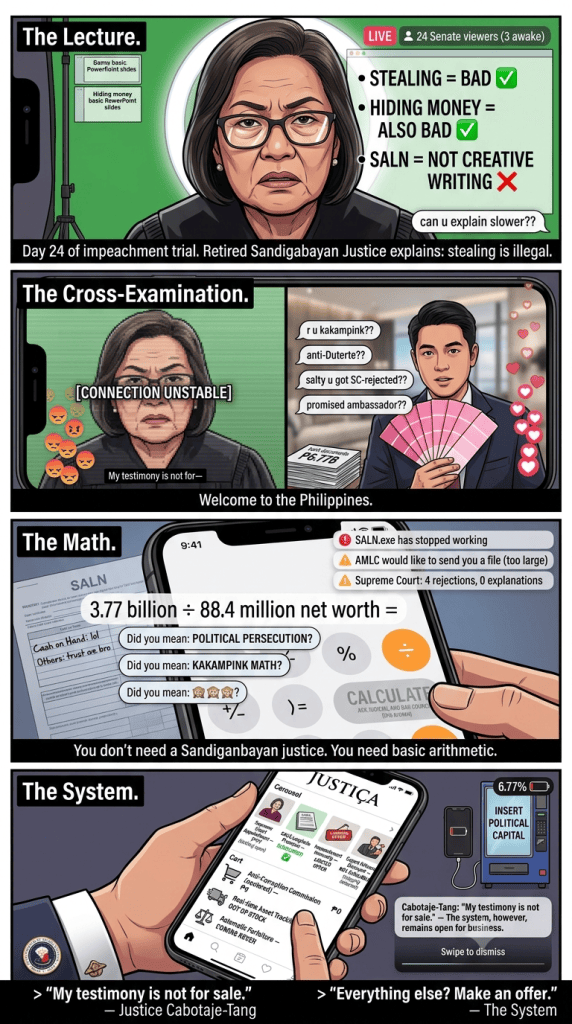
The Republic of the Philippines spent Day 24 of a Senate impeachment trial listening to a retired judge explain, for several hours, that stealing is, in fact, illegal.
Retired Sandiganbayan Presiding Justice Amparo Cabotaje-Tang took the witness stand on Monday to deliver what the prosecution generously termed “expert testimony” on unexplained wealth. She explained Article VII, Section 13 of the 1987 Constitution of the Republic of the Philippines (1987 Constitution). She explained Republic Act No. 1379 (An Act Declaring Forfeiture in Favor of the State Any Property Found to Have Been Unlawfully Acquired by Any Public Officer or Employee). She explained Republic Act No. 3019 (Anti-Graft and Corrupt Practices Act). She explained that hiding money through dummies is bad, that repeated Statement of Assets, Liabilities, and Net Worth (SALN) omissions might indicate concealment, that a spouse’s assets can be examined if the spouse lacks independent financial capacity.
In other words, a lecture any first-year law student at San Beda — where she teaches — could have given after one semester of Political Law.
And the defense spent cross-examination asking whether she was a “Kakampink.”
Welcome to the Philippines, where the question isn’t whether you broke the law, but whether you’re politically affiliated with the people who might hold you accountable.
The Kabuki Theatre of Accountability
The prosecution called Cabotaje-Tang not because she has personal knowledge of Sara Duterte’s finances — she explicitly admitted she doesn’t. They called her because they needed someone with a fancy title to say, “Here is what the law says,” before dumping bank records on senator-judges.
Smart strategy. Also an indictment of the entire system.
In a functioning democracy, you don’t need a retired Sandiganbayan justice to explain that hiding wealth is illegal. You need that explained only if you’ve spent your career in a political culture where the SALN is a creative writing exercise and “unexplained wealth” is a lifestyle choice.
The fact that her testimony was considered “expert” rather than blindingly obvious tells you everything about governance in this country.
The Convenient Silence of the Technocrats
Cabotaje-Tang — 44 years in law, chaired the Office of the Solicitor General (OSG) task force hunting Marcos ill-gotten wealth, Sandiganbayan Presiding Justice for over a decade — delivered a legal lecture carefully avoiding naming names.
She described the framework: dummies, nominees, proxies. The evidentiary standards: preponderance, Rabusa, Ligot. The five-year omission standard. But she also said explicitly she had no personal knowledge of whether Duterte had unexplained wealth, no knowledge of undeclared properties, and wasn’t there to render conclusions of fact or law.
Translation: She gave the prosecution a legal map, sanitized of actual accusations.
This is institutionalized corruption in its most sophisticated form. Not just the stealing — the entire ecosystem of legal professionals providing intellectual cover while maintaining plausible deniability. The prosecution can say, “We presented an expert.” The defense can say, “She admitted she knows nothing.” And the public watches a legal seminar while the actual evidence sits in boxes, waiting to be “authenticated” by officials who will also carefully avoid conclusions.
The AMLC Numbers Are Screaming. Nobody Is Listening.
The Anti-Money Laundering Council (AMLC) reported P6.77 billion in covered and suspicious transactions tied to Sara Duterte and Manases Carpio. P3.77 billion to Duterte’s accounts. P2.99 billion to Carpio’s.
For context: Duterte’s declared net worth in 2024 was P88.4 million. Her salary as Vice President is roughly P1.5 million yearly.
You don’t need a Sandiganbayan justice to tell you P3.77 billion doesn’t reconcile with P88.4 million. You need basic arithmetic.
Cabotaje-Tang made a point that cuts both ways: Money deposited and withdrawn before December 31 doesn’t appear in a SALN because the asset no longer exists. Technically correct. Also the loophole through which entire fortunes flow. Move P500 million through your account in January, withdraw in November — your December 31 SALN shows nothing.
This is not a bug. It’s the feature. The SALN was never designed to catch sophisticated concealment. It was designed to create the appearance of transparency while providing escape hatches for those who know how to use them.
The “Kakampink” Defense: When Accountability Is a Political Attack
Mark Vinluan asked Cabotaje-Tang whether she was “anti-Duterte.” Whether she was a “Kakampink.” Whether she was disappointed Rodrigo Duterte didn’t appoint her to the Supreme Court despite her applications. Whether she was promised an ambassadorial post.
Her response: “My testimony is not for sale, sir.”
Powerful. Also irrelevant.
The “political bias” defense is unfalsifiable. You can’t prove you’re not biased. You can only deny it, and then the defense says, “She would say that, wouldn’t she?”
This is the strategy in every high-profile corruption case. Don’t engage the evidence. Don’t address the numbers. Don’t explain the P6.77 billion. Attack the messenger. Make it about personalities, not principles.
It works because the public is exhausted, the media loves a horse race more than a forensic audit, senator-judges are politicians first and jurors second — and because Cabotaje-Tang’s testimony was, by her own admission, purely theoretical. The defense can now say, “Even the prosecution’s own expert admits she doesn’t know if Sara did anything wrong.”
The Systemic Rot Beneath the Surface
Cabotaje-Tang applied for the Supreme Court four times. Shortlisted in 2018 and twice in 2019, all under Rodrigo Duterte. Never appointed.
The defense wants us to believe this is a motive for revenge. Maybe. But here’s a better question: Why was she never appointed?
Because she wasn’t politically aligned enough? Because she had a reputation for independence? Because she actually prosecuted corruption rather than protecting the corrupt?
We’ll never know. The Judicial and Bar Council (JBC) process is opaque. Presidential appointments are political. And the message to every judge is clear: If you want promotion, don’t be too independent. Don’t make powerful enemies.
This is how institutional corruption perpetuates itself. Not just through bribes, but through the quiet neutering of institutions supposed to hold the corrupt accountable. The Sandiganbayan. The Ombudsman. The Supreme Court. The Senate. Each staffed with people who understand there are limits to how far you can go.
Cabotaje-Tang was a rare exception — someone who rose to the top and apparently maintained her integrity. Her reward: four Supreme Court rejections and a summons to testify in a political circus while the defense calls her a Kakampink.
What Reforms? The Ones Nobody Will Implement
The Philippines has been “reforming” anti-corruption for decades. We have RA 1379. RA 3019. Republic Act No. 6713 (The Code of Conduct and Ethical Standards for Public Officials and Employees). The Ombudsman. The Sandiganbayan. The AMLC. The SALN.
And corruption so systemic it’s become a form of government.
And because every corruption exposé needs a reform section, here’s mine — filed under ‘Won’t Happen’:
- Real-time asset tracking, not annual SALNs. The SALN is a snapshot anyone can manipulate. We need real-time reporting of significant transactions — a publicly accessible database that updates automatically. If you don’t want your wealth scrutinized, don’t run for Vice President.
- Automatic forfeiture, not endless litigation. RA 1379 creates a presumption of unlawful acquisition when wealth is disproportionate. But the burden shifts to the government to prove the operative act. This is backwards. If you have P3.77 billion in transactions on a P1.5 million salary, the burden should be on you to explain. If you can’t, the money goes back to the state.
- Independent anti-corruption commission with real teeth. The Ombudsman is politically vulnerable. The Sandiganbayan is slow and under-resourced. We need a commission that can investigate, prosecute, and seize assets without fear of retaliation — properly funded.
- SALN perjury as a serious crime. Filing a false SALN is perjury. Nobody ever gets prosecuted. If we treated SALN violations as seriously as drug offenses, maybe officials would think twice before omitting P30 million in firearms.
- Public financing of campaigns and strict donation limits. Much money flowing through Philippine politics is laundered through campaign contributions. Reduce the money, reduce the corruption.
None of these will happen. Not because they’re bad ideas, but because the people who would implement them benefit from the current system.
The Bottom Line: We’re All Watching the Same Show
The Sara Duterte impeachment trial is not a trial. It’s a performance. The prosecution performs outrage. The defense performs victimhood. The senator-judges perform deliberation. The media performs scrutiny. The public performs belief that any of this will result in accountability.
Cabotaje-Tang’s testimony was part of that performance — a legal framework delivered by a credible witness who carefully avoided anything that could be construed as an accusation. The defense attacked her credibility with insinuations about bias and disappointed ambition. The court allowed it all, because rules of evidence are “liberally construed” in impeachment — a fancy way of saying anything goes.
Meanwhile, the P6.77 billion sits there, waiting to be authenticated. The SALN omissions wait to be explained. The corporate records wait to be traced. And the question nobody wants to ask — the question Cabotaje-Tang’s testimony carefully avoided — remains unanswered:
If Sara Duterte had P3.77 billion moving through her accounts over two decades, and her declared net worth is P88.4 million, where did the money come from, and why didn’t anyone notice until now?
The answer: Plenty noticed. The banks. The AMLC. The Securities and Exchange Commission (SEC). But noticing isn’t acting. And acting requires institutions that work — institutions systematically weakened, politicized, and neutered over generations.
Cabotaje-Tang testified that unexplained wealth is a ground for removal under RA 3019. She’s right. But the fact that this needs explaining — in a Senate impeachment trial, in 2026, in a country fighting corruption since before she was born — tells you everything about why the fight is being lost.
My testimony is not for sale. The system, apparently, is.
Louis ‘Barok’ C Biraogo is a writer and recovering optimist who blogs at Kweba ni Barok. He has been disappointed by Philippine politics since 1986 and sees no reason to stop now.
Key Citations
A. Legal & Official Sources
- The 1987 Constitution of the Republic of the Philippines. Official Gazette of the Republic of the Philippines, 1987, http://www.officialgazette.gov.ph/constitutions/1987-constitution/.
- The 1987 Constitution of the Republic of the Philippines – Article VII. Official Gazette of the Republic of the Philippines, http://www.officialgazette.gov.ph/constitutions/the-1987-constitution-of-the-republic-of-the-philippines/the-1987-constitution-of-the-republic-of-the-philippines-article-vii/.
- Republic Act No. 1379. An Act Declaring Forfeiture in Favor of the State Any Property Found to Have Been Unlawfully Acquired by Any Public Officer or Employee and Providing for the Proceedings Therefor. 18 June 1955, lawphil.net/statutes/repacts/ra1955/ra_1379_1955.html.
- Republic Act No. 3019. Anti-Graft and Corrupt Practices Act. 17 Aug. 1960, http://www.officialgazette.gov.ph/1960/08/17/republic-act-no-3019/.
- Republic Act No. 6713. An Act Establishing a Code of Conduct and Ethical Standards for Public Officials and Employees. 20 Feb. 1989, http://www.officialgazette.gov.ph/1989/02/20/republic-act-no-06713/.
- Republic of the Philippines v. Lt. Col. George Abonito Rabusa, et al. G.R. No. 208183, 31 Aug. 2022, lawphil.net/judjuris/juri2022/aug2022/gr_208183_2022.html.
- Heirs of Gen. Jacinto C. Ligot v. Republic of the Philippines. Supreme Court E-Library, elibrary.judiciary.gov.ph/thebookshelf/showdocs/1/69940.
B. News Reports
- de Leon, Dwight. “‘My Testimony Is Not for Sale’: Ex-Justice Tang Claps Back at Defense’s Bias Insinuations.” Rappler, 14 Sept. 2026, http://www.rappler.com/philippines/former-justice-amparo-tang-claps-back-defense-bias-insinuations-sara-duterte-trial/.
- Panti, Llanesca T. “Cabotaje-Tang Tells Sara Duterte’s Camp: My Testimony Is Not for Sale.” GMA News Online, 14 Sept. 2026, http://www.gmanetwork.com/news/topstories/nation/1002298/cabotaje-tang-tells-sara-duterte-s-camp-my-testimony-is-not-for-sale/story/.
- “Defense Couldn’t ‘Sabotage’ Cabotaje-Tang, Says Prosecution.” GMA News Online, 14 Sept. 2026, http://www.gmanetwork.com/news/topstories/nation/1002363/vp-sara-duterte-impeachment-saln-amparo-cabotaje-tang/story/.
- Reganit, Jose Cielito. “AMLC Reports P6.7B in ‘Red-Flag’ Transactions Tied to VP Sara Accounts.” Philippine News Agency, 22 Apr. 2026, http://www.pna.gov.ph/articles/1273472.
- ₱9 Billion in ‘Savings’? DILG’s Fire Truck Deal Smells Like Smoke
- ₱8B BBM Pork: CCTV for Every Captain’s Kumpare?
- ₱8.9 Billion, 331 Ghost Police Stations: The TIKAS Scandal Explained
- ₱8.4 Billion, 42,000 Barangays, 1 Election: The “Bawat Barangay Makikinabang” Vote-Buying Masterclass
- ₱75 Million Heist: Cops Gone Full Bandit
- ₱63 to the Dollar: The Only Thing Falling Faster Than the Peso Is the Government’s Credibility
- ₱6.77B Ghost Haunts Duterte: RTC Dismisses Mans Carpio’s Desperate Plea
- ₱6.77 Billion and Zero Cash: The Sara Duterte SALN Math That Doesn’t Add Up
- ₱6.7-Trillion Temptation: The Great Pork Zombie Revival and the “Collegial” Vote-Buying Circus
- ₱58.53B, Zero Receipts: The LGSF Pork Barrel Nobody Wants to Name
- ₱53 Million Man Tells ₱695-a-Day Workers to Stop Being ‘Mayabang’: The Audacity of BSP’s Remolona
- ₱4.4 Billion and a Witness Who Can’t Explain It: The Duterte Impeachment’s Most Expensive Non-Answer









Leave a Reply