The Quantum of Proof Problem: When You’ve Been Arguing Beyond Reasonable Doubt in a Proceeding That Never Required It
By Louis ‘Barok‘ C. Biraogo — September 30, 2026
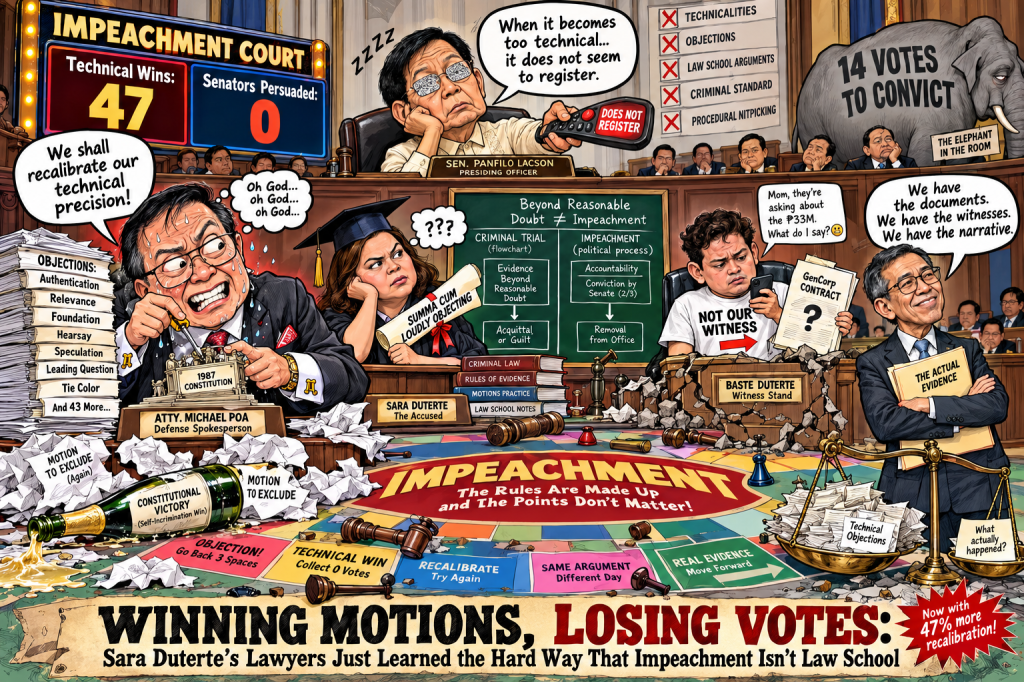
LET the record reflect my disbelief. You spend weeks cross-examining prosecution witnesses with the surgical precision of a lawyer who billable hour is measured in fractions of a second. You object to everything that moves. You challenge authentication, relevance, foundation, and the color of the opposing counsel’s tie.
And at the end of it all, a senator-judge—not a judge, mind you, but a senator—politely informs you that none of it is “registering.”
Welcome to impeachment, where the rules of evidence are apparently made up and the points don’t matter.
The Feedback That Launched a Thousand Recalibrations
Senator-Judge Panfilo Lacson’s critique of Sara Duterte’s defense strategy on September 28 was, in the genteel language of Philippine politics, a polite way of saying: “We have no idea what you’re doing, and we’re not sure you do either.”
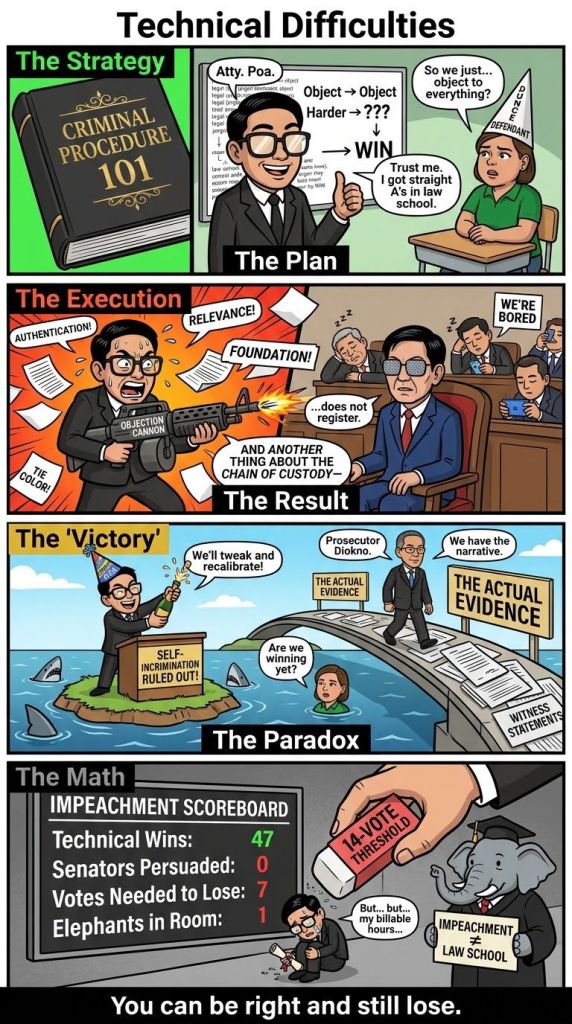
The defense had been operating on the theory that if you throw enough technical objections at the wall, something might stick. Lacson’s response? “When it becomes too technical and gives the impression that you are just looking for very small holes, it does not seem to register.” Translation: Your Honor, we’re bored.
Defense spokesperson Atty. Michael Poa, displaying the adaptability of a man who just realized his entire litigation strategy was built on sand, promptly called the criticism “constructive” and promised to “tweak” and “recalibrate.” This is lawyer-speak for “Oh God, we have no idea what we’re doing either, but we’ll pretend this was the plan all along.”
The Quantum of Proof Problem: Or, “We’re Not in Criminal Court Anymore, Toto”
Here’s the thing that the defense seems to have forgotten: impeachment is not a criminal trial. The Constitution doesn’t specify a quantum of proof. Lacson explicitly questioned whether the defense was trying to inject a beyond-reasonable-doubt standard into a proceeding that requires something less.
The defense’s entire cross-examination strategy appears to have been built on the premise that if they can create just one iota of doubt—one tiny, minuscule, microscopic sliver of uncertainty—they win. This is a lovely theory if you’re defending a murder case where the prosecution must prove guilt beyond a reasonable doubt and one procedural misstep can collapse the entire edifice.
But impeachment? The senator-judges are not bound by the Rules of Court in the same way. Article XI of the 1987 Philippine Constitution says “two-thirds of all the Members of the Senate” shall concur in conviction. It doesn’t say anything about reasonable doubt, preponderance, or clear and convincing evidence. The defense’s strategy assumed a standard that may not apply.
The Self-Incrimination “Victory” That Might Not Be
On September 29, the impeachment court handed the defense a procedural win: Vice President Duterte cannot be compelled to admit ownership of bank accounts through the prosecution’s Rule 26 of the Rules of Court request for admission. Senate President Francis “Chiz” Escudero ruled that this would violate her right against self-incrimination, citing Gutierrez v. House of Representatives and In re Horrilleno.
The defense probably popped champagne. A constitutional victory! The Bill of Rights applies! The prosecution can’t shift its burden of proof!
But here’s the paradox: legally, it’s a win. Persuasive? Not necessarily. Because while the defense was celebrating its constitutional victory, the prosecution was moving on to the actual allegations. The bank records themselves still exist. They were subpoenaed. They’re in the record.
The prosecution can still call bank representatives to authenticate them. The defense just made the prosecution’s job slightly more tedious, not impossible. This is the fundamental problem with a technical defense: you can win every motion and still lose the war, because the senator-judges are asking “What actually happened?” and you’re answering “Well, technically, the request for admission was procedurally improper.”
Baste Duterte and the Hostile Witness Who Wasn’t Theirs
Meanwhile, on September 29, the defense found itself in the awkward position of having no idea what to do with Sebastian “Baste” Duterte, who was declared a hostile witness. Poa told reporters that Baste is “not our witness” and that the defense hadn’t coordinated with him.
This is either admirably hands-off or a sign that the Duterte family’s internal communications are as chaotic as the defense’s trial strategy.
Baste testified that he knew of GenCorp contracts but didn’t know of Sara’s declared interest. The prosecution emphasized that Sara declared an interest in GenCorp while corporate records didn’t list her as a shareholder. This creates precisely the sort of factual ambiguity that a substantive defense could exploit: Did Sara actually have a beneficial interest? Was the Statement of Assets, Liabilities, and Net Worth (SALN) declaration accurate? Was the corporate documentation incomplete?
But the defense, by its own admission, hadn’t prepared for Baste’s testimony and would decide on cross-examination based on how the direct examination went. This is not a strategy. This is showing up to a chess match and deciding which pieces to move after your opponent has already taken your queen.
The Lowered Threshold: The Elephant in the Impeachment Courtroom
Let’s not forget the context in which this strategic recalibration is happening. On September 23, the Senate impeachment court voted 13-1 to lower the conviction threshold from 16 to 14 votes by changing the denominator from all 24 senators to only those “legally and factually capable of participating.”
This means the prosecution needs only 14 votes, and the defense needs only 7 to block conviction. The defense’s margin for error just shrank. Every senator-judge’s attention, comprehension, and willingness to listen now matters more than ever. And Lacson just told them, publicly, that their arguments aren’t landing.
Constitutional framer Christian Monsod called the senators who opposed the change “wrong” and suggested the Supreme Court should not interfere. But petitions have been filed. The legal uncertainty surrounding the threshold adds another layer of chaos to a proceeding that already feels like it’s making up the rules as it goes along.
The Materiality-First Defense That Should Have Been the Strategy from Day One
Here’s what a competent defense would have done from the beginning:
- Identify the essential elements of each impeachment article.
- Determine what evidence the prosecution needs to prove each element.
- Attack the inferential links between evidence and conclusion.
- Provide alternative explanations to neutralize prosecution narratives.
- Connect every technical point directly to a material factual dispute.
Instead, the defense apparently spent weeks objecting to authentication and foundation, creating a record that will be lovely on appeal but useless in a Senate trial where the “judges” include people who may not know what “authentication” means.
The recalibration Poa is now promising should have been the strategy from the start. Technical objections are tools, not a philosophy. They serve to exclude evidence, not to persuade decision-makers. And in impeachment, persuasion is the entire game.
The Prosecution’s Quiet Confidence
Meanwhile, the prosecution seems unbothered. After the bank records ruling, House prosecutor Zamora said: “This is not a setback. We will still continue with the strategy.”
Former senator and prosecutor Jose Manuel “Chel” Diokno offered stipulations to streamline the proceedings, essentially saying: “We don’t need to play your procedural games. We have the documents. We have the witnesses. We have the narrative.”
That’s the confidence of a team that understands the assignment. The prosecution isn’t trying to win motion practice. It’s trying to tell a story about unexplained wealth, corporate interests, and public trust violated. The defense, by contrast, has been trying to win a law school exam.
The Bottom Line
Sara Duterte’s defense team has discovered what every litigator eventually learns: you can be right and still lose. You can win every objection and still fail to persuade. You can create reasonable doubt in a proceeding that doesn’t require it.
The “tweak” Poa is promising is not a minor adjustment. It’s an admission that the defense’s entire theory of the case—that technical precision alone would carry the day—was flawed. The recalibration, if done properly, would require the defense to actually answer the allegations, explain the evidence, and provide a coherent alternative narrative.
Whether they can do that at this late stage, with the prosecution’s case already largely presented and the threshold lowered to 14 votes, is another question entirely.
But here’s the thing about technical defenses in political trials: they work best when the decision-makers are lawyers who appreciate the nuances. When the decision-makers are senators—some of whom may not know the difference between authentication and accreditation—you need to speak a different language.
Lacson just told them that. The question is whether they’re listening.
Louis ‘Barok’ C. Biraogo is the author of the Kweba ni Barok blog, where he provides irreverent commentary on Philippine law and politics. He has never been impeached, but he has been cited for contempt twice.
Key Citations
A. Legal & Official Sources
- Constitutional Commission of 1986. The 1987 Constitution of the Republic of the Philippines. Article XI: Accountability of Public Officers, 1987.
- Supreme Court of the Philippines. Gutierrez v. House of Representatives Committee on Justice. G.R. No. 193459, 15 Feb. 2011.
- Supreme Court of the Philippines. In re: Estate of Tomas Horrilleno. General Register No. 6994, 31 Aug. 1934.
- Supreme Court of the Philippines. 1997 Rules of Civil Procedure: Rule 26 – Admission by Adverse Party. Promulgated 8 Apr. 1997.
B. News Articles & Media Coverage
- ConstitutionNet. “The Philippines’ Senate Votes to Lower Threshold for Conviction in Vice President’s Impeachment Trial.” International IDEA / ConstitutionNet, 25 Sept. 2026.
- Inquirer.net. “2/3 Rule Revisited: Fewer Votes Needed to Convict Sara Duterte.” Philippine Daily Inquirer, 24 Sept. 2026.
- Inquirer.net. “Defense Welcomes Criticism of Its Cross-Examination Strategy.” Philippine Daily Inquirer, 28 Sept. 2026.
- Manila Bulletin. “VP Sara Defense May Tweak Strategy After Senator-Judges’ Feedback.” Manila Bulletin, 28 Sept. 2026.
- Panti, Llanesca T. “Sara Duterte Impeachment Trial: Lacson Remarks on ‘Too Technical’ Defense Strategy.” GMA News Online, 28 Sept. 2026.

- “Ang Hirap Maging Mahirap”: The PAO Scandal That Proves Government Contempt Is Nothing New

- “Far-Off” My Axx: Malacañang’s Claire Castro Drowns in Her Own Legal Gaslighting

- “Forthwith” to Farce: How the Senate is Killing Impeachment—And Why Enrile’s Right (Even If You Can’t Trust Him)

- “HINDI AKO NAG-RESIGN!”

- “I Know Nothing”: Baste Duterte’s Amnesia Defense Meets ₱33M in GenCorp Contracts

- “I’m calling you from my new Globe SIM. Send load!”

- “Mahiya Naman Kayo!” Marcos’ Anti-Corruption Vow Faces a Flood of Doubt

- “Manageable” Debt, Unmanageable Lies: DBM’s ₱21 Trillion Fairy Tale

- “Meow, I’m calling you from my new Globe SIM!”

- “Natrabaho”: One Word, One Ombudsman, and a Judiciary on Trial

- “No Special Jail for Crooks!” Boying Remulla Slams VIP Perks for Flood Scammers

- “Philippine-Controlled” or Yankee Gas Station? The Davao Fuel Depot Farce Exposed








Leave a Reply