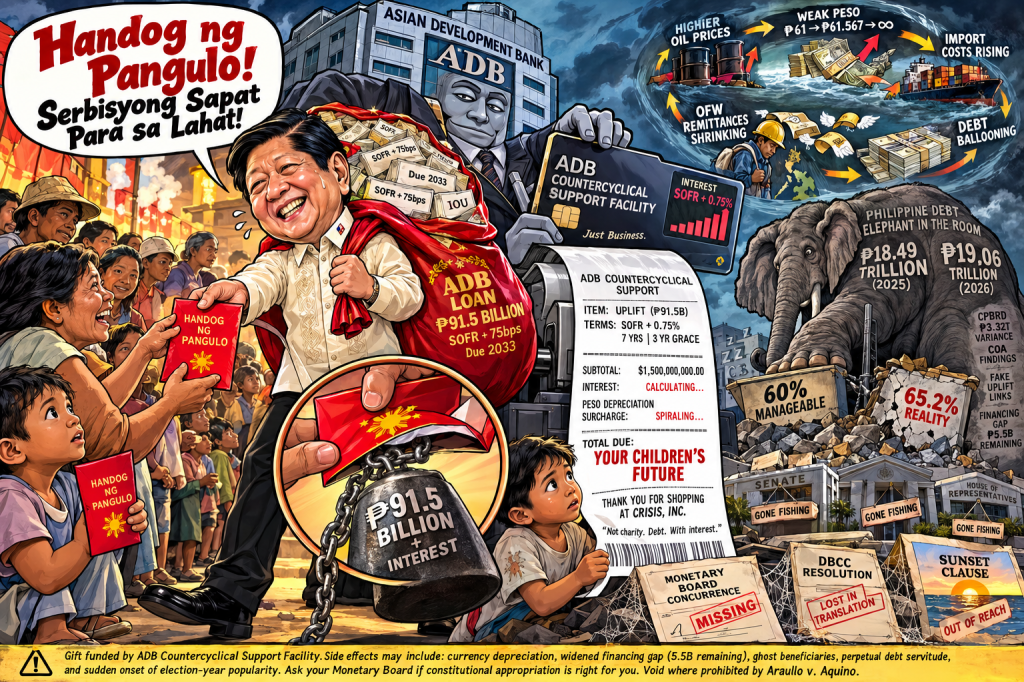
The ADB calls it “countercyclical support.” The Constitution calls it a foreign loan requiring Monetary Board concurrence and congressional appropriation. Malacañang calls it “Handog ng Pangulo.” Only one of these things is legally binding.
By Louis ‘Barok’ C. Biraogo — September 27, 2026
So let me get this straight—and forgive me, I’m just a concerned citizen with a suspicious mind and a working calculator. The Asian Development Bank (ADB) just approved $1.5 billion for the Philippines because the Middle East is on fire. The money is supposed to “help protect families from rising prices” through a program called UPLIFT—which, I must say, is the most aggressively optimistic acronym I’ve seen since “Build Back Better” quietly became “Build Back Later.”
But here’s the thing about crisis loans from multilateral banks: they’re not charity. They’re debt. With interest. And the ADB—God bless its Manila-based heart—is not in the business of writing checks it doesn’t expect to be repaid.
So let’s do what the Philippine press apparently won’t do: follow the money.
The Debt-to-GDP Elephant in the Room
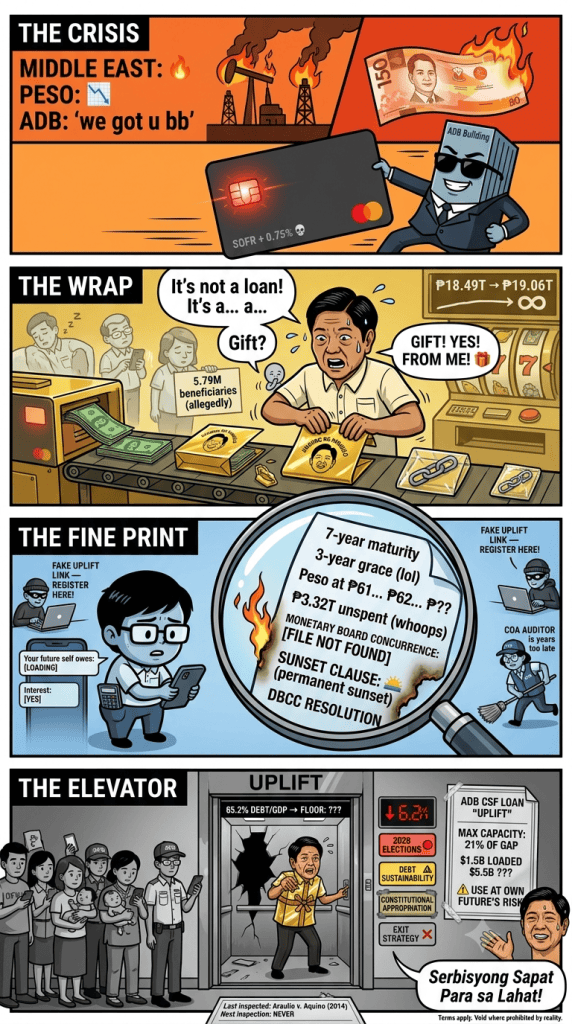
At the end of March 2026, the Philippines’ debt-to-Gross Domestic Product (GDP) ratio hit 65.2%—the highest since 2005. That’s above the 60% threshold that multilateral lenders consider “manageable,” which is banker-speak for “we’re not panicking yet, but we’re updating our models.”
Outstanding debt: ₱18.49 trillion. Projected to hit ₱19.06 trillion by year-end.
And now we’re adding $1.5 billion more. At ₱61 to the dollar—which, by the way, is where the peso has been trading—that’s roughly ₱91.5 billion in new foreign-currency obligations.
The ADB calls this “countercyclical support.” I call it buying time on a credit card when your income is falling and your expenses are rising.
What’s the Emergency, Exactly?
The ADB says the Philippines imports “nearly all its fuel” and is “heavily dependent on imported fertilizers,” making it vulnerable to Middle East price shocks. True enough. Oil accounts for about a third of primary energy supply, and 1.1 million Overseas Filipino Workers (OFWs) sent home 18% of the country’s $35.6 billion remittances from the region in 2025.
These are real vulnerabilities. I’m not disputing that.
But here’s where my journalistic Spidey-sense starts tingling: The ADB’s own policy paper from July 2026—just two months before this loan—explicitly expanded the Countercyclical Support Facility (CSF) to cover “energy and food-price shocks” and allowed support for “targeted social protection” and “continuity of services.”
Convenient timing, isn’t it? The facility gets expanded in July, and by September, the Philippines has a $1.5 billion “crisis” loan.
The ADB isn’t responding to a sudden emergency. It’s retrofitting an existing lending instrument to justify a loan that was already being discussed. ADB Philippines Country Director Andrew Jeffries admitted as much in September: “We’ve been working with the government on it for months now.”
Months. Before the “crisis” was formally declared.
The UPLIFT Program: Social Protection or Political Slush Fund?
Now let’s talk about where the money is actually going.
UPLIFT stands for the “Unified Package for Livelihoods, Industry, Food, and Transport.” It includes fare discounts, fuel subsidies, fertilizer subsidies, medical packages, and cash assistance. The government says it will reach “millions of poor and vulnerable Filipinos.”
The Department of Social Welfare and Development (DSWD) claims that as of September, 5.79 million beneficiaries have received ₱11.80 billion. The Department of Agriculture (DA) is distributing ₱6.2 billion in Special Allotment Release Orders (SAROs) for fertilizer support, fuel assistance, and solar irrigation.
Sounds great, right?
Except here’s what the Congressional Policy and Budget Research Department (CPBRD) found: The gap between allotment releases (SAROs) and actual cash disbursements (Notices of Cash Allocation, or NCAs) has been widening since 2020. In 2025, the variance hit ₱1.37 trillion. In 2026, it’s already at ₱3.32 trillion as of March.
Translation: The government has a spending problem, not just a funding problem. You can appropriate all the money you want, but if the agencies can’t actually push it out the door efficiently, you’re just adding debt without delivering relief.
And if history is any guide, emergency social protection programs in the Philippines have a nasty habit of attracting the wrong kind of attention. The Commission on Audit (COA) has flagged previous programs for unutilized funds, ghost beneficiaries, and “insufficient validation” of recipient lists.
The DSWD itself has already warned about fake UPLIFT registration links online. If scammers can spot the program’s vulnerabilities from outside the government, imagine what well-connected insiders can do from within.
The “Handog ng Pangulo” Branding Problem
Speaking of optics, let’s talk about the packaging.
The UPLIFT distributions are being branded under something called “Handog ng Pangulo: Serbisyong Sapat Para sa Lahat” — “Gift of the President: Sufficient Service for All.”
I’m sorry, but since when did government assistance—funded by borrowed money from an international bank—become a personal gift from the President?
This is not a new problem. Philippine politicians have been slapping their names and faces on government programs since the invention of the tarpaulin. But when the money comes from a foreign loan that future taxpayers will have to repay, the branding exercise takes on a different character.
It’s not a gift. It’s a loan. And the people receiving ₱2,000 in cash aid in Bukidnon or Albay are not being told that their children will be paying interest on that money for years to come.
The $7 Billion Question
Here’s where the story gets really interesting.
The BusinessMirror reported that the ADB estimated the Philippines could face a $7 billion financing gap from its crisis response.
Let that sink in. The $1.5 billion loan covers roughly 21% of the estimated gap.
So where’s the other $5.5 billion coming from?
The government hasn’t said. The ADB hasn’t said. And the press, by and large, hasn’t asked.
This is the journalistic equivalent of reporting that someone bought a house with a ₱1.5 million down payment and failing to mention the ₱5.5 million mortgage.
The Foreign Currency Trap
Remember when the peso was at ₱58 to the dollar? That was the assumption in the government’s 2026 borrowing program.
The peso is now trading above ₱61. It hit a record low of ₱61.567 in April.
Every peso of depreciation increases the local-currency cost of servicing dollar-denominated debt. The $1.5 billion loan isn’t just a fixed obligation—it’s a moving target that gets more expensive every time the currency weakens.
And what’s weakening the peso? Higher oil prices, which increase import costs, which widen the trade deficit, which pressures the currency. The very crisis the loan is supposed to address is making the loan more expensive to repay.
This is what financial professionals call a “doom loop.” The ADB calls it “countercyclical support.”
What the ADB Won’t Tell You
Let’s look at the actual terms of the ADB’s Countercyclical Support Facility, because the press releases conveniently omit them.
According to the ADB’s own policy paper, CSF loans carry an interest rate of Secured Overnight Financing Rate (SOFR) plus 75 basis points, plus a commitment fee of 15 basis points, with a 7-year maturity including a 3-year grace period.
That’s not predatory. It’s actually competitive for a middle-income country with a 65% debt-to-GDP ratio.
But here’s the kicker: the CSF was designed for short-term liquidity support, not for prolonged structural crises. The ADB’s own assessment notes that the facility’s “emphasis on demand-side fiscal stimulus and shorter maturities makes the CSF less well suited to prolonged, supply-side shocks, such as energy supply and food price crises.”
So we’re using a short-term instrument to address what may be a long-term problem.
If the Middle East conflict drags on for years—and there’s no reason to believe it won’t—the Philippines will be stuck with 7-year debt financing what could be permanent subsidy programs.
The Senate and the House: Where Are You?
Here’s the constitutional question that no one in Congress seems eager to ask: What is the legal basis for spending this money?
Article VI, Section 29 of the 1987 Constitution is clear: “No money shall be paid out of the Treasury except in pursuance of an appropriation made by law.”
The ADB loan proceeds must be appropriated by Congress before they can be spent. The 2026 General Appropriations Act (RA 12314) contains provisions for loan agreements, but those provisions are procedural—they don’t create a blank check.
The Supreme Court has been consistent on this point. In Araullo v. Aquino (2014), the Court struck down the Disbursement Acceleration Program precisely because it involved spending that hadn’t been properly appropriated by Congress.
Is the UPLIFT program properly appropriated? Or is it being financed through “savings,” “augmentation,” and other creative accounting mechanisms that the Court has repeatedly frowned upon?
The government hasn’t provided a clear answer. And Congress—which is supposed to guard the purse—has been remarkably quiet.
The Political Economy of “Crisis”
I’m not naive. I understand that governments borrow money during crises. That’s what sovereign debt is for.
But I also understand that crises are politically useful.
The 2028 presidential election is two years away. The Marcos administration needs to demonstrate that it can respond effectively to economic shocks. It needs to show that it cares about ordinary Filipinos struggling with high prices.
A $1.5 billion loan from the ADB—announced with great fanfare, branded as a “gift from the President,” and distributed through highly visible cash payouts—is perfect political theater.
And here’s the thing: it might even be good policy. The economic rationale for countercyclical support is sound. The targeting mechanisms, if properly implemented, could reach vulnerable households efficiently.
But good policy and good politics are not the same thing. And when the two align, the incentives for abuse multiply exponentially.
What Would Accountability Look Like?
If the Marcos administration were serious about transparency—and if the ADB were serious about ensuring its money is well spent—we would see the following:
- Full disclosure of the loan terms. Interest rate, maturity, grace period, fees. The ADB publishes this information for other loans. Why not this one?
- A Development Budget Coordination Committee (DBCC) resolution covering the full $1.5 billion. The 2026 GAA requires a DBCC resolution for program loans. Has one been issued? Is it public?
- Monetary Board concurrence. Article VII, Section 20 of the Constitution requires prior concurrence of the Monetary Board for foreign loans. Where is the documentation?
- A clear sunset clause. When do the subsidies end? What happens when oil prices normalize? Or is this a permanent expansion of the social protection system financed by debt?
- Independent, real-time audit. COA should be embedded in the UPLIFT implementation from day one—not conducting post-facto reviews years after the money is gone.
- Public beneficiary lists. If the targeting is objective, the data should be public. If the data is not public, the targeting is not objective.
None of these safeguards are unreasonable. None of them are unprecedented. And none of them appear to be in place.
The Bottom Line
The ADB’s $1.5 billion loan is not inherently bad. The Philippines faces real external shocks from the Middle East conflict, and countercyclical borrowing is a legitimate policy response.
But the loan is being deployed in an environment of elevated debt, weak expenditure execution, upcoming elections, and a government that has mastered the art of branding borrowed money as a presidential gift.
The difference between a successful crisis response and a debt trap with wasted resources lies in the details—details that the government and the ADB have been conspicuously reluctant to provide.
So here’s my question, and I’ll keep asking it until someone answers:
Where is the Monetary Board concurrence? Where is the DBCC resolution? Where is the sunset clause? And who, exactly, is going to pay back this $1.5 billion when the crisis is over?
The silence is deafening.
Key Citations
A. Reports & Studies
- Asian Development Bank. Enhancing ADB’s Crisis Response Modalities to Address Energy Supply and Food Price Shocks. 14 July 2026, https://www.adb.org/news/adb-speeds-crisis-response-energy-and-food-prices-shock-asia-and-pacific.
- Asian Development Bank. Enhancing Contingent Disaster Financing and the Countercyclical Support Facility. 2023, https://www.adb.org/sites/default/files/institutional-document/801071/enhancing-cdf-and-csf.pdf.
- Congressional Policy and Budget Research Department. Slower Growth Environment and Global Oil Market Disruptions: Implications for Philippine Debt Sustainability. May 2026, https://cpbrd.congress.gov.ph/.
B. News Articles
- Asian Development Bank. “ADB Boosts Philippines’ Crisis Response with $1.5 Billion.” ADB News Release, 24 Sept. 2026, https://www.adb.org/news/adb-boosts-philippines-crisis-response-1-5-billion.
- Mencias, Eileen. “Middle East Crisis Leaves Philippines with $7B Financing Gap — ADB.” Bilyonaryo, 23 Sept. 2026, https://bilyonaryo.com/2026/09/23/middle-east-crisis-leaves-philippines-with-7b-financing-gap-adb/money/.
- Tabile, Justine Irish D. “Philippines’ Debt-to-GDP Ratio Hits 21-Year High at End of March.” BusinessWorld, 8 May 2026, https://bworldonline.com/top-stories/2026/05/08/748277/philippines-debt-to-gdp-ratio-hits-21-year-high-at-end-of-march/.
- “End-March Govt Debt Hits New All-Time High of ₱18.49T.” BusinessMirror, 7 May 2026, https://businessmirror.com.ph/2026/05/07/end-march-govt-debt-hits-new-all-time-high-of-%E2%82%B118-49t/.
- Ta-Asan, Keisha. “Peso Hits Record Low 61.56 per Dollar.” The Philippine Star, 30 Apr. 2026, https://www.philstar.com/headlines/2026/04/30/2524557/peso-hits-record-low-6156-dollar.
- De Vera-Ruiz, Ellalyn. “Over 5.78 Million Households Receive UPLIFT Cash Aid, Says DSWD.” Manila Bulletin, 14 Sept. 2026, https://mb.com.ph/2026/09/14/over-578-million-households-receive-uplift-cash-aid-says-dswd.
- “IN NUMBERS: Overseas Filipinos under Threat in the Middle East.” Rappler, 5 Mar. 2026, https://www.rappler.com/newsbreak/data-documents/overseas-filipinos-middle-east-strikes-2026-numbers/.
C. Legal & Official Sources
- Republic of the Philippines. The 1987 Constitution of the Republic of the Philippines. Official Gazette, https://www.officialgazette.gov.ph/constitutions/1987-constitution/.
- Republic of the Philippines. Republic Act No. 12314: General Appropriations Act, Fiscal Year 2026. Department of Budget and Management, https://www.dbm.gov.ph/index.php/2026/general-appropriations-act-gaa-fy-2026.
- Araullo v. Aquino, G.R. No. 209287, 1 July 2014. The Lawphil Project, https://lawphil.net/judjuris/juri2014/jul2014/gr_209287_2014.html.
- Department of Social Welfare and Development. “DSWD Warns Public against Fake UPLIFT Educational Assistance Registration Links.” 7 Sept. 2026, https://www.dswd.gov.ph/dswd-warns-public-against-fake-uplift-educational-assistance-registration-links/.
- Presidential Communications Office. “President Marcos Expands UPLIFT with Additional Aid for Low-Income Filipinos.” 16 July 2026, https://pco.gov.ph/news_releases/president-marcos-expands-uplift-with-additional-aid-for-low-income-filipinos/.
- Unified Package for Livelihoods, Industry, Food, and Transport. UPLIFT, https://uplift.gov.ph/vulnerable-sectors.

- ₱9 Billion in ‘Savings’? DILG’s Fire Truck Deal Smells Like Smoke
- ₱8B BBM Pork: CCTV for Every Captain’s Kumpare?
- ₱8.9 Billion, 331 Ghost Police Stations: The TIKAS Scandal Explained

- ₱8.4 Billion, 42,000 Barangays, 1 Election: The “Bawat Barangay Makikinabang” Vote-Buying Masterclass
- ₱75 Million Heist: Cops Gone Full Bandit

- ₱6.77B Ghost Haunts Duterte: RTC Dismisses Mans Carpio’s Desperate Plea
- ₱6.77 Billion and Zero Cash: The Sara Duterte SALN Math That Doesn’t Add Up

- ₱6.7-Trillion Temptation: The Great Pork Zombie Revival and the “Collegial” Vote-Buying Circus

- ₱58.53B, Zero Receipts: The LGSF Pork Barrel Nobody Wants to Name
- ₱53 Million Man Tells ₱695-a-Day Workers to Stop Being ‘Mayabang’: The Audacity of BSP’s Remolona
- ₱4.4 Billion and a Witness Who Can’t Explain It: The Duterte Impeachment’s Most Expensive Non-Answer
- ₱3.06 Billion for Evacuation Centers—But Nobody Knows Where They’ll Stand (Or If They’ll Exist)



Leave a Reply