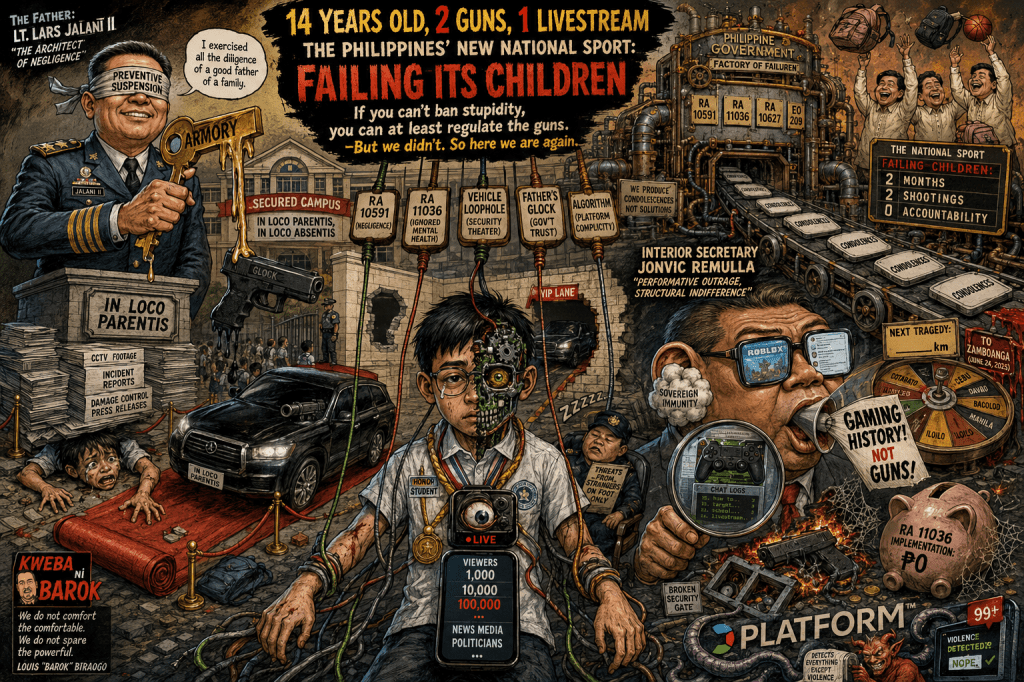
From Tacloban to Zamboanga: The Philippines’ New National Sport Is Failing Its Children
By Louis ‘Barok‘ C. Biraogo — August 20, 2026
Prologue: The Paradox of the Dead Shooter
Here is the grotesque irony that should haunt every Filipino tonight: a 14-year-old honor student—a boy who allegedly excelled in academics, who presumably knew the difference between right and wrong—walked into his own school on August 18, 2026, armed with his father’s government-issued Glock and a chest-mounted camera, and executed a plan so meticulous it would make a military strategist blush. He livestreamed the entire massacre. He moved from classroom to classroom, hunting. And when the horror was complete, he took his own life.
The shooter is dead. Criminal liability? Extinguished under Article 89 of Act No. 3815 (Revised Penal Code). Case closed? Not even close.
Because here’s the thing about a dead perpetrator: he becomes the perfect scapegoat. The narrative writes itself—troubled youth, mental illness, video games, bad parenting. Everyone nods solemnly. Everyone promises reforms. And everyone waits for the next tragedy.
But the Kweba is not in the business of accepting convenient narratives. The story began with a factual error—Grade 7, then Grade 9, then officially 14 years old. If the government cannot even get the shooter’s grade level straight in the first 24 hours, what confidence should we have in their ability to unravel the complex web of systemic failures that armed a child with a government-issued weapon?
Let us begin.
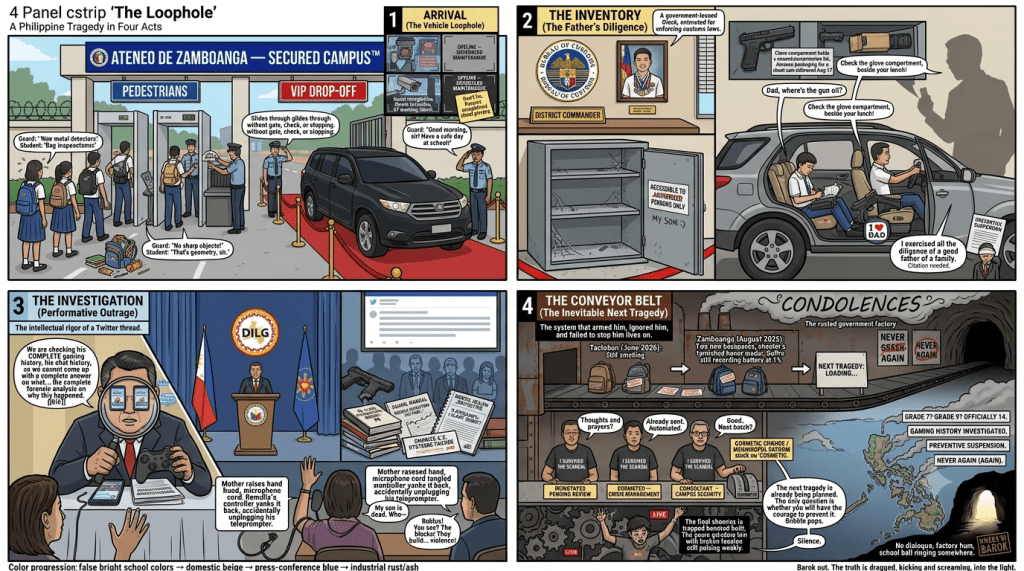
*Gaming history? Checked. Chat logs? Checked. Government-issued weapon in family car? Schedule maintenance.
I. The Official Narrative vs. The Factual Minefield
The initial Manila Bulletin report, bless its deadline-driven heart, told us the shooter was a “Grade 7 student.” Reuters and AP, citing police sources, said Grade 9. The official confirmation eventually settled on a 14-year-old—which in the Philippine system could be either. This is not pedantry, mga ka-kweba. This is the first indication that the institutions we trust to protect our children cannot even establish basic facts about a tragedy that unfolded in real-time, on camera, for the world to see.
Meanwhile, the rumor mill has been working overtime. Bullying! Failing grades! Video game addiction! Dead security guards! The last one is particularly instructive—social media users circulated photographs of alleged victims, only for other users to identify the images as coming from an earlier school simulation exercise. A photograph without provenance is not proof; it is propaganda. And yet, in the vacuum of official information, these rumors become the de facto narrative.
But here is the real scandal that the government seems eager to bury beneath a mountain of video game rhetoric: the vehicle loophole.
The shooter did not walk through a metal detector. He did not have his bag inspected by a security guard. He entered the campus through a basement drop-off point, seated comfortably in his father’s vehicle, driven by the family chauffeur. The school’s security apparatus—the bag checks, the personnel screening, the active shooter drills conducted after the Tacloban tragedy—was all bypassed with the ease of a privileged student arriving at school in an SUV.
This is not a failure of technology. This is a failure of imagination. The school imagined threats coming from strangers on foot, not from students in vehicles. And in that failure of imagination, a child died.
II. The Geometry of Blame: Dissecting the Key Actors
The Dead Shooter: Victim or Villain?
Mohammad Mael Jalani is dead. He cannot defend himself. He cannot explain his motives. And in the court of public opinion, he has already been tried, convicted, and sentenced as a monster.
But here is the uncomfortable truth that no one wants to hear: monsters are not born. They are manufactured—by neglect, by unaddressed pain, by a society that prefers to look away until the shooting starts.
The fact that he was an honor student is not an argument for sympathy. It is an indictment of our failure to recognize that academic excellence and psychological deterioration can coexist in the same adolescent mind. The fact that he livestreamed the attack is not evidence of depravity alone; it is evidence of a desperate need for witness, for acknowledgment, for someone to see him even as he destroyed himself.
But let us be clear: explanation is not exoneration. What he did was evil. The question is not whether he is responsible—he is. The question is whether a 14-year-old with access to love, support, mental health care, and a locked gun cabinet would have become capable of this evil.
The answer, I suspect, is no.
The Father: The Architect of Negligence
Lt. Lars Jalani II, Bureau of Customs ESS District Commander, is the central figure in this tragedy. Not the shooter. The father.
Because while the shooter pulled the trigger, it was the father who left the gun within reach. And not just any gun—a government-issued 9mm Glock pistol, entrusted to him by the Republic of the Philippines, supposedly for the purpose of enforcing customs laws. Instead, it became the instrument of a school massacre.
The legal framework is clear. Republic Act No. 10591 (Comprehensive Firearms and Ammunition Regulation Act) mandates that firearms be stored in a secure, locked container inaccessible to unauthorized persons. Article 2180 of Republic Act No. 386 (Civil Code of the Philippines) holds parents liable for damages caused by their minor children “who live in their company,” unless they can prove they exercised “all the diligence of a good father of a family.”
A loaded Glock in a vehicle accessible to a 14-year-old? That is not diligence. That is dereliction.
The Bureau of Customs’ response—a swift “preventive suspension”—is not justice. It is damage control. It is a bureaucratic reflex designed to protect the institution from embarrassment, not to hold an individual accountable for catastrophic negligence. If the father had been a private citizen, would the response have been so swift? Or would we be watching the slow machinery of Philippine bureaucracy grind toward a quiet dismissal?
The School: In Loco Parentis, In Loco Absentis
Ateneo de Zamboanga University is a “secured campus.” Those are their words, not mine. And yet, a 14-year-old student entered with two firearms—one modified with a Roni conversion kit to function like a rifle—without anyone noticing.
Executive Order No. 209 (Family Code of the Philippines) is explicit: schools, administrators, and teachers have special parental authority and responsibility over minor children while under their supervision (Articles 218-219). This is the legal doctrine of in loco parentis—the school stands in the place of the parent. And what parent would allow their child to enter a building with a concealed firearm?
The school’s defense will likely be: “We had protocols. We had drills. We could not have anticipated this.”
But the vehicle loophole makes a mockery of that defense. The school anticipated threats from pedestrians, not from vehicles. They inspected the bags of students who walked through the front gates while waving through the SUVs of the privileged. The failure is not that the shooter was clever. The failure is that the school’s security was performative—designed to reassure parents, not to actually protect students.
To their credit, the school’s emergency response appears to have been swift. Classes were suspended. Counselors were deployed. A press conference was held. But reactive competence does not excuse proactive failure.
The Government: Performative Outrage, Structural Indifference
And then there is the state. The Philippine government, in its infinite wisdom, has responded to the second fatal school shooting in two months with the intellectual rigor of a Twitter thread.
Interior Secretary Jonvic Remulla—the man tasked with safeguarding the nation’s peace and order—has announced, with a straight face, an investigation into the shooter’s ‘gaming history and chat history.’ Because obviously the problem is that a 14-year-old played too much Roblox, not that his father left a government-issued Glock in the family SUV.
Republic Act No. 11036 (Mental Health Act) requires educational institutions to develop mental health programs, identify at-risk students, and provide access to treatment. Where were these programs? Where was the early intervention system that should have flagged a high-achieving student who was apparently planning a massacre?
The answer, of course, is that mental health services in the Philippines are chronically underfunded, understaffed, and underappreciated. We prefer to talk about mental health only in the aftermath of tragedy, as a convenient explanation for the inexplicable. But where were the counselors, the psychologists, the social workers during the months and years when this child was deteriorating in plain sight?
III. The Law as a Blunt Instrument
The shooter is dead. Criminal liability is extinguished. But the legal battle is far from over—it has simply shifted to a different battlefield.
The weapon used in the shooting was a government-issued firearm. This is not a private tragedy; it is a public scandal. The father, as a government official, was entrusted with a weapon for official duties. He brought it home. He stored it—or failed to store it—in a manner that allowed his 14-year-old son to access it. The chain of custody that was supposed to end in an armory ended in a classroom massacre.
Under RA 10591, the father faces potential criminal charges for negligent storage and for allowing unauthorized access to firearms. Under the Civil Code, he faces civil liability for damages caused by his minor child. And under civil service rules, he faces administrative sanctions that could end his career.
But here is the critical question: will the government pursue this aggressively, or will the father’s status as a fellow law enforcement official protect him from the full force of the law?
The victims’ families have legal avenues. Article 2180 of the Civil Code is clear: parents are liable for damages caused by their minor children. The school, under the Family Code’s in loco parentis doctrine, faces potential liability for its security failures. The government, while protected by sovereign immunity from direct lawsuits, faces political accountability that will shape policy for years to come.
The legal battle will be fought not over whether the shooter is guilty—he is, and he is dead—but over whether the adults who failed him will be held accountable for their negligence.
IV. The Verdict: If You Can’t Ban Stupidity, You Can At Least Regulate the Guns
This tragedy demands more than thoughts and prayers. It demands more than performative outrage and video game witch hunts. It demands a comprehensive, multi-dimensional response that addresses the root causes of this failure.
Legal
First, we demand a full, independent, and transparent investigation that identifies all persons and institutions responsible. The Bureau of Customs must not be allowed to investigate itself. The school must not be allowed to conduct its own security audit without external oversight.
Second, the father must face appropriate civil and criminal liability. If we cannot hold a law enforcement officer accountable for the negligent storage of a government-issued weapon, then our firearms laws are meaningless.
Third, we need precedent-setting clarity on the legal duty of care for educational institutions. The in loco parentis doctrine cannot be a theoretical concept—it must be enforced with the full weight of the law.
Policy
First, we need uniform, enforceable national standards for campus safety. The vehicle loophole that allowed the shooter to bypass security must be closed. Every vehicle entering a school campus must be subject to inspection, regardless of who is inside.
Second, we need mandatory mental health screening and early-intervention programs in all schools. RA 11036 already requires this—but implementation has been inconsistent, underfunded, and treated as an afterthought.
Third, we need strengthened firearms laws. Safe storage must be mandatory, and violations must carry severe penalties. A firearm in a vehicle accessible to a minor is not a storage failure—it is a public safety emergency.
Social
First, we need a national campaign to destigmatize mental health. Our culture treats psychological struggles as a sign of weakness, not as a treatable condition. This must change.
Second, we need comprehensive anti-bullying and conflict-resolution programs. Republic Act No. 10627 (Anti-Bullying Act of 2013) requires schools to address bullying—but enforcement has been inconsistent.
Third, we need sustained investment in youth well-being. Mental health counselors, social workers, and early-intervention specialists are not luxuries—they are necessities.
Technological
First, digital platforms must be held accountable for hosting or livestreaming violence. The shooter’s livestream was not an accident—it was a feature of his plan. Platforms must do better.
Second, we need mandatory algorithmic detection and immediate removal of harmful content. A massacre should not remain online for hours before it is taken down.
Third, we need safeguards against the glorification of violence. The shooter sought notoriety—and we gave it to him. We must refuse to turn murderers into celebrities.
Epilogue: The Choice
The shooter is dead. But the system that armed him, ignored him, and failed to stop him lives on.
The choice before us is not between action and inaction. It is between meaningful reform and cosmetic change. It is between holding the powerful accountable and allowing them to hide behind the corpse of a 14-year-old boy.
The victims’ families deserve more than condolences. They deserve accountability. They deserve answers. They deserve a system that learns from its failures instead of repeating them.
And the rest of us? We deserve to know that when we send our children to school, we are sending them to a place of learning, not a place of danger.
The alternative is unthinkable. But so, too, was the idea of a school shooting in the Philippines—until it happened twice in two months.
The next tragedy is already being planned. The only question is whether we will have the courage to prevent it.
Barok out.
This is the Kweba ni Barok. We do not comfort the comfortable. We do not spare the powerful. And we will not stop until the truth is dragged, kicking and screaming, into the light.
Key Citations
A. Legal & Official Sources
- Act No. 3815. Revised Penal Code. 1930, http://www.lawphil.net/statutes/acts/act1930/act_3815_1930b.html.
- Republic Act No. 10591. An Act Providing for a Comprehensive Law on Firearms and Ammunition and Providing Penalties for Violations Thereof. 2013, http://www.lawphil.net/statutes/repacts/ra2013/ra_10591_2013.html.
- Republic Act No. 386. An Act to Ordain and Institute the Civil Code of the Philippines. 1949, http://www.lawphil.net/statutes/repacts/ra1949/ra_386_1949.html.
- Executive Order No. 209. The Family Code of the Philippines. 1987, http://www.lawphil.net/executive/execord/eo1987/eo_209_1987.html.
- Republic Act No. 11036. An Act Establishing a National Mental Health Policy for the Purpose of Enhancing the Delivery of Integrated Mental Health Services, Promoting and Protecting the Rights of Persons Utilizing Psychosocial Health Services, Appropriating Funds Therefor and Other Purposes. 2018, http://www.lawphil.net/statutes/repacts/ra2018/ra_11036_2018.html.
- Republic Act No. 10627. An Act Requiring All Elementary and Secondary Schools to Adopt Policies to Prevent and Address the Acts of Bullying in Their Institutions. 2013, http://www.lawphil.net/statutes/repacts/ra2013/ra_10627_2013.html.
B. News Reports
- Jocson, Liza. “Grade 7 student goes on shooting spree inside Zamboanga school.” Manila Bulletin, 18 Aug. 2026, mb.com.ph/2026/08/18/grade-7-student-goes-on-shooting-spree-inside-zamboanga-school.
- “Philippines shooting: Students and teen gunman dead at school attached to Ateneo de Zamboanga University.” CNN (via Reuters), 17 Aug. 2026, http://www.cnn.com/2026/08/17/asia/school-shooting-philippines-intl-hnk.
- “Student shooter kills classmate and himself at a Philippine school in attack he livestreamed.” AP News, 18 Aug. 2026, apnews.com/article/philippines-zamboanga-school-shooting-fe3aa5d6d1f3dd2ca614d68bb373d604.
- GMA News. “DILG investigates shooter’s gaming, chat history in Ateneo de Zamboanga shooting.” GMA News Online, GMA Network, 19 Aug. 2026, http://www.gmanetwork.com/news/topstories/regions/999001/dilg-investigates-shooter-s-gaming-chat-history-in-ateneo-de-zamboanga-shooting/story/.

- ₱9 Billion in ‘Savings’? DILG’s Fire Truck Deal Smells Like Smoke

- ₱8B BBM Pork: CCTV for Every Captain’s Kumpare?

- ₱8.9 Billion, 331 Ghost Police Stations: The TIKAS Scandal Explained

- ₱8.4 Billion, 42,000 Barangays, 1 Election: The “Bawat Barangay Makikinabang” Vote-Buying Masterclass

- ₱75 Million Heist: Cops Gone Full Bandit

- ₱6.77B Ghost Haunts Duterte: RTC Dismisses Mans Carpio’s Desperate Plea
- ₱6.77 Billion and Zero Cash: The Sara Duterte SALN Math That Doesn’t Add Up

- ₱6.7-Trillion Temptation: The Great Pork Zombie Revival and the “Collegial” Vote-Buying Circus

- ₱58.53B, Zero Receipts: The LGSF Pork Barrel Nobody Wants to Name
- ₱53 Million Man Tells ₱695-a-Day Workers to Stop Being ‘Mayabang’: The Audacity of BSP’s Remolona

- ₱4.4 Billion and a Witness Who Can’t Explain It: The Duterte Impeachment’s Most Expensive Non-Answer
- ₱3.06 Billion for Evacuation Centers—But Nobody Knows Where They’ll Stand (Or If They’ll Exist)




Leave a Reply