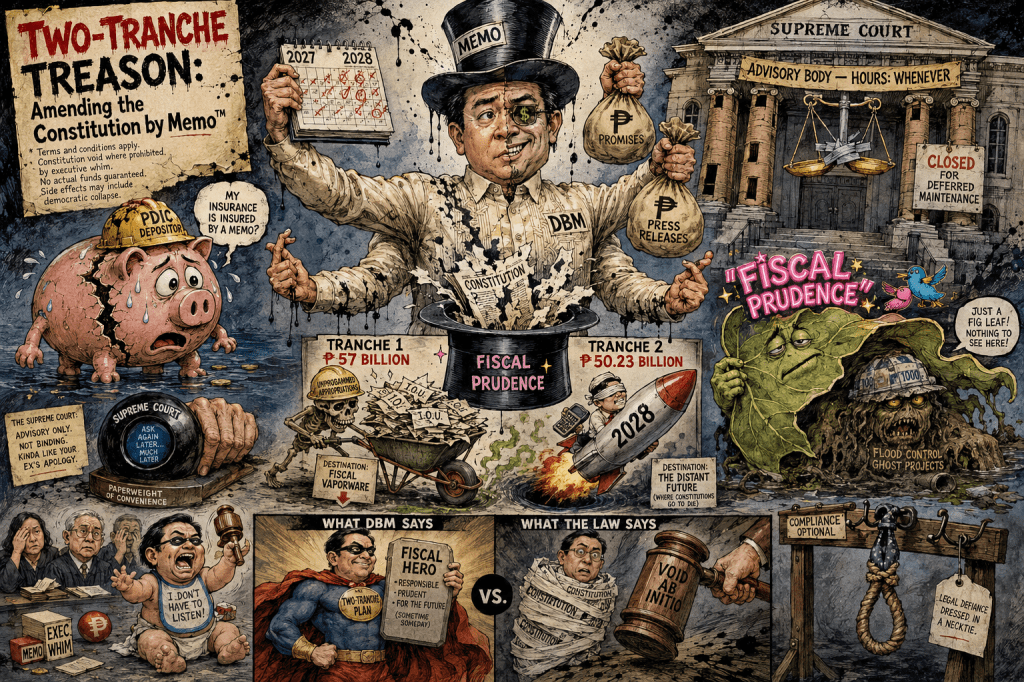
The Deferred Repayment Scheme That Turns the Supreme Court into an Advisory Body
By Louis ‘Barok‘ C. Biraogo — August 20, 2026
THE hallowed halls of the Department of Budget and Management (DBM) have once again echoed with the sound of legal sophistry so profound it could make a first-year law student weep. The agency, under the stewardship of Acting Secretary Kim Robert de Leon, has decided that the Constitution is not a command but a suggestion. A suggestion that can be deferred, scheduled, and ultimately, perhaps, forgotten.
The controversy is as simple as it is scandalous. In January 2025, the Philippine Deposit Insurance Corporation (PDIC) remitted a staggering ₱107.23 billion to the Bureau of the Treasury. This was done under the authority of a special provision tucked into Republic Act No. 11975 (2024 General Appropriations Act) and a circular from the Department of Finance. There was only one small problem: that legal authority was a constitutional abomination. In December 2025, the Supreme Court, in the case of Pimentel v. House of Representatives (G.R. No. 274778, December 3, 2025), declared the very provision authorizing this raid to be void ab initio—void from the beginning, as if it never existed.
Now, faced with the legal equivalent of a smoking gun, the DBM’s response is not compliance, but choreography. They propose a two-tranche scheme: a paltry ₱57 billion under the highly suspect category of Unprogrammed Appropriations (UA) for 2027, and the remaining ₱50.23 billion kicked down the road to the distant fiscal year of 2028. Their justification? A masterpiece of bureaucratic gaslighting: “fiscal prudence.”
Let us dissect this absurdity across every relevant dimension—legal, constitutional, fiscal, institutional, and political—and expose it for the constitutional heist it truly is.
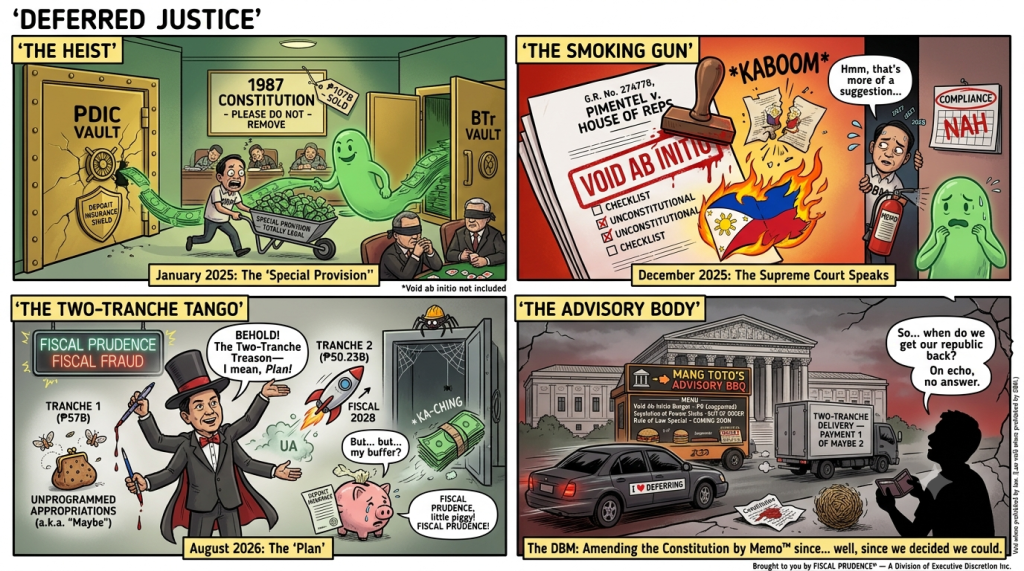
How DBM turned the Constitution into a two-tranche joke
The Inversion of Constitutional Order: Waiting for Permission to Obey
The DBM’s core argument is a perversion of civic duty. They argue that because there is no “final and executory court directive” specifically commanding the return of PDIC funds, they are not yet obligated to act. This is the logic of a child claiming they don’t have to stop hitting their sibling until a parent specifically says their name.
Our constitutional framework is not a system of compelled obedience; it is a covenant of proactive fidelity. Public officials swear an oath to “do justice to every man” and to “consecrate myself to the service of the Nation.” This oath does not say, “I will comply when a final and executory court directive tells me to.” The DBM’s stance inverts the entire structure of government. It transforms the executive from a co-equal branch bound by the Constitution into a reluctant vassal that must be dragged, kicking and screaming, to the altar of the law. It is the antithesis of the rule of law; it is rule by litigation.
The Legal Effect of Void Ab Initio: The Obligation is Now
The DBM’s insistence on awaiting a specific court order reveals either a profound ignorance of, or a brazen contempt for, a settled legal principle. When the Supreme Court declares a law or provision void ab initio, it is not merely cancelled going forward. It is legally erased from history. It is treated as though it never existed. The legal foundation for the ₱107.23 billion transfer has evaporated. It is gone.
The logical and legal consequence is immediate and non-negotiable: the obligation to restore the status quo and return the full amount arises right now, unconditionally. It is not a contingent duty that ripens upon a future judicial pronouncement. The DBM is treating a clear, present constitutional command as a potential future liability. This is not fiscal prudence; it is legal defiance dressed in a necktie.
The Two-Tranche Approach Scrutinized: Administrative Hubris
The proposed split—partial return in 2027, remainder in 2028—is a cynical political maneuver designed to buy time and minimize political pain. It is an assertion of raw executive discretion over a constitutional mandate. By unilaterally deciding the timeline and terms of compliance, the DBM is effectively claiming the power to amend the Constitution by memorandum.
This is the height of administrative hubris. A legal obligation is not a discretionary project to be scheduled based on political convenience or fiscal forecasts. It is a constitutional debt that is due immediately. To treat it as a line item that can be shuffled between fiscal years is to declare that the executive branch is above the fundamental law of the land. The DBM is not just budgeting; it is legislating, adjudicating, and amending the Constitution all in one fell swoop.
Systemic Rule-of-Law Implications: The Death of Judicial Supremacy
The precedent being set here is terrifying. If the executive may unilaterally decide when and how to comply with a Supreme Court declaration of unconstitutionality, then the judiciary’s power of judicial review is rendered meaningless. A declaration of unconstitutionality is only as strong as the executive’s willingness to comply. If the executive can adopt its own timeline and terms, it can effectively suspend or rewrite the law at will.
This is not a technical budget dispute; it is a fundamental assault on the separation of powers. It is the blueprint for authoritarianism. Today it is the PDIC’s ₱107.23 billion. Tomorrow, could the executive decide to defer compliance with a ruling on human rights? On election laws? On the very powers of Congress? If this two-tranche maneuver is validated, the Supreme Court will have been reduced to an advisory body, issuing opinions the executive is free to ignore or delay into irrelevance.
The Fig Leaf of “Fiscal Prudence” and the Stench of Unprogrammed Funds
The DBM’s claims of fiscal strain are a distraction. Where did the money go? The ₱107.23 billion was funneled into the Treasury to fund the 2024 budget, which was bloated with a staggering ₱1.166 trillion for flood control over four years—a sector so corrupt that a former DPWH secretary admitted hundreds of billions were lost to “ghost projects.”
Now, the DBM claims it cannot return the stolen funds without “displacing expenditures.” This is the logic of a thief who, after being caught, pleads poverty because he has already spent the loot. The displacement argument is an admission of guilt; it confirms the government’s fiscal planning was predicated on unlawfully obtained cash.
And where is the ₱57 billion “buffer” being hidden? In Unprogrammed Appropriations. This is the final insult. UA is not a real, funded appropriation. It is a standby authority, a wish list of projects that can only be funded if the government stumbles upon excess revenue or new loans. It is fiscal vaporware. To place the legal obligation to return the PDIC funds into this category is to admit that the government has no intention of actually paying its debt unless it finds spare change in the couch cushions. As Supreme Court Justice Ramon Paul Hernando noted, this entire category of UA is itself constitutionally suspect—discretionary lump sums that undermine legislative oversight.
The Demands: Justice, Not Installment Plans
The solution is not complex. It is called obeying the law.
First, the full ₱107.23 billion must be included in programmed appropriations for FY 2027. This is required by Article VI, Section 25(4) of the 1987 Constitution, which demands a definite fund source. Hiding the obligation in UA is a constitutional cop-out.
Second, the government must identify specific, offsetting revenue measures or expenditure reductions to fund this restoration. The Constitution mandates fiscal discipline. That discipline should have been exercised before they decided to spend money that wasn’t theirs. To fund the return, start by slashing the corrupt swamp of flood control projects.
Third, the PDIC Board must immediately pass a formal resolution demanding the full return of its funds, as is its mandate under its Charter (Republic Act No. 3591). The current silence from the PDIC and the Bangko Sentral ng Pilipinas (BSP) is a dereliction of their fiduciary duty to depositors.
Fourth, the Ombudsman must initiate a criminal investigation into the diversion of these funds, focusing on the architects of the unconstitutional provision. The applicable statutes are not obscure: Article 220 of the Revised Penal Code (Malversation of Public Funds) and Section 3(e) of Republic Act No. 3019 (Anti-Graft and Corrupt Practices Act).
The DBM’s staged repayment plan is not a budget strategy; it is a constitutional crime scene. It reveals a government that views the national treasury as a personal slush fund, the Constitution as an inconvenience, and the people’s trust as a commodity to be spent. The call for a “brighter future” is empty rhetoric if we cannot even compel the government to give back what it stole. This is not about fiscal space; it is about the soul of the nation. The battle is joined. The question is whether the rule of law will survive the encounter.
Key Citations
A. Legal & Official Sources
- The 1987 Constitution of the Republic of the Philippines. Official Gazette of the Republic of the Philippines, 1987, http://www.officialgazette.gov.ph/constitutions/1987-constitution/.
- Article VI, Section 25(4) of the 1987 Constitution. Official Gazette of the Republic of the Philippines, http://www.officialgazette.gov.ph/constitutions/the-1987-constitution-of-the-republic-of-the-philippines/the-1987-constitution-of-the-republic-of-the-philippines-article-vi/.
- Department of Budget and Management. “General Appropriations Act (GAA) FY 2024.” DBM.gov.ph, Republic of the Philippines, http://www.dbm.gov.ph/index.php/2024/general-appropriations-act-gaa-fy-2024.
- Department of Finance. Department Circular No. 003.2024. 2 Apr. 2024, http://www.dof.gov.ph/download/dc_003-2024/.
- Aquilino Pimentel III et al. v. House of Representatives et al. (consolidated with Bayan Muna Chairman Neri Colmenares et al. v. Executive Secretary Lucas P. Bersamin et al. and 1Sambayan Coalition et al. v. House of Representatives et al.), G.R. Nos. 274778, 275405 & 276233. Supreme Court of the Philippines, 3 Dec. 2025, sc.judiciary.gov.ph/274778-275405-276233-aquilino-pimentel-iii-et-al-vs-house-of-representatives-represented-by-the-speaker-ferdinand-martin-romualdez-et-al-bayan-muna-chairman-neri-colmenares-et-al-vs-president/.
- Republic Act No. 3591. An Act Establishing the Philippine Deposit Insurance Corporation, Defining Its Powers and Duties and for Other Purposes. 1963, lawphil.net/statutes/repacts/ra1963/ra_3591_1963.html.
- Act No. 3815. The Revised Penal Code. 1930, http://www.officialgazette.gov.ph/1930/12/08/act-no-3815-s-1930/.
- Republic Act No. 3019. Anti-Graft and Corrupt Practices Act. 1960, http://www.officialgazette.gov.ph/1960/08/17/republic-act-no-3019/.
B. News Reports
- Inosante, Aubrey Rose. “DBM: Returning Full P107 Billion to PDIC Not Fiscally Prudent.” Philstar.com, The Philippine Star, 19 Aug. 2026, http://www.philstar.com/business/2026/08/19/2550195/dbm-returning-full-p107-billion-pdic-not-fiscally-prudent.
- Chan, Katherine K. “PDIC Studying Return of P107-Billion Remittance After Supreme Court Ruling.” BusinessWorld Online, 7 Jan. 2026, http://www.bworldonline.com/banking-finance/2026/01/07/722629/pdic-studying-return-of-p107-billion-remittance-after-supreme-court-ruling/.

- “Ang Hirap Maging Mahirap”: The PAO Scandal That Proves Government Contempt Is Nothing New
- “Far-Off” My Axx: Malacañang’s Claire Castro Drowns in Her Own Legal Gaslighting
- “Forthwith” to Farce: How the Senate is Killing Impeachment—And Why Enrile’s Right (Even If You Can’t Trust Him)
- “HINDI AKO NAG-RESIGN!”

- “I Know Nothing”: Baste Duterte’s Amnesia Defense Meets ₱33M in GenCorp Contracts

- “I’m calling you from my new Globe SIM. Send load!”

- “Mahiya Naman Kayo!” Marcos’ Anti-Corruption Vow Faces a Flood of Doubt

- “Manageable” Debt, Unmanageable Lies: DBM’s ₱21 Trillion Fairy Tale
- “Meow, I’m calling you from my new Globe SIM!”

- “Natrabaho”: One Word, One Ombudsman, and a Judiciary on Trial
- “No Special Jail for Crooks!” Boying Remulla Slams VIP Perks for Flood Scammers

- “Philippine-Controlled” or Yankee Gas Station? The Davao Fuel Depot Farce Exposed




Leave a Reply