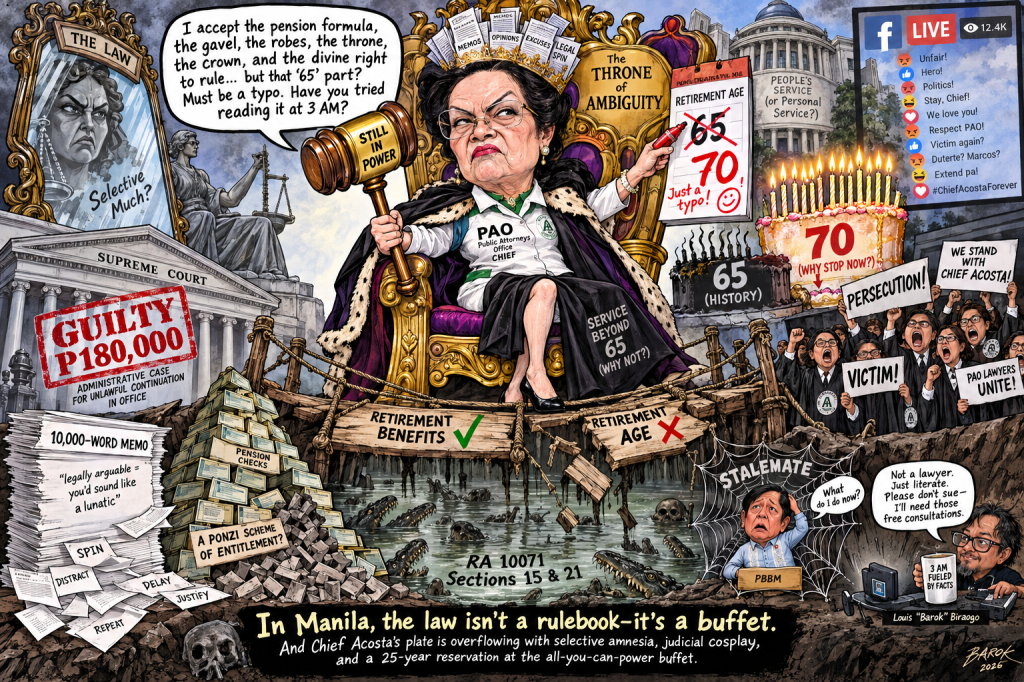
The Parity Paradox – Where benefits are embraced, but age limits are rejected.
By Louis ‘Barok’ C. Biraogo — September 8, 2026
DATELINE: Manila, where the legal system is a three-ring circus, the clowns have law degrees, and the tightrope walker refuses to come down from the wire because she insists the safety net extends to age 70.
We have obtained a leaked internal memorandum—a sprawling, 10,000-word executive assessment—that reads less like a legal brief and more like a psychological profile of a monarch refusing to leave the throne. The subject: Public Attorney’s Office (PAO) Chief Persida V. Rueda-Acosta. The question: Is she retiring at 65, or is she planning to occupy that office until the Second Coming?
The answer, buried under mountains of statutory text, Supreme Court reprimands, and bureaucratic infighting, is a masterclass in the use of legal ambiguity to entrench personal power. Forget the boring legal codes; this is a story about ambition, audacity, and the art of arguing your job is a birthright.
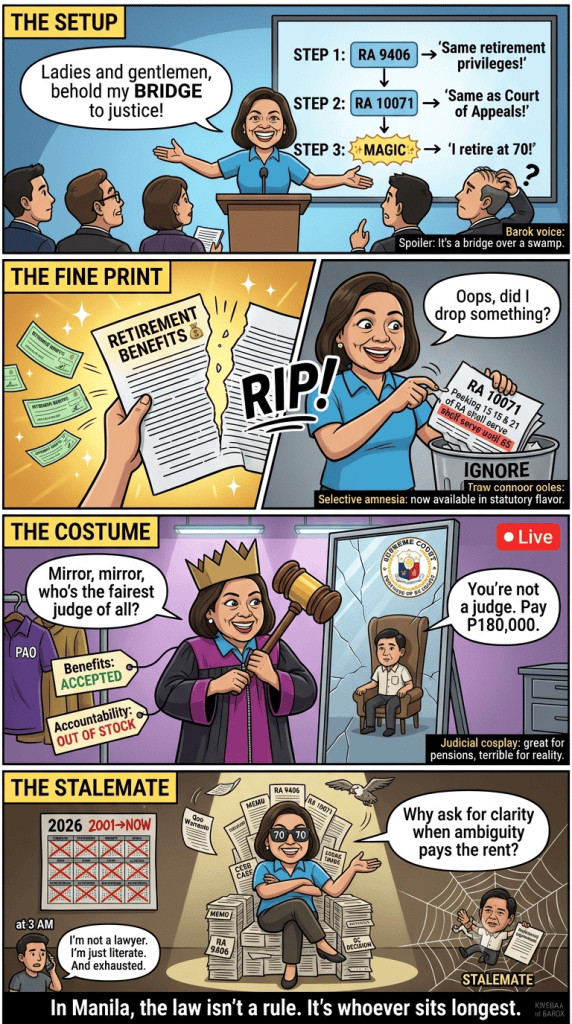
The “Parity” Shuffle: A Dance of Statutes
Let’s talk about the legal “genius” at play here. Acosta’s argument for staying until 70 is a beautiful, rickety bridge built over a swamp. It’s a three-step logic chain that relies on you not reading the fine print:
- Step One: Republic Act No. 9406 (PAO Law) says the Chief Public Attorney gets the same “retirement privileges” as the Chief State Prosecutor.
- Step Two: Republic Act No. 10071 (Prosecution Service Act of 2010) says the Chief State Prosecutor—now “Prosecutor General”—gets the same benefits as the Presiding Justice of the Court of Appeals.
- Step Three: Court of Appeals Justices retire at 70.
Voilà! Acosta is, ipso facto, a de facto judge, entitled to burnish her gavel until she hits the big 7-0.
It’s clever. It’s seductive. And it’s utterly bankrupt.
Here’s the problem the Chief Public Alchemist doesn’t want you to see. RA 10071—the same law she invokes for judicial parity—explicitly states in Sections 15 and 21 that prosecutors “shall serve until they reach the age of sixty-five (65) years old.” It’s not even a typo hidden in a footnote. It’s the core of the statute.
Acosta’s team is essentially arguing: “We accept the benefits of the Prosecution Service Act (the fancy judicial pension), but we reject the statutory baggage that comes with it (the 65-year-old exit door).” It’s selective amnesia dressed up as constitutional law.
The internal memo—prepared by people who clearly don’t get paid enough to deal with this drama—concludes the 65-year-old interpretation is “substantially stronger.” They call the 70-year argument “legally arguable,” which is lawyer-speak for “Yes, you could say that in court, but you’d sound like a lunatic.”
The “Retirement Benefits” Fallacy: A Ponzi Scheme of Logic
Here is where the mockery writes itself. Acosta and her allies conflate “retirement benefits” with “retirement age.”
Imagine your boss tells you: “You have the same health insurance as the CEO.”
Does that mean you get to sit in the CEO’s office?
Does that mean you get to fire people?
Does that mean you get the company jet?
No. It means when you get sick, the same doctor patches you up.
In statutory construction, giving a PAO Chief the pension formula of a judge does not transform the PAO Chief into a member of the Judiciary. It doesn’t grant her the constitutional identity, the security of tenure, or the tenure-ending age of a judge. She is an executive official playing dress-up with a judge’s paycheck.
The memo is devastating on this point: “The fact that a retiree receives a judicially aligned pension does not logically establish that the incumbent officer has a judicial officer’s retirement age.” Ouch. That’s a legal strike right to the jugular.
The 2024 Supreme Court Smackdown: A History of Bullying
Ah, but you can’t analyze Persida without mentioning her favorite pastime: bullying the judiciary.
Remember February 2024? The Supreme Court En Banc—that’s all the Justices—unanimously found her guilty of:
- Indirect Contempt of Court (P30,000 fine)
- Grossly Undignified Conduct Prejudicial to the Administration of Justice (P150,000 fine)
Why? Because she didn’t like a rule the Supreme Court passed regarding conflicts of interest for PAO lawyers. Her response wasn’t a legal motion. It was a Facebook mob. She mobilized her subordinates, stirred up public sentiment, and attacked the Court in the court of public opinion.
This is the modus operandi. When the law isn’t on your side, you generate noise. You create a “controversy.” You paint yourself as the victim of the elitist Judiciary or the stingy Department of Budget and Management (DBM). It’s populism, not jurisprudence.
The Long Game: The 25-Year Itch
Acosta has been Chief since 2001. Five presidents. She has survived them all. She is the immovable object in the chaotic landscape of Philippine justice.
The memo suggests the President can’t simply fire her due to security of tenure, but also notes that “continued occupation could potentially constitute unlawful holding of public office” if she has already retired by law. This isn’t just a squabble; it’s a slow-motion constitutional crisis. If Marcos Jr. tries to replace her based on the 65-year rule, she will sue. If she stays until 70 based on her twisted logic, the Republic might have to sue her via a Quo Warranto petition to yank her out of the chair.
The Bottom Line: The Truth Behind the Bluster
The truth is stark. The memo concludes that the law favors 65. The Supreme Court precedent on PAO parity (the 2017 Career Executive Service Board (CESB) case) cuts against Acosta here. That ruling said PAO must be treated like the National Prosecution Service (NPS). Well, guess what? The NPS now retires at 65. You can’t have your parity cake and eat it too, Chief.
Her strongest argument isn’t legal—it’s political. It’s the fear of backlash. It’s the fear of the mob. It’s the fact that she has a microphone and she isn’t afraid to use it to decry “persecution” when she is, in fact, the one pushing the envelope.
This isn’t a fight over the retirement age. It’s a fight over whether the rule of law can survive an encounter with a charismatic bureaucrat who believes the rules apply to everyone but her.
The memo ends with a recommendation for a “formal legal determination” or a “congressional amendment.” But we know better. Why ask for clarity when ambiguity is the source of your power?
Persida doesn’t want a ruling. She wants a stalemate. And in a bureaucracy, a stalemate means the incumbent stays. It’s brilliant. It’s cynical. And it’s the most Persida thing imaginable.
Disclaimer: If Chief Acosta is reading this, please don’t sue. I am not a lawyer. I am merely a humble blogger with a WiFi connection and an unhealthy obsession with reading government statutes at 3 AM. My only crime is literacy. Although, if arguing myself into a job extension is a crime, I hear you offer free consultations.
— Barok
Key Citations
A. Legal & Official Sources
- Republic Act No. 9406. An Act Reorganizing and Strengthening the Public Attorney’s Office (PAO), Amending for the Purpose Pertinent Provisions of Executive Order No. 292, Otherwise Known as the “Administrative Code of 1987”, as Amended, Granting Special Allowance to PAO Officials and Lawyers, and Providing Funds Therefor. 23 Mar. 2007, http://www.officialgazette.gov.ph/2007/03/23/republic-act-no-9406/.
- Republic Act No. 10071. An Act Strengthening and Rationalizing the National Prosecution Service (Prosecution Service Act of 2010). 8 Apr. 2010, lawphil.net/statutes/repacts/ra2010/ra_10071_2010.html.
- Career Executive Service Board v. Civil Service Commission, G.R. No. 197762. Supreme Court of the Philippines, 7 Mar. 2017, lawphil.net/judjuris/juri2017/mar2017/gr_197762_2017.html.
- Request of the Public Attorney’s Office to Delete Section 22, Canon III of the Proposed Code of Professional Responsibility and Accountability (A.M. No. 23-05-05-SC). Supreme Court of the Philippines, 27 Feb. 2024, sc.judiciary.gov.ph/wp-content/uploads/2024/06/23-05-05-SC.pdf.
- The 1987 Constitution of the Republic of the Philippines. Official Gazette of the Republic of the Philippines, 1987, http://www.officialgazette.gov.ph/constitutions/1987-constitution/.
B. News Reports
- Bolledo, Jairo. “SC Finds PAO Chief Acosta Guilty of Indirect Contempt, Orders Her to Pay Fine.” Rappler, 27 Feb. 2024, http://www.rappler.com/philippines/sc-decision-pao-chief-persida-acosta-guilty-indirect-contempt-pay-fine/.
- Galvez, Daphne. “SC Fines PAO Chief P180,000 for Contempt.” Philstar.com, 28 Feb. 2024, http://www.philstar.com/headlines/2024/02/28/2336698/sc-fines-pao-chief-p180000-contempt.
- Panaligan, Rey G. “SC Fines PAO Chief Acosta P180,000 for Indirect Contempt, Grossly Undignified Conduct.” Manila Bulletin, 27 Feb. 2024, mb.com.ph/2024/2/27/sc-fines-pao-chief-acosta-p180-000-for-indirect-contempt-grossly-undignified-conduct.

- “Ang Hirap Maging Mahirap”: The PAO Scandal That Proves Government Contempt Is Nothing New

- “Far-Off” My Axx: Malacañang’s Claire Castro Drowns in Her Own Legal Gaslighting

- “Forthwith” to Farce: How the Senate is Killing Impeachment—And Why Enrile’s Right (Even If You Can’t Trust Him)

- “HINDI AKO NAG-RESIGN!”

- “I Know Nothing”: Baste Duterte’s Amnesia Defense Meets ₱33M in GenCorp Contracts

- “I’m calling you from my new Globe SIM. Send load!”

- “Mahiya Naman Kayo!” Marcos’ Anti-Corruption Vow Faces a Flood of Doubt

- “Manageable” Debt, Unmanageable Lies: DBM’s ₱21 Trillion Fairy Tale

- “Meow, I’m calling you from my new Globe SIM!”

- “Natrabaho”: One Word, One Ombudsman, and a Judiciary on Trial

- “No Special Jail for Crooks!” Boying Remulla Slams VIP Perks for Flood Scammers

- “Philippine-Controlled” or Yankee Gas Station? The Davao Fuel Depot Farce Exposed









Leave a Reply