
Presto, Chango, 16 Becomes 14: The Senate’s Greatest Illusion Yet
By Louis “Barok” C. Biraogo — September 9, 2026
The Philippine Senate—a chamber that once debated whether ‘all’ means ‘all’ with the intellectual rigor of a drunk philosophy major—has outdone itself. Senator Erwin Tulfo, a man whose legal acumen is matched only by his ability to state the obvious with messianic conviction, has formally asked the impeachment court to clarify what ‘two-thirds of all Members’ means. The Vice President’s fate now hinges on whether 24 senators can count to 16, or whether we should just lower the bar to whatever number makes the math work. Spoiler: it’s the second one.
The news from Day 23 of the Sara Duterte impeachment saga is that Senator-judge Erwin Tulfo has formally asked the impeachment court to revisit the voting threshold, citing the absence of four colleagues. He posits, with the gravity of a man who has just discovered fire, that if the voting basis remains fixed at 24, the absence of senators “will result in an acquittal by default.”
Groundbreaking. The man has discovered that supermajority requirements are, in fact, difficult to meet when people don’t show up. Next, he’ll tell us water is wet and that the line at the Land Transportation Office (LTO) is long.
But let us not be too hasty. Beneath the veneer of procedural housekeeping lies a fetid swamp of political calculation, constitutional anxiety, and the kind of legal gymnastics that would earn a standing ovation at the Olympics of Bad Faith. Let’s dive in, shall we?
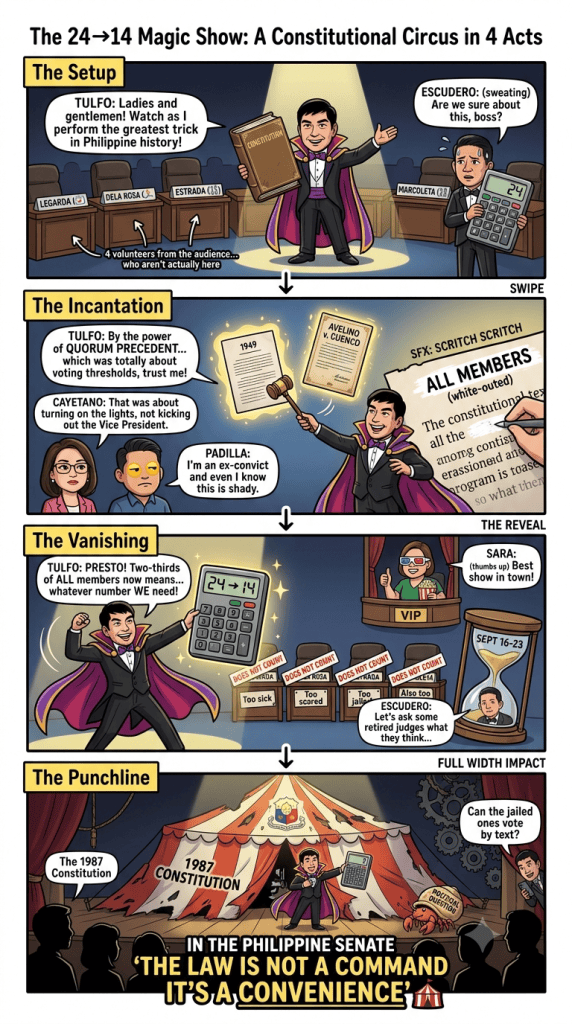
– The Philippine Senate, 2026
The “Avelino” Gambit: A Precedent Stretched Thinner Than a Politician’s Promise
Tulfo’s ace card is Avelino v. Cuenco (G.R. No. L-2821), the 1949 case he clings to like a drowning man to a piece of driftwood. His argument: the Supreme Court has previously held that the Senate can function with a reduced quorum when members are beyond its “coercive jurisdiction.” Therefore, he reasons, the same logic should apply to the constitutionally mandated two-thirds vote for impeachment conviction. Ergo, the denominator should shrink, making conviction—or acquittal—a more attainable prize for someone.
But let’s be precise, because precision matters in law, even if it’s a foreign concept in this circus. Avelino v. Cuenco was about quorum. That is, the number of warm bodies needed to turn on the lights and pretend to legislate.
The impeachment provision, Article XI, Section 3(6) of the 1987 Constitution of the Republic of the Philippines (1987 Constitution), is about conviction. It speaks of “two-thirds of all the Members of the Senate.” Not “members present.” Not “members who aren’t hiding from the International Criminal Court (ICC).” Not “members who aren’t currently in jail or on an extended spa vacation in Europe.” “All.” It’s a fixed number. It’s 16.
This isn’t a game of “adjust the denominator to fit the political narrative.” That’s called “changing the rules in the middle of the game,” which, to be fair, is a beloved Filipino pastime, second only to basketball and blaming the previous administration.
Tulfo’s argument also conveniently ignores the fact that Avelino v. Cuenco has been abused more times than a quarantine pass during the pandemic—most recently in the June 3 “coup” that saw a dozen senators declare a quorum with a straight face, ousting the previous leadership. Now, that same doctrinal tool is being dusted off for the impeachment court. Consistency from this crowd would be a terrifying sight, akin to the sun rising in the west. But let’s not mistake this for principle. This is about math, and math is power.
The Unholy Quartet: A Study in Absenteeism
Let’s look at our four missing senator-judges, the phantoms haunting this trial.
- Loren Legarda: On medical leave abroad. Fair enough. The woman is sick. The best argument for excluding her? Weak. She’s still a senator. She could theoretically get better, or at least get a reliable Wi-Fi connection to Zoom in from a Swiss clinic.
- Ronald “Bato” dela Rosa: In hiding, apparently, due to an ICC arrest warrant for his alleged role in the drug war’s extrajudicial killings. He is, to use the legal term, a fugitive from international justice. His absence is a choice. He is self-excluding to avoid being handcuffed at the airport. To reward this behavior by lowering the threshold would be to enshrine obstruction as a legitimate legal strategy. “Can’t convict me if I just don’t show up!” is a bold defense, perhaps best suited for a schoolyard, not the Senate.
- Jinggoy Estrada & Rodante Marcoleta: Detained for plunder. This is where it gets interesting, and by “interesting,” I mean legally and ethically murky. They are, in theory, unable to attend. But are they no longer “Members of the Senate”? The 1987 Constitution says the Senate has 24 members. It doesn’t have an asterisk that says “minus those who allegedly stole from the public coffers.” The Sandiganbayan hasn’t removed them from office; they’re suspended, a legal limbo that isn’t death, resignation, or expulsion.
Tulfo’s argument conflates inability to attend with cessation of membership. It’s a sleight of hand. A legal fiction. A lie, told with PowerPoint slides and a solemn face.
The Real Game: Political Math and the Phantom Veto
What we are witnessing is not a dispassionate debate over constitutional interpretation. It is a desperate attempt to game the system by whichever faction believes it has the numbers on its side. The irony is delicious. The very senators who, in June, used Avelino v. Cuenco to justify a quorum with 12 people are now being asked to use Avelino v. Cuenco to justify a conviction threshold that might be 14 or 15. It’s a movable feast of constitutional convenience.
Tulfo’s “acquittal by default” argument is rhetorically potent but constitutionally hollow. An acquittal is not a “default.” It is the constitutional result when the state fails to meet the high bar it set for itself. The framers of the 1987 Constitution, scarred by martial law, deliberately made it hard to remove an official. This high bar is a feature, not a bug. It’s a bulwark against partisan witch hunts. It’s supposed to be difficult. It’s supposed to require overwhelming consensus.
What Tulfo is really saying is: “We might not have the votes to convict, so let’s change the number of votes required.” This is the political equivalent of a struggling basketball team demanding the hoop be lowered.
The response from Senator Pia Cayetano—opposing the move—is telling. She and Robin Padilla, strange bedfellows if ever there were ones, are right to call this what it is: an attempt to alter or circumvent the 1987 Constitution. Cayetano, still smarting from her family’s ouster in the “coup,” sees this as another power grab. Padilla, perhaps, sees it as a threat to his amo. Either way, a broken clock is right twice a day.
The Escudero Maneuver: Kicking the Can with “Friends”
And what of Presiding Officer Chiz Escudero, the man tasked with herding these cats? His solution is quintessentially Escudero: rather than rule with principle, he has summoned amici curiae—retired Supreme Court justices, presumably to be wheeled in, given a glass of water, and asked to provide cover for an impossible decision.
This is not leadership. This is outsourcing. It is the political equivalent of asking your dad to come to the principal’s office because you don’t want to get detention. It’s a delay tactic designed to run out the clock, to let the political temperature simmer, to allow for more backroom horse-trading. The hearing is set for September 16, the decision for September 23. That’s two more weeks of leaks, threats, and “principled standpoints” that are actually just bargaining positions in disguise.
The move is brilliant in its cowardice. If the amici agree with the 16-vote threshold, Escudero can say, “See? The wise elders agree with me.” If they suggest a lower threshold, he can throw up his hands and say, “Well, the experts have spoken,” absolving himself of political responsibility. It’s a masterclass in the art of passing the buck.
The Final Verdict: A Circus Disguised as a Trial
So here we are. The impeachment trial of the Vice President, ostensibly a solemn constitutional exercise, has devolved into a debate about the meaning of “all,” featuring a cast of characters that includes a fugitive, two detainees, a missing senator, and a brother act that seems to treat the 1987 Constitution as a set of suggestions.
The broader lesson is this: The Philippine impeachment process is not a legal proceeding; it is a political one, governed by the raw arithmetic of power. The 1987 Constitution’s language is being twisted not in service of truth or accountability, but in service of whoever has the votes on any given day. The system is working exactly as designed—flawed, messy, and profoundly susceptible to the whims of the people who were supposed to be its guardians.
What is truly astonishing is the brazenness of it all. They are not even trying to hide the calculus. Senator Raffy Tulfo’s question about allowing detained senators to “monitor” the proceedings “if they want to vote” is so transparently about ensuring they have enough informed votes to reach a desired outcome that it would be funny if it weren’t so corrosive to the rule of law.
The Supreme Court, in its recent Sara Z. Duterte v. House of Representatives (Duterte v. House) ruling, has already signaled it is willing to peer into this cesspool. If the Senate ultimately votes to lower the threshold, a constitutional challenge is almost certain. The question is whether the Supreme Court will have the stomach to correct its political betters or whether it will hide behind the “political question doctrine” like a hermit crab retreating into its shell.
The Filipino people deserve better. They deserve a Senate that understands the words “sole power to try and decide” as a responsibility, not a blank check. They deserve an impeachment trial focused on evidence, not arithmetic. Instead, they are getting a masterclass in legal sophistry from a group of politicians who wouldn’t know a constitutional principle if it hit them in the face with a two-thirds majority.
Mark my words: this battle over the denominator is the trial. The actual trial of Sara Duterte—the evidence, the arguments, the verdict—is merely an afterthought, the closing credits to a film that has already delivered its punchline. And the punchline, ladies and gentlemen, is that in the Philippine Senate, the law is not a command. It’s a convenience.
This has been The Barok Bulletin. Stay skeptical.
Key Citations
A. Legal & Official Sources
- The 1987 Constitution of the Republic of the Philippines. Official Gazette of the Republic of the Philippines, 1987, http://www.officialgazette.gov.ph/constitutions/1987-constitution/.
- The 1987 Constitution of the Republic of the Philippines, art. XI, sec. 3(6). Official Gazette of the Republic of the Philippines, http://www.officialgazette.gov.ph/constitutions/the-1987-constitution-of-the-republic-of-the-philippines/the-1987-constitution-of-the-republic-of-the-philippines-article-xi/.
- Avelino v. Cuenco, G.R. No. L-2821, 4 Mar. 1949, Supreme Court of the Philippines, lawphil.net/judjuris/juri1949/mar1949/gr_l-2821_1949.html.
- Sara Z. Duterte v. House of Representatives, G.R. Nos. 278353 and 278359, Supreme Court of the Philippines, sc.judiciary.gov.ph/278353-278359-sara-z-duterte-vs-house-of-representatives-et-al-atty-israelito-p-torreon-et-al-vs-house-of-representatives-et-al/.
- International Criminal Court. Official Website. http://www.icc-cpi.int/.
- Sandiganbayan. Official Website. sb.judiciary.gov.ph/.
B. News Reports
- Locus, Sundy. “Impeachment Court Asked to Revisit Voting Threshold.” Rappler, 8 Sept. 2026, http://www.rappler.com/philippines/impeachment-court-asked-revisit-voting-threshold/.
- Ombay, Giselle. “Senate Impeachment Court Sets Sept. 23 for Oral Arguments on Voting Threshold.” GMA News Online, GMA Network, 8 Sept. 2026, http://www.gmanetwork.com/news/topstories/nation/1001583/senate-impeachment-court-sets-sept-23-for-oral-arguments-on-voting-threshold/story/.
- Servallos, Neil Jayson. “Amici Curiae: Impeach Court to Tap Legal Experts on Voting Threshold.” Philstar.com, 9 Sept. 2026, http://www.philstar.com/headlines/2026/09/09/2555022/amici-curiae-impeach-court-tap-legal-experts-voting-threshold.
- Laqui, Ian. “Senate Presidency in Limbo after 12-Senator Quorum Move.” Philstar.com, 3 June 2026, http://www.philstar.com/headlines/2026/06/03/2532585/senate-presidency-limbo-after-12-senator-quorum-move.
- “Ang Hirap Maging Mahirap”: The PAO Scandal That Proves Government Contempt Is Nothing New

- “Far-Off” My Axx: Malacañang’s Claire Castro Drowns in Her Own Legal Gaslighting

- “Forthwith” to Farce: How the Senate is Killing Impeachment—And Why Enrile’s Right (Even If You Can’t Trust Him)

- “HINDI AKO NAG-RESIGN!”

- “I Know Nothing”: Baste Duterte’s Amnesia Defense Meets ₱33M in GenCorp Contracts

- “I’m calling you from my new Globe SIM. Send load!”

- “Mahiya Naman Kayo!” Marcos’ Anti-Corruption Vow Faces a Flood of Doubt

- “Manageable” Debt, Unmanageable Lies: DBM’s ₱21 Trillion Fairy Tale

- “Meow, I’m calling you from my new Globe SIM!”

- “Natrabaho”: One Word, One Ombudsman, and a Judiciary on Trial

- “No Special Jail for Crooks!” Boying Remulla Slams VIP Perks for Flood Scammers

- “Philippine-Controlled” or Yankee Gas Station? The Davao Fuel Depot Farce Exposed








Leave a Reply