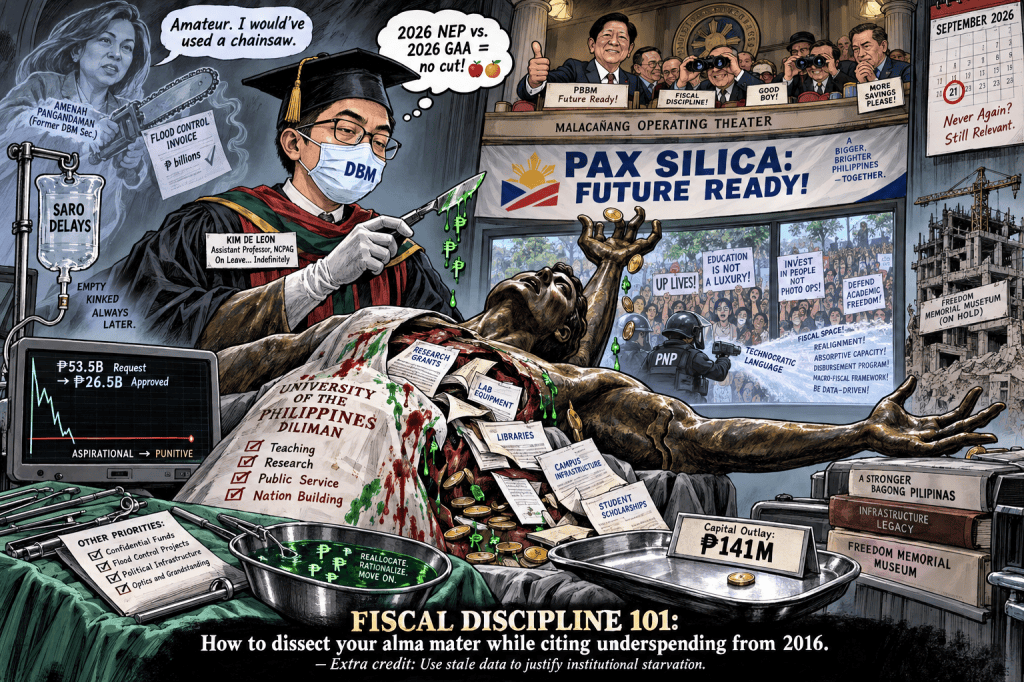
DBM Secretary Kim de Leon is a UP Diliman professor. He just proposed the steepest cut to his own university in years. The irony is not lost on the students.
By Louis “Barok” C. Biraogo | September 20, 2026
I want to make sure I’m not hallucinating this.
The Department of Budget and Management (DBM)—an agency whose previous secretary resigned amid a flood-control corruption scandal that would make a warlord blush—has just gutted the budget of the country’s premier state university by roughly half. And the man holding the knife is an assistant professor at University of the Philippines (UP) Diliman.
You can’t make this up.
Kim Robert de Leon, the 32-year-old acting DBM secretary who took over after Amenah Pangandaman‘s unceremonious exit, is a UP faculty member. He is, by any reasonable measure, one of us. And he just presided over the steepest proposed cut to his own employer in recent memory.
The irony is so thick you could build the Freedom Memorial Museum out of it.
The Numbers Game: A Masterclass in Apples-to-Oranges
Let’s start with the semantic gymnastics, because this is where the DBM’s defense already looks like it was drafted by a debate team that lost its moral compass.
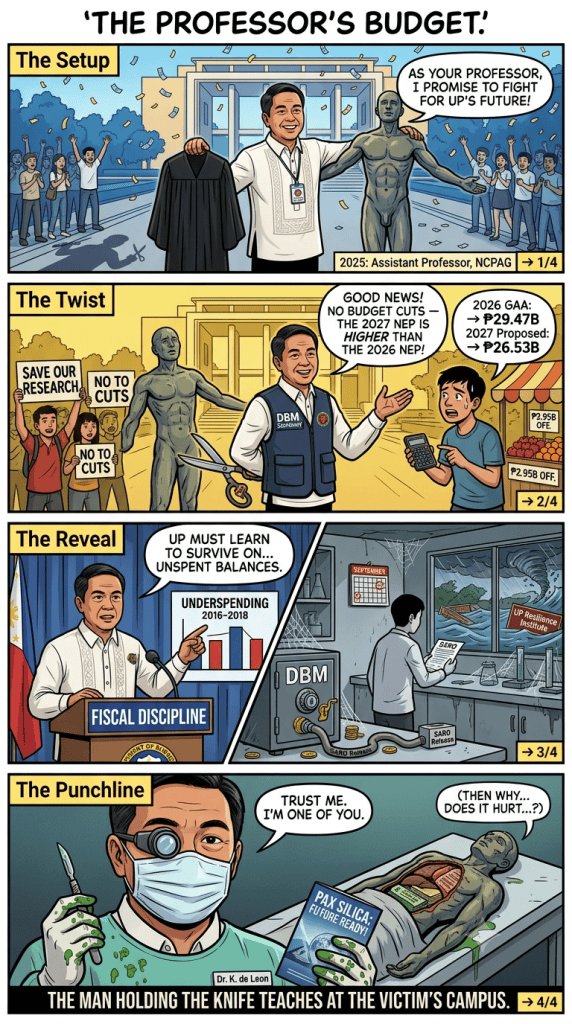
UP President Angelo Jimenez says the proposed 2027 budget represents a ₱2.95 billion cut from the university’s actual 2026 General Appropriations Act (GAA) funding. He wants “apples to apples, not apples to oranges.”
DBM, meanwhile, insists there’s no “cut” at all—because the ₱26.53 billion proposed for 2027 is actually higher than the ₱25.82 billion UP received in the 2026 National Expenditure Program (NEP).
Both are technically correct. Both are also engaged in the time-honored Philippine tradition of piso-piso accounting, where you choose the baseline that makes your side look best.
Here’s the actual apples-to-apples reality: UP’s 2026 GAA allocation was ₱29.47 billion. The proposed 2027 allocation is ₱26.53 billion. That is a 10% year-on-year reduction.
The university’s request was ₱53.5 billion. DBM approved less than half of that.
But sure, let’s pretend the “no cut” framing holds water because the 2026 NEP was lower. The 2026 NEP was also not the final budget. Congress increased it. That’s called the legislative process. You don’t get to pretend the enacted budget never happened just because it’s inconvenient for your narrative.
The Composition Problem: Where the Real Damage Lies
If the aggregate reduction is politically embarrassing, the composition of the cut is institutionally catastrophic.
Capital outlay: ₱141 million. That’s it. For the entire UP system.
Twenty-six locally funded capital projects in 2026. Five in 2027. The rest? Frozen.
This includes the UP Resilience Institute—a facility that would research disaster resilience in a country that experiences approximately 20 typhoons annually, flash floods that kill hundreds, and landslides that bury communities alive. The same government that is currently investigating ghost flood control projects is proposing to defund actual disaster research infrastructure.
The irony is so heavy it could sink a barangay.
And then there’s the research budget: down ₱930 million, or roughly 53%.
Let me translate that for the non-academic reader. UP’s shift toward becoming a “research and innovation university”—the stated vision of President Jimenez, the entire justification for the university’s national mandate under Republic Act No. 9500 (University of the Philippines Charter of 2008)—just got kneecapped. The national university is being asked to compete in the global knowledge economy while its research funding is being slashed by half.
But sure, no cut.
The Underspending Defense: The Circular Logic of Starvation
DBM’s favorite talking point is “underspending.” De Leon says agencies should “survive on unspent 2026 balances carried into 2027.”
This is the budget equivalent of a loan shark telling you that since you couldn’t pay last month’s interest, you don’t need the money this month anyway.
Here’s the circularity, in case it’s not obvious: DBM controls the speed of fund releases. SAROs—the special allotment release orders that allow agencies to actually spend their appropriations—are issued by DBM. If DBM delays releases, agencies can’t spend. If agencies can’t spend, DBM cites “underspending.” If DBM cites underspending, it justifies future cuts. Rinse. Repeat.
The Commission on Audit (COA) has flagged UP Manila for delays in planning and implementation, resulting in nearly ₱990 million in idle funds. But COA attributed those delays to “weak management oversight” and “failure to update project statuses”—not necessarily to UP’s inherent inability to spend.
Translation: the university may have administrative problems. But DBM’s slow-walking of releases is a structural feature of the system, not a bug UP invented.
And here’s the kicker: citing underspending data from 2016–2018 to justify a 2027 cut is like citing your college GPA to justify not getting a job promotion in your 40s. It’s stale, it’s irrelevant, and it says more about the person wielding the data than the institution being judged.
The Pax Silica Paradox: Cutting Research While Marketing Yourself as a Tech Hub
Let’s zoom out for a moment, because the policy incoherence here is genuinely stunning.
The Marcos administration is aggressively marketing the Philippines as an AI and semiconductor hub under the U.S.-led Pax Silica Initiative. That program is explicitly built around AI, semiconductors, and critical minerals—seeking an initial $10 billion in investment and promising up to 190,000 jobs.
This is the future, we’re told. Knowledge economy. Innovation. High-tech.
And then the same administration proposes cutting ₱930 million from the research budget of the national university—the institution responsible for training the engineers, data scientists, and researchers who would staff this alleged Pax Silica boom.
The students are, unsurprisingly, not amused. The Black Friday protests at UP Diliman and Los Baños explicitly tied the budget cuts to Pax Silica, calling the initiative “pahirap sa masa” and warning about displacement of farmers and Indigenous Peoples.
You can’t simultaneously claim to be building a knowledge economy and defund the knowledge-producing institutions. Pick a lane.
The Political Timing: A Masterclass in Plausible Deniability
The budget cuts surfaced days before the September 21–23 commemorations of the declaration of Martial Law under Ferdinand Marcos Sr.
UP, of course, has a particular relationship with that history. It was the epicenter of anti-Marcos activism. It houses the scholarship that documents the dictatorship’s human rights abuses. It is where the Freedom Memorial Museum—a project that Jimenez says is “a go”—is supposed to rise.
And now, on the eve of the 54th anniversary of martial law, the current Marcos administration proposes gutting its budget.
Is this deliberate retaliation? There’s no smoking gun. No leaked memo saying “punish the activists.” The DBM can point to its fiscal discipline rhetoric, its own agency cuts (12.45% to DBM’s own budget), and the general austerity posturing after the flood-control scandal.
But here’s what we can say: the timing is politically radioactive, and the administration knows it. Whether or not the cuts were motivated by retaliation, they will be perceived as retaliation. And in politics, perception is often more consequential than intent.
The Black Friday protests—6,000 at UPLB, 3,000 at UPD—were already pre-primed mobilization infrastructure from last year’s flood-control corruption protests. This year, the budget cuts just gave them another target.
The Insider Irony: The Professor Who Cuts His Own University
Let me return to Kim de Leon, because this is the detail that refuses to stop nagging.
The acting DBM secretary is an assistant professor at UP Diliman’s National College of Public Administration and Governance. He is a “product of state scholars,” as one lawmaker put it during the House appropriations hearings.
Representative Elijah San Fernando—himself a graduate of the Polytechnic University of the Philippines—asked De Leon why, as a “product of state scholars,” he apparently allowed State Universities and Colleges (SUCs) to suffer cuts while defense enjoyed increases.
De Leon didn’t have a good answer.
Now, there are two ways to read this. The charitable interpretation: De Leon is an insider who knows UP’s weaknesses intimately—its chronic underspending, its administrative bottlenecks—and is enforcing discipline precisely because he cares about the institution’s long-term credibility with Congress. The cynical interpretation: a young technocrat, eager to prove his fiscal bona fides to Malacañang after his predecessor’s scandal-tainted exit, is using his own university as a sacrifice to the altar of reform branding.
I know which reading the campus discourse favors. I also know which one De Leon’s career trajectory suggests.
The Bottom Line: A Budget Process That Punishes the Wrong Institution
Here’s the truth that neither DBM nor UP’s most vocal defenders want to confront:
DBM has a legitimate constitutional role. Article VI, Section 29 of the 1987 Constitution reserves the power of the purse to Congress, and the Executive prepares the proposed budget. UP’s fiscal autonomy under RA 9500—as the Commission on Audit has repeatedly clarified—governs how UP administers funds once appropriated, not an entitlement to whatever the Board of Regents requests.
UP has a legitimate institutional grievance. The national university cannot fulfill its statutory mandate—research, innovation, public service, disaster resilience—while its capital outlay is reduced to pocket change and its research budget is halved. The university’s ₱53.5 billion request may have been aspirational, but the ₱26.5 billion response is punitive.
And the students, as usual, are the ones who will pay the price. Fewer facilities. Fewer research opportunities. Fewer scholarships. A university that is supposed to be the engine of Philippine knowledge production, reduced to a graduate factory running on fumes.
The deepest scandal here isn’t the number. It’s the process—a budget system that rewards political visibility over institutional need, that punishes long-term investment in favor of short-term ribbon-cutting, and that treats the national university as just another line item to be squeezed.
DBM says it wants “fiscal discipline.” But discipline without vision is just austerity. And austerity without investment is just decline.
UP is not asking for a blank check. It’s asking for the resources to do the job Congress mandated it to do. The DBM’s response is, in effect: do less with less, and be grateful we didn’t cut you further.
That’s not fiscal discipline. That’s institutional starvation dressed up in technocratic language.
And the man holding the knife teaches at the victim’s campus.
You can’t make this up.
Barok’s note: The 2027 GAA is not yet enacted. Congress has the power to restore, realign, and amend. UP is scheduled to present its case before the Senate Committee on Finance. If you care about the national university—or about the country’s capacity to produce knowledge rather than just consume it—pay attention to the bicameral conference. That’s where the real decisions get made. And this time, demand that the proceedings be public. The flood-control scandal taught us what happens when budget decisions happen in the dark.
Key Citations
A. Legal & Official Sources
- The 1987 Constitution of the Republic of the Philippines. Official Gazette of the Republic of the Philippines, 1987, http://www.officialgazette.gov.ph/constitutions/1987-constitution/.
- The 1987 Constitution of the Republic of the Philippines, art. VI, sec. 29. Official Gazette of the Republic of the Philippines, http://www.officialgazette.gov.ph/constitutions/the-1987-constitution-of-the-republic-of-the-philippines/the-1987-constitution-of-the-republic-of-the-philippines-article-vi/.
- Republic Act No. 9500. An Act to Strengthen the University of the Philippines as the National University (University of the Philippines Charter of 2008). 29 Apr. 2008, http://www.lawphil.net/statutes/repacts/ra2008/ra_9500_2008.html.
- Proclamation No. 1081. Proclaiming a State of Martial Law in the Philippines. 21 Sept. 1972, http://www.officialgazette.gov.ph/1972/09/21/proclamation-no-1081/.
- General Appropriations Act, FY 2026. Official Gazette of the Republic of the Philippines / Department of Budget and Management, http://www.officialgazette.gov.ph/general-appropriations-act/.
- National Expenditure Program Volume I, FY 2027. Department of Budget and Management, 2026, http://www.dbm.gov.ph/index.php?view=article&id=4137:national-expenditure-program-volume-i-fy-2027&catid=446.
B. News Reports
- Hernandez, Jacqueline. “LIST: State Universities and Colleges’ Proposed Budgets for 2027.” Rappler, 25 Aug. 2026, http://www.rappler.com/philippines/list-state-universities-colleges-proposed-2027-budgets/.
- “UP to Ask Lawmakers to Restore P29.5-Billion Budget.” BusinessWorld, 18 Sept. 2026, http://www.bworldonline.com/the-nation/2026/09/18/778432/up-to-ask-lawmakers-to-restore-p29-5-billion-budget/.
- Limos, Allen. “UP President Sets FY 2027 for Infra Completion, Research.” The Manila Times, 19 Sept. 2026, http://www.manilatimes.net/2026/09/19/news/up-president-sets-fy-2027-for-infra-completion-research/2428399.
- Bonzo, Lyjah Tiffany. “UP Students Stage Walkout over 2027 Budget Cuts, Pax Silica.” GMA News Online, GMA Network, 18 Sept. 2026, http://www.gmanetwork.com/news/topstories/nation/1002911/up-students-stage-walkout-over-2027-budget-cuts-pax-silica/story/.
- Gita-Carlos, Ruth Abbey. “DBM Cuts Proposed 2027 Budget, Vows Fiscal Discipline.” Philippine News Agency, 16 Sept. 2026, http://www.pna.gov.ph/articles/1284190.
- “Bersamin, Pangandaman Resign; Recto Appointed Executive Secretary.” Rappler, 17 Nov. 2025, http://www.rappler.com/philippines/lucas-bersamin-amenah-pangandaman-resignation-ralph-recto-appointment-executive-secretary/.
- “The United States and The Philippines Launch Plans for 4,000-Acre Economic Security Zone to Shore Up Supply Chains.” U.S. Embassy in the Philippines, 16 Apr. 2026, ph.usembassy.gov/the-united-states-and-the-philippines-launch-plans-for-4000-acre-economic-security-zone-to-shore-up-supply-chains/.
- Sinaking, Erika Mae P. “BCDA Pegs Pax Silica Investment at up to $70B.” BusinessWorld, 24 July 2026, http://www.bworldonline.com/editors-picks/2026/07/24/765615/bcda-pegs-pax-silica-investment-at-up-to-70b/.

- ₱8B BBM Pork: CCTV for Every Captain’s Kumpare?

- ₱8.9 Billion, 331 Ghost Police Stations: The TIKAS Scandal Explained

- ₱8.4 Billion, 42,000 Barangays, 1 Election: The “Bawat Barangay Makikinabang” Vote-Buying Masterclass

- ₱75 Million Heist: Cops Gone Full Bandit

- ₱6.77B Ghost Haunts Duterte: RTC Dismisses Mans Carpio’s Desperate Plea
- ₱6.77 Billion and Zero Cash: The Sara Duterte SALN Math That Doesn’t Add Up

- ₱6.7-Trillion Temptation: The Great Pork Zombie Revival and the “Collegial” Vote-Buying Circus

- ₱58.53B, Zero Receipts: The LGSF Pork Barrel Nobody Wants to Name
- ₱53 Million Man Tells ₱695-a-Day Workers to Stop Being ‘Mayabang’: The Audacity of BSP’s Remolona

- ₱4.4 Billion and a Witness Who Can’t Explain It: The Duterte Impeachment’s Most Expensive Non-Answer
- ₱3.06 Billion for Evacuation Centers—But Nobody Knows Where They’ll Stand (Or If They’ll Exist)
- ₱16 Billion, 280 Accounts, 8 Helicopters: Boying Remulla’s Case Against the Yaps Is Not a Drill






Leave a Reply