A Sitting Senator, a Cabinet Portfolio, and a Family Business: Anatomy of a Conflict of Interest So Blatant It’s Almost Impressive
By Louis ‘Barok’ C. Biraogo — September 18, 2026
LET’S get one thing straight before the Villar family’s impressive legal communications apparatus starts flooding my inbox: the Office of the Ombudsman’s September 18, 2026 filing is a preliminary investigation, not a conviction. I know that. You know that. The Villars’ lawyers definitely know that, and you can bet they’ll repeat it until the phrase loses all meaning.
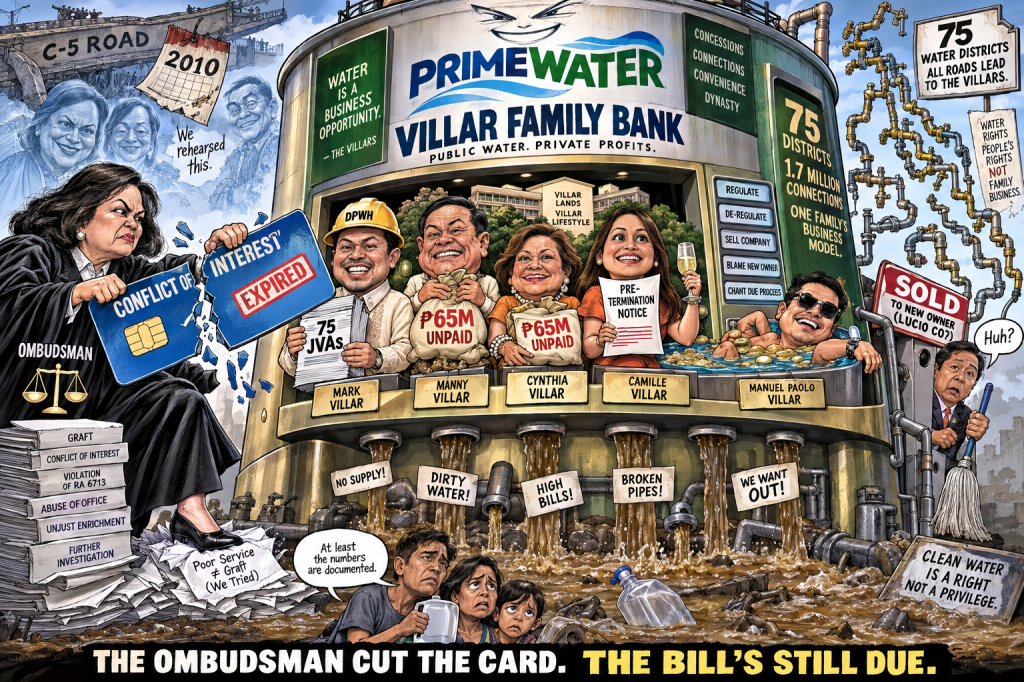
But here’s what the Villars don’t want you to focus on while they chant “due process” like a mantra: the sheer, breathtaking audacity of this entire arrangement. We’re not talking about a few bad contracts. We’re talking about 75 joint venture agreements with local water districts across the Philippines, signed between 2015 and 2022, while a member of the Villar family was serving as Secretary of Public Works and Highways (DPWH)—the department to which the Local Water Utilities Administration (LWUA), created under Presidential Decree No. 198 (Provincial Water Utilities Act of 1973), was attached under Executive Order No. 62.
The structural conflict of interest here isn’t subtle. It’s not a whisper. It’s a bullhorn.

🤔 #VillarDynasty #PrimeWaterScam
The Numbers That Should Keep You Up at Night
Let’s walk through this like an actual investigation, not a press release.
- 2015 to 2022: PrimeWater Infrastructure Corporation, owned by Manuel Paolo Villar—son of Manny and Cynthia, brother of Mark and Camille—expands from a handful of water district contracts to 75. The company’s footprint grows to 161 cities and municipalities, 1.7 million service connections, and 16 regions.
- 2016 to 2021: Mark Villar serves as DPWH Secretary. During this period, LWUA—which oversees local water districts—is an attached agency of DPWH.
- 2019: Malacañang’s own investigation flags a “spike” in PrimeWater JVAs during this period.
You don’t need a doctorate in statistics to see the pattern. You just need to be conscious and not a Villar.
The Ombudsman says it has identified 19 water districts that issued notices of pre-termination due to PrimeWater’s alleged failures—uninterrupted supply, water quality, unmet capital expenditure commitments. The Senate’s own survey in December 2025 found that of 70 responding water districts, 61 expressed dissatisfaction and 52 had begun or were preparing to terminate their agreements.
Let me translate that for the Villar family’s PR team: the customers are revolting. Not in the abstract political sense. In the “we’d rather take our chances with a bankrupt water district than continue with your company” sense.
The ₱65 Million Question (Among Others)
The Ombudsman’s complaint cites ₱65,650,708.07 in unpaid obligations—money PrimeWater allegedly owes three water districts for the use or consumption of materials and supplies belonging to those districts.
Let’s sit with that for a moment.
PrimeWater didn’t just fail to deliver on its promises. It allegedly used public assets—materials and supplies owned by the water districts—and then didn’t pay for them.
That’s not a business dispute. That’s theft with extra steps.
And the Commission on Audit (COA), which doesn’t deal in hyperbole, flagged this. COA findings aren’t opinions. They’re audit facts.
The Villars will argue—as they always do—that “poor service is not criminal intent.” And they’re right. Poor service alone is not graft under Republic Act No. 3019 (Anti-Graft and Corrupt Practices Act). But taking public property and not paying for it while simultaneously failing to deliver the services you promised? That starts to look less like incompetence and more like a business model.
The “We Sold the Company” Defense
In December 2025, the Villars sold PrimeWater to Crystal Bridges Holdings Corp., owned by Lucio Co. The Philippine Competition Commission (PCC) approved the acquisition in April 2026. PrimeWater was renamed Hiraya Water Corp.
The Villars’ narrative writes itself: “We’re not the owners anymore. Why are you still blaming us?”
Here’s the problem with that argument: the alleged acts occurred between 2015 and 2022. The sale happened after the Senate investigations, after the COA findings, after the consumer complaints had already reached a crescendo.
The timing isn’t suspicious. It’s choreographed.
And the Palace itself noted in 2026 that the ownership change does not automatically erase PrimeWater’s outstanding liabilities. That’s the government saying, politely: “Nice try.”
The Family That Contracts Together…
The Ombudsman’s respondents include Mark and Camille Villar (sitting senators), Manny and Cynthia Villar (former senators), and Manuel Paolo Villar (the actual PrimeWater owner until the sale).
The legal question that will decide this case is individual participation. Beneficial ownership alone doesn’t prove conspiracy. Family relationship alone doesn’t prove conspiracy. The prosecution must show who did what, when, and how.
But let’s be clear about what the Ombudsman has already established: it believes the Villars were beneficial owners of PrimeWater during the relevant period. It has cited Mark Villar’s dual role as DPWH Secretary and LWUA Board of Trustees member during the JVA expansion.
That’s not nothing. That’s a structural conflict of interest that should have disqualified any public official with a functioning moral compass from participating in decisions affecting his family’s business under Republic Act No. 6713 (The Code of Conduct and Ethical Standards for Public Officials and Employees).
The fact that it apparently didn’t tells you everything you need to know about how the Villars view public office: not as a public trust, but as a business development tool.
The C-5 Ghost
For those with long memories—or access to the Senate archives—this isn’t the first time a Villar has faced allegations of using public office for private gain.
In 2010, the Senate Committee of the Whole recommended censure of then-Senator Manny Villar for improper and unethical conduct related to the C-5 road extension realignment, which allegedly benefited his real estate properties. The committee found that Villar made the Filipino people suffer ₱6.22 billion in losses through this arrangement.
The censure motion failed due to lack of quorum. Villar’s allies simply didn’t show up.
Seventeen years later, we’re watching the same movie with different actors and a much bigger budget.
The Political Calculus
I’m not naive. I know the Marcos administration has its own reasons for allowing this investigation to proceed. The Villars and the Marcoses have been uneasy allies at best. Weakening a rival political dynasty is always a bonus.
But here’s the thing: even if the motives are impure, the facts remain the facts.
75 JVAs. 19 pre-termination notices. ₱65 million in unpaid obligations. 61 out of 70 water districts dissatisfied. ₱18.5 billion in infrastructure contracts awarded to a relative under separate Department of Justice (DOJ) investigation.
You don’t need to like the Ombudsman. You don’t need to trust the Marcos administration. You just need to look at the numbers.
What Happens Next
The preliminary investigation will proceed. The Villars will file their counter-affidavits. They’ll argue—correctly—that poor performance is not necessarily graft. They’ll argue—correctly—that beneficial ownership alone doesn’t prove conspiracy. They’ll argue—correctly—that the sale of PrimeWater complicates attribution of current problems.
But they’ll have a much harder time arguing that a family that controlled both the regulator (DPWH/LWUA) and the regulated entity (PrimeWater) simultaneously somehow accidentally found itself on the receiving end of 75 government contracts.
The Ombudsman’s case may ultimately succeed or fail on evidentiary technicalities. The conspiracy charge may be difficult to prove. The individual participation of Manny, Cynthia, and Camille may be hard to establish.
But the structural corruption—the use of public office to facilitate private business expansion—is right there in the timeline.
The Bottom Line
The Villar family has spent decades building an empire that blurs the line between public service and private profit. The PrimeWater investigation is the most comprehensive effort yet to hold them accountable for that blurring.
It may not result in convictions. The Philippine justice system has a long and storied history of letting powerful families skate.
But at least now, the pattern is documented.
75 water districts. 1.7 million connections. A nation’s water supply entangled with a family’s business interests while a family member held the regulatory portfolio.
That’s not a coincidence. That’s a strategy.
And the bill for that strategy—in unpaid obligations, failed infrastructure, and broken promises—is being handed to the Filipino people.
As always.
Key Citations
A. Legal & Official Sources
- The 1987 Constitution of the Republic of the Philippines. Official Gazette of the Republic of the Philippines, 1987, http://www.officialgazette.gov.ph/constitutions/1987-constitution/.
- Article XI, Section 1. The 1987 Constitution of the Republic of the Philippines. Official Gazette of the Republic of the Philippines, http://www.officialgazette.gov.ph/constitutions/the-1987-constitution-of-the-republic-of-the-philippines/the-1987-constitution-of-the-republic-of-the-philippines-article-xi/.
- Republic Act No. 3019. Anti-Graft and Corrupt Practices Act. 17 Aug. 1960, http://www.officialgazette.gov.ph/1960/08/17/republic-act-no-3019/.
- Republic Act No. 6713. An Act Establishing a Code of Conduct and Ethical Standards for Public Officials and Employees. 20 Feb. 1989, lawphil.net/statutes/repacts/ra1989/ra_6713_1989.html.
- Presidential Decree No. 198. Provincial Water Utilities Act of 1973. 25 May 1973, elibrary.judiciary.gov.ph/thebookshelf/showdocs/26/25825.
- Executive Order No. 62. Transferring the Local Water Utilities Administration (LWUA) from the Department of Health to the Department of Public Works and Highways (DPWH). 26 Oct. 2011, lawphil.net/executive/execord/eo2011/eo_62_2011.html.
B. News Reports
- Bolledo, Jairo. “Villar Family Faces Graft Complaints over PrimeWater Contracts.” Rappler, 18 Sept. 2026, http://www.rappler.com/philippines/villar-family-graft-complaints-primewater-contracts/.
- “Most Water Districts Want Out of PrimeWater JVAs.” BusinessMirror, 3 Dec. 2025, businessmirror.com.ph/2025/12/03/most-water-districts-want-out-of-primewater-jvas/.
- Bajo, Anna Felicia. “Palace: PrimeWater to Be Held Liable if Proven at Fault.” GMA News Online, GMA Network, 17 Dec. 2025, http://www.gmanetwork.com/news/topstories/nation/969902/palace-primewater-to-be-held-liable-if-proven-at-fault/story/.
- “Philippine Tycoon to Sell Troubled Water Utility Amid Scrutiny.” Bloomberg, 16 Dec. 2025, http://www.bloomberg.com/news/articles/2025-12-16/philippine-tycoon-to-sell-troubled-water-utility-amid-scrutiny.
- Calica, Aurea. “Senate Panel OKs Villar Censure.” Philstar.com, 19 Jan. 2010, http://www.philstar.com/headlines/2010/01/19/541694/senate-panel-oks-villar-censure.
- Legaspi, Amita. “‘Boycott’ Dooms Senate Move to Censure Villar on C5 Mess.” GMA News Online, GMA Network, 3 Feb. 2010, http://www.gmanetwork.com/news/topstories/nation/183102/boycott-dooms-senate-move-to-censure-villar-on-c5-mess/story/.
- Casilao, Joahna Lei. “DOJ: Villars under Investigation for Ties to Contractor with P18.5 Billion in Gov’t Deals.” GMA News Online, GMA Network, 1 Oct. 2025, http://www.gmanetwork.com/news/topstories/nation/960968/mark-camille-cynthia-villar-las-pi-as-contractor-p18-5-billion/story/.
- “Palace: More PrimeWater Deals in 2019 When LWUA Was under Villar-Led DPWH.” GMA News Online, GMA Network, 4 July 2025, http://www.gmanetwork.com/news/topstories/nation/951554/palace-more-primewater-deals-2019-lwua-under-villar-led-dpwh/story/.
- ₱8B BBM Pork: CCTV for Every Captain’s Kumpare?
- ₱8.9 Billion, 331 Ghost Police Stations: The TIKAS Scandal Explained
- ₱8.4 Billion, 42,000 Barangays, 1 Election: The “Bawat Barangay Makikinabang” Vote-Buying Masterclass
- ₱75 Million Heist: Cops Gone Full Bandit
- ₱6.77B Ghost Haunts Duterte: RTC Dismisses Mans Carpio’s Desperate Plea
- ₱6.77 Billion and Zero Cash: The Sara Duterte SALN Math That Doesn’t Add Up
- ₱6.7-Trillion Temptation: The Great Pork Zombie Revival and the “Collegial” Vote-Buying Circus
- ₱58.53B, Zero Receipts: The LGSF Pork Barrel Nobody Wants to Name
- ₱53 Million Man Tells ₱695-a-Day Workers to Stop Being ‘Mayabang’: The Audacity of BSP’s Remolona
- ₱4.4 Billion and a Witness Who Can’t Explain It: The Duterte Impeachment’s Most Expensive Non-Answer
- ₱3.06 Billion for Evacuation Centers—But Nobody Knows Where They’ll Stand (Or If They’ll Exist)
- ₱16 Billion, 280 Accounts, 8 Helicopters: Boying Remulla’s Case Against the Yaps Is Not a Drill







Leave a comment