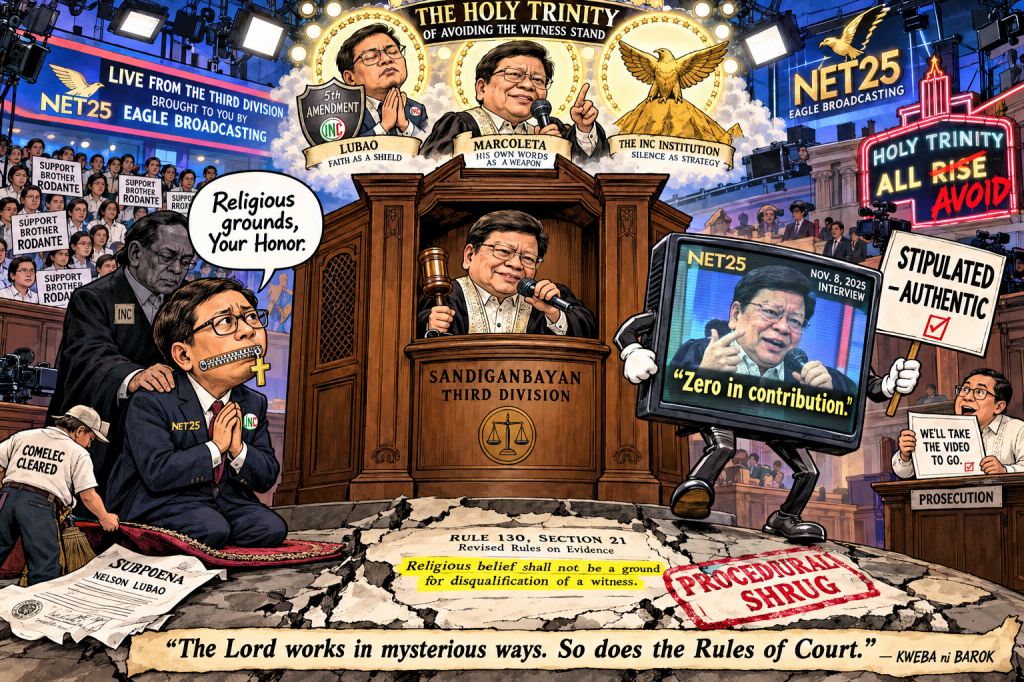
One invoked God. One invoked the Fifth. The church invoked silence. The video invoked Marcoleta’s own mouth.
By Louis “Barok” C. Biraogo — September 29, 2016
GRAB your popcorn and your copy of the Rules on Evidence, because this one requires both: Nelson Lubao did not save Rodante Marcoleta from the witness stand. The prosecution did. And the defense walked right into it.
On September 28, 2026, the Sandiganbayan Third Division excused Lubao from testifying against his co-host and fellow Iglesia ni Cristo (INC) member on “religious grounds.” The headlines wrote themselves: “Religion shields Marcoleta’s TV partner from testifying.” The INC political machine likely popped open a bottle of lambanog. Their man was protected by the Lord’s anointed, or at least by the Lord’s anointed’s co-host.
Except here’s the problem with that triumphant narrative: Lubao’s testimony was never about Marcoleta’s guilt. It was about authenticating a video. And the defense just stipulated to its authenticity. The prosecution didn’t lose a witness. They gained an evidentiary shortcut.
So let’s dispense with the theatrics and examine what actually happened — and what it reveals about the Philippine justice system’s favorite pastime: creating procedural loopholes so wide you could drive a motorcade of INC bloc voters through them.
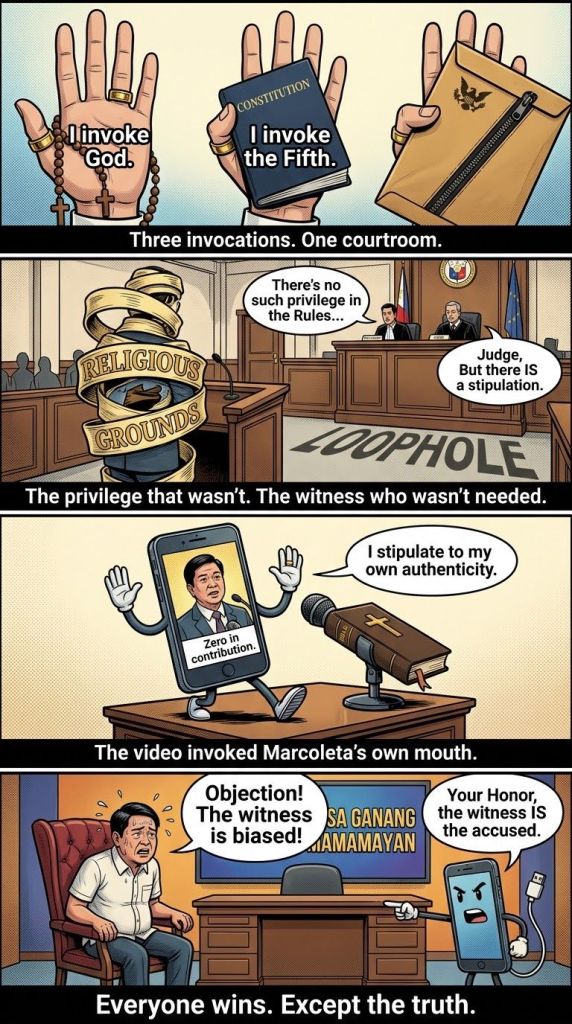
The “Religious Privilege” That Doesn’t Exist
Let’s play a game. Name the testimonial privileges recognized under the 2019 Amendments to the 1989 Revised Rules on Evidence (A.M. No. 19-08-15-SC).
Attorney-client. Physician-patient. Priest-penitent. Marital. Parental.
Notice what’s missing? “Co-religionist.” There is no legal privilege that says “I belong to the same church as the accused, therefore I don’t have to testify.” Rule 130, Section 21 is explicit: religious belief “shall not be a ground for disqualification.” The priest-penitent privilege applies to confessions made to a minister in their professional capacity. Lubao wasn’t Marcoleta’s confessor. He was his co-host. A television interviewer asking softballs on a network owned by the same church that employs both of them.
But here’s the beautiful part: nobody actually ruled on the legal question. The court didn’t say “religious grounds is a valid exemption.” The prosecution simply said, “Fine, we don’t need him if you stipulate to the video’s authenticity.” The defense — at least Defensor, Espiritu, and Viray’s lawyers — agreed. Marcoleta’s own counsel reportedly refused to stipulate initially, but that became moot once the others did.
So the “religious exemption” isn’t a legal precedent. It’s a procedural shrug. The court didn’t have to decide whether religion excuses testimony because the testimony became unnecessary. Lubao gets to feel pious. The prosecution gets the video. The defense gets to avoid cross-examination of a witness who was actually present during the incriminating interview.
Everyone wins. Except the truth.
The Video Is Not Just Evidence. It’s a Confession.
Let’s talk about what’s actually on that recording, because this is where the religious theater becomes almost comically irrelevant.
On November 8, 2025, Marcoleta sat on his own show — Sa Ganang Mamamayan, a NET25 program owned by the INC — and admitted, on air, that “friends” gave him campaign contributions on the condition that their identities not be disclosed. His exact words, as reported: he reported zero contributions in his Statement of Contributions and Expenditures (SOCE) because disclosing the amounts would require disclosing the donors’ names.
Read that again. A sitting congressman, on his own church-owned television program, explaining that he intentionally filed a false campaign finance report to protect anonymous donors.
The prosecution’s theory practically writes itself. Under Rule 130, Section 27, an act, declaration, or omission of a party concerning a relevant fact may be admitted against that party. Marcoleta’s own words, captured on video, authenticated by stipulation, are coming into evidence whether or not Lubao takes the stand. The interviewer’s presence adds nothing to the admissibility. He was a prop. The video is the evidence.
And what evidence it is. The prosecution alleges three tranches: P30 million from Mike Defensor, P25 million from Joseph Espiritu, P20 million from Aristotle Viray. All in January 2025, before the campaign period. All allegedly omitted from Marcoleta’s SOCE and his Statement of Assets, Liabilities and Net Worth (SALN).
The video doesn’t just prove money changed hands. It potentially proves knowledge and intent — the crucial mental element in plunder. Marcoleta knew the money came in. He knew it should have been reported. He chose not to report it. That’s not an accounting error. That’s a confession of deliberate concealment.
But Wait — Where’s the Plunder?
Here’s where the prosecution’s case gets interesting, and by “interesting” I mean “legally vulnerable in ways that have nothing to do with religion.”
Plunder under Republic Act No. 7080 (An Act Defining and Penalizing the Crime of Plunder) requires:
- (1) a public officer;
- (2) who amasses ill-gotten wealth through a combination or series of overt criminal acts;
- (3) with an aggregate value of at least P50 million.
Marcoleta ticks the first box. The P75 million ticks the third. The middle box — the statutory predicate acts — is where the fight will be.
The defense will argue: these were private donations, not public funds. No government money was stolen. Where’s the plunder predicate?
Prosecutors have a response: Section 1(d) of RA 7080 includes “receiving commissions, gifts, kickbacks or pecuniary benefits connected with government contracts or by reason of office.” And Department of Justice (DOJ) officials have publicly argued the source of the money needn’t be public funds. But that’s a theory, not a conviction. The Supreme Court has been strict about requiring the Information to specify predicate acts with particularity.
Meanwhile, the Ombudsman has been building a circumstantial case around documentation timing. Donor’s taxes for the January 2025 transfers were allegedly paid only in December 2025. Deeds of donation were notarized in November 2025 — ten months after the money moved. That’s the kind of evidence that suggests the “donation” characterization was retrofitted after the video scandal broke.
If the prosecution can prove the documents were backdated or manufactured to legitimize what was actually an undisclosed campaign contribution — or worse, a gift tied to Marcoleta’s official position — the plunder theory strengthens considerably.
But if the defense can convince the court that these were legitimate private gifts, received before the campaign period, properly treated as personal funds, and merely poorly documented? The plunder charge could collapse into an election-law violation, which the Commission on Elections (COMELEC) already cleared.
The INC Elephant in the Room
Let’s address what everyone is thinking but few will say directly: the INC dimension.
Marcoleta is a prominent INC member. NET25 is INC-owned. Lubao is INC. The network that aired the incriminating interview is the same network that employs both the accused and the witness. This is not a coincidence. This is an ecosystem.
The INC practices bloc voting. It delivers millions of votes as a unified bloc. Politicians court its endorsement. Marcoleta won a Senate seat in 2025 — sixth place — with INC support. When the Ombudsman filed plunder charges, INC held mass rallies. The church’s political muscle is not subtle.
So when Lubao invokes “religious grounds” to avoid testifying against a fellow INC member, the question isn’t whether his faith is sincere. The question is whether institutional pressure — explicit or implicit — made testifying against Marcoleta professionally, socially, or spiritually untenable. Lubao is a 20% stockholder in Eagle Broadcasting Corporation, which operates NET25. His livelihood depends on the same corporate structure that employs Marcoleta. His standing in the INC depends on not being seen as disloyal.
Is that religious conviction? Or is it institutional self-preservation dressed in Sunday best?
The court didn’t ask. The prosecution didn’t push. The defense certainly wasn’t going to object. Everyone got what they wanted, and the constitutional question — can a religious institution effectively shield its members from testifying against each other in criminal proceedings? — remains unanswered.
The Stipulation That Ate the Witness
Here’s the irony that should bother anyone who cares about truth-finding: the stipulation made Lubao’s absence irrelevant, but it also made his testimony unnecessary.
The prosecution originally wanted Lubao to authenticate the video. That’s it. He was a foundation witness — someone to say “yes, I was there, this is what aired, this is the actual broadcast.” Once the defense stipulated to the video’s authenticity, faithfulness, and contents, Lubao became redundant.
But what did the prosecution lose by not putting him on the stand?
They lost the ability to ask him:
- What was Marcoleta’s demeanor?
- Did he seem nervous?
- Did he know the cameras were rolling?
- Did he rehearse that answer?
- Were there off-camera conversations?
- Did Marcoleta ever say anything more incriminating that didn’t make the broadcast?
They lost the chance to humanize the evidence. A video is cold. A live witness — even a reluctant one — adds texture, context, credibility.
And they lost the opportunity to test whether Lubao’s “religious grounds” was sincere or strategic. Cross-examination would have revealed whether he sought guidance from INC ministers, whether he was pressured, whether his objection was a principled stand or a convenient exit.
Instead, the prosecution accepted a stipulation and moved on. Pragmatic? Yes. Optimal? Probably not.
What Happens Next
The bail hearing is essentially over. The court tentatively set November 3 to resolve the bail petition. The trial proper begins October 8.
The prosecution will rely on the video, financial records, donor tax documents, the timing discrepancies, and the testimony of Ombudsman investigators. The defense will argue that private donations, properly characterized, do not constitute plunder — and that the COMELEC’s clearance undermines the criminal case.
But here’s the thing the religious theater has obscured: the most damaging evidence against Marcoleta is Marcoleta himself. His own words, on his own show, on his own church’s network, admitting he concealed contributions. No witness needed. No religious exemption required. Just a video, a stipulation, and a court willing to follow the evidence where it leads.
Lubao’s “religious grounds” will be remembered as a footnote. The video will be remembered as the moment Marcoleta talked himself into a plunder charge.
The Lord works in mysterious ways. So does the Rules of Court.
Key Citations
A. Legal & Official Sources
- 2019 Amendments to the 1989 Revised Rules on Evidence (A.M. No. 19-08-15-SC). Supreme Court of the Philippines, 8 Oct. 2019, 2019 Amendments to the 1989 Revised Rules on Evidence – Supreme Court of the Philippines https://lawphil.net/courts/rules/am_19-08-15-sc_2019.html.
- Republic Act No. 7080. An Act Defining and Penalizing the Crime of Plunder. 12 July 1991, http://www.officialgazette.gov.ph/1991/07/12/republic-act-no-7080/.
- Republic Act No. 6713. An Act Establishing a Code of Conduct and Ethical Standards for Public Officials and Employees. 20 Feb. 1989, lawphil.net/statutes/repacts/ra1989/ra_6713_1989.html.
- “The Basics: Statement of Assets, Liabilities, and Net Worth.” Official Gazette of the Republic of the Philippines, http://www.officialgazette.gov.ph/saln/.
- The 1987 Constitution of the Republic of the Philippines. Official Gazette of the Republic of the Philippines, 1987, http://www.officialgazette.gov.ph/constitutions/1987-constitution/.
- Sandiganbayan. Official Website of the Sandiganbayan, sb.judiciary.gov.ph/.
B. News Reports
- Panti, Llanesca T. “Interviewer Asks to Be Excused as Witness in Marcoleta Plunder Trial.” GMA News Online, GMA Network, 10 Sept. 2026, http://www.gmanetwork.com/news/topstories/nation/1001941/interviewer-asks-to-be-excused-as-witness-in-marcoleta-plunder-trial/story/.
- Mendoza, J. E. “Marcoleta Co-Host Seeks Exemption from Testifying in P75-M Plunder Case.” Inquirer.net, Philippine Daily Inquirer, 10 Sept. 2026, newsinfo.inquirer.net/2303095/marcoleta-co-host-seeks-exemption-from-testifying-in-p75-m-plunder-case.
- Cantos, Joy. “Video ni Marcoleta, Iprinisinta ng Ombudsman.” Pang-Masa / The Philippine Star, 15 Sept. 2026, http://www.philstar.com/pang-masa/police-metro/2026/09/15/2556400/video-ni-marcoleta-iprinisinta-ng-ombudsman.
- “TIMELINE: The Plunder Case vs. Rodante Marcoleta over P75M Campaign Contributions.” GMA News Online, GMA Network, 30 June 2026, http://www.gmanetwork.com/news/topstories/nation/993233/timeline-the-plunder-case-vs-rodante-marcoleta-over-p75m-campaign-contributions/story/.
- Chi, Cristina. “Ombudsman Files Plunder Charges vs Rodante Marcoleta.” Philstar.com, The Philippine Star, 3 July 2026, http://www.philstar.com/headlines/2026/07/03/2539557/ombudsman-files-plunder-charges-vs-rodante-marcoleta.
- Tupas, Emmanuel, and Mark Ernest Villeza. “INC Gathers at EDSA for Marcoleta.” Philstar.com, The Philippine Star, 1 July 2026, http://www.philstar.com/headlines/2026/07/01/2539015/inc-gathers-edsa-marcoleta.
- Patinio, Ferdinand. “Comelec Clears Marcoleta over SOCE, Terminates Probe.” Philippine News Agency, 18 Mar. 2026, http://www.pna.gov.ph/articles/1271328.
- de Leon, Dwight. “Comelec Clears Marcoleta of Poll Violation over Undeclared Campaign Contributions.” Rappler, 18 Mar. 2026, http://www.rappler.com/philippines/comelec-clears-marcoleta-poll-violation-undeclared-campaign-contributions/.
- “Ang Hirap Maging Mahirap”: The PAO Scandal That Proves Government Contempt Is Nothing New
- “Far-Off” My Axx: Malacañang’s Claire Castro Drowns in Her Own Legal Gaslighting
- “Forthwith” to Farce: How the Senate is Killing Impeachment—And Why Enrile’s Right (Even If You Can’t Trust Him)
- “HINDI AKO NAG-RESIGN!”

- “I Know Nothing”: Baste Duterte’s Amnesia Defense Meets ₱33M in GenCorp Contracts

- “I’m calling you from my new Globe SIM. Send load!”

- “Mahiya Naman Kayo!” Marcos’ Anti-Corruption Vow Faces a Flood of Doubt

- “Manageable” Debt, Unmanageable Lies: DBM’s ₱21 Trillion Fairy Tale

- “Meow, I’m calling you from my new Globe SIM!”

- “Natrabaho”: One Word, One Ombudsman, and a Judiciary on Trial
- “No Special Jail for Crooks!” Boying Remulla Slams VIP Perks for Flood Scammers

- “Philippine-Controlled” or Yankee Gas Station? The Davao Fuel Depot Farce Exposed





Leave a Reply