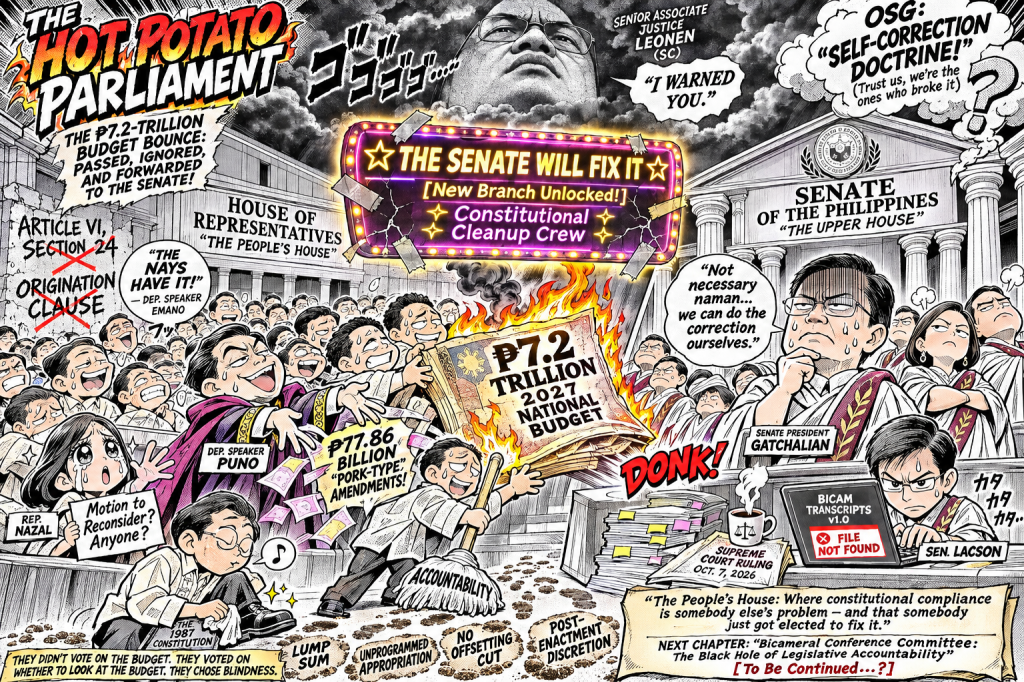
The ₱7.2-Trillion Hot Potato: How the House Passed Its Constitutional Mess to the Upper Chamber
By Louis ‘Barok‘ C. Biraogo — November 11, 2026
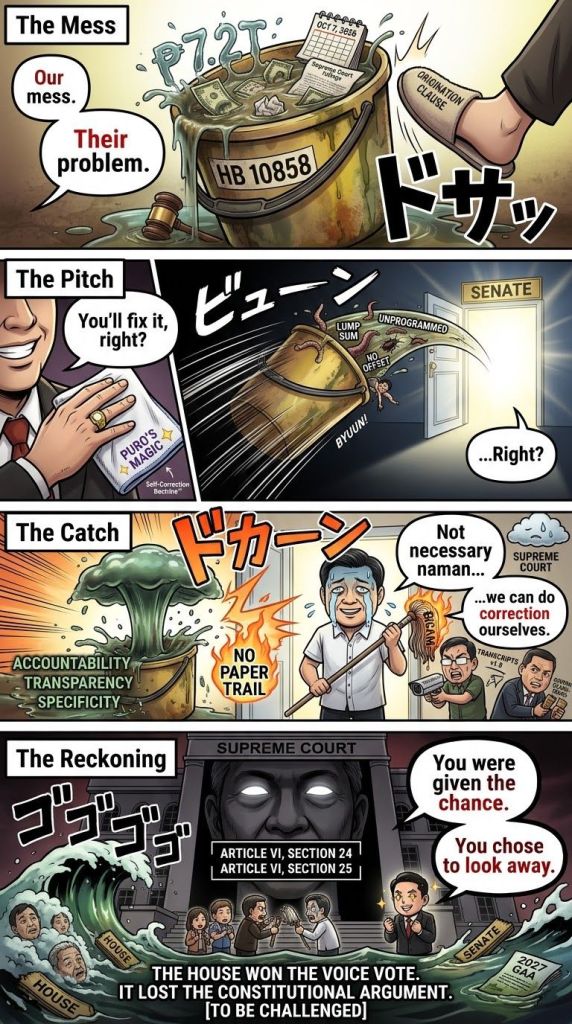
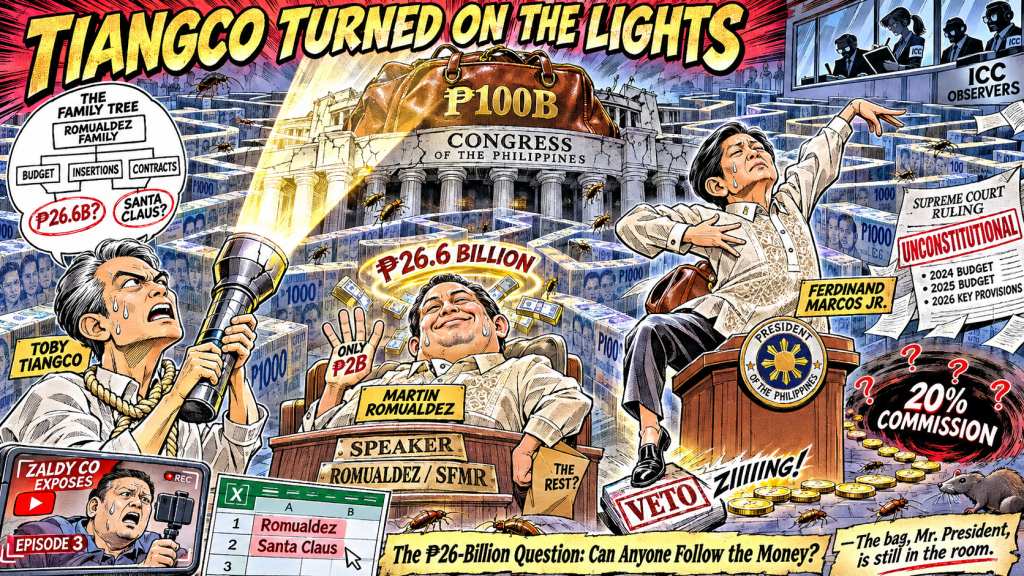
On November 10, 2026, the House of Representatives was handed a chance to clean up its own mess. It chose instead to hand the mop to the Senate and hope nobody noticed the stains on the floor.
Bagong Henerasyon Rep. Robert Nazal moved to reconsider the House’s approval of House Bill No. 10858, the ₱7.2-trillion 2027 General Appropriations Bill, citing the Supreme Court’s October ruling that had just blown up key provisions of the 2024, 2025, and 2026 budgets. The House responded with a voice vote so swift that Deputy Speaker Yevgeny Emano barely had to clear his throat before declaring “the nays have it.”
With that, the People’s House—the chamber constitutionally entrusted with originating the power of the purse—officially decided that constitutional compliance is somebody else’s problem.
#NazalMotion #VoiceVote #Bicameral #TransparencyNow #FilipinoTaxpayers #HoldThemAccountable
The Timing Is Not a Coincidence. It Is the Point.
The Supreme Court promulgated its decision on October 7, 2026, and announced it publicly on October 20. The ruling, penned by Senior Associate Justice Marvic Leonen, invalidated congressional increases to the 2024 and 2025 budgets and struck down special provisions in the 2026 General Appropriations Act (GAA) governing unprogrammed appropriations. The Court did not mince words: unprogrammed funds cannot be lump sums, must have clear funding conditions, need prioritization standards, and must remain within the fiscal program.
The House approved HB 10858 on October 12—five days after the Court’s ruling was promulgated, eight days before it was publicly announced. The House’s defenders will say they couldn’t have known. Except the motion to reconsider was filed on November 9—twenty days after the public announcement, and nearly a month after the Court’s internal promulgation. By then, every lawyer in the building had read the decision. Nazal himself said the 2027 bill contained provisions mirroring those the Court had just invalidated.
The House did not reject reconsideration because it lacked information. It rejected reconsideration because it had information—and decided the information was inconvenient.
The “Senate Will Fix It” Defense Is an Admission, Not an Argument
Deputy Speaker Ronaldo Puno reportedly saw “no need to recall the 2027 [House General Appropriations Bill (HGAB)] since adjustments can be done in the Senate and at the bicameral conference committee.” Senate President Sherwin Gatchalian obligingly agreed: “Not necessary naman dahil papasok na kami sa consolidation ng budget dito, so we can do the correction ourselves.”
This is the institutional equivalent of a homeowner refusing to fix a gas leak because the neighbors have a wrench.
Article VI, Section 24 of the 1987 Constitution of the Republic of the Philippines (Constitution) gives the House the exclusive power to originate appropriation bills. That power is not a ceremonial honorific. It is a responsibility. When the House transmits a budget bill it has reason to believe contains constitutionally defective provisions, it is not exercising legislative prerogative. It is outsourcing constitutional accountability to a chamber that did not write those provisions, did not insert those amendments, and has no institutional obligation to clean up the lower chamber’s mess.
And let us be clear about what the Senate’s “correction” looks like in practice. The bicameral conference committee is where budget provisions go to be renegotiated in private, stripped of their legislative history, and reborn as consensus language that no single chamber can be blamed for. Senator Panfilo Lacson himself admitted that the bicam has historically operated without transcripts—meaning no one can trace who inserted what, when, or why. He is now pushing for transparency, which is admirable and also an indictment of every budget cycle that came before.
The House’s rejection of Nazal’s motion effectively guarantees that the most constitutionally suspect provisions in the 2027 budget will be resolved in a forum that, until very recently, left no paper trail.
The Numbers They Don’t Want You to Add Up
Tinio’s October 1 disclosure remains the most damning piece of evidence in this saga. Of the ₱116.32 billion in amendments approved by the House Budget Amendments Review Subcommittee (BARSc), ₱77.86 billion—67 percent—went to programs he identified as “pork-type”: Department of Public Works and Highways (DPWH) capital outlays, the Local Government Support Fund (LGSF), farm-to-market roads, the Health Facilities Enhancement Program, medical assistance, Tulong Panghanapbuhay sa Ating Disadvantaged/Displaced Workers (TUPAD), and crisis assistance.
The Department of Budget and Management (DBM) has mounted a spirited defense of the ₱58.53-billion LGSF, insisting that local government units (LGUs) submit applications directly, that a scorecard evaluates governance and financial management, and that the Supreme Court itself upheld the LGSF’s validity in Belgica v. Executive Secretary, G.R. No. 208566 (Belgica). These are not trivial points. The LGSF is not the Priority Development Assistance Fund (PDAF). There is no individual legislator’s lump sum sitting in a bank account waiting for a project list.
But here is the question the DBM’s presentation cannot answer: If the LGSF is so rigorously rules-based, why did Tinio note that the BARSc approved an additional ₱4.09 billion for it without identifying a single offsetting cut? Why were “several major amendments presented without named projects or locations”? Why did Tinio warn that agencies retain the power to “modify” projects after enactment—changing location, scope, or beneficiaries—with no safeguard beyond the promise of clerical-error correction?
The DBM’s scorecard evaluates LGUs. It does not evaluate the legislative process that decides which LGUs get how much before the scorecard ever comes into play.
The Office of the Solicitor General (OSG)’s “Self-Correction” Doctrine Is Constitutional Nonsense
Perhaps the most intellectually insulting element of this farce is the OSG’s argument that the political branches should be allowed to “self-correct.”
Solicitor General Darlene Berberabe told reporters that because the Constitution gives Congress and the Executive the power of the purse, the Supreme Court should leave “some guardrails” to them. The OSG is preparing a motion for reconsideration that may raise “judicial overreach.”
Let us translate this from legal Latin into plain English: The branches that just violated the Constitution should be trusted to decide how much of the Constitution they need to obey.
The Supreme Court did not invent the prohibition on lump sums. It did not manufacture the requirement that appropriations be specific. It read Article VI, Section 25 of the Constitution—the same document the OSG swears to uphold—and applied it to budgets structured to evade it. The Court’s October ruling was not judicial creativity. It was a remedial reading of a Constitution the political branches had spent years treating as a suggestion.
And here is the tell: The OSG advised the Executive to defer spending on the 2026 provisions the Court flagged, as a “show of good faith.” If the provisions are constitutionally defensible—if the OSG genuinely believes the Court overreached—why defer spending? Why not release the funds and defend the releases? The answer is obvious. The OSG knows the provisions are indefensible. It is simply trying to negotiate the terms of surrender.
What the House Actually Voted For
The voice vote on Nazal’s motion was not a vote on whether the 2027 budget is constitutional. It was a vote on whether the House would examine whether the 2027 budget is constitutional.
The House voted no.
Tinio called it a “missed opportunity.” That is too generous. A missed opportunity implies a failure of timing or circumstance. This was a refused opportunity—a deliberate decision not to look, not to ask, not to check, because looking and asking and checking might produce an answer that inconveniences the majority.
Nazal, to his credit, did not let the rejection end the matter. He formally requested that his specific concerns—Special Provisions 1(A) and 1(B), the ₱57-billion Philippine Deposit Insurance Corporation (PDIC) fund restoration, the ₱8.8-billion conversion of national government advances into government-owned or controlled corporation (GOCC) subsidies—be transmitted to the Senate for consideration in bicam. He even offered to serve on the House bicam panel if tapped.
This is what accountability looks like when it is denied a vote on the floor: it becomes a memo to the other chamber, a request that someone else do the job the House was elected to do.
The Questions the House Must Answer Before It Signs the 2027 GAA
The House may have defeated Nazal’s motion. It cannot defeat the following:
- First: Who proposed the ₱77.86 billion in BARSc amendments, and what objective criteria determined their approval? Tinio noted that the amendments were not itemized. If the House cannot produce a legislator-by-legislator, project-by-project accounting, the “no pork” claim is a press release, not a fact.
- Second: Why did the House not conduct a constitutional audit of its own bill between October 20 and November 9? Twenty days is an eternity in legislative time. What was the majority doing?
- Third: What specific corrections does the House expect the Senate to make, and will the House accept them without reinserting the same provisions in bicam? Puno’s “adjustments can be done in the Senate” is not a plan. It is a hope.
- Fourth: If the 2027 budget becomes law with provisions materially identical to those the Court struck down, who will be liable? The Court’s ruling explicitly noted that it “does not automatically absolve those who authored, proposed, or implemented the challenged appropriations from criminal, civil, or administrative liability.” The House’s vote does not immunize anyone. It merely delays the reckoning.
The Larger Pattern: A Legislature That Has Learned Nothing
This is not the first time the House has treated constitutional budget limits as obstacles to be routed around rather than rules to be obeyed. The Belgica decision invalidated PDAF in 2013. Araullo v. Aquino III, G.R. No. 209287 (Araullo) invalidated the Disbursement Acceleration Program (DAP) in 2014. The October 2026 ruling invalidated congressional increases in 2024 and 2025 and special provisions in 2026. Each time, the Court has said the same thing: Congress cannot use accounting tricks, reclassification, or post-enactment discretion to spend money the Constitution does not authorize it to spend.
Each time, Congress has nodded solemnly, promised reform, and then found a new label for the same practice.
The 2027 budget is the first test of whether the October ruling changes anything. The House’s rejection of reconsideration is not an encouraging sign. It suggests that the institutional reflex—protect the insertions, protect the discretion, protect the majority’s hold on the purse—remains stronger than any commitment to constitutional compliance.
The Senate’s Moment (and Its Trap)
The Senate now holds the burden the House refused. Ejercito, Gatchalian, and Lacson have all signaled that the upper chamber will review the House’s provisions against the Court’s standards. Lacson’s push for bicam transcripts and his call for civil society “guardia civil” oversight are genuinely important reforms.
But the Senate must resist the temptation to become the House’s constitutional cleanup crew. If the Senate removes the defective provisions, the House will claim credit for a “corrected” budget it never corrected. If the Senate retains them, responsibility will be diffused across two chambers, two committees, and a conference report that no one will read.
The only acceptable outcome is a public, provision-by-provision reconciliation between the House General Appropriations Bill (GAB), the Senate amendments, and the Supreme Court’s safeguards. Every removed lump sum must be identified. Every retained unprogrammed appropriation must be justified against the Court’s four-part test. Every bicam insertion must have a named sponsor.
Lacson’s transcripts are a start. They are not enough. The Senate should publish the full amendment trail—House version, Senate version, bicam version, side by side—before the final GAA reaches the President’s desk.
The Final Indictment
The House of Representatives had a choice on November 10, 2026. It could have voted to reopen its own budget bill, invited the Court’s standards into its own process, and demonstrated that the power of the purse is exercised with constitutional fidelity rather than parliamentary convenience.
It chose otherwise.
It chose to transmit a bill it had reason to believe was constitutionally defective, and to ask the Senate to fix it. It chose to reject a motion that was not about policy, not about politics, and not about procedure, but about whether the House would take five minutes to ask itself a question the Supreme Court had already answered.
The House may have won the voice vote. It has lost the constitutional argument.
And when the 2027 GAA is challenged—and it will be challenged—the record will show that the House was given the chance to correct its own work, and declined. The record will show that the warnings were specific, documented, and ignored. The record will show that the only branch of government that took the Constitution seriously in October 2026 was the one the House now accuses of overreach.
The Constitution does not give Congress the power of the purse so that legislators can exercise the power of patronage. It gives Congress that power so that public money is spent according to law, under the scrutiny of the people, and with the consent of those who pay the taxes.
The House’s vote on November 10 was not a defense of legislative independence. It was a defense of legislative impunity.
And the Filipino people, who will pay for this budget one way or another, deserve to know exactly who voted to look away.
Key Citations
A. Legal & Official Sources
- The 1987 Constitution of the Republic of the Philippines. Official Gazette of the Republic of the Philippines, 1987, http://www.officialgazette.gov.ph/constitutions/1987-constitution/.
- Araullo v. Aquino III. G.R. No. 209287, Supreme Court of the Philippines, 1 July 2014. Lawphil, lawphil.net/judjuris/juri2014/jul2014/gr_209287_2014.html.
- Belgica v. Executive Secretary Ochoa. G.R. No. 208566, Supreme Court of the Philippines, 19 Nov. 2013. Lawphil, lawphil.net/judjuris/juri2013/nov2013/gr_208566_2013.html.
- Department of Budget and Management. “DBM, Senate Push for Stronger Safeguards in P58.53-B LGU Support Fund.” DBM.gov.ph, 22 Oct. 2026, http://www.dbm.gov.ph/index.php/management-2/4328-dbm-senate-push-for-stronger-safeguards-in-p58-53-b-lgu-support-fund.
- Department of Budget and Management. “No Middleman: LGUs to Directly Seek P58.53-B Local Fund; Releases Transparent, Rules-Based — DBM.” DBM.gov.ph, 15 Sept. 2026, http://www.dbm.gov.ph/index.php/management-2/4233-no-middleman-lgus-to-directly-seek-p58-53-b-local-fund-releases-transparent-rules-based-dbm.
B. News Reports
- ABS-CBN News. “ANC: Rep. Nazal Seeks Reconsideration of House-Approved 2027 Budget, Citing SC Ruling.” ABS-CBN, 9 Nov. 2026, http://www.abs-cbn.com/news/nation/2026/11/9/anc-rep-nazal-seeks-reconsideration-of-house-approved-2027-budget-2206.
- Basilio, Kenneth Christiane. “House Denies Motion Recalling P7.2-Trillion Budget Bill.” Inquirer.net, 10 Nov. 2026, newsinfo.inquirer.net/2339150/house-denies-motion-recalling-p7-2-trillion-budget-bill/amp.
- Begas, Billy. “New Budget, Same Old Pork? Tinio Flags P77.86B Budget Amendments by House Subcommittee.” POLITIKO, 1 Oct. 2026, politiko.com.ph/new-budget-same-old-pork-tinio-flags-p77-86b-budget-amendments-by-house-subcommittee/.
- Bacay, Holly. “Tinio Seeks Full Disclosure of BARSc Budget Amendments.” Inquirer.net, 2 Oct. 2026, newsinfo.inquirer.net/2316198/tinio-seeks-full-disclosure-of-barsc-budget-amendments/amp.
- Dantes, Charles, Chavez, Pot, Cruz, Maricel & Zurbano, Joel E. “OSG: Defer Spending of Flagged Budget Items.” Manila Standard, 22 Oct. 2026, manilastandard.net/news/314809112/osg-defer-spending-of-flagged-budget-items.html.
- Bayan, Raquel. “OSG, Naniniwalang Malilinawan ang Korte Suprema sa Panig ng Ehekutibo at Kongreso sa Oras na Maihain na ang Motion for Reconsideration, Hinggil sa Budget Ruling ng SC.” Radyo Pilipinas, 22 Oct. 2026, radyopilipinas.ph/2026/10/22/osg-naniniwalang-malilinawan-ang-korte-suprema-sa-panig-ng-ehekutibo-at-kongreso-sa-oras-na-maihain-na-ang-motion-for-reconsideration-hinggil-sa-budget-ruling-ng-sc/.
- Esguerra, Darryl John. “OSG to Ask SC to Let Congress, Executive ‘Self-Correct’ Budget Issues.” Philippine News Agency, 22 Oct. 2026, http://www.pna.gov.ph/article/osg-to-ask-sc-to-let-congress-executive-self-correct-budget-issues.
- Gulla, Vivienne. “House Rejects Motion to Reconsider Approval of 2027 Budget Bill.” ABS-CBN News, ABS-CBN, 10 Nov. 2026, http://www.abs-cbn.com/news/nation/2026/11/10/house-rejects-motion-to-reconsider-approval-of-2027-budget-bill-1905.
- Orcullo, Jerod. “House Rejects Bid to Recall Budget Bill.” Daily Tribune, 10 Nov. 2026, tribune.net.ph/2026/11/10/house-rejects-bid-to-recall-budget-bill.
- Servallos, Neil Jayson. “Lacson Wants Transcripts of Bicam Budget Proceedings Released.” Philstar.com, The Philippine Star, 9 Nov. 2026, http://www.philstar.com/headlines/2026/11/09/2568877/lacson-wants-transcripts-bicam-budget-proceedings-released.
- “Tinio Seeks Full Disclosure of BARSc Budget Amendments.” Inquirer.net, 2 Oct. 2026, newsinfo.inquirer.net/2316198/tinio-seeks-full-disclosure-of-barsc-budget-amendments/amp.

- ₱9 Billion in ‘Savings’? DILG’s Fire Truck Deal Smells Like Smoke

- ₱8B BBM Pork: CCTV for Every Captain’s Kumpare?
- ₱8.9 Billion, 331 Ghost Police Stations: The TIKAS Scandal Explained

- ₱8.4 Billion, 42,000 Barangays, 1 Election: The “Bawat Barangay Makikinabang” Vote-Buying Masterclass

- ₱75 Million Heist: Cops Gone Full Bandit

- ₱63 to the Dollar: The Only Thing Falling Faster Than the Peso Is the Government’s Credibility

- ₱6.77B Ghost Haunts Duterte: RTC Dismisses Mans Carpio’s Desperate Plea
- ₱6.77 Billion and Zero Cash: The Sara Duterte SALN Math That Doesn’t Add Up

- ₱6.7-Trillion Temptation: The Great Pork Zombie Revival and the “Collegial” Vote-Buying Circus

- ₱58.53B, Zero Receipts: The LGSF Pork Barrel Nobody Wants to Name
- ₱53 Million Man Tells ₱695-a-Day Workers to Stop Being ‘Mayabang’: The Audacity of BSP’s Remolona
- ₱491-M Right-of-Way Scam: DPWH Paid for Ghost Land, Ombudsman Finally Notices




Leave a Reply