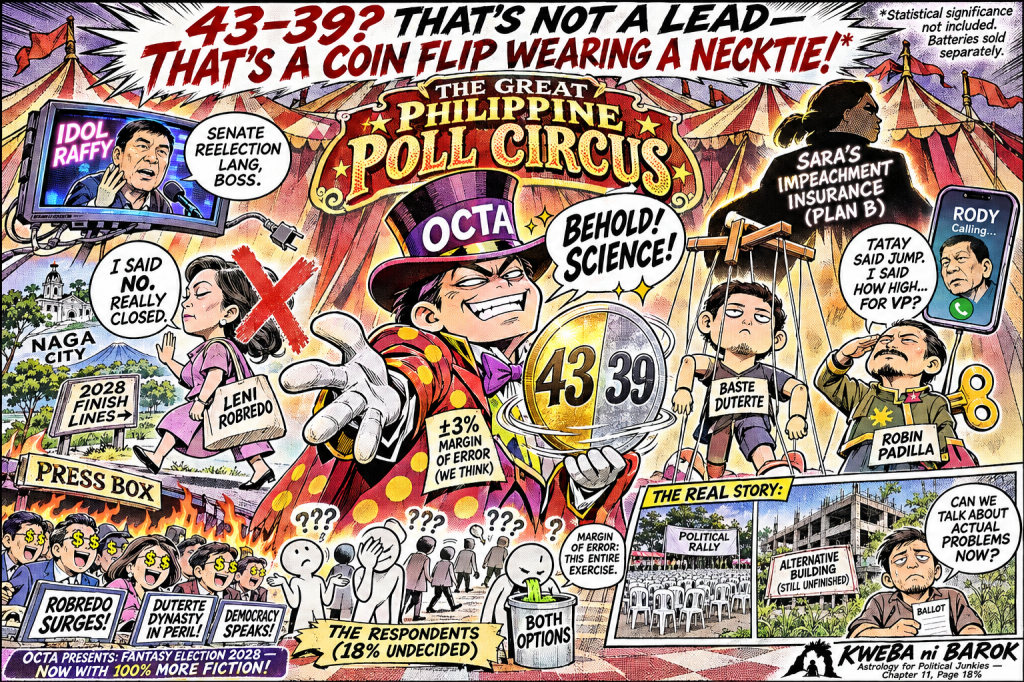
Inside the survey that polled two candidates who said no, one who never said yes, and a running mate who only answers to Rodrigo Duterte
By Louis ‘Barok‘ C. Biraogo | November 12, 2026
The Poll That Wasn’t a Poll
Something is rotten in the state of Philippine polling, and it smells suspiciously like a press release dressed up as science.
On November 11, 2026, OCTA Research unveiled what it breathlessly called its “first 2028 tandem survey”. The headline practically wrote itself: Leni Robredo and Raffy Tulfo, 43 percent. Baste Duterte and Robin Padilla, 39 percent. Eighteen percent undecided. Cue the triumphant headlines, the giddy Kakampink group chats, the solemn cable news panels. Democracy, we were told, had spoken.
But here is what democracy actually said, if you bother to read past the first paragraph:
nothing statistically conclusive. Nothing politically actionable. And nothing that should have been published as though it were a prophecy rather than a parlor game.
A Coin Flip Wearing a Necktie
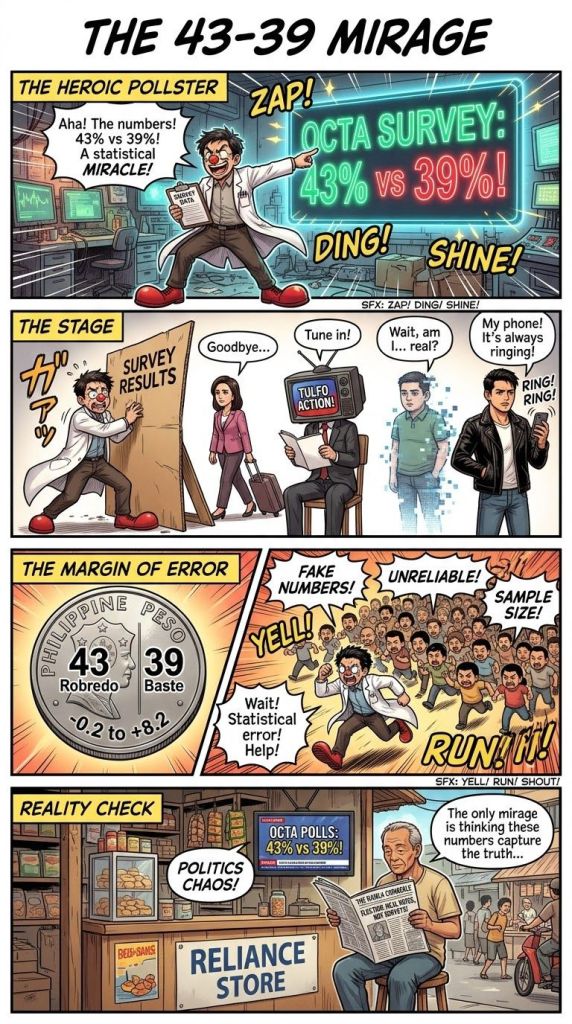
The four-point gap sits comfortably inside OCTA’s own ±3-point margin of error—indeed, a rough calculation of the difference’s standard error puts the 95 percent interval at roughly minus 0.2 to plus 8.2 points, meaning the “lead” could plausibly be zero (OCTA Research; GMA News). This is not a landslide. This is a coin flip wearing a necktie.
Fantasy Tickets and Unavailable Candidates
And yet the survey’s most extraordinary feature is not its statistical modesty. It is the breathtaking audacity of asking 1,200 Filipinos to choose between two tickets whose members have, in various combinations, either refused the office outright or never been formally nominated for it.
- Leni Robredo said on November 9—two days before the survey made headlines—that she would not run for any national post in 2028, declaring her decision “really closed” (Philstar.com, “Robredo Rules Out”).
- Raffy Tulfo has spent most of 2026 insisting he wants Senate reelection, not higher office (Philstar.com, “Tulfo Rules Out”).
- Baste Duterte has never declared a presidential candidacy; his name is being floated as a contingency should his sister Sara be convicted in her impeachment trial (Daily Tribune, “Opposition’s 2028 ‘Plan B(aste)’”).
- Robin Padilla has merely said he would consider a vice-presidential run if Rodrigo Duterte personally asked him (News5, “Padilla Open”).
So OCTA polled a fantasy ticket against a contingency ticket, then released the results as though they illuminated the road to 2028. This is not measurement. This is fan fiction with a margin of error.
The Timing Problem
Consider the timing, which is either exquisitely careless or exquisitely deliberate. Fieldwork ran September 28 to October 4. Robredo’s definitive refusal came November 9. The survey dropped November 11.
If the release was coincidental, it reflects a newsroom culture so indifferent to political context that it would publish a weather forecast for a hurricane that already made landfall. If it was strategic—well, one need not allege conspiracy to notice that the headline creates precisely the kind of pressure on Robredo that her statement was designed to foreclose.
The survey says, in effect: Look how much you’d win by! Robredo’s answer, delivered before the poll even published, was: I don’t care. That is not a finding. That is a rebuke.
A Baseline for What?
OCTA, for its part, protests that the survey simply captures “baseline voter sentiment.” Perhaps. But a baseline for what, exactly? The pollsters concede their figures “cannot yet show whether support for either tandem is rising or falling” (Philstar.com, “More Pinoys Back”).
They also concede that fieldwork coincided with Sara Duterte’s impeachment trial yet “results are not reflected” in the findings. So we have a snapshot of a moving target, taken during a political earthquake, published after the target announced she was leaving the room. This is not social science. This is a Rorschach test for political obsessives.
OCTA’s Track Record
Nor is OCTA a stranger to scrutiny. In 2021, a House panel grilled the group over Coronavirus Disease 2019 (COVID-19) projections whose variance, according to Rep. Stella Quimbo, ran “higher than 5 percent—even going above 50% in some cases,” and warned that OCTA’s pronouncements could “force the administration to act, for fear that it might be crucified by the public” (Inquirer.net, “House Panel Bombards OCTA”).
One might think a polling firm with that history would be especially careful about publishing hypothetical matchups between undeclared candidates. One would be wrong.
What Respondents Were Actually Asked
Then there is the question of what, precisely, respondents were asked. A two-tandem question forces a binary choice between packages, not a measurement of presidential or vice-presidential preference. The 1987 Constitution elects the president and vice president separately; a voter may choose Robredo for president and Padilla for vice president, or Duterte for president and Tulfo for vice president (Official Gazette). A tandem survey measures the appeal of a combination, not the actual mechanics of the ballot.
OCTA’s own data complicate the picture: in the firm’s separate senatorial survey, Tulfo scored 47 percent and Padilla 45 percent—both within the statistically tied top four that also included Alan Peter Cayetano (44%) and Vico Sotto (42%)—while Baste Duterte registered 36 percent, tied with Grace Poe for fifth and sixth (GMA News, “Vico Sotto, Kasama”). If Tulfo and Padilla are effectively interchangeable senatorial commodities, and Baste trails them by roughly ten points, what exactly does their pairing tell us about 2028?
Other Polls Tell a Different Story
And speaking of other polls: OCTA’s own third-quarter presidential matchup had Sara Duterte at 40 percent and Robredo at 33 percent—a seven-point lead, the narrowest in the series (GMA News, “Sara Duterte’s Lead”). Pulse Asia’s September survey had Sara at 50 percent, Robredo at 26 percent, Tulfo at 12 percent (GMA News, “Sara Duterte, Nanguna”). Momentum Research had Sara at 45.8 percent, Robredo at 19.5 percent.
So which is it? Is Robredo the triumphant frontrunner or the distant second-place finisher? The answer, of course, is that these surveys measure different things—and any journalist who presents OCTA’s tandem result as evidence of a Robredo surge is either innumerate or dishonest. Probably both.
The Demographic Breakdowns
The demographic breakdowns are fascinating, in the way that phrenology is fascinating. Ilocano speakers go 80–8 for Robredo-Tulfo; Cebuano/Bisaya speakers go 10–75 for Duterte-Padilla (OCTA Research, “Mayor Leni Robredo”). Class D is split 41–41. The Visayas split 43–41 for Duterte-Padilla, but Central Visayas goes 79 percent Duterte-Padilla while Western Visayas and Negros go 60 and 62 percent Robredo-Tulfo.
These are not findings; they are a map of ethnolinguistic tribalism dressed up as electoral insight. The survey tells us that Ilocanos like Robredo and Cebuanos like Duterte. Next it will tell us that water is wet and that Robin Padilla has said something controversial.
The Cast of Characters
Which brings us to the cast of characters and their carefully staged options.
Robredo
Robredo has ruled out a national run and retreated to Naga, where she is pushing her “2028 Finish Lines” roadmap (City of Naga). Her supporters, undeterred, keep drafting her—Kiko Pangilinan says the national interest “will be best served if at some future time she changes her mind” (Philstar.com, “Robredo Rules Out”). This is less a political movement than a support group in denial.
Tulfo
Tulfo, meanwhile, has ruled out higher office while his media empire keeps his numbers aloft; his “Idol Raffy” brand transcends politics precisely because it never has to govern anything (Rest of World).
Duterte and Padilla
Baste Duterte is the family’s Plan B, a “soft launch” whose Senate testimony was read as a national audition (Daily Tribune). And Padilla—Padilla called Gen Z “weak” and downplayed depression (South China Morning Post). This is the man 39 percent of respondents would entrust with the vice presidency. One struggles to decide whether this indicts the survey, the respondents, or the republic.
The 18 Percent Problem
Perhaps the most revealing detail is the 18 percent uncommitted—roughly 216 people in a sample of 1,200. This bloc is treated as a reservoir of swing voters, but it is almost certainly a mixture of the genuinely undecided, the disgusted, and the people who simply wanted the interviewer to go away.
A survey that does not distinguish between “I haven’t decided” and “I reject both of these absurd options” is not measuring the electorate. It is measuring its own questionnaire design.
What Responsible Poll Reporting Requires
None of this is to say surveys are worthless. Well-designed polls, transparently reported, with full technical documentation, can inform public debate. But the responsible reporting of a poll requires more than a headline.
It requires:
- stating the fieldwork dates,
- distinguishing adult respondents from registered voters,
- explaining that the margin of error does not apply uniformly to every subgroup, and
- refusing to treat family succession speculation as confirmed candidacy.
OCTA’s own release did some of this. The coverage did not. And OCTA, which knows better, allowed a hypothetical matchup between two unavailable candidates to be sold as a political earthquake.
Astrology for Political Junkies
So what are we left with? A poll that tells us Robredo remains popular among people who like Robredo, that Duterte remains popular among people who like Duterte, that the Visayas is competitive, that Class D is the battleground, and that 18 percent of Filipinos have better things to do than answer hypothetical questions about an election 19 months away. This is not insight. This is astrology for political junkies—and like astrology, it flatters the believer, obscures the future, and sells newspapers.
The Real Story
The real story is not the 43–39. The real story is that Philippine political journalism has become so desperate for narrative that it will seize on a poll of unavailable candidates and call it a horse race.
The real story is that a family under impeachment is already planning its succession. The real story is that the opposition’s most popular figure has said, plainly and repeatedly, that she will not lead it—and that her supporters refuse to believe her. The real story is that we would rather measure a fantasy than confront the actual, grinding, unglamorous work of building a political alternative.
OCTA asked 1,200 Filipinos whom they would vote for in a contest that cannot happen. The nation answered, and the answer was: 18 percent of us would rather not say. That, perhaps, is the most honest number in the entire survey.
Key Citations
A. Reports & Studies
- Momentum Research. “2 in 5 Filipinos Would Vote for Sara Duterte in 2028 Presidential Race—Momentum Research.” Momentum Research, 20 Oct. 2026.
- OCTA Research. “Mayor Leni Robredo–Sen. Raffy Tulfo Tandem Leads Mayor Baste Duterte–Sen. Robin Padilla Nationally, 43% to 39%, in OCTA’s First 2028 Tandem Survey.” OCTA Research. Accessed 11 Nov. 2026.
B. News Articles
- Daily Tribune. “Opposition’s 2028 ‘Plan B(aste)’.” Daily Tribune, 20 Oct. 2026.
- GMA News. “Leni Robredo-Raffy Tulfo Leading Baste Duterte-Robin Padilla — OCTA 2028 Tandem Survey.” GMA Network, 9 Nov. 2026.
- GMA News. “Sara Duterte, Nanguna sa 2028 Presidential Preferences ng Pulse Asia Survey.” GMA News Online, 12 Oct. 2026.
- GMA News. “Sara Duterte’s Lead over Leni Robredo Narrows to 7 Points in 2028 Matchup—OCTA.” GMA News Online, 4 Nov. 2026.
- GMA News. “Vico Sotto, Kasama Nina Raffy Tulfo, Padilla, Alan Cayetano sa mga Nangunguna sa 2028 Senatorial Survey ng OCTA.” GMA News Online, 19 Oct. 2026.
- Lalu, Gabriel Pabico. “House Panel Bombards OCTA with Questions on Surveys, Expertise, Funding.” Inquirer.net, 7 Sept. 2021.
- News5. “Padilla Open to Be VP Sara’s Running Mate.” TV5, 20 Feb. 2026.
- Philstar.com. “More Pinoys Back Leni-Raffy vs Baste-Robin – OCTA.” Philstar.com, 11 Nov. 2026.
- Philstar.com. “Robredo Rules Out Presidential Run Anew: ‘It’s Really Closed’.” Philstar.com, 9 Nov. 2026.
- Philstar.com. “Tulfo Rules Out Seeking Higher Office in 2028.” Philstar.com, 3 Mar. 2026.
- Rest of World. “Filipinos Want YouTube Star Raffy Tulfo to Run for President.” Rest of World, 31 July 2024.
- South China Morning Post. “Philippine Senator Slammed for Calling Gen Z Filipinos ‘Weak’.” South China Morning Post, 12 Feb. 2026.
C. Official Websites
- City of Naga. “Robredo Reports Progress in First Month, Pushes 2028 Finish Lines.” City of Naga, 5 Aug. 2025.
- Official Gazette. The Constitution of the Republic of the Philippines. 1987.



Leave a Reply