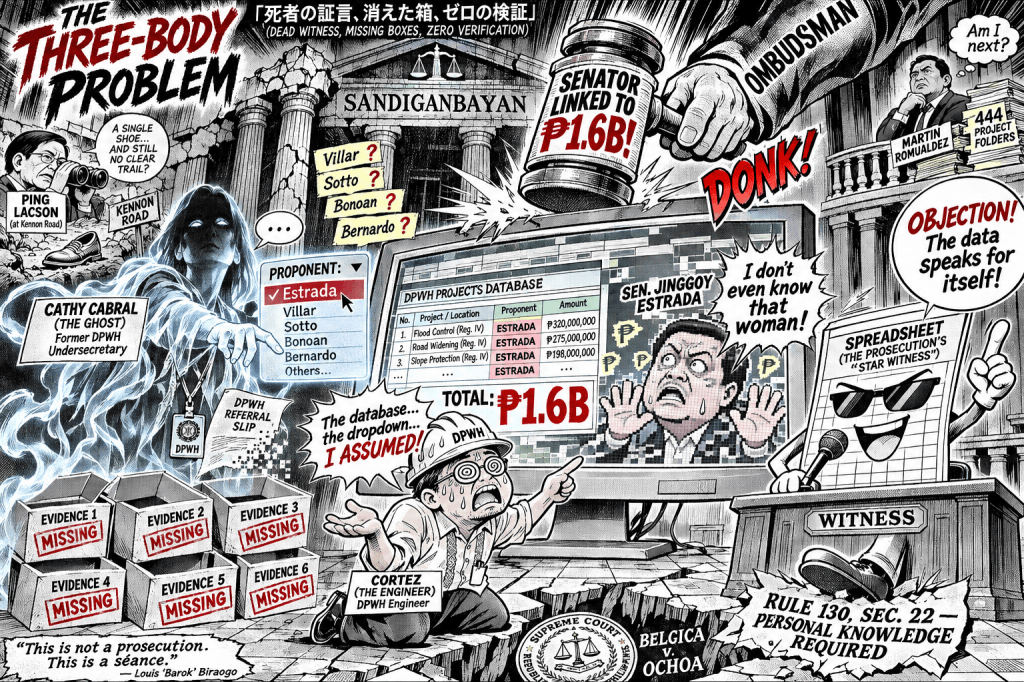
Cathy Cabral Is Gone, Her Six Boxes Are Gone, and the Only Thing Left Is a Database Field That Says ‘Proponent: Estrada’
By Louis ‘Barok‘ C. Biraogo | November 12, 2026
The Engineer, the Database, and the Dropdown Menu
Let me get this straight—or should I say, let me get this inserted?
A Department of Public Works and Highways (DPWH) engineer walks into Sandiganbayan, points at a database, and says: “Sixteen projects, ₱1.6 billion, all tagged to Senator Jinggoy Estrada.” The prosecution preens. The headlines scream. The public, bless its exhausted heart, prepares for another round of “plunderer in the Senate.”
Then the same engineer, under cross-examination, admits he never spoke to Estrada. Never received a written request. Never even verified that the senator knew his name was on the list. The attribution, he says, was based on an “assumption”. A name in a dropdown menu. A bureaucratic Post-it note.

A Dead Witness and Six Missing Boxes
And the man who supposedly gave the instructions—the late Undersecretary Cathy Cabral—is dead. Conveniently, tragically, permanently unavailable for cross-examination. Her lawyer says she was under “pressure we could not explain”. Six boxes of documents she showed her lawyer before her death are now missing.
The woman who allegedly controlled the entire insertion mechanism, who reportedly kept the “allocables” formula in her head, who could have blown open the entire DPWH patronage machine—she took a walk along Kennon Road and never came back.
This is not a prosecution. This is a séance.
What Cortez Actually Testified To
Let’s be clear about what Cortez actually testified to. He said Cabral instructed his staff to encode Estrada’s name as “proponent” for sixteen projects absent from the National Expenditure Program (NEP). He did not say Estrada requested them. He did not say Estrada knew about them. He said the database said so, and the database said so because Cabral said so, and Cabral is dead.
The prosecution’s star witness is a spreadsheet. The corroborating witness is a referral slip that no one has authenticated. And the alleged mastermind is a senator whose name may have been typed into a government computer by someone who never met him.
Ugly Pattern, Not Proof
I am not here to defend Jinggoy Estrada. The man has been acquitted of plunder once, which in this country is less a vindication than a reminder that our courts sometimes require more than a PowerPoint presentation and a convenient witness with an immunity deal. He faces a separate ₱573-million plunder case involving alleged kickbacks from flood control projects. The pattern is ugly. The company he keeps is uglier.
But “ugly pattern” is not “proof beyond reasonable doubt.” And if the Ombudsman cannot distinguish between the two, we are all in trouble.
The Romualdez Parallel
Consider the Romualdez parallel. Cortez gave essentially the same testimony in the bail proceedings involving the former Speaker: 444 projects, ₱27.43 billion, names encoded on Cabral’s instructions. The same witness. The same dead undersecretary. The same “we assumed the name meant they requested it” logic. The Ombudsman’s own spokesman admitted that Bonoan was made a state witness specifically to pin down Romualdez.
This is not a prosecution of Estrada. This is a prosecution of a system, with Estrada as the opening act and Romualdez as the headliner.
And that system—if it exists—is far more damning than any individual senator. If Cabral could assign legislators’ names to projects without their knowledge, then the entire attribution chain in the DPWH is worthless as evidence of individual criminality.
It becomes evidence of institutional rot: a bureaucracy where a single undersecretary could manufacture “proponents” like entries in a customer relationship management database, and where those manufactured attributions are now being treated as confessions.
What the Rules of Evidence Require
The defense will argue—correctly—that under Rule 130, Section 22, a witness can only testify to facts derived from personal perception. Cortez perceived a database. He perceived a referral slip. He did not perceive Estrada requesting anything. His conclusion about who “requested” the projects is an inference, and a shaky one at that, built on the assumption that a name in a field means a request from a person.
The prosecution will counter that circumstantial evidence can establish conspiracy. True. But circumstantial evidence must be consistent with guilt and inconsistent with innocence.
Is it inconsistent with innocence that a senator’s name appeared in a DPWH database because a now-deceased undersecretary put it there? No. It is entirely consistent with innocence—the innocence of a man whose name was used without his knowledge, whether to open floodgates for a broader scheme, to curry favor, or simply because that is how the department did business.
Belgica and the Question of Insertions
The Supreme Court, in Belgica v. Ochoa, struck down the Priority Development Assistance Fund (PDAF) because it allowed legislators to exercise post-enactment control over budget execution. The Court did not say that legislators cannot advocate for projects. It did not say that a project absent from the NEP is automatically unconstitutional. It said that the system of lump-sum allocations controlled by legislators violated separation of powers.
The question here is whether the 2025 insertions were legitimate legislative amendments or a Belgica workaround dressed in a new procedural costume. That question cannot be answered by a witness who admits he does not know who actually requested the projects.
The Bonoan Mess
Meanwhile, the Ombudsman’s case against Bonoan is a mess. The Sandiganbayan initially rejected his exclusion, then reversed itself. Remulla publicly warned Bonoan that if his testimony was “half-baked,” they would drop him and prosecute him alongside Romualdez, as a Philstar editorial on Bonoan as state witness noted.
This is not how you treat a witness whose credibility is supposed to be beyond reproach. This is how you treat a hostile asset you are trying to extract value from before discarding him.
Cabral’s Silence
And Cabral? The woman who allegedly ran the entire operation? The Independent Commission for Infrastructure summoned her. She didn’t show. Her lawyer says she never got the invitation. She met with Lacson, seemed ready to talk, then died.
Lacson himself said he hoped she left notes “that may have evidentiary value”. She apparently did. Six boxes of them. They are now missing.
How convenient.
What the Prosecution Needs Us to Believe
The prosecution’s narrative requires us to believe that Estrada personally orchestrated a ₱1.6-billion insertion through Cabral, but that the only evidence of his personal involvement is a name in a database that Cabral controlled. It requires us to believe that Cabral was the linchpin of a massive corruption scheme, but that her death—and the disappearance of her documents—is an unfortunate coincidence rather than a catastrophic evidentiary failure.
It requires us to believe that Bonoan’s testimony will implicate Estrada, even though the Ombudsman has publicly stated that Bonoan’s real value is against Romualdez.
A Headline Is Not a Conviction
I am not saying Estrada is innocent. I am saying the prosecution has not yet earned a conviction. It has earned a headline. It has earned a bail hearing. It has earned the right to keep investigating.
But if the Sandiganbayan denies bail based on a witness who admits he has no personal knowledge of the accused’s involvement, then the anti-graft court has effectively decided that a database entry is sufficient proof of plunder.
That would be a scandal far larger than Estrada.
Follow the Money, Not the Spreadsheet
The real question—the question that Cabral’s missing documents might have answered—is not whether Jinggoy Estrada’s name was in a DPWH spreadsheet. It is who had the power to put it there, why they put it there, and who benefited when the money flowed.
If the answer is “Cabral, and we’ll never know who told her what,” then the prosecution has a problem. If the answer is “Estrada, and here is the money trail,” then the prosecution should show it. But a referral slip and an assumption are not a money trail. They are a starting point.
A Warning Shot at the Whole Establishment
Right now, the Estrada case looks less like a prosecution and more like a warning shot. The Ombudsman is firing across the bow of the Philippine Senate, the House, and the entire infrastructure establishment. The message is: we can attribute projects to anyone.
The corollary, which no one in the prosecution wants to say aloud, is: and we can prosecute you for it, whether or not you knew.
That should terrify every legislator in this country. It should also terrify every citizen who believes that criminal liability requires more than a name in a field.
A Hypothesis, Not a Case
The ₱1.6 billion may be real. The projects may be real. The corruption may be real. But the evidence against Jinggoy Estrada, as currently presented, is a house built on Cabral’s grave. And Cabral’s grave is empty of the one thing the prosecution needs most: a living witness who can say, under oath and subject to cross-examination, “I know what Estrada asked for, because I heard him ask for it.”
Until that witness appears—or until the money trail replaces the database trail—the Estrada prosecution is not a case. It is a hypothesis. And hypotheses, in a court of law, are supposed to be tested before they are believed.
Key Citations
A. Legal & Official Sources
- Belgica, Greco Antonious Beda B., et al. v. Ochoa, Jr., Executive Secretary, et al. G.R. Nos. 208566, 208493, and 209251, Supreme Court of the Philippines, 19 Nov. 2013, Supreme Court E-Library.
- Estrada, Joseph Ejercito v. Sandiganbayan (Third Division), et al. G.R. No. 148560, Supreme Court of the Philippines, 19 Nov. 2001, Supreme Court E-Library.
B. News Articles
- “Bonoan as State Witness.” Philstar.com, 4 Sept. 2026.
- “Cabral Left Complete List of Budget Insertions.” OneNews.PH, 22 Dec. 2025.
- “Court Junks Ombudsman’s Bid to Drop Bonoan from Graft Case.” Inquirer.net, 2 Aug. 2026.
- “DPWH Engineer Links Jinggoy to P1.6 Billion Budget Insertions.” Philstar.com, 11 Nov. 2026.
- “Ombudsman Says Bonoan Turned State Witness to Build Romualdez Case.” Daily Tribune, 30 June 2026.
- “Romualdez Listed as Proponent of 444 Projects Worth Over P27 Billion, DPWH Official Tells Anti-Graft Court.” Manila Bulletin, 9 Nov. 2026.
- “Six Boxes of Documents Cabral Had Go Missing.” Senate of the Philippines eClips, 6 Jan. 2026.
- “Stellar Rise in DPWH, Mysterious Fall Amid Graft Probe.” Inquirer.net, 19 Dec. 2025.
- “Unfortunate and Tragic: Ping Lacson Says Death of Ex-DPWH Usec Cabral a Big Loss in Corruption Probe.” Politiko, 20 Dec. 2025.
- “Witness: Romualdez, Co Proponents for P27-B DPWH Projects per Cabral’s Instructions.” GMA News Online, 8 Nov. 2026.
- ₱9 Billion in ‘Savings’? DILG’s Fire Truck Deal Smells Like Smoke

- ₱8B BBM Pork: CCTV for Every Captain’s Kumpare?

- ₱8.9 Billion, 331 Ghost Police Stations: The TIKAS Scandal Explained

- ₱8.4 Billion, 42,000 Barangays, 1 Election: The “Bawat Barangay Makikinabang” Vote-Buying Masterclass

- ₱75 Million Heist: Cops Gone Full Bandit

- ₱63 to the Dollar: The Only Thing Falling Faster Than the Peso Is the Government’s Credibility

- ₱6.77B Ghost Haunts Duterte: RTC Dismisses Mans Carpio’s Desperate Plea

- ₱6.77 Billion and Zero Cash: The Sara Duterte SALN Math That Doesn’t Add Up

- ₱6.7-Trillion Temptation: The Great Pork Zombie Revival and the “Collegial” Vote-Buying Circus

- ₱58.53B, Zero Receipts: The LGSF Pork Barrel Nobody Wants to Name
- ₱53 Million Man Tells ₱695-a-Day Workers to Stop Being ‘Mayabang’: The Audacity of BSP’s Remolona
- ₱491-M Right-of-Way Scam: DPWH Paid for Ghost Land, Ombudsman Finally Notices



Leave a Reply