A Cousin’s Testimony, a Speaker’s Suspension, and a President’s Convenient Amnesia
By Louis “Barok” C. Biraogo | November 12, 2026
LET me get one thing out of the way before the knives come out: Martin Romualdez is not a victim. He is a defendant. There is a difference between being politically sacrificed and being legally innocent, and the former Speaker currently occupies the unfortunate intersection of both possibilities. But fairness demands we say it plainly—the prosecution’s case against him, while serious, is not yet a conviction. The ₱7.44-billion plunder charge is an accusation, not a verdict. The 90-day suspension is not a sentence. And Toby Tiangco’s testimony, for all its theatrical value, contains a confession of ignorance that should make every prosecutor in the room sweat.
Now that the formalities are done, let us proceed to the actual circus.
The Philippine budget process has always been a contact sport played in the dark. What Tiangco did before the Sandiganbayan Third Division was not merely testify. He turned on the lights. And what we saw was a choreography so elaborate, so brazen, and so utterly predictable that one wonders why anyone bothered to pretend the Republic Act No. 12116 (General Appropriations Act of 2025) was anything other than a shopping list with a national seal.
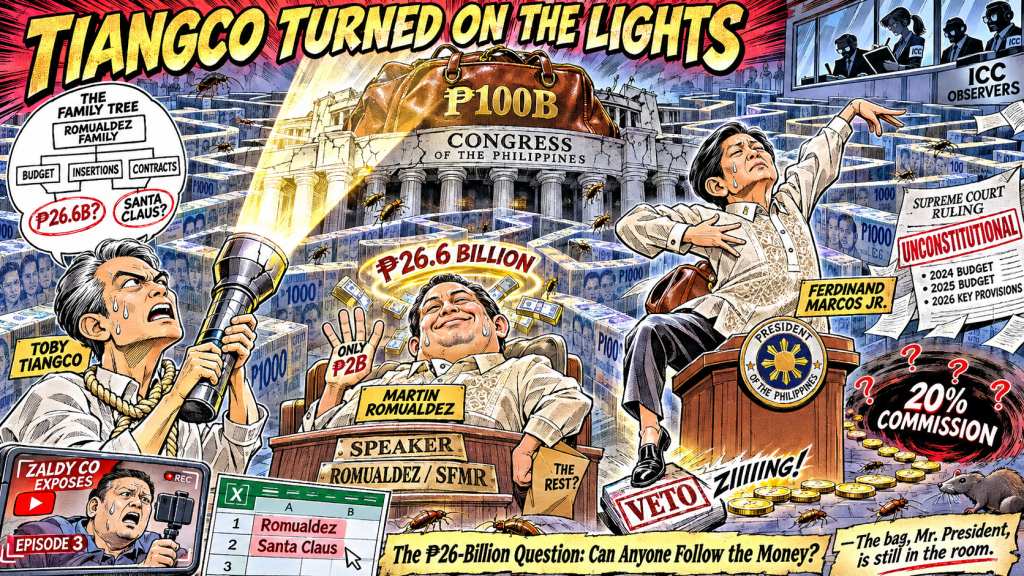
The numbers are almost comically obscene. Tiangco identified ₱209 billion in Department of Public Works and Highways (DPWH) projects inserted by the House during bicameral deliberations. Of that, ₱26.6 billion was tagged to Romualdez—”Romualdez,” “Speaker,” “SFMR”—with only ₱2 billion actually landing in his own district of Leyte. The rest? Scattered across the archipelago like breadcrumbs leading to a very expensive gingerbread house.
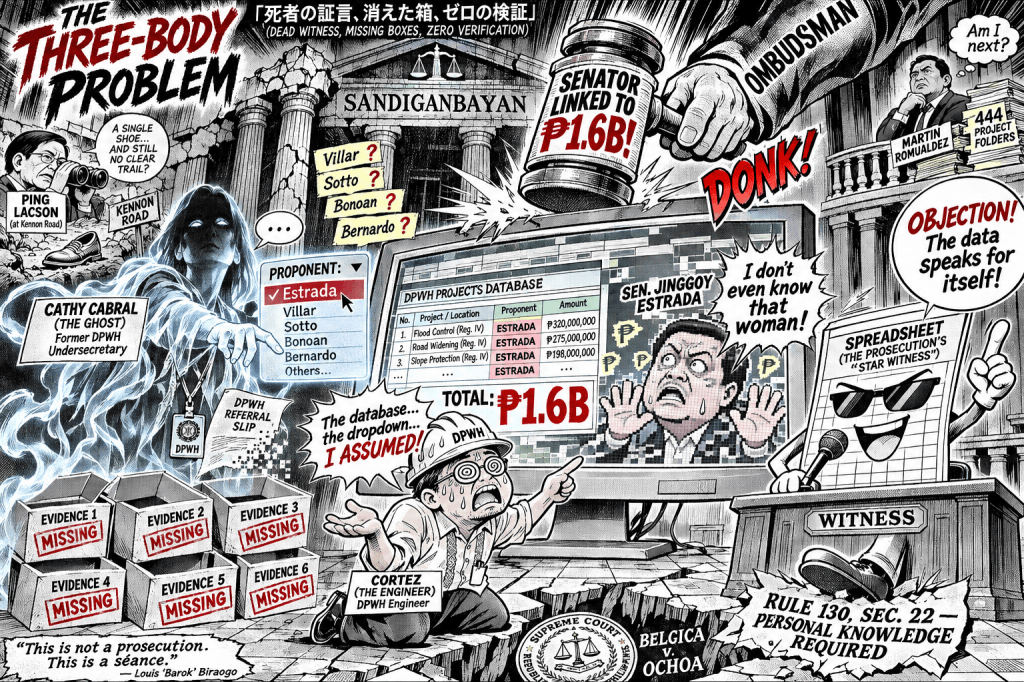
But here is where the narrative gets interesting, and where the prosecution’s case begins to wobble. DPWH Programming Division Chief Peter Paul Cortez testified that the names attached to these projects came from the late Undersecretary Catalina Cabral. His office did not independently verify whether Romualdez actually requested them. He had no personal knowledge of whether the former Speaker even knew his name was being used.
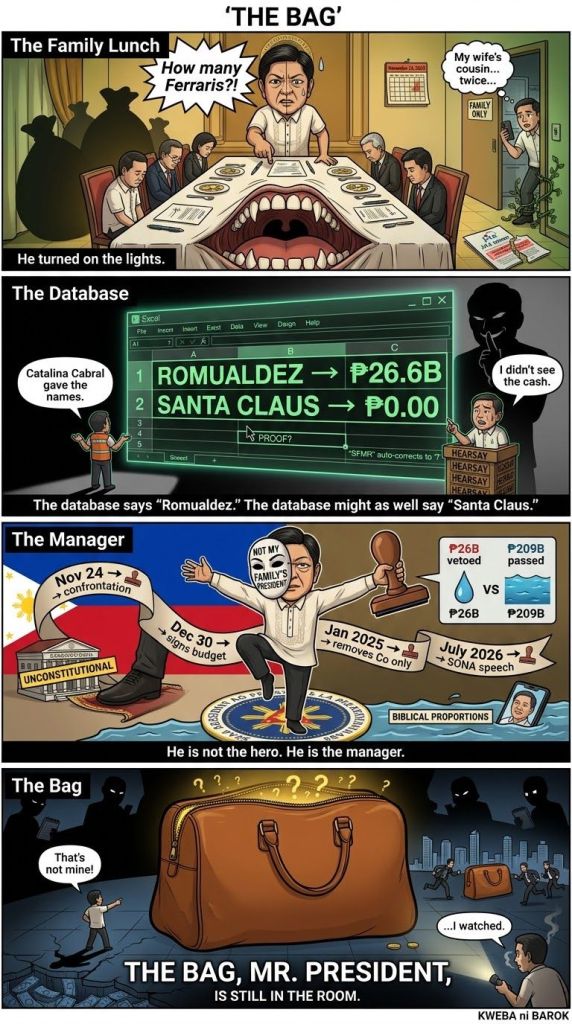
Translation: The database says “Romualdez.” The database might as well say “Santa Claus.” The evidentiary value depends entirely on who put the name there and why.
This is not a minor technicality. This is the entire ballgame.
Tiangco himself conceded the point that should give every plunder prosecutor pause: being listed as a proponent does not establish receipt of commissions. He admitted he had no personal knowledge of cash deliveries to Romualdez. His testimony is strongest on what he heard in meetings—the alleged presidential confrontation on November 24, 2024, the December 2 conversation where Romualdez supposedly told him “Dapat dineretso mo na lang sa akin”. Those are firsthand accounts. They are also conveniently unrecorded, uncorroborated by other attendees, and filtered through a witness whose wife is a cousin to both the accused and the President.
Let us pause on that family tree for a moment, because it is doing a lot of heavy lifting in the background. Toby Tiangco’s spouse, Michelle Romuáldez-Yap, is a cousin of both Ferdinand Marcos Jr. and Martin Romualdez. Tiangco was at the November 24 gathering because it was a family affair. He abstained from the speakership vote. He skipped the Palace lunch. He is, in other words, not a neutral observer parachuted in from The Hague. He is a relative who chose a side, and the side he chose was not the one sitting in the dock.
This does not make him a liar. It makes him a witness with a biography, and biographies matter in courtrooms where the standard is proof beyond reasonable doubt.
Now to the President, who has been performing a delicate dance of late. In his July 2026 State of the Nation Address (SONA), Marcos declared, “Hindi ako Pangulo ng aking pamilya”. He announced that charges against Romualdez were near filing and that nearly ₱25 billion in assets had been recovered or frozen. It was a masterclass in political distancing, delivered with the pained gravitas of a man who wants credit for throwing his cousin under the bus while also asking you to admire the strength of his arm.
But here is the inconvenient question: If Marcos knew about the alleged 20-percent commission system in November 2024, as Tiangco’s testimony suggests, why did the 2025 GAA get signed on December 30, 2024, with only ₱26.065 billion in DPWH items vetoed? [Note: The veto message exists. The reconciliation between the vetoed projects and Tiangco’s list does not.] Why was Zaldy Co removed in January 2025 rather than referred to the Ombudsman? Why did it take a Senate investigation, a fugitive lawmaker’s video confession, and a flood control scandal of biblical proportions before the machinery of accountability began to creak into motion?
The answer, I suspect, is that Marcos is not the hero of this story. He is the manager. He confronted his cousin privately, removed the most radioactive appropriations chair, vetoed enough projects to create the appearance of fiscal hygiene, and then hoped the tide would recede. It did not. The tide brought Zaldy Co.
And Co’s allegations are the grenade rolling toward the President’s feet. In his video testimony, Co claimed that Marcos personally ordered ₱100 billion in bicam insertions, that Budget Secretary Amenah Pangandaman conveyed the instruction, and that Undersecretary Adrian Bersamin handed him a project list pulled from a brown leather bag. The bag, Co said, was a recurring prop in Marcos’s life, once chased down by the Presidential Security Group on a Singapore trip.
I am not saying the bag is real. I am saying that if you are the President of the Philippines and your defense against a corruption allegation involves explaining why a leather bag is not a metaphor for your administration, you have already lost the communications war.
But here is where I must, in the interest of fairness, note that Co is a fugitive. He fled the country. He released his accusations in video installments, like a Netflix true-crime series with worse production values. His P100 billion figure contradicts earlier Senate estimates of ₱142.7 billion in bicam insertions. He did not address his own family’s construction empire, Sunwest, which has feasted on DPWH contracts for years. His credibility is, to put it generously, contested.
The prosecution cannot build a plunder case on Zaldy Co’s YouTube channel. It cannot build one on Tiangco’s recollections either, at least not without the documentary spine that Cortez’s testimony failed to provide. What it needs—what it has always needed—is the money trail. Bank records. Contractor testimony. The metadata on Cabral’s Excel files. The identities of the intermediaries who allegedly collected the 20-percent tariff. The actual recipients, not the names in a database that may have been populated by a deceased undersecretary with her own agenda.
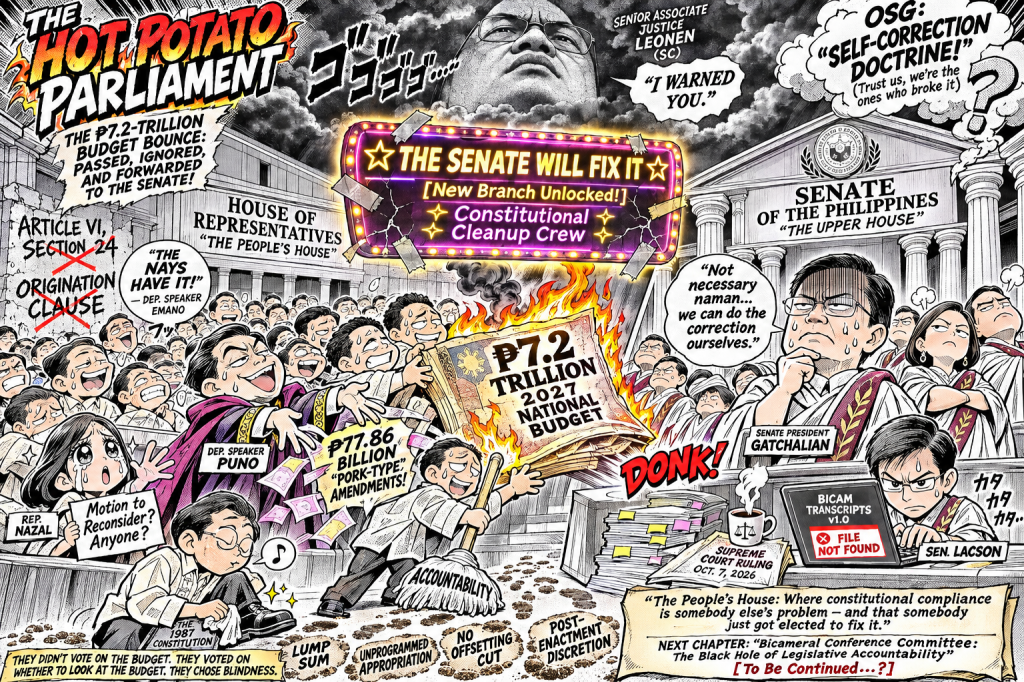
The Supreme Court’s October 2026 ruling declaring the 2024 and 2025 budgets unconstitutional for congressional overreach provides the institutional context, but it does not fill the evidentiary void. It confirms that the process was abused. It does not confirm who pocketed what.
So where does this leave us?
Martin Romualdez faces serious charges and a suspension, but the case against him remains a work in progress. He is entitled to the presumption of innocence, a right that his critics on social media have conveniently misplaced. The ₱26.6-billion list is a red flag, not a smoking gun. The December 2 conversation is ambiguous enough to sustain three interpretations, only one of which is criminal. And the DPWH’s own witness admitted he did not know whether Romualdez was complicit in the attribution.
Ferdinand Marcos Jr. faces no criminal charges but carries the heaviest political burden. His claim to have been a reformer who discovered corruption and moved against it is undermined by the timeline. He knew. He acted, but selectively. He removed Co, but not Romualdez. He vetoed ₱26 billion, but signed a budget that the Supreme Court would later call unconstitutional. His “not the President of my family” speech was moving, but it came eighteen months after the alleged confrontation and only after the scandal had metastasized.
And Toby Tiangco? He is the witness who might be telling the truth, or might be telling the version of the truth that serves his political survival. He provided documents. He provided dates. He also provided a family connection to both principals and an admission that he did not see the money change hands. His testimony is a gift to the prosecution, but it is a gift with strings attached.
The ₱26-billion question, ultimately, is not whether Romualdez is guilty or Marcos is complicit. It is whether the Philippine state is capable of following the money through the labyrinth of congressional insertions, bicameral manipulations, and executive vetoes without the investigation collapsing under the weight of its own political calculations.
I am not optimistic. But I am watching. And so, I suspect, is the International Criminal Court (ICC), whose prosecutors have a curious habit of noticing when national accountability mechanisms fail.
The bag, Mr. President, is still in the room.
Key Citations
A. Legal & Official Sources
- Republic Act No. 7080. An Act Defining and Penalizing the Crime of Plunder. Official Gazette of the Republic of the Philippines, 12 July 1991, http://www.officialgazette.gov.ph/1991/07/12/republic-act-no-7080/.
- Republic Act No. 12116. General Appropriations Act of 2025. Lawphil.net, 2024, lawphil.net/statutes/repacts/ra2025/ra_12116_2025.html.
- Supreme Court of the Philippines. Decision in G.R. Nos. 271059, 271347, E-02472, et al. (declaring 2024 and 2025 GAAs unconstitutional). 7 Oct. 2026, sc.judiciary.gov.ph/sc-holds-unprogrammed-appropriations-subject-to-guidelines-voids-congressional-increases-in-2024-and-2025-budgets/.
B. News Reports
- ABS-CBN News. “ANC: Tiangco: P26.6-B of P209-B in DPWH 2025 budget insertions listed under Romualdez.” ABS-CBN News, 10 Nov. 2026, http://www.abs-cbn.com/news/nation/2026/11/10/anc-tiangco-p26-6-b-of-p209-b-in-dpwh-2025-budget-insertions-listed-under-romualdez-2225.
- Daily Tribune. “Tiangco: House inserted P209-B DPWH projects in 2025 budget.” Daily Tribune, 10 Nov. 2026, tribune.net.ph/2026/11/10/tiangco-house-inserted-p209-b-dpwh-projects-in-2025-budget.
- “DPWH Witness No Direct Knowledge Linking Ex-Speaker to Infra Projects.” Manila Standard, 8 Nov. 2026, manilastandard.net/news/314816178/dpwh-witness-no-direct-knowledge-linking-ex-speaker-to-infra-projects.html.
- Daily Tribune. “‘I’m not my family’s president.’” Daily Tribune, 27 July 2026, tribune.net.ph/2026/07/27/im-not-my-familys-president.
- GMA Network. “Marcos berated Romualdez, Zaldy Co over fund mess, says Tiangco.” GMA News Online, 23 Nov. 2025, http://www.gmanetwork.com/news/topstories/nation/967286/marcos-berated-romualdez-zaldy-co-over-fund-mess-says-tiangco/story/.
- Inquirer.net. “The gaps and omissions in Zaldy Co’s ‘tell-all.’” Inquirer.net, 27 Nov. 2025, newsinfo.inquirer.net/2147616/the-gaps-and-omissions-in-zaldy-cos-tell-all/amp.
- OneNews.PH. “Co Tags Marcos, Romualdez In Budget Insertions.” OneNews.PH, 14 Nov. 2025, http://www.onenews.ph/articles/co-tags-marcos-romualdez-in-budget-insertions.
- Clapano, Jose Rodel. “Co tags President Marcos, Romualdez in budget insertions.” Philstar.com, 15 Nov. 2025, http://www.philstar.com/headlines/2025/11/15/2487335/co-tags-president-marcos-romualdez-budget-insertions.
- Philippine News Agency. “‘Painful but necessary’: Marcos says raps vs Romualdez near filing.” Philippine News Agency, 27 July 2026, http://www.pna.gov.ph/articles/1280381.
- POLITIKO. “From ally to absent: Is Toby Tiangco sending a message with his Palace lunch snub?” POLITIKO, 8 Aug. 2025, politiko.com.ph/2025/08/09/from-ally-to-absent-is-toby-tiangco-sending-a-message-with-his-palace-lunch-snub/daily-feed/.
- Senate of the Philippines. “Marcos: Kin not spared from corruption fight.” eClips Senate News Updates, 27 July 2026, eclips.senate.gov.ph/malacanang/marcos-kin-not-spared-from-corruption-fight.




Leave a Reply