GenCorp’s own lawyer couldn’t find the paperwork—but she did find a constitutional problem the defense can’t explain away
By Louis “Barok” C. Biraogo | November 12, 2026
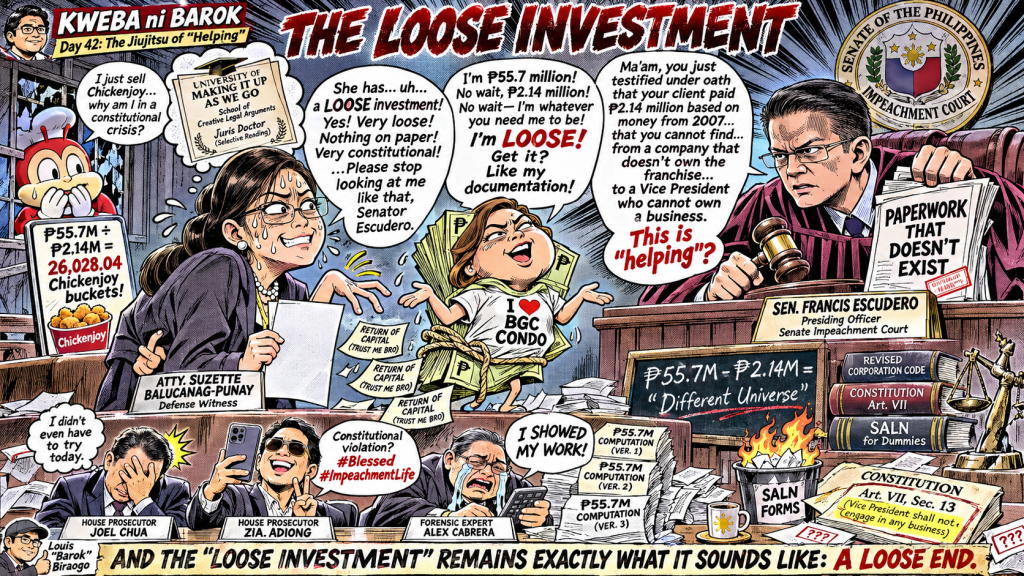
LET us begin with a round of applause for Atty. Suzette Balucanag-Punay, corporate counsel of GenCorp Industries, Inc., who took the witness stand on Day 42 of the impeachment trial of Vice President Sara Duterte and managed to accomplish something truly remarkable: she testified for the defense and somehow made the prosecution’s case more interesting.
This requires a certain kind of legal jiujitsu—the kind where you show up to prove that your client’s alleged beneficiary owned no shares in the corporation, and you leave having confirmed that she had a financial interest in one of its branches, received payments from it for four years, and that nobody can produce a single piece of paper establishing where the original money came from.
In the trade, we call this “helping.”
But let us be fair. Balucanag-Punay was there to establish that the prosecution’s forensic analyst, Alexander Cabrera, had conjured a ₱55.7-million figure out of corporate transactions that may or may not have had anything to do with the Vice President. On that narrow point, she may have succeeded. The defense’s transaction summary shows ₱2,142,369.14 in payments to Duterte from 2022 to 2025. The prosecution says ₱55,714,292 in 2023 alone. That is not a discrepancy. That is a different universe—the prosecution figure is approximately 100.25 times the defense’s number. For context, that is roughly the difference between buying a condo in Bonifacio Global City (BGC) and buying coffee at the Jollibee Times Square branch at the center of this controversy.
The Investment That Dare Not Speak Its Name
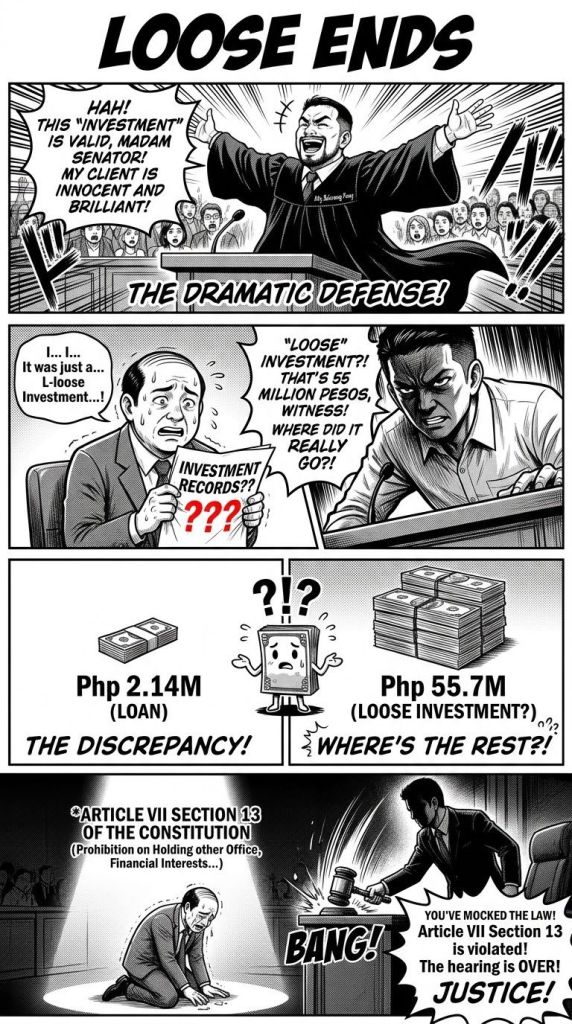
Here is what we now know: Duterte had a “loose investment” in the Jollibee Times Square branch in Davao City. This arrangement allegedly originated in 2007 with Davao Bounty Times Food Corporation, was carried over through succeeding operators—Great Jolly Times, Time Square Bee Foods Corporation—and eventually landed at GenCorp Industries.
The word “loose” is doing a lot of work here. In Philippine corporate law, we have shares, loans, partnerships, joint ventures, beneficial interests. We do not, to my knowledge, have “loose investments.” There is no provision in Republic Act No. 11232 (Revised Corporation Code) for “loose.” There is no Bureau of Internal Revenue (BIR) form for “loose.” There is no Securities and Exchange Commission (SEC) filing category for “loose.”
But there is, apparently, a “loose investment.” And it has been generating payments to the Vice President of the Philippines.
Balucanag-Punay reportedly admitted that she had not personally seen a written document establishing Duterte’s original investment. She could not verify the original amount contributed. She could not establish the precise contractual or legal nature of the investment. Nevertheless, GenCorp had been making payments to Duterte and classifying them as returns of capital.
Let us pause on this. A return of capital ordinarily presupposes an identifiable capital contribution. If the original contribution cannot be established, the classification requires further explanation. The absence of documentation does not automatically prove the investment was fictitious—oral agreements and historical transactions may be legally recognizable. But the absence of records makes it substantially harder to establish what the original amount was, who actually invested it, where the funds came from, whether it was transferred between successive corporations, and whether the subsequent payments were repayment of principal, profit distributions, interest, or something else entirely.
This is not a minor evidentiary gap. This is the entire foundation of the defense’s explanation for why GenCorp was paying the Vice President hundreds of thousands of pesos per year. And the foundation, according to the foundation’s own lawyer, is missing.
The Accounting Problem: ₱55.7 Million Versus ₱2.14 Million
Cabrera attributed ₱55,714,292 in alleged undeclared GenCorp income to Duterte for 2023. The defense’s transaction summary shows ₱555,750 for the same year. The difference is ₱55,158,542—not a rounding error, not a “gross versus net” adjustment, but a number that requires an explanation beyond “our forensic accountant used a different methodology.”
Cabrera should be required to identify the source documents used, the accounts and entities included, the transactions attributed to Duterte, whether those involved actual payments or accounting entries, whether transfers between related corporations were counted more than once, whether the computation distinguished capital from earnings, and whether the methodology used cash or accrual accounting. A forensic computation cannot become conclusive merely because it appears in an expert report. If the report is wrong, correct it. If it is right, explain why the company’s accounting summary does not capture the full financial picture.
But here is the uncomfortable question for the defense: if GenCorp was making payments to Duterte for four years, why can’t the company produce the original investment documents? Why can’t its own counsel identify the original amount contributed? Why does “loose investment” appear to be doing the work that a written contract, a corporate resolution, or a bank deposit slip should be doing?
The absence of documentation cuts both ways. It weakens the prosecution’s ability to establish the original investment was fictitious, but it also weakens the defense’s ability to establish that subsequent payments were legitimate returns of capital. If you cannot prove what was invested, you cannot prove what is being returned.
The Constitutional Problem Nobody Wants To Talk About
Article VII, Section 13 of the 1987 Constitution applies specifically to the President, Vice President, members of the Cabinet, and their deputies. It provides that these officials shall not, during their tenure, directly or indirectly practice another profession, participate in any business, be financially interested in any contract with, or franchise or special privilege granted by, the government, or fail to strictly avoid conflicts of interest.
The prohibition is not confined to corporate shareholding. If Duterte contributed capital to a commercial outlet, maintained a financial interest in its operations, and received periodic distributions from its business account, the prosecution could argue that she indirectly participated in a private business. The fact that the investment was restricted to one Jollibee branch rather than the entire corporation would not necessarily remove it from the constitutional prohibition.
The defense could argue that a passive, historical investment is not equivalent to active participation in business, and that the investment originated in 2007, approximately 15 years before Duterte became Vice President. But the fact that an investment predates public office does not automatically exempt it from constitutional restrictions during the official’s tenure. Article VII, Section 13 does not merely prohibit holding corporate office or receiving dividends. It expressly prohibits direct or indirect participation in business. The defense must therefore explain why an arrangement involving a continuing financial interest in a commercial outlet, accompanied by payments during the Vice Presidency, did not amount to prohibited participation.
This is a materially different inquiry from whether Duterte’s name appeared in GenCorp’s General Information Sheet (GIS). The GIS shows she was not a shareholder. It does not show whether she had a contractual interest in a branch, whether she received distributions from its operations, or whether she retained economic rights requiring disclosure and divestment under Republic Act No. 6713 (Code of Conduct and Ethical Standards for Public Officials and Employees). The defense’s focus on the absence of shareholdings is, to put it gently, a distraction. The constitutional question is not “Did Sara Duterte own GenCorp shares?” It is “Did Sara Duterte participate in a business during her tenure as Vice President?” And on that question, the witness’s testimony has made the defense’s position more complicated, not less.
The Saln Problem
According to GMA News, Philstar, and SunStar, Duterte and her husband declared GenCorp, including its former corporate names, among their business interests in their Statements of Assets, Liabilities and Net Worth (SALNs) for the relevant years.
This creates three possible interpretations. First, the SALN accurately disclosed a genuine business interest—evidence of transparency rather than concealment, though disclosure of a business name is not necessarily complete disclosure of the nature and value of the underlying financial interest. Second, the SALN disclosure was incomplete or misleading—if Duterte had a branch-specific contractual interest, the prosecution could ask whether the SALN accurately reflected it. Third, the SALN and corporate records describe different legal relationships—a person can be a creditor of a corporation without being its shareholder, or hold a contractual interest in a branch without owning the operating corporation. These statements are not necessarily contradictory.
The Senate should obtain the original SALNs for 2022, 2023, 2024, and 2025, including supporting schedules and disclosure forms, and compare the corporate names disclosed, the nature of the interest stated, the declared acquisition costs, the declared current values, the dates of acquisition, any changes in ownership or financial relationships, and the treatment of the alleged branch investment. This could establish whether the SALNs were accurate, incomplete, or materially inconsistent with the underlying transactions—and whether the Vice President complied with her constitutional obligation to submit declarations under oath of her assets, liabilities, and net worth.
The Jaime Cruz Connection
We would be remiss not to mention the name that keeps appearing in the margins: Jaime T. Cruz, described as a long-time business partner of the Duterte family, an incorporator of multiple companies with Duterte stockholdings, an appointee of Rodrigo Duterte to government positions, and a major shareholder in Metro City Chow Foods Corporation—1,997 shares, compared to Duterte’s 500.
The SEC has testified that Duterte retained a 20% stake in Metro City Chow Foods Corporation from 2016 to 2025, remained on the board of directors from 2018 to 2025, and was a member of the compensation committee from 2024 to 2025. This directly contradicts Balucanag-Punay’s claim that Duterte had “no corporate position.”
If Cruz holds shares as Duterte’s nominee, the “loose investment” narrative collapses, and Duterte’s true economic interest in GenCorp-affiliated entities may be far larger than disclosed. The prosecution should investigate whether Duterte’s interests were held through nominees or dummies, whether the “loose investment” was a mechanism to obscure the true nature of her financial relationship with GenCorp, and whether the corporate succession from Davao Bounty Times to GenCorp was designed to create plausible deniability rather than to reflect genuine business transactions.
The Senate’s Responsibility
The senators must avoid turning the hearing into a political contest between the Duterte and Marcos camps. Their responsibility is to determine what the investment actually was, whether the reported payments were properly characterized, whether the SALNs were accurate, whether the Constitution was violated, and whether the evidence satisfies the applicable impeachment standard.
The Senate should subpoena Alexander Cabrera to explain the forensic computation, the GenCorp accountant to authenticate the transaction summary, the GenCorp treasurer or finance officer to explain actual payments and authorizations, former Davao Bounty Times officers to establish the original investment, former corporate secretaries to establish corporate succession and transfer of obligations, relevant bank representatives to authenticate deposits and payments, and Duterte, if properly called, to explain the investment and its disclosure. The Senate should also require a complete written reconciliation of the two competing financial computations.
The impeachment court has the institutional authority to determine what evidence is necessary to resolve the controversy. It is not simply a passive recipient of competing political narratives.
The Unanswered Questions
Who originally received Duterte’s alleged 2007 investment? How much was actually contributed? Where is the original documentary evidence? What legal agreement transferred the obligation to GenCorp? Why was GenCorp making payments without a verifiable original capital balance? Were the payments exclusively capital repayments or did they include profits? Did Duterte have a right to participate in branch management or operations? What exactly did she declare in her SALNs? Was the investment divested when she assumed the Vice Presidency? How did Cabrera arrive at ₱55.714 million? Did any GenCorp government contracts involve decisions or intervention by Duterte? Who in GenCorp authorized the payments and on what documentary basis?
These are the questions that should dominate the next hearing. Not the political spin. Not the partisan talking points. The answers will not be found in another press conference. They will be found in the original investment documents, the corporate succession records, the bank transactions, the SALNs, and a defensible forensic reconciliation.
Until those records are produced, the ₱55.7-million allegation remains contested, the ₱2.14-million payment history requires verification, and the constitutional question remains unresolved.
And the “loose investment” remains exactly what it sounds like: a loose end.
Key Citations
A. Legal & Official Sources
- The 1987 Constitution of the Republic of the Philippines. Official Gazette of the Republic of the Philippines, officialgazette.gov.ph/constitutions/1987-constitution/.
- Republic Act No. 6713. Code of Conduct and Ethical Standards for Public Officials and Employees. 20 Feb. 1989. Official Gazette of the Republic of the Philippines, officialgazette.gov.ph/1989/02/20/republic-act-no-06713/.
- Republic Act No. 11232. Revised Corporation Code of the Philippines. 20 Feb. 2019. The Lawphil Project, lawphil.net/statutes/repacts/ra2019/ra_11232_2019.html.
B. News Reports
- Cinco, Maricar. “SEC Exec: VP Part of Food Firm’s Board While in Office.” Inquirer Plus, 22 Sept. 2026, plus.inquirer.net/news/sec-exec-vp-part-of-food-firms-board-while-in-office/.
- Cruz, James Patrick. “Jaime T. Cruz: The Business Partner of Sara, Baste, and Pulong Duterte.” Rappler, 29 Sept. 2026, http://www.rappler.com/philippines/jaime-t-cruz-business-partner-sara-baste-paolo-duterte-ties/.
- Divina, Thea. “GenCorp Counsel Disputes Forensic Report’s Figures on VP Sara’s Alleged Undeclared Income.” DZRH, 11 Nov. 2026, http://www.dzrh.com.ph/post/gencorp-counsel-disputes-forensic-reports-figures-on-vp-saras-alleged-undeclared-income.
- Panti, Llanesca T. “Defense Witness: VP Sara Has Zero Stocks in GenCorp Firm.” GMA News Online, GMA Network, 11 Nov. 2026, http://www.gmanetwork.com/news/topstories/nation/1009086/defense-witness-vp-sara-has-zero-stocks-in-gencorp-firm/story/.
- Panti, Llanesca T. “Sara Duterte Had ‘Loose Investment’ in GenCorp, Received P2.14M—Witness.” GMA News Online, GMA Network, 11 Nov. 2026, http://www.gmanetwork.com/news/topstories/nation/1009095/sara-duterte-had-loose-investment-in-gencorp-received-p2-14m-witness/story/.
- Valente, Catherine S. “Sara Duterte Has ‘Loose Investment’ in Jollibee Times Square Branch, GenCorp Counsel Testifies.” The Manila Times, 11 Nov. 2026, http://www.manilatimes.net/2026/11/11/news/sara-duterte-has-loose-investment-in-jollibee-times-square-branch-gencorp-counsel-testifies/2467214.
- Laqui, Ian. “Sara Duterte Received ‘Return of Capital’ of 2.14 Million from GenCorp — Witness.” Philstar.com, 11 Nov. 2026, http://www.philstar.com/headlines/2026/11/11/2569440/sara-duterte-received-return-capital-214-million-gencorp-witness.
- Peralta-Malonzo, Third Anne. “Defense Witness Denies Sara Duterte Owns Shares in GenCorp Despite SALN Disclosure.” SunStar, 11 Nov. 2026, http://www.sunstar.com.ph/manila/defense-witness-denies-sara-duterte-owns-shares-in-gencorp-despite-saln-disclosure.
- Echegoyen, Chalssea Kate. “Witness: Sara Duterte Had No GenCorp Stake but Received P2.1 Million in Capital Returns.” ABS-CBN News, 11 Nov. 2026, http://www.abs-cbn.com/news/nation/2026/11/11/sara-duterte-had-no-gencorp-stake-but-received-p2-1-million-in-capital-returns-witness-1700.
- “Ang Hirap Maging Mahirap”: The PAO Scandal That Proves Government Contempt Is Nothing New

- “Far-Off” My Axx: Malacañang’s Claire Castro Drowns in Her Own Legal Gaslighting
- “Forthwith” to Farce: How the Senate is Killing Impeachment—And Why Enrile’s Right (Even If You Can’t Trust Him)
- “HINDI AKO NAG-RESIGN!”

- “I Know Nothing”: Baste Duterte’s Amnesia Defense Meets ₱33M in GenCorp Contracts

- “I’m calling you from my new Globe SIM. Send load!”

- “Mahiya Naman Kayo!” Marcos’ Anti-Corruption Vow Faces a Flood of Doubt

- “Manageable” Debt, Unmanageable Corruption: The ₱19.66-Trillion Lie

- “Manageable” Debt, Unmanageable Lies: DBM’s ₱21 Trillion Fairy Tale

- “Meow, I’m calling you from my new Globe SIM!”

- “Natrabaho”: One Word, One Ombudsman, and a Judiciary on Trial

- “No Special Jail for Crooks!” Boying Remulla Slams VIP Perks for Flood Scammers







Leave a Reply