Because Nothing Says ‘Social Justice’ Like Taxpayer-Funded Condo Clearance for Developers Who Bet on Gambling
By Louis ‘Barok‘ C. Biraogo | November 13, 2026
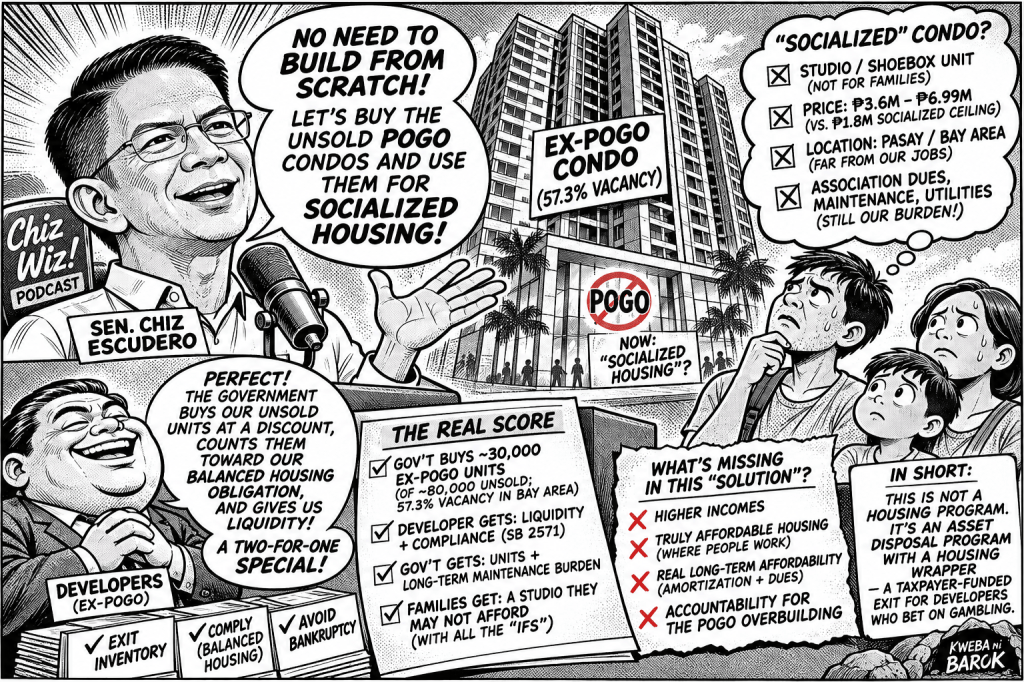
ALLOW me to translate the press release: Senator Francis “Chiz” Escudero, Chair of the Senate Committee on Urban Planning, Housing and Resettlement, has looked upon the smoldering wreckage of the Philippine Offshore Gaming Operators (POGO) real estate bubble—a market that collapsed because the government finally decided harboring offshore gambling was not the wisest national policy—and arrived at a stunning conclusion: the Filipino taxpayer should buy the leftovers.
This is what passes for “housing policy” in 2026. Not “why did we allow developers to build an entire urban ecosystem around an industry we would eventually ban?” Not “why are there 80,000 empty condos while millions remain homeless?” No, the question is almost childlike in its innocence: “Why build from scratch when there are already existing units that can be made available to our people?”
Why indeed, Senator.
The Math That Doesn’t Add Up
Escudero’s podcast—the Chiz Wiz! show, apparently where serious legislative policy is now formulated between sponsor reads—featured Colliers Philippines Research Director Joey Roi Bondoc, who cited “approximately 80,000 unsold condominium units in Metro Manila.”
Eighty thousand. It sounds like a solution.
But Colliers’ own Q4 2025 report says of those 79,200 unsold units, only about 30,000 are ready-for-occupancy (RFO). The rest are under construction or preselling. Those 30,000 are concentrated in Cubao-New Manila, Quezon City, the Bay Area, Pasig, and Alabang-Las Piñas—with the Bay Area recording a staggering 57.3% vacancy rate.
The Bay Area. Where POGO workers used to live—and where Leechiu Property Consultants says POGO demand inflated Metro Manila rents for years, a “distortion driven by POGO premiums” that collapsed back to “real market levels” once the industry exited (Golez). Studios and one-bedrooms were designed and priced for transient foreign laborers, not Filipino families.
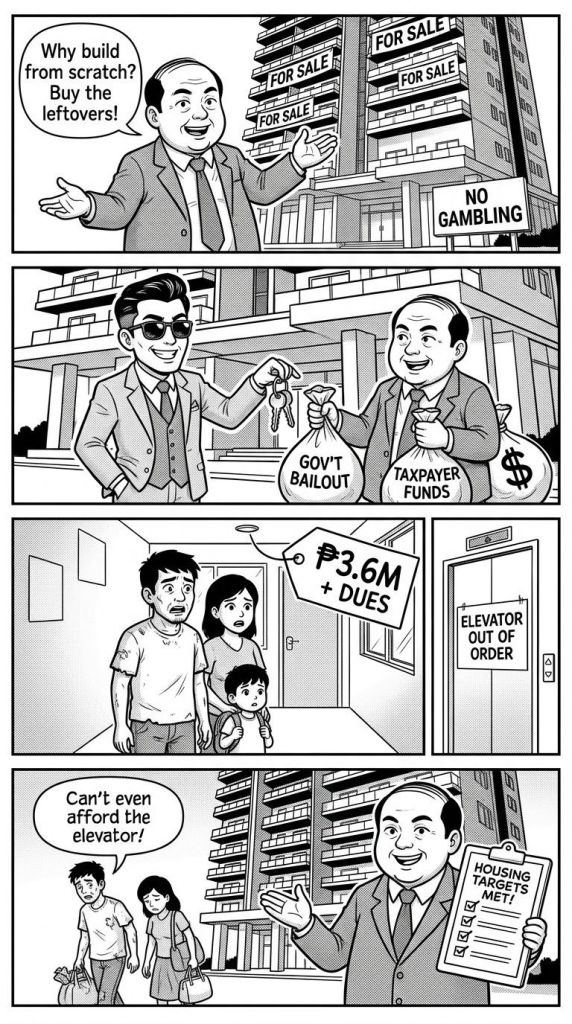
Now these monuments to speculative overbuilding are supposed to solve the housing crisis? The Senator wants government to take 30,000 shoebox units in Pasay, many in buildings with 57% vacancy, and rebrand them “socialized housing.” The only thing missing is a government-issued crowbar to pry the “POGO” signs off the lobby walls.
The “Housing Paradox” Is Not What Escudero Thinks
Escudero calls this a “housing paradox”—empty condos coexisting with homeless families. The implication: a simple distribution failure, and if we just get the empty units to needy families, everyone wins.
But this is not a paradox. It’s a mismatch, and it cannot be solved by pretending it’s a logistics issue.
A Bay Area condo designed for a POGO worker earning ₱40,000 a month is not “available” to a minimum-wage family in Quezon City. It’s too small (studios, not family units). Too expensive (the socialized condominium ceiling under Joint Memorandum Circular No. 2023-003 (Adjusting the Price Ceiling for Socialized Subdivision and Condominium Projects) is ₱1.8 million, while mid-income RFO units run ₱3.6 million to ₱6.99 million). Wrong location (far from employment for workers who cannot afford daily transport from Pasay to Laguna). And the monthly association dues don’t disappear because the government bought the unit. The rest is maintenance, security, utilities, and inevitable special assessments when the elevators break—which they will, because these buildings were built for investors, not families.
The UP Center for Integrative and Development Studies already warned that the expanded 4PH program suffers from “high monthly amortization,” “housing prices beyond the capacity of the poorest households,” and “rigid eligibility requirements” (Dimalanta et al.). PIDS research by Ballesteros, Ramos, and Ancheta found the conventional 30% affordability standard “can overestimate affordability among poorer households.” In plain English: a family earning ₱15,000 a month cannot afford a ₱4,500 housing payment because they still need to eat.
The Developer Bailout in Disguise
Department of Human Settlements and Urban Development (DHSUD) Undersecretary Marisol Anenias, on the Senator’s podcast, confirmed the agency already allows developers to enroll excess inventory under 4PH, but “doing so may require developers to accept lower margins or absorb losses.”
Translation: the government will buy the unsold units, but at a discount. Developers eat the difference between what they hoped to sell for and what government will pay.
On its face, reasonable. If developers overbuilt in a POGO-dependent market, they should bear the consequences. That’s capitalism.
But the government is still buying. The taxpayer is still absorbing the inventory. And developers still get liquidity for assets that would otherwise sit empty while carrying costs accumulate.
This is not a bailout in the sense of a direct cash transfer. It is a bailout in the sense that the government is providing a guaranteed exit for a market that collapsed because of a policy decision the government itself made. The POGO ban was correct—the industry was a nexus of human trafficking and money laundering. But that decision created a negative externality for developers who bet heavily on POGO. Now the government is being asked to socialize that loss.
If this were framed honestly—”we’ll buy some unsold condos at steep discounts for transitional housing, and yes, this incidentally helps developers avoid bankruptcy”—I might be less critical. But it’s framed as a housing solution, as if the primary beneficiary is the homeless family, not the developer with a balance sheet full of non-performing assets.
The Senate Bill That Lets Developers Double-Dip
Senate Bill No. 2571 is where the real mischief lives.
Under current law, condominium developers must allocate at least 5% of project area or cost to socialized housing under the Balanced Housing Development Program (Republic Act No. 7279 (Urban Development and Housing Act of 1992), as amended by Republic Act No. 10884 (An Act Strengthening the Balanced Housing Development Program))—a cost of doing business designed to ensure private development contributes to public housing stock.
SB 2571 would allow developers to convert RFO units into “accredited socialized housing” and credit them toward balanced housing obligations.
On its face, efficient. But consider the incentives. A developer with 500 unsold units in a POGO-dependent building has two problems: units aren’t selling, and the developer still owes a balanced housing obligation. Under SB 2571, both problems vanish at once: sell the unsold units to government at a negotiated “socialized” price and count those same units toward the obligation.
That’s not housing policy. That’s a two-for-one special.
The developer gets liquidity for dead inventory, compliance with a legal obligation, and moral cover. The government gets units that may not be suitable, a long-term maintenance liability, and administrative burden. The beneficiary family gets a studio in Pasay with an amortization they may not afford, in a building with 57% vacancy, far from their job, with association dues never part of the affordability calculation.
The Numbers DHSUD Doesn’t Want You to Remember
In March 2026, DHSUD appeared before Escudero’s own committee and admitted the 6.5-million housing backlog—the cornerstone of the 4PH program—was a “misconception.” The actual backlog, DHSUD said, was 2.2 million.
Escudero, to his credit, was furious. “My problem with recalibrating numbers is that you are just making the books look good,” he said. “Let us not fool ourselves that our backlog is that small just so that we can say that we accomplished something during our term.”
That was eight months ago. Now the same Senator proposes a program that would count unsold POGO condos as “housing delivery.” The irony is so thick you could pour it over pancake.
If the government can claim credit for every condo purchased from a distressed developer, what stops the “accomplishment” count from ballooning? A unit built for a POGO worker, sold to government at a discount, credited toward a balanced housing obligation, then turned over to a family that may not afford it—is that “one housing unit delivered”? Or a statistical fiction dressed up as social justice?
The answer depends on whether the family is still there in five years, still paying, still able to afford the dues, still able to reach their job. Nobody in this proposal is talking about that.
What Escudero Should Be Asking
“Why build from scratch?” is the wrong question. The right ones are:
- First: Who absorbs the loss? If developers overbuilt for a market the government correctly shut down, they should bear the commercial consequences. The government should not be buyer of last resort for speculative real estate. If it is, every future developer will build expecting the taxpayer to catch them. That is moral hazard, and it is expensive.
- Second: Who actually benefits? The primary beneficiaries, as written, are developers with unsold inventory. Secondary: banks with exposure to those developers. Tertiary: potentially some Filipino families—if the units are suitable, if financing works, if locations are viable, if maintenance costs are manageable. That’s a lot of “ifs.”
- Third: What happens after the keys are handed over? A condominium is not a house. It is shared ownership with common areas, building administration, and recurring expenses. If government subsidizes the purchase price but not ongoing costs, it sets families up for distress. UP-CIDS already warned that “expanding the number of housing modalities does not automatically make housing accessible to the poorest” (Dimalanta et al.).
The Cynical Reading (Which Is Probably Correct)
When a Senator proposes a program benefiting developers, the framing is always about the poor. The poor are the moral cover, the justification, the reason critics like me should shut up and be grateful someone is “doing something.”
But let’s be clear. The government is considering purchasing tens of thousands of condominium units built for an industry banned because it was a criminal enterprise. The purchase provides liquidity to developers who made bad bets. The units get counted toward housing targets and balanced housing obligations. And the families who end up there are responsible for payments and maintenance costs never designed with their incomes in mind.
This is not a housing program. It is an asset disposal program with a housing wrapper.
Does the idea have no merit? No. A limited number of units in suitable locations could work for transitional housing, rental arrangements, or rent-to-own schemes. Government should explore those options with clear eyes about what it’s doing: helping developers exit a market they misread while extracting maximum public benefit.
What it should not do is pretend 80,000 empty POGO shoeboxes are the answer to a crisis fundamentally about income, not inventory. The crisis is not too few buildings. It’s that millions of Filipinos do not earn enough to afford the buildings we already have—including the ones sitting empty right now.
Escudero knows this. He said it himself: “Housing is not simply a problem of supply. The bigger challenge is making homes affordable for ordinary Filipinos through financing terms they can realistically pay every month.”
If that’s true—and it is—why is the headline proposal about supply? Why buy empty condos rather than raise incomes, subsidize rents, or build genuinely affordable housing where people actually work?
The answer, I suspect, is that buying condos is easier. It doesn’t require confronting wage stagnation. It doesn’t require land reform. It doesn’t require challenging the developers who have captured the housing policy apparatus. It just requires a checkbook and a press release.
And it allows everyone to say, with a straight face, that they are “doing something about housing.”
The families who end up in these units, paying amortizations they can barely afford, in buildings with 57% vacancy, far from their jobs, will discover soon enough what the Senator has not said: the government rescued the developers, and all they got was a studio unit with a view of the Manila Bay sunset—assuming they can afford the association dues to access the rooftop deck.
Key Citations
A. Legal & Official Sources
- Republic Act No. 7279. An Act to Provide for a Comprehensive and Continuing Urban Development and Housing Program, Establish the Mechanism for Its Implementation, and for Other Purposes. 24 Mar. 1992. Official Gazette of the Republic of the Philippines, https://www.officialgazette.gov.ph/1992/03/24/republic-act-no-7279/.
- Republic Act No. 10884. An Act Strengthening the Balanced Housing Development Program, Amending for the Purpose Republic Act No. 7279, as Amended, Otherwise Known as the Urban Development and Housing Act of 1992. 17 July 2016. Official Gazette of the Republic of the Philippines, https://www.officialgazette.gov.ph/2016/07/17/republic-act-no-10884/.
- Department of Human Settlements and Urban Development, and National Economic and Development Authority. Joint Memorandum Circular No. 2023-003: Adjusting the Price Ceiling for Socialized Subdivision and Condominium Projects. DHSUD, 19 Oct. 2023, dhsud.gov.ph/news/neda-dhsud-adjust-outdated-price-ceiling-for-socialized-housing/. Accessed 12 Nov. 2026.
- Republic Act No. 12312. An Act Banning and Declaring Illegal Offshore Gaming Operations in the Philippines and Other Operations Related Thereto, Repealing for the Purpose Republic Act Numbered Eleven Thousand Five Hundred Ninety, Otherwise Known as “An Act Taxing Philippine Offshore Gaming Operations,” and for Other Purposes. 23 Oct. 2025. Presidential Communications Office, https://pco.gov.ph/news_releases/pbbm-signs-into-law-anti-pogo-act-of-2025-institutionalizing-ban-on-pogos/.
- Ballesteros, Marife M., Tatum P. Ramos, and Jenica A. Ancheta. “Measuring Housing Affordability in the Philippines.” Philippine Journal of Development, vol. 48, no. 1, 2024. Philippine Institute for Development Studies, https://doi.org/10.62986/pjd2024.48.1b.
- Dimalanta, Rafael Vicente V., et al. “More Modalities, Still Limited Reach for the Poorest?: A Preliminary Assessment of the Expanded 4PH Social Housing Program.” UP Center for Integrative and Development Studies, 2025. Socioeconomic Research Portal for the Philippines, https://serp-p.pids.gov.ph/publication/public/view?slug=more-modalities-still-limited-reach-for-the-poorest-a-preliminary-assessment-of-the-expanded-4ph.
B. News Reports
- Bondoc, Joey Roi. “Colliers Property Market Report – Residential | Q4 2025 | Philippines.” Colliers Philippines, 18 Feb. 2026, https://www.colliers.com/en-ph/research/colliers-property-market-report-residential-q4-2025-philippines.
- “Chiz Eyes Integration of Unsold Condo Units into State Housing Program.” chizescudero.com, 9 Nov. 2026, https://chizescudero.com/chiz-eyes-integration-of-unsold-condo-units-into-state-housing-program/.
- “Chiz: Tap Unsold Condos for Gov’t Housing.” Manila Standard, 9 Nov. 2026, https://manilastandard.net/news/314816803/chiz-tap-unsold-condos-for-govt-housing.html.
- “DHSUD: 6.5-Million Housing Backlog a ‘Misconception.’” Daily Tribune, 10 Mar. 2026, https://tribune.net.ph/2026/03/10/dhsud-65-million-housing-backlog-a-misconception.
- “Manila Condo Oversupply Seen Keeping Vacancy High This Year — Colliers.” BusinessWorld Online, 3 Feb. 2026, https://bworldonline.com/corporate/2026/02/03/728047/manila-condo-oversupply-seen-keeping-vacancy-high-this-year-colliers/.
- “No Need to Build from Scratch: Chiz Escudero Wants Unsold Condos Used for Govt’s Housing Program.” POLITIKO, 10 Nov. 2026, https://politiko.com.ph/no-need-to-build-from-scratch-chiz-escudero-wants-unsold-condos-used-for-govts-housing-program/.
- Golez, Roy Amado, Jr. “Metro Manila Housing Market Recalibrates as Buyers Seek Value.” Manila Standard, 10 Dec. 2025, manilastandard.net/business/314679189/metro-manila-housing-market-recalibrates-as-buyers-seek-value.html. Accessed 12 Nov. 2026.
- “Senator Pushes for Unsold Condo Units’ Inclusion in Gov’t Housing Program.” BusinessWorld Online, 10 Nov. 2026, https://bworldonline.com/the-nation/2026/11/10/792945/senator-pushes-for-unsold-condo-units-inclusion-in-govt-housing-program/.
- ₱9 Billion in ‘Savings’? DILG’s Fire Truck Deal Smells Like Smoke

- ₱8B BBM Pork: CCTV for Every Captain’s Kumpare?
- ₱8.9 Billion, 331 Ghost Police Stations: The TIKAS Scandal Explained

- ₱8.4 Billion, 42,000 Barangays, 1 Election: The “Bawat Barangay Makikinabang” Vote-Buying Masterclass
- ₱75 Million Heist: Cops Gone Full Bandit

- ₱63 to the Dollar: The Only Thing Falling Faster Than the Peso Is the Government’s Credibility

- ₱6.77B Ghost Haunts Duterte: RTC Dismisses Mans Carpio’s Desperate Plea
- ₱6.77 Billion and Zero Cash: The Sara Duterte SALN Math That Doesn’t Add Up

- ₱6.7-Trillion Temptation: The Great Pork Zombie Revival and the “Collegial” Vote-Buying Circus

- ₱58.53B, Zero Receipts: The LGSF Pork Barrel Nobody Wants to Name
- ₱53 Million Man Tells ₱695-a-Day Workers to Stop Being ‘Mayabang’: The Audacity of BSP’s Remolona
- ₱491-M Right-of-Way Scam: DPWH Paid for Ghost Land, Ombudsman Finally Notices




Leave a Reply