Inside the Palace’s Damage Control Playbook: When 55% of Filipinos Say ‘We Don’t Trust You,’ Blame the Pollster
By Louis ‘Barok‘ C. Biraogo | November 13, 2026
SOMETHING curious is happening in Philippine politics, and it smells worse than a Manila estero at low tide.
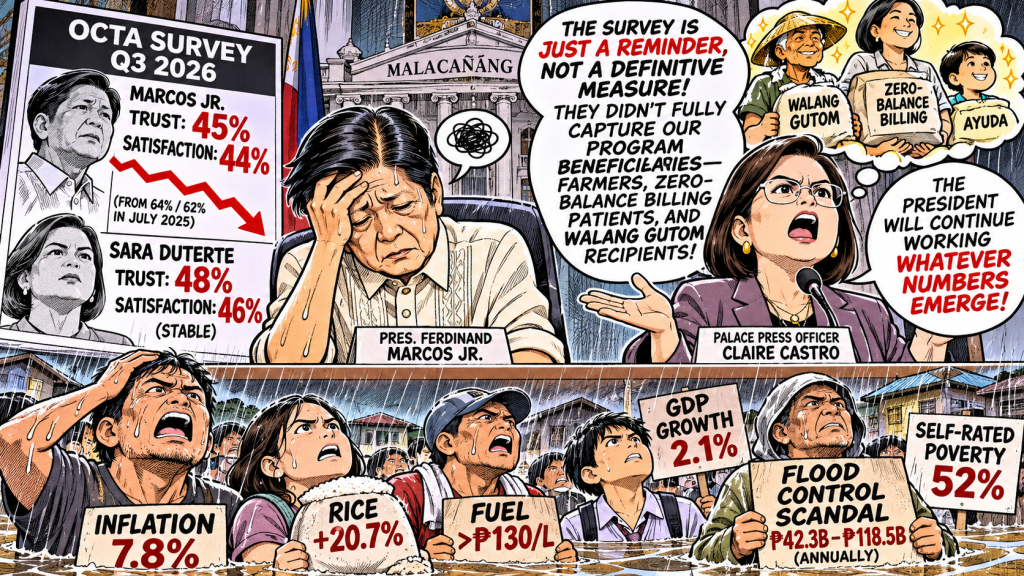
President Ferdinand Marcos Jr. has just recorded the lowest trust and satisfaction ratings of his entire presidency—45% trust, 44% satisfaction—according to OCTA Research’s Third Quarter 2026 Tugon ng Masa survey. Vice President Sara Duterte, meanwhile, sits comfortably at 48% trust and 46% satisfaction, statistically unchanged despite facing an impeachment trial that would end lesser political careers.
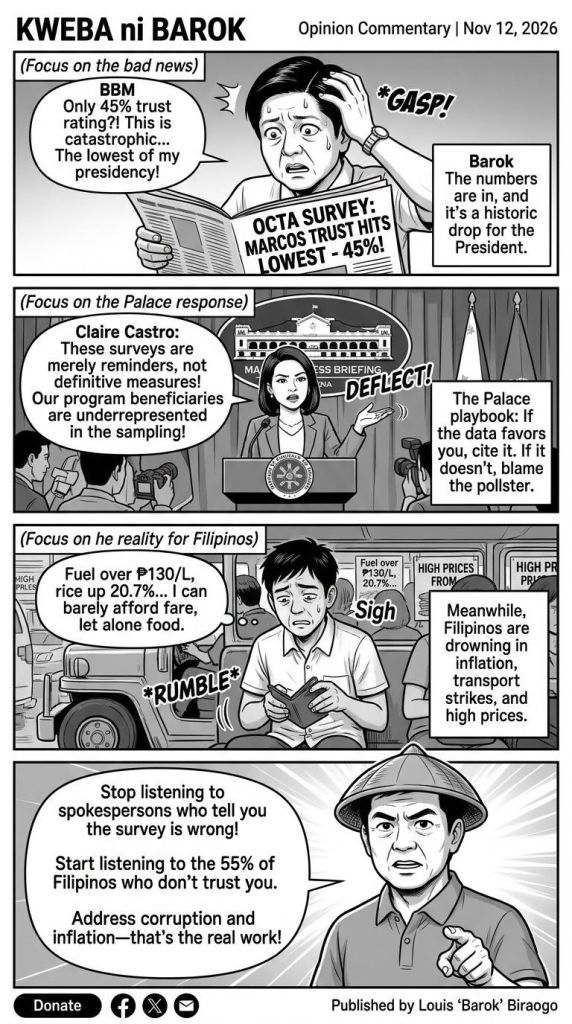
The Palace’s response? Press Officer Claire Castro says surveys are merely “reminders, not definitive measures.” She claims program beneficiaries—farmers, zero-balance billing patients, Walang Gutom recipients—are underrepresented in the sampling. The President, she insists, will continue working “whatever numbers emerge.”
How touching. How predictable. How utterly, depressingly familiar.
This is the same playbook authoritarian-adjacent administrations have used for decades: when the data favors you, cite it endlessly; when it doesn’t, question the methodology. But here’s the inconvenient truth the Palace doesn’t want you to consider: the numbers aren’t just bad—they’re catastrophic, and they’ve been trending downward for over a year.
The Anatomy of a Collapse
Let’s dispense with the Palace’s damage control and examine the actual trajectory. In July 2025, Marcos enjoyed 64% trust. By September 2026, that figure had plummeted to 45%—a 19-point freefall. Performance satisfaction followed an almost identical path, dropping from 62% to 44%.
This isn’t statistical noise. This isn’t a one-quarter blip. This is a sustained, multi-survey erosion of public confidence that cuts across both personal trust and job performance—two dimensions that, when they decline together, signal something far deeper than policy disagreement.
The Palace wants you to believe this is about communication. That if only Filipinos understood the Walang Gutom program or zero-balance billing, they’d suddenly appreciate the President’s genius. But here’s what Castro conveniently ignores: the survey was conducted September 28 to October 4, 2026—during transport strikes over fuel prices exceeding ₱130 per liter, amid inflation at 7.8%, with rice prices up 20.7% year-on-year, and with GDP growth crawling at 2.1% in the third quarter.
Tell me, Ms. Castro: how many Walang Gutom beneficiaries do you think were worrying about their next meal while stuck in traffic because they couldn’t afford the fare to get to work?
The Regional Fracture: A Nation Divided
But the truly alarming finding isn’t Marcos’s national decline—it’s the geographic polarization that has transformed Philippine politics into something resembling a confederation of warring fiefdoms.
Marcos retains 54% trust in Balance Luzon—his traditional stronghold—but that’s down from 63% just one quarter earlier. In Mindanao, his trust has collapsed to 28%, a staggering 64-point drop from October 2022. Meanwhile, Sara Duterte commands 94% trust in Mindanao and 66% in the Visayas, but only 25% in Balance Luzon and 40% in the National Capital Region.
The gap between highest and lowest regional trust ratings has widened to 26 points for Marcos and an astonishing 69 points for Duterte.
This isn’t merely geographic variation. This is the fragmentation of national political identity into regional tribal blocs. When a Vice President can command near-unanimous support in one-third of the country while being viewed with suspicion in another, we’re no longer talking about a unified polity. We’re watching the slow-motion disintegration of the post-EDSA democratic settlement into something resembling the pre-colonial barangay system—minus the communal solidarity.
The UniTeam alliance that won a historic majority in 2022 was always an unnatural marriage of convenience between two authoritarian dynasties. Its collapse was predictable. What wasn’t predictable—or at least, what the political class refuses to acknowledge—is how completely it would shatter the country’s political geography.
The Corruption Question: Ghost Projects, Real Anger
Now let’s address the elephant in the room—or rather, the ₱118.5 billion elephant that’s been trampling through the national budget.
The flood control corruption scandal isn’t merely a controversy. It’s a metaphor for everything that’s wrong with Philippine governance. Estimates suggest ₱42.3 to ₱118.5 billion has been lost annually since 2023 to ghost projects, substandard construction, and overpriced contracts. Senator Lacson estimates ₱180 billion diverted to phantom infrastructure since 2016.
And where did some of that money allegedly go? According to Senator Trillanes, ₱1 billion in bribes was delivered to Marcos aide Jojo Cadiz.
The President’s response? He created an Independent Commission for Infrastructure in September 2025. He promised a crackdown in his 2025 SONA. He told Filipinos to “have some shame.”
Yet as of this writing, no major convictions have materialized. The Ombudsman filed 79 flood-control-related criminal cases involving ₱10.78 billion in November 2026—but filing charges is not the same as securing convictions. And the public knows it.
Here’s what the Palace doesn’t understand: Filipinos aren’t stupid. They see the investigations, the hearings, the press conferences—and then they see the floods return every rainy season. They see politicians promising accountability while allegedly pocketing billions. They see a President who lectures them about shame while his own aides face bribery allegations.
You want to know why trust is at 45%? Because 45% is generous.
The Duterte Paradox: How Impeachment Became a Shield
Now let’s examine the most fascinating political phenomenon of 2026: Sara Duterte’s ability to maintain 48% national trust while facing an impeachment trial for allegedly unexplained wealth totaling ₱817 million.
How is this possible?
The answer lies in the peculiar psychology of political persecution narratives. When supporters believe their champion is being unfairly targeted by a hostile establishment, attacks only strengthen loyalty. The impeachment proceedings, rather than damaging Duterte, may have solidified her base by allowing her to frame herself as a martyr—a victim of political persecution rather than accountability.
Consider the SWS findings: net satisfaction with the prosecution stands at -5, while net satisfaction with Duterte’s defense stands at +23. Fifty percent believe the trial has given appropriate consideration to both sides. Thirty-nine percent consider the proceedings too slow.
This suggests that the public isn’t convinced the impeachment is a genuine accountability mechanism. Many see it as political theater—an attempt by the Marcos camp to neutralize a rival rather than pursue justice.
And here’s the uncomfortable truth: they might be right.
The prosecution’s decision to narrow its case from four articles to one—dropping allegations of public fund misuse, bribery, and threats—raises questions. Was the original case overreach? Was it designed to generate headlines rather than secure conviction? If the remaining case rests solely on unexplained wealth, the defense can argue that the most serious allegations have been abandoned.
This doesn’t mean Duterte is innocent. It means the prosecution’s strategy has given her grounds to claim victimization while avoiding full scrutiny of the broader allegations. The result is a political stalemate: Duterte remains vulnerable but unbroken, her regional fortress intact while her national reach remains limited.
The Economic Reality: Numbers Don’t Feed Families
Let’s return to the economic context, which the Palace desperately wants to avoid discussing.
Inflation at 7.8%. Rice inflation at 20.7%. Transport inflation at 20.1%. GDP growth at 2.1%—a figure that, while technically positive, represents near-stagnation for a developing economy that needs 6-7% growth to absorb its expanding labor force. Agricultural production contracting by 4.8%. Gross capital formation declining by 0.2%.
The IMF projects 3.4% growth for 2026, well below government targets. Self-rated poverty stands at 52%—meaning more than half of Filipino families consider themselves poor, regardless of what official statistics claim.
These aren’t abstractions. They’re the daily reality of Filipinos who must choose between rice and transportation, between medicine and electricity, between their children’s education and their family’s survival.
And what has the Marcos administration done? It declared an energy emergency in March 2026 but refused to suspend the oil deregulation law. It offered free rides during transport strikes but didn’t roll back fuel taxes. It expanded Walang Gutom but didn’t address the structural causes of food insecurity. It pushed the Maharlika Investment Fund but delayed its first investment repeatedly.
The Palace says the survey doesn’t capture the President’s “real work.” Perhaps not. But it captures something more important: the lived experience of Filipinos who are tired, hungry, and increasingly convinced that their government doesn’t care.
The Palace Response: A Tutorial in Denial
Let’s return to Claire Castro’s response, because it deserves special scrutiny.
She claims surveys are “reminders, not definitive measures.” Fine. But reminders of what? That the President is failing? That the public is losing patience? That the administration’s communication strategy isn’t working?
She argues that beneficiaries of government programs are underrepresented. This may be true—but it’s also irrelevant. A person can receive Walang Gutom assistance and still be dissatisfied with the government’s overall performance. Access to a program doesn’t obligate gratitude, especially when that program is seen as inadequate compensation for systemic failures.
She cites “program successes” that surveys allegedly ignore. But here’s the thing: the survey doesn’t measure whether programs exist. It measures whether people are satisfied with the government’s performance. And clearly, they aren’t.
The Palace’s response reveals a fundamental misunderstanding of democratic accountability. It assumes that governing is about implementing programs and then explaining them to the public. But governance is also about results—about whether those programs actually improve people’s lives in measurable, meaningful ways.
When 52% of families self-rate as poor, when inflation is eating into wages, when corruption scandals dominate headlines, no amount of Walang Gutom propaganda will convince people that things are getting better. The numbers tell a different story.
The Supreme Court Weighs In: Budget as Battleground
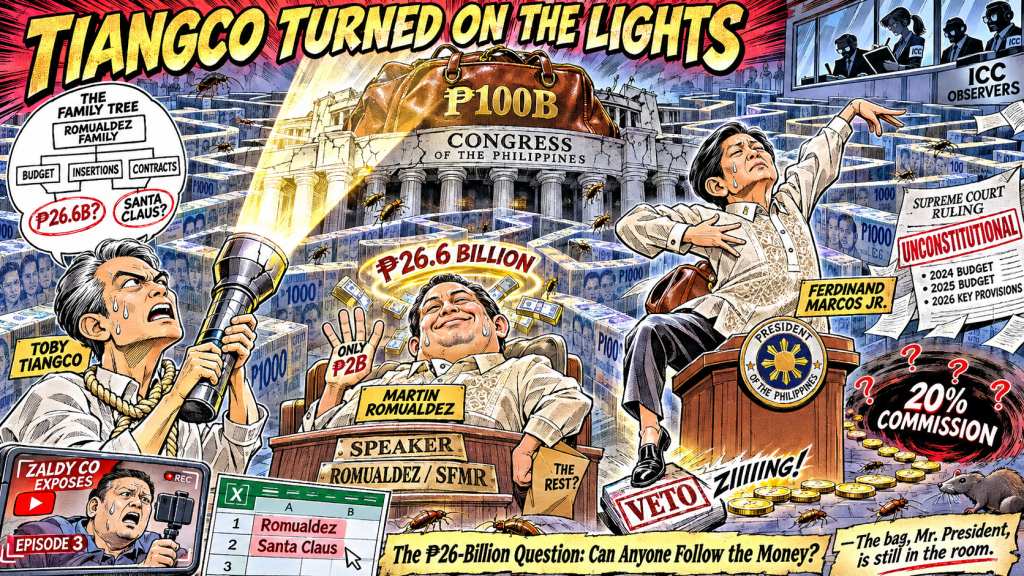
If the corruption scandal weren’t enough, the Supreme Court’s October 2026 ruling on unprogrammed appropriations added another layer of institutional crisis.
The Court declared unconstitutional several budget provisions, including a ₱449.5 billion increase in unprogrammed appropriations in the 2024 budget and a ₱17.99 billion increase in the DPWH Special Road Fund under the 2025 budget. While the Court clarified that unprogrammed appropriations aren’t inherently unconstitutional, it emphasized that they must comply with constitutional limits and adequate safeguards.
This ruling exposes the administration’s fiscal management to serious questions. The executive branch, after all, prepares the budget proposal that Congress modifies. The President has veto power. If unconstitutional provisions made it into the final budget, who bears responsibility?
The Palace can argue that Congress inserted these provisions and that the President vetoed what he could. But the public sees a government that can’t manage its own finances, that allows questionable appropriations to become law, and that then claims ignorance when courts intervene.
This is not the image of competence that the Marcos administration wants to project. It reinforces the narrative that the government is either corrupt or incompetent—or both.
The 2028 Question: Robredo’s Shadow
Amid all this chaos, an intriguing subplot has emerged: the narrowing gap between Sara Duterte and Leni Robredo in hypothetical 2028 presidential matchups.
OCTA’s polling shows Duterte leading Robredo 40% to 33%—a seven-point gap that has narrowed from eleven points in Q1. More importantly, 26% of respondents remain undecided or uncommitted.
This suggests two things. First, Duterte’s regional dominance doesn’t automatically translate into national majority support. Her 94% Mindanao trust rating is impressive, but Mindanao isn’t the Philippines. She needs Luzon and NCR to win a national election, and her 25% Balance Luzon trust rating suggests she has a long way to go.
Second, dissatisfaction with Marcos doesn’t automatically benefit Duterte. The growing uncommitted bloc indicates that many Filipinos are looking for alternatives to both dynasties. Robredo, despite her 2022 defeat, retains enough credibility to attract voters seeking a third way.
But here’s the question that haunts Philippine democracy: is there a third way? Or are we doomed to choose between two political families whose rivalry has already fractured the nation?
The Deeper Crisis: Democracy in Retreat
Step back from the survey numbers, the corruption scandals, the impeachment drama, and the economic statistics. What do you see?
You see a country where political loyalty is determined by regional identity and family name rather than policy or performance. You see institutions—Congress, the Ombudsman, even the Supreme Court—struggling to assert independence against executive pressure. You see a media landscape where disinformation thrives and accountability journalism is under attack. You see a public that has lost faith in the very idea that government can improve their lives.
The Marcos ratings collapse isn’t just about Ferdinand Marcos Jr. It’s about the failure of the post-EDSA democratic project to deliver on its promises. It’s about a political system that replaced one set of elites with another without fundamentally changing the structures of power. It’s about a constitution that created a presidency so powerful that whoever occupies it can evade accountability—until the public loses patience.
And the Duterte phenomenon? It’s not about Sara Duterte’s competence or integrity. It’s about the enduring appeal of strongman politics in a country where institutions have failed. Rodrigo Duterte’s popularity wasn’t despite his brutality—it was because of it. He offered certainty in a world of chaos, direction in a sea of drift. His daughter inherits that legacy, even as she faces charges that would destroy a less charismatic figure.
What Should Happen
If I were advising the President—and God knows he hasn’t asked—I would tell him this:
stop listening to spokespersons who tell you the survey is wrong. Start listening to the 55% of Filipinos who don’t trust you.
That means prosecuting corruption at the highest levels, not just filing charges against small fish. It means addressing inflation through structural reforms, not just cash transfers. It means acknowledging that the economy isn’t working for most Filipinos and taking responsibility for fixing it.
But I’m not advising the President, and he probably wouldn’t listen anyway. The logic of dynastic politics doesn’t reward accountability—it rewards loyalty. The logic of patronage doesn’t reward reform—it rewards distribution. The logic of Philippine politics doesn’t reward competence—it rewards charisma and regional appeal.
So what’s the alternative?
Perhaps it’s time to consider whether the current constitutional framework can deliver the accountability that Filipinos deserve. Perhaps it’s time to revisit the debate over federalism—not as a vehicle for Marcos’s political ambitions, but as a genuine response to regional inequality. Perhaps it’s time to strengthen political parties so that elections are about platforms rather than personalities.
Or perhaps it’s time to accept that Philippine democracy will continue to oscillate between dynastic rivals until a new generation of leaders—untainted by family legacies and regional loyalties—emerges to challenge the status quo.
I’m not holding my breath.
The Final Verdict
The OCTA survey is not merely a snapshot of public opinion. It’s a warning siren.
It warns that the Marcos presidency is losing legitimacy. It warns that the country is fragmenting along regional lines. It warns that corruption and economic failure are eroding faith in democratic institutions. It warns that the 2028 election could become a contest between regional warlords rather than national leaders.
The Palace can dismiss these warnings as “reminders” that don’t capture the President’s “real work.” But the public isn’t fooled. They know what they see. They know what they feel. And they know that the numbers—45% trust, 44% satisfaction, 28% in Mindanao—reflect a reality that no amount of propaganda can conceal.
The question now is whether anyone in power is willing to listen. If they aren’t, the next survey will be worse. And the one after that worse still. Until the numbers become so catastrophic that even the Palace can’t pretend they don’t matter.
But by then, it may be too late.
Key Citations
A. Reports & Studies
- OCTA Research. “President Marcos Jr.’s Trust and Performance Ratings Slip in Q3 2026; VP Duterte-Carpio’s National Ratings Hold Steady.” OCTA Research, Nov. 2026, octaresearch.com.
- Social Weather Stations. “Social Weather Report: Net Satisfaction with the Prosecution of the Impeachment Case at -5, with the Defense of Vice President Sara Duterte at +23.” Social Weather Stations, 28 Oct. 2026, sws.org.ph.
- Social Weather Stations. “SOCIAL WEATHER REPORT | Self-Rated Poverty (SRP) at 52% on March 2026.” Social Weather Stations, 8 May 2026, sws.org.ph.
- International Monetary Fund. “IMF Staff Completes 2026 Article IV Mission to the Philippines.” International Monetary Fund, 25 Sept. 2026, imf.org.
- Philippine Statistics Authority. “GDP Grows by 2.1 Percent in the Third Quarter of 2026.” Philippine Statistics Authority, 9 Nov. 2026, psa.gov.ph.
- Philippine Statistics Authority. “Consumer Price Index and Inflation Rate: October 2026.” Philippine Statistics Authority, 5 Nov. 2026, psa.gov.ph.
B. News Articles
- Al Jazeera. “Thousands of Drivers Strike in the Philippines over Rising Fuel Prices.” Al Jazeera, 29 Sept. 2026, aljazeera.com.
- GMA Network. “Ombudsman: 79 Flood Control-Related Cases Filed in Courts.” GMA News Online, 6 Nov. 2026, gmanetwork.com.
- GMA Network. “Sara Duterte’s Lead over Leni Robredo Narrows to 7 Points in 2028 Matchup — OCTA.” GMA News Online, 4 Nov. 2026, gmanetwork.com.
- The Manila Times. “Marcos Ratings Hit Lowest Levels in OCTA Survey Series.” The Manila Times, 12 Nov. 2026, manilatimes.net.
- Reuters. “Philippine VP Duterte’s Impeachment Nears End as Prosecutors Stake Case on Unexplained Wealth.” Reuters, 10 Nov. 2026, reuters.com.
C. Official Websites
- Supreme Court of the Philippines. “SC Holds Unprogrammed Appropriations Subject to Guidelines, Voids Congressional Increases in 2024 and 2025 Budgets.” Supreme Court of the Philippines, 20 Oct. 2026, sc.judiciary.gov.ph.
- Department of Budget and Management. “DBM, Senate Push for Constitutionally Sound 2027 Budget Amid SC Ruling on Unprogrammed Funds.” Department of Budget and Management, 22 Oct. 2026, dbm.gov.ph.
- “Ang Hirap Maging Mahirap”: The PAO Scandal That Proves Government Contempt Is Nothing New
- “Far-Off” My Axx: Malacañang’s Claire Castro Drowns in Her Own Legal Gaslighting
- “Forthwith” to Farce: How the Senate is Killing Impeachment—And Why Enrile’s Right (Even If You Can’t Trust Him)
- “HINDI AKO NAG-RESIGN!”

- “I Know Nothing”: Baste Duterte’s Amnesia Defense Meets ₱33M in GenCorp Contracts

- “I’m calling you from my new Globe SIM. Send load!”

- “Mahiya Naman Kayo!” Marcos’ Anti-Corruption Vow Faces a Flood of Doubt

- “Manageable” Debt, Unmanageable Corruption: The ₱19.66-Trillion Lie
- “Manageable” Debt, Unmanageable Lies: DBM’s ₱21 Trillion Fairy Tale
- “Meow, I’m calling you from my new Globe SIM!”

- “Natrabaho”: One Word, One Ombudsman, and a Judiciary on Trial
- “No Special Jail for Crooks!” Boying Remulla Slams VIP Perks for Flood Scammers




Leave a Reply