Debunking the Nostalgia: Why Blaming 1941 Lets 2026’s Bureaucrats Off the Hook
By Louis ‘Barok‘ C. Biraogo — September 4, 2026
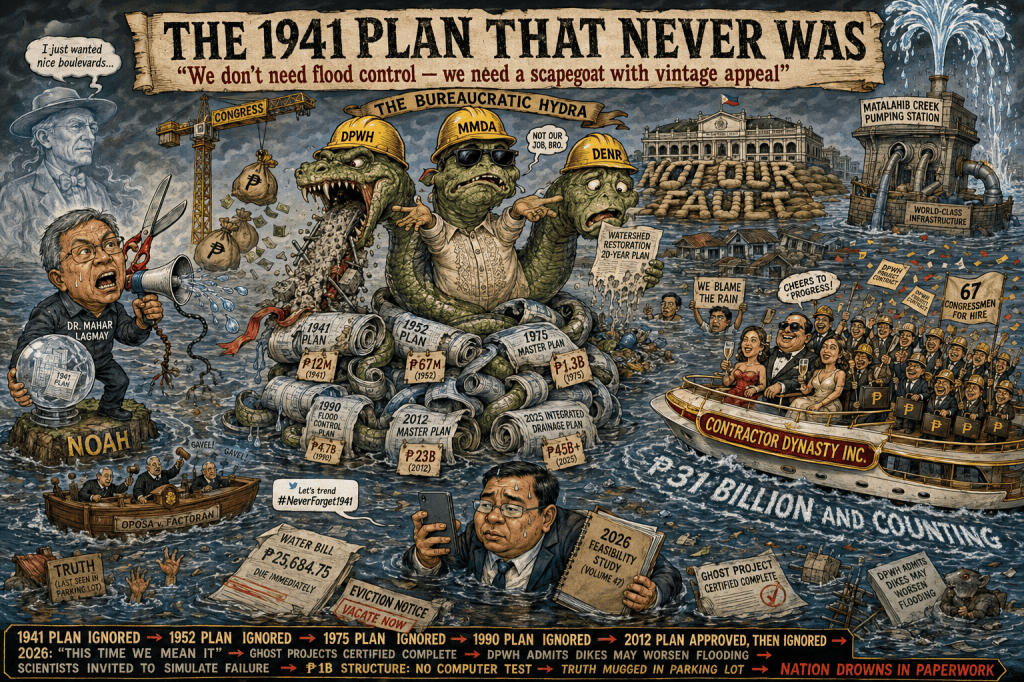
IT IS a peculiar trait of the Philippine bureaucracy that it treats blueprints like confetti—produced with great fanfare, scattered to the wind, and remembered only when the floodwaters rise to lap at the gates of Malacañang. Dr. Mahar Lagmay, the executive director of the UP Resilience Institute and the man who has made a career out of warning a nation that refuses to listen, has once again dragged a skeleton out of the archive.
His assertion is simple: the Philippines is drowning not because of the rain, but because of a decision made—or rather, unmade—in 1941.
The narrative is seductive. A Commonwealth-era master plan, drawn in the twilight of American rule, envisioned a rational hydrology for a future capital. Then the war came, the plans were lost, and the Republic spent the next eighty years paving over its own lungs and arteries, wondering why it couldn’t breathe when the monsoons arrived.
But is the good doctor practicing history, or is he performing necromancy on a convenient corpse?
Let us examine the evidence with the suspicion it deserves.
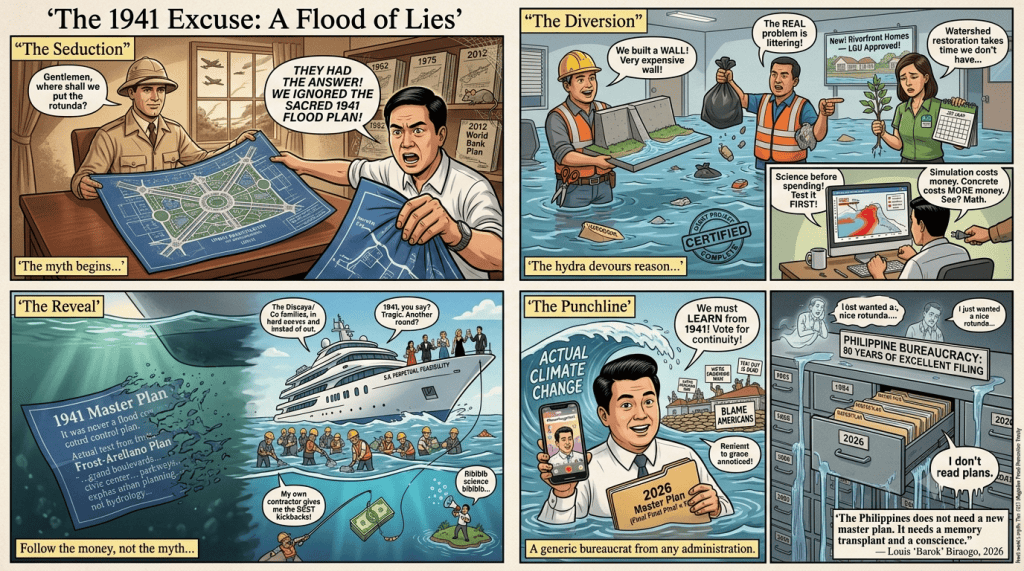
Dr. Lagmay’s historical flex collapses under actual history. The real flood? Pork barrel politics.
The Problem with the 1941 Prophecy
The first rule of investigative analysis is to never accept the existence of a document solely on the say-so of a man with an agenda. Dr. Lagmay has an agenda. It is a noble one—the institutionalization of science over pork-barrel politics—but it is an agenda nonetheless.
His reference to a “1941 flood-control master plan” is a rhetorical device, a cudgel with which to beat the Department of Public Works and Highways (DPWH). The historical record, however, is messier than a campaign promise.
The Intramuros Administration and Quezon City planning documents confirm that a 1941 Frost-Arellano Plan existed. It was an urban plan for Quezon City, a grand vision of boulevards and green spaces. It was not a hydraulic engineering schematic.
To conflate the Frost-Arellano Plan with a modern, basin-wide flood-control master plan is akin to confusing a shopping list with a nutritional guide. One describes where to put the house; the other explains how to keep the water out of the basement.
The true “master plan” for Pasig-Marikina flooding is widely recognized in Japan International Cooperation Agency (JICA) documentation as emerging from the catastrophic 1943 floods, leading to a 1952 plan. If we are to play the blame game, should we not castigate the ghosts of 1952? Or 1975? Or 1990? Or the 2012 World Bank plan that was approved by the National Economic and Development Authority (NEDA) and then promptly ignored like a New Year’s resolution?
Lagmay’s assertion that the country “ignored the 1941 plan” is, therefore, historically defensible only in the sense that a broken clock is right twice a day. The Philippines did not ignore a plan; it has ignored every plan.
To fixate on 1941 is to miss the forest for the rotting trees. The more damning indictment is not that we forgot a plan, but that we generate plans faster than we clear the silt from our rivers. It is an industry of procrastination disguised as governance.
The Bureaucratic Hydra and the Art of Passing the Buck
The report suggests that flooding is a “systems problem.” This is the polite, academic way of saying that the Philippine government is a chaotic federation of fiefdoms that would rather fight over jurisdiction than dig a canal.
The DPWH builds a wall; the local government unit (LGU) approves a subdivision behind it; the Metropolitan Manila Development Authority (MMDA) blames the garbage; the Department of Environment and Natural Resources (DENR) blames the quarrying; and the poor, as always, blame the rain.
Dr. Lagmay’s revelation that the DPWH and MMDA are now sending designs to Nationwide Operational Assessment of Hazards (NOAH) for simulation is a glimmer of hope, but it reeks of a too-late conversion. It is the equivalent of a chain-smoker buying a treadmill after the emphysema diagnosis. Why were simulations not required before we poured billions of pesos into concrete?
The report hits the nail on the head with the “Science before Spending” framework. The idea that a ₱1 billion structure should be tested against a computer model before ground is broken is not radicalism; it is basic fiduciary responsibility.
Yet, in the Wild West of Philippine infrastructure, the “feasibility study” is often just a victory lap for the contractor. The recent Department of Justice (DOJ) reports of “ghost projects” and the Davao Occidental fiasco—where a ₱96.5-million project was certified complete despite being a mirage—confirm that the system has been optimized not for flood reduction, but for the efficient extraction of public funds.
The Political Economy of Concrete
Why does the DPWH build dikes? Because a dike is visible. A ribbon can be cut on a dike. A politician can stand on a dike and declare victory over nature. A watershed restoration project, by contrast, involves planting trees and waiting twenty years. It is a political non-starter in a democracy where elections happen every six years.
Lagmay’s statement that “dikes are not the solution” is scientifically reasonable but politically radioactive. The DPWH’s own admission in 2025 that some dikes may actually worsen flooding is a stunning confession from an agency built on concrete. It admits that the medicine is part of the poison.
The Matalahib Creek episode—where a pumping station built to prevent floods actually exacerbated them—is a perverse metaphor for the entire enterprise. We are building monuments to our own incompetence.
The corruption angle cannot be ignored. The Philippine Center for Investigative Journalism (PCIJ) data cited—the Discaya family cornering ₱31 billion, the Co family’s control over the appropriations committee—paints a picture of a system where the legislative branch is effectively a subsidiary of the construction industry. When 67 congress members are their own contractors, the “plan” becomes irrelevant. The only plan that matters is the one that ensures the kickback clears the bank.
The Lagmay Paradox
Is Dr. Lagmay a savior or a self-promoter? The research is admirably fair on this point, noting that his institutional motivation—securing a permanent role for NOAH—coincides with his public interest motivation. It is not a crime to benefit from doing the right thing.
However, we must be wary of the “White Knight” complex in Philippine governance. The history of this nation is littered with brilliant technocrats who were co-opted, silenced, or exiled when their simulations showed the money flowing into the wrong river.
The near-death experience of Project NOAH in 2017, documented in Lagmay’s own bitter quotes (“Two years ago pa kaming pinapatay”), reveals the battle lines. The scientific community is in a knife fight with the bureaucracy. The bureaucracy has the budget; the scientists have the truth. In this arena, the truth usually gets mugged in the parking lot.
The Verdict
This critique is not an exoneration of the government. Far from it. The evidence is overwhelming that Metro Manila’s flooding is a man-made disaster, orchestrated by decades of fragmented planning, institutional amnesia, and outright theft.
The legal framework—from Oposa v. Factoran to the Manila Bay continuing mandamus—gives the courts the power to compel action. Yet the courts cannot design a river basin.
Dr. Lagmay is right about the disease but wrong about the patient’s history. The problem is not that we ignored the “1941 plan.” The problem is that we have a pathological inability to execute any long-term strategy that does not involve the immediate disbursement of cash to a politically connected contractor.
The ultimate question, as the research suggests, should not be “Who failed to follow the 1941 plan?” but “Who profited from the chaos?” That is an audit trail, and it leads not to a dusty library in Intramuros, but to the marble halls of Batasan, the executive offices of the DPWH, and the corporate boardrooms of the construction magnates.
The Philippines does not need a new master plan. It needs a memory transplant and a conscience. The ghost of 1941 is not haunting us because we forgot its blueprints; it is haunting us because we learned nothing from the flood that followed. We are a nation that drowns in its own paperwork, and Dr. Lagmay is merely the latest voice shouting at the tide to turn back. Unfortunately, the tide, like the bureaucracy, is deaf.
Key Citations
A. Reports & Studies
- Japan International Cooperation Agency. The Study on Flood Control and Drainage Project in Metro Manila. JICA, 1990, openjicareport.jica.go.jp/pdf/12041497_01.pdf.
- World Bank. “Project Highlights: Metro Manila Flood Management.” World Bank, www.worldbank.org/en/country/philippines/brief/project-highlights-metro-manila-flood-management.
- Philippine Center for Investigative Journalism. “Five Reveals from the Flood-Control Data.” PCIJ.org, 31 Aug. 2025, pcij.org/2025/08/31/5-reveals-from-the-flood-control-data.
B. News Articles
- Cariaso, Bella, and Mark Ernest Villeza. “NOAH Head: Philippines Ignored 1941 Flood Control Master Plan.” Philstar.com, 1 Sept. 2026, www.philstar.com/headlines/2026/09/01/2553178/noah-head-philippines-ignored-1941-flood-control-master-plan.
- Palicte, Che. “P96.5-M ‘Ghost Project’ in Davao Occidental Exposed.” Philippine News Agency, 25 Sept. 2025, www.pna.gov.ph/articles/1259590.
- Patinio, Ferdinand. “Ill-Planned, Harmful Flood Control Projects to Be Halted – DPWH.” Philippine News Agency, 27 Oct. 2025, www.pna.gov.ph/articles/1261927.
- “Lacson: 67 Solons in 2022 Doubled as Contractors for Their Own Projects.” Inquirer.net, 4 Aug. 2025, newsinfo.inquirer.net/2091070/lacson-67-solons-in-2022-doubled-as-contractors-for-their-own-projects.
- Gonzales, Yuji Vincent. “Politics, Lack of Funds Spell Disaster for Project NOAH.” Inquirer.net, 30 Jan. 2017, newsinfo.inquirer.net/866550/politics-lack-of-funds-spell-disaster-for-project-noah.
- “DPWH Taps Scientists in Fixing Infamous Pumping Station.” Inquirer.net, 19 Mar. 2026, newsinfo.inquirer.net/2197932/dpwh-taps-scientists-in-fixing-infamous-pumping-station.
C. Official Websites & Legal Authorities
- “Frost Plan.” Wikipedia, en.wikipedia.org/wiki/Frost_Plan.
- Oposa v. Factoran, G.R. No. 101083, 30 July 1993. Wikipedia, en.wikipedia.org/wiki/Oposa_v._Factoran.
- “Concerned Citizens of Manila Bay v. Metropolitan Manila Development Authority and Others (Philippines).” R2HE Casebook, r2he.info/casebook/concerned-citizens-of-manila-bay-v-metropolitan-manila-development-authority-and-others-philippines/.
- UP Resilience Institute. resilience.up.edu.ph, resilience.up.edu.ph.
- Project NOAH. noah.up.edu.ph, noah.up.edu.ph.
- Department of Public Works and Highways. dpwh.gov.ph, www.dpwh.gov.ph.
- Intramuros Administration. intramuros.gov.ph, intramuros.gov.ph.

- ₱8B BBM Pork: CCTV for Every Captain’s Kumpare?

- ₱8.9 Billion, 331 Ghost Police Stations: The TIKAS Scandal Explained

- ₱8.4 Billion, 42,000 Barangays, 1 Election: The “Bawat Barangay Makikinabang” Vote-Buying Masterclass

- ₱75 Million Heist: Cops Gone Full Bandit

- ₱6.77B Ghost Haunts Duterte: RTC Dismisses Mans Carpio’s Desperate Plea

- ₱6.7-Trillion Temptation: The Great Pork Zombie Revival and the “Collegial” Vote-Buying Circus

- ₱53 Million Man Tells ₱695-a-Day Workers to Stop Being ‘Mayabang’: The Audacity of BSP’s Remolona

- ₱3.06 Billion for Evacuation Centers—But Nobody Knows Where They’ll Stand (Or If They’ll Exist)
- ₱10B Ghost in New Clark City: Matibag’s Haunted Séance for Cayetano

- ₱1.9 Billion for 382 Units and a Rooftop Pool: Poverty Solved, Next Problem Please

- ₱1.35 Trillion for Education: Bigger Budget, Same Old Thieves’ Banquet

- ₱1 Billion Congressional Seat? Sorry, Sold Out Na Raw — Si Bello Raw Ang Hindi Bumili







Leave a comment