The Senate vs. The RTC: Two Courts, One Vice President, and a Constitutional Showdown with No Referee
By Louis ‘Barok‘ C.. Biraogo — September 5, 2026
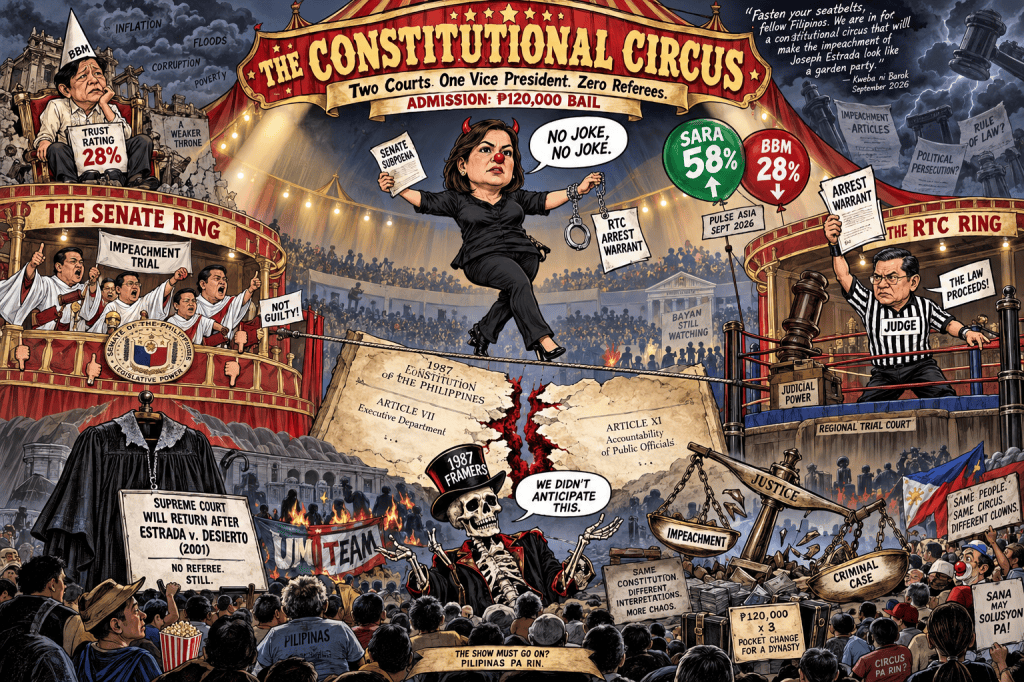
BEHOLD, the land where “no joke, no joke” becomes a constitutional crisis and the courts become boxing rings. Today, mga ka-kweba, we gather around the smoking crater that is the Philippine justice system to examine the arrest warrant issued against Vice President Sara Duterte for three counts of grave threats—a document that has transformed the Quezon City Regional Trial Court (RTC) Branch 98 into the hottest ticket in town since the impeachment of Joseph Estrada.
September 4, 2026. Mark the date. The same Vice President who once told the world she had already contracted an assassin to kill President Bongbong Marcos, First Lady Liza Araneta-Marcos, and Speaker Martin Romualdez if she herself were killed—all while insisting “no joke, no joke”—is now officially a wanted woman in the very Republic she serves.
The audacity. The horror. The sheer entertainment value. Only in the Philippines could a sitting Vice President face an arrest warrant while simultaneously fighting an impeachment trial over the same damn statements, creating a constitutional pileup so spectacular that even the framers of the 1987 Constitution of the Republic of the Philippines (1987 Constitution) are probably spinning in their graves wondering what went wrong.
So grab your popcorn, fellow Filipinos. The circus has come to town, and this time, the clowns are running the show.
THE CONSTITUTIONAL BLACK HOLE: IMMUNITY OR IMPUDENCE?
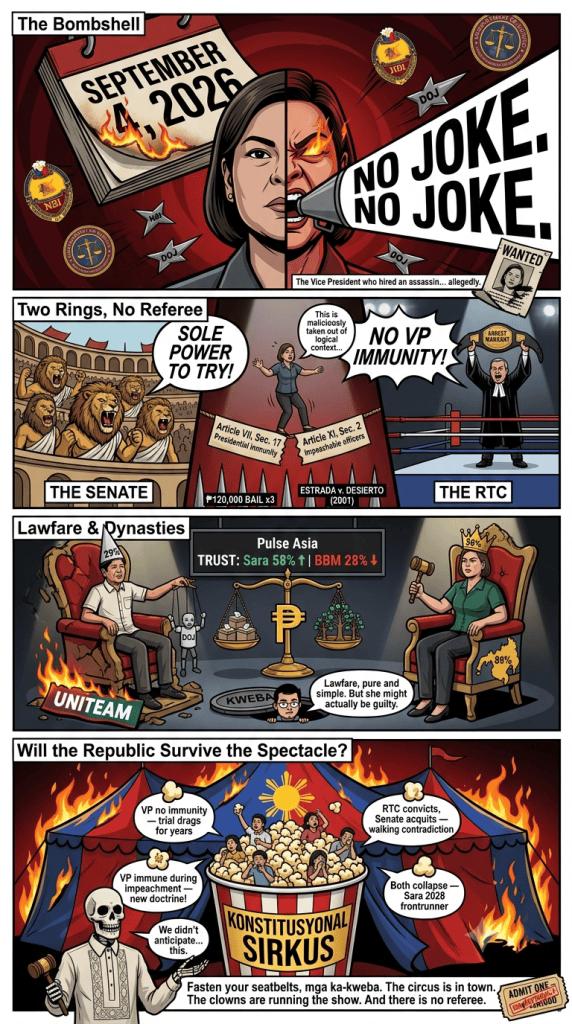
The central legal question: Does the Vice President enjoy immunity from criminal prosecution? Article VII, Section 17 explicitly grants immunity to the President during their tenure. The Vice President? Nowhere to be found. The framers, fresh from the trauma of the Marcos dictatorship, deliberately chose to shield only the chief executive while leaving the spare tire exposed to legal punctures.
Duterte’s legal team argues that Article XI, Section 2 lists the Vice President as an impeachable officer, making impeachment the exclusive remedy. This argument is not without sophistication, but it reeks of intellectual gymnastics. The 1987 Constitution’s silence on vice presidential immunity is not an oversight; it’s a design feature.
The Supreme Court’s ruling in Estrada v. Desierto (2001) held that presidential immunity is personal to the sitting President and ends upon leaving office. The Court did not directly address vice presidential immunity, but its reasoning strongly implies that constitutional immunity is tied to the Office of the President, not merely to impeachability.
This is why Duterte’s lawyers have abandoned any direct immunity claim and instead argue separation of powers: that the Senate’s “sole power” to try impeachments should bar concurrent criminal prosecution. The first argument is dead after Estrada; the second remains genuinely unsettled. And in the Philippines, an unsettled constitutional question is not a legal puzzle—it is a political weapon waiting to be fired.
Duterte’s team is now deploying that weapon with calculated precision. The Senate is currently conducting an impeachment trial where the same statements form Article IV of the Articles of Impeachment. To allow a criminal court to simultaneously prosecute the same conduct, they argue, would constitute judicial interference with the Senate’s “sole power” to try impeachments under Article XI, Section 3(6).
This forces us to confront an uncomfortable question: Can a Vice President be simultaneously impeached and criminally prosecuted for the same conduct without one process contaminating the other? The 1987 Constitution does not directly answer this, because the framers never squarely addressed the possibility of a sitting Vice President threatening the President’s assassination—let alone one facing both impeachment and criminal prosecution for substantially the same conduct.
THE TEXTUAL BATTLEFIELD: WHAT DID SARA ACTUALLY SAY?
On November 23, 2024, Sara Duterte declared: “May kinausap na ako na tao. Sinabi ko sa kanya kapag pinatay ako, patayin mo si BBM, si Liza Araneta, at si Martin Romualdez. No joke. No joke.”
Translation: “I have spoken to a person. I told him if I am killed, kill BBM, Liza Araneta, and Martin Romualdez. No joke. No joke.”
The National Bureau of Investigation (NBI) described her as “furious and fuming mad,” cursing at least eight times. The “No joke, no joke” qualifier eliminates any reasonable claim that this was satire or hyperbole.
Yet Duterte’s defenders argue this was a “conditional” threat — that the condition (“if I am killed”) transforms it from an unconditional grave threat under Article 282(2) into a conditional threat under Article 282(1) of Act No. 3815 (Revised Penal Code). This is legal sophistry of the highest order. Under Paera v. People (2011), the Supreme Court held that threats are consummated when the victim hears them, regardless of whether the threatener had the actual capability to carry them out. The “condition” merely specifies the trigger.
Notably, the Department of Justice (DOJ) dismissed the separate inciting-to-sedition complaint, finding insufficient prima facie evidence. This actually cuts in the government’s favor — it suggests prosecutors are not indiscriminately throwing every possible charge at Duterte. But the NBI found that her statements had “tendency to stir up the people against the government.” The irony is exquisite: The Vice President allegedly stirring up sedition against the government she serves. Only in the Philippines.
THE POLITICAL SUBTEXT: UNITEAM’S CIVIL WAR
Let us dispense with the fiction that this is merely a legal dispute. This is war between two dynasties that once swore eternal allegiance under the banner of “UniTeam.”
In May 2022, Marcos and Duterte won a landslide victory. By January 2024, the alliance was in shambles. By June 2024, Sara had resigned from the Cabinet. By November 2024, she was threatening to have the President killed. This is not a gradual political drift; it is a spectacular collapse of a political coalition held together by convenience rather than conviction.
The numbers tell the story. Marcos’s approval rating has collapsed to 29% as of July 2026, while Duterte’s has soared to 56%. Mindanao remains overwhelmingly loyal to Duterte (89% approval), while Marcos is barely tolerated (6% approval). This is not a popularity contest; it is a legitimacy war, and Duterte is winning.
This context makes the timing of the arrest warrant — September 4, 2026, during the impeachment trial — suspicious in the extreme. Why did it take the DOJ from February 2025 (when the NBI recommended prosecution) to August 2026 to file charges? Why did the QC RTC wait until September to issue the warrant? The coincidence of timing suggests either profound prosecutorial incompetence or calculated political timing.
I suspect the latter. The Marcos administration, politically wounded and desperate, appears to be deploying the justice system as a weapon of political destruction. This is lawfare, pure and simple.
But here’s the twist: Duterte may actually be guilty of the crime charged. The fact that the prosecution is politically motivated does not necessarily mean the prosecution is wrong. A political motive does not invalidate a legitimate criminal prosecution. The question is whether the process can be trusted when the motive is contaminated.
THE CONSTITUTIONAL LEGACY: WHAT HAPPENS NEXT?
Scenario 1: The Supreme Court Rules No VP Immunity
The most likely outcome. The Court follows the textual logic of the 1987 Constitution and the Estrada precedent. Duterte posts bail (₱120,000 per count — pocket change for a dynasty), the trial proceeds, and the case drags on for years, parallel to the impeachment trial. Result: Constitutional clarity on VP immunity, but political chaos.
Scenario 2: The Supreme Court Rules VP Has Limited Immunity During Impeachment
A bombshell. The Court could craft a new doctrine holding that when impeachment is pending, criminal prosecution must be deferred to preserve the Senate’s constitutional role. Result: Duterte’s impeachment trial becomes the central arena, and the criminal case is frozen. This would be a victory for Duterte, but future VPs would enjoy de facto immunity during impeachment proceedings.
Scenario 3: The Criminal Case Proceeds, Duterte Is Convicted, and the Senate Acquits
The nightmare scenario. The RTC convicts Duterte, but the Senate — controlled by pro-Duterte senators after Cayetano’s takeover — acquits her in the impeachment trial. Result: A Vice President with a criminal conviction but political immunity, a walking contradiction, unable to function but legally impossible to remove.
Scenario 4: Both Processes Collapse
The criminal case is dismissed on a technicality, and the Senate acquits Duterte. She emerges politically strengthened, Marcos is further weakened, and the 2028 election becomes a referendum on the administration. Result: Duterte becomes the frontrunner for 2028, and the Marcos dynasty faces political extinction. The lawfare strategy backfires spectacularly.
THE VERDICT: A TEST FOR THE REPUBLIC
This is not merely a criminal case or a political dispute. This is a fundamental test of whether the Philippine Constitution can survive contact with reality.
The Constitution is being tested in ways its framers never imagined. The question is whether our institutions—the courts, the Senate, the prosecution service—can rise above the political fray and deliver justice that is both legally sound and politically legitimate.
I am not optimistic. The Philippine justice system has never been fully independent; it has always been susceptible to political pressure. The courts are staffed by human beings with political sympathies and family interests. The Senate is a den of political animals more concerned with reelection than constitutional duty. The DOJ is an executive department answerable to the President.
Can these institutions deliver a verdict that even Duterte’s supporters would accept as legitimate? Can they convict a Vice President who enjoys majority public support without triggering a political crisis? Can they acquit her without being seen as bowing to political pressure?
I doubt it. The Philippine justice system has never been good at handling politically charged cases. It tends to either collapse under pressure or produce decisions that satisfy no one.
The real question is not whether Duterte is guilty—she probably is—but whether the system can handle the case without collapsing under its own contradictions. The early signs are not encouraging.
So, fellow Filipinos, fasten your seatbelts. We are in for a constitutional circus that will make the impeachment of Joseph Estrada look like a garden party. The only question is whether the Republic will survive the spectacle.
This is Barok, signing off from the Kweba, where we watch the circus so you don’t have to buy a ticket.
DISCLAIMER: This analysis is based on publicly available information and does not constitute legal advice. The author is not a lawyer, not a constitutional scholar, and not a political partisan. He is merely a blogger with a keyboard and a healthy skepticism of all political dynasties. The views expressed herein are the author’s own and do not reflect the views of any political party, government agency, or sane human being. Reader discretion is advised.
Key Citations
A. Legal & Official Sources
- The 1987 Constitution of the Republic of the Philippines. Official Gazette of the Republic of the Philippines, 1987, http://www.officialgazette.gov.ph/constitutions/1987-constitution/.
- The 1987 Constitution of the Republic of the Philippines – Article VII. Official Gazette of the Republic of the Philippines, http://www.officialgazette.gov.ph/constitutions/the-1987-constitution-of-the-republic-of-the-philippines/the-1987-constitution-of-the-republic-of-the-philippines-article-vii/.
- The 1987 Constitution of the Republic of the Philippines – Article XI. Official Gazette of the Republic of the Philippines, http://www.officialgazette.gov.ph/constitutions/the-1987-constitution-of-the-republic-of-the-philippines/the-1987-constitution-of-the-republic-of-the-philippines-article-xi/.
- Act No. 3815. Revised Penal Code. 8 Dec. 1930, http://www.lawphil.net/statutes/acts/act_3815_noyear.html.
- Estrada v. Desierto. G.R. Nos. 146710-15, Supreme Court of the Philippines, 2 Mar. 2001, lawphil.net/judjuris/juri2001/mar2001/gr_146710_2001.html.
- Paera v. People. G.R. No. 181626, Supreme Court of the Philippines, 30 May 2011, lawphil.net/judjuris/juri2011/may2011/gr_181626_2011.html.
B. News Reports
- “DOJ Files Grave Threats vs. Sara Duterte.” GMA News Online, GMA Network, 11 Aug. 2026, http://www.gmanetwork.com/news/topstories/nation/998144/doj-grave-threats-sara-duterte/story/.
- “Pulse Asia: Marcos Trust Rating Drops to 28%; Sara Duterte Steady at 58%.” GMA News Online, GMA Network, 20 July 2026, http://www.gmanetwork.com/news/topstories/nation/995468/pulse-asia-marcos-trust-rating-drops-to-28-sara-duterte-steady-at-58/story/.
- Quismorio, Ellson. “Half of Pinoys Not Satisfied with PBBM’s Performance; VP Sara Retains Majority Ratings—Survey.” Manila Bulletin, 20 July 2026, mb.com.ph/2026/07/20/majority-of-filipinos-disapprove-of-marcos-distrust-him-vp-duterte-retains-majority-ratingssurvey.
- Reganit, Jose Cielito. “NBI: VP Sara May Be Convicted for Sedition, Grave Threats.” Philippine News Agency, 29 Apr. 2026, http://www.pna.gov.ph/articles/1273966.
- “Sara Duterte Camp Seeks Dismissal of Grave Threats Complaint.” INQUIRER.net, 13 Aug. 2026, newsinfo.inquirer.net/2283997/sara-duterte-camp-seeks-dismissal-of-grave-threat-raps-filed-in-qc-court.
- ₱9 Billion in ‘Savings’? DILG’s Fire Truck Deal Smells Like Smoke

- ₱8B BBM Pork: CCTV for Every Captain’s Kumpare?

- ₱8.9 Billion, 331 Ghost Police Stations: The TIKAS Scandal Explained

- ₱8.4 Billion, 42,000 Barangays, 1 Election: The “Bawat Barangay Makikinabang” Vote-Buying Masterclass

- ₱75 Million Heist: Cops Gone Full Bandit

- ₱6.77B Ghost Haunts Duterte: RTC Dismisses Mans Carpio’s Desperate Plea
- ₱6.77 Billion and Zero Cash: The Sara Duterte SALN Math That Doesn’t Add Up

- ₱6.7-Trillion Temptation: The Great Pork Zombie Revival and the “Collegial” Vote-Buying Circus

- ₱58.53B, Zero Receipts: The LGSF Pork Barrel Nobody Wants to Name
- ₱53 Million Man Tells ₱695-a-Day Workers to Stop Being ‘Mayabang’: The Audacity of BSP’s Remolona

- ₱4.4 Billion and a Witness Who Can’t Explain It: The Duterte Impeachment’s Most Expensive Non-Answer
- ₱3.06 Billion for Evacuation Centers—But Nobody Knows Where They’ll Stand (Or If They’ll Exist)






Leave a Reply