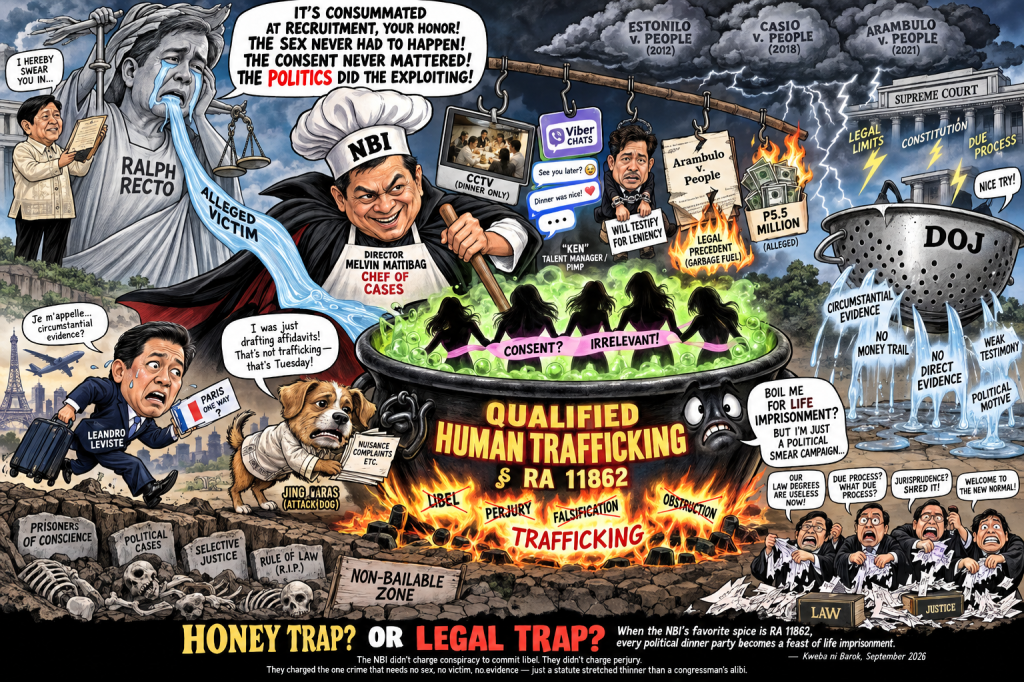
The NBI’s Case Rests on a Pimp’s Testimony, CCTV of People Eating Dinner, and a Legal Theory That Would Make Congress Blush
By Louis ‘Barok‘ C. Biraogo — September 5, 2026
LET us be absolutely clear about what is happening here, because the narrative is already being written by people who have never read Republic Act No. 9208 (Anti-Trafficking in Persons Act of 2003), as amended by Republic Act No. 11862 (Expanded Anti-Trafficking in Persons Act of 2022), and who certainly have never heard of Arambulo v. People.
The National Bureau of Investigation (NBI)—an agency whose director, Melvin Matibag, was sworn in by the very man who is now the alleged victim—has announced, with the theatrical flourish befitting a telenovela villain, that it will file “qualified human trafficking” charges against seven individuals, including a sitting congressman, a former congressman, four lawyers, and a talent manager who is already under arrest for separate trafficking offenses.
The alleged crime? A “honey trap” operation targeting Executive Secretary Ralph Recto, wherein women would allegedly fabricate accusations of sexual misconduct and drug use. The alleged financier? Rep. Leandro Leviste, the 31-year-old billionaire congressman from Batangas whose family has been locked in a bitter political feud with the Recto-Santos dynasty for years. The alleged coordinator? Jacinto “Jing” Paras, the erstwhile Duterte attack dog whose political career has been reduced to filing nuisance complaints against administration critics.
And the legal theory? That recruiting women to lie about having sex with a politician constitutes human trafficking.
Stop and think about that for a moment.
The NBI is not charging these individuals with conspiracy to commit libel, perjury, falsification of public documents, obstruction of justice, or any of the other garden-variety offenses that would naturally flow from an alleged political smear campaign. No. They are charging them with qualified human trafficking—a non-bailable offense carrying a penalty of life imprisonment and a fine of up to ₱5 million.
This is either a stroke of prosecutorial genius or an act of such breathtaking legal overreach that it should make every civil libertarian in the country’s blood run cold.
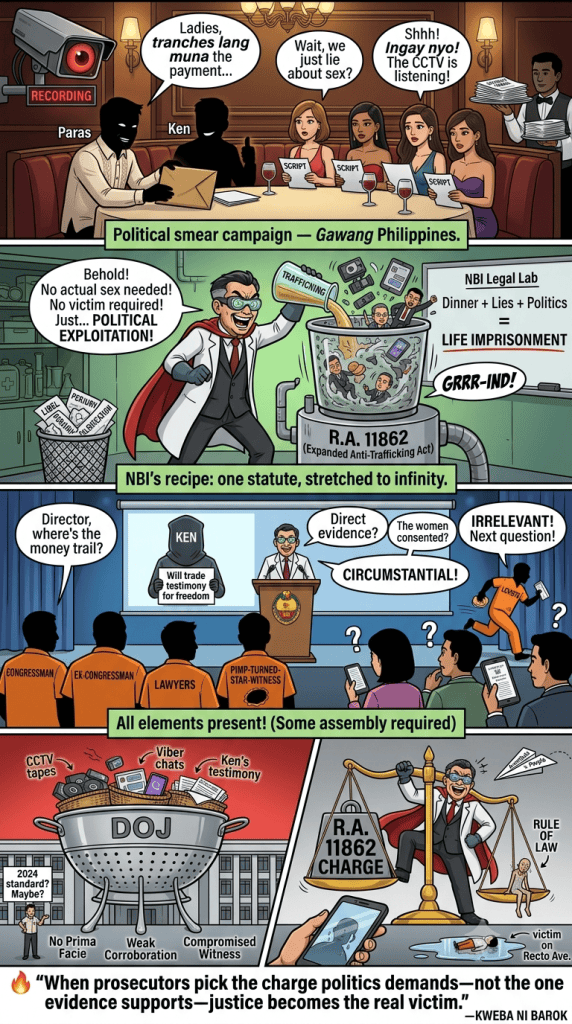
THE LEGAL ARCHITECTURE: HOW RA 11862 BECAME THE NBI’S FAVORITE WEAPON
Let us begin with what the law actually says, because the NBI is counting on the public’s ignorance of the finer points of statutory construction.
RA 9208, as amended by Republic Act No. 10364 (Expanded Anti-Trafficking in Persons Act of 2012) and dramatically expanded by RA 11862 in 2022, defines trafficking in persons as the “recruitment, obtaining, hiring, providing, offering, transporting, transferring, maintaining, harboring, or receiving of persons” through specified means—including “fraud, deception, abuse of power or position, taking advantage of vulnerability, or the giving or receiving of payments or benefits”—for the purpose of “exploitation.”
Here is where it gets interesting. RA 11862 expanded the definition of “sexual exploitation” to include “actual or attempted abuse of vulnerability, differential power or trust for sexual purposes or lewd designs, including profiting monetarily, socially, or politically from another’s sexual exploitation, regardless of consent.”
Read that clause again: profiting politically from another’s sexual exploitation, regardless of consent.
The NBI’s theory, presumably, is this: The women were recruited (act) through deception or abuse of vulnerability (means) to participate in a scheme that would sexually exploit them for political gain (purpose). The fact that they may have consented is irrelevant under the 2022 amendments. The fact that no sexual act actually occurred is also irrelevant, because the Supreme Court has repeatedly held—in People v. Estonilo and People v. Casio—that trafficking is consummated at the point of recruitment, not at the point of exploitation.
It is a clever argument. It is also, potentially, a catastrophic misapplication of the statute.
Because here is the thing the NBI does not want you to focus on: The prosecution must still prove that what was being organized was actually trafficking, not merely political dirty tricks.
THE PARAS PROBLEM: WHY THE NBI’S CASE AGAINST THE FORMER CONGRESSMAN MAY COLLAPSE
Let us focus on Jacinto “Jing” Paras, because his defense is the most instructive—and, frankly, the most legally interesting—aspect of this entire sordid affair.
Paras, if reports are to be believed, has admitted to meeting with the talent manager “Ken” and the four women. He has admitted to discussions about affidavits. He has not, however, admitted to trafficking anyone—and this is where the NBI’s case begins to wobble.
The Supreme Court’s decision in Arambulo v. People is the legal equivalent of a wrecking ball to the NBI’s theory. In that case, the Court held—unanimously, I might add—that Section 6 of RA 9208, which enumerates the circumstances that elevate trafficking to “qualified trafficking,” does not independently create a substantive offense. A conviction for qualified trafficking requires proof of an underlying trafficking offense plus a Section 6 qualifying circumstance.
This means the NBI cannot simply say, “Seven people conspired, therefore qualified trafficking.” It must first prove that trafficking occurred. And that is where the case against Paras—and, by extension, against Leviste—may very well collapse.
Who, exactly, was trafficked?
The women? But the women allegedly knew what they were doing. They were allegedly willing participants in a political operation, not victims of exploitation. The fact that RA 11862 says consent is not a defense does not mean consent is irrelevant; it means the prosecution must still prove the statutory means—fraud, deception, abuse of vulnerability—and the statutory purpose—exploitation.
What was the exploitative purpose?
The NBI will argue that using women to make false sexual accusations is itself a form of sexual exploitation, because it “profits politically” from their sexuality. But is that really what Congress intended when it passed RA 11862? Was the legislature really trying to criminalize political smear campaigns as human trafficking? Or was it trying to address the very real problem of sexual exploitation in the context of prostitution, pornography, and forced labor?
If the NBI’s interpretation is correct, then any political operative who pays a woman to accuse a rival of sexual misconduct has committed trafficking. Any journalist who pays a source for salacious information has committed trafficking. Any private investigator who hires a woman to pose as a prostitute in a sting operation has committed trafficking.
That cannot be the law. Or, at least, it should not be the law in a functioning democracy.
THE EVIDENCE: WHAT THE NBI HAS, WHAT IT DOES NOT HAVE, AND WHY IT MATTERS
Let us be honest about what the NBI actually has, based on public reporting.
It has CCTV footage of meetings. It has Viber messages. It has witness affidavits from “Ken” and “Jen.” It has allegations that Paras invoked Leviste’s name as the financier.
What it appears to lack—based on everything that has been made public—is direct evidence linking Leviste to the alleged scheme. There is no money trail. There are no communications between Leviste and Paras. There is no evidence that Leviste ever met with the women, the lawyers, or the talent manager.
The NBI’s own director, Melvin Matibag, admitted as much in August, when he publicly described the evidence against Leviste as “circumstantial.”
Now, circumstantial evidence can be sufficient to sustain a conviction. But it must be strong circumstantial evidence, capable of excluding every reasonable hypothesis other than guilt. And the hypothesis that Paras—a known political operative with a long history of filing complaints against administration critics—was acting on his own initiative, or at the behest of someone other than Leviste, is not exactly unreasonable.
And then there is the credibility problem with “Ken.” The man is a talent manager who was arrested in July for human trafficking—the very crime he is now accusing others of committing. He has an enormous incentive to cooperate with the NBI: leniency on his own charges, witness protection, possibly even monetary compensation. His testimony must be corroborated by independent evidence if it is to be believed. And if that independent evidence does not exist, the case against Paras and Leviste becomes a game of “he said, she said” with the deck stacked heavily in favor of the accused.
THE POLITICAL CONTEXT: WHY THIS CASE REEKS OF SELECTIVE PROSECUTION
Let us not be naïve. This is not an ordinary trafficking case. This is a case in which the Executive Secretary of the President—the most powerful official in the Palace after the President himself—is the alleged victim. This is a case in which the NBI director was sworn in by that same Executive Secretary. This is a case in which the accused include a sitting congressman whose family has been locked in a bitter political feud with the Recto-Santos dynasty for years.
The optics are terrible. And optics matter in cases like this, because the rule of law is not just about what is legal; it is about what is legitimate. If the public believes that the NBI is being used as a political weapon to destroy the administration’s enemies, then the legitimacy of the entire prosecution is called into question—regardless of the legal merits.
But here is the thing: The optics cut both ways.
If the allegations are true—if Leviste and Paras really did conspire to recruit women to fabricate accusations against Recto—then this is not just a political smear campaign. It is a coordinated effort to weaponize the justice system against a sitting government official, using vulnerable women as pawns. That is, or should be, a serious crime. And the fact that the accused are wealthy, powerful, and well-connected should not immunize them from prosecution.
The question is whether the NBI can prove it. And that question will be answered not in press conferences or social media posts, but in the cold, unforgiving light of a courtroom.
THE DOJ’S ROLE: THE FILTER THAT MUST WORK
The NBI has announced that it will transmit its complaint to the Department of Justice (DOJ). That is the first step in a long process. The DOJ’s National Prosecution Service must conduct a preliminary investigation to determine whether there is “prima facie evidence with reasonable certainty of conviction”—a standard that was adopted in 2024 and upheld by the Supreme Court in 2025.
This is not a rubber stamp. The DOJ must independently evaluate the evidence, assess the credibility of the witnesses, and determine whether the elements of the offense can be proven beyond reasonable doubt. If the evidence does not meet that standard, the complaint should be dismissed. And if the DOJ does its job—if it refuses to be pressured by the Palace or the public—then this case will either stand or fall on the merits.
That is the test. Will the DOJ act as an independent arbiter, or will it simply validate the NBI’s conclusions? Will it require the prosecution to prove every element of the offense, or will it allow the NBI to stretch the definition of trafficking beyond all recognition?
The answer to that question will determine not just the fate of Jing Paras and Leandro Leviste, but the future of the rule of law in the Philippines.
THE BOTTOM LINE: A CASE THAT SHOULD NOT EXIST, OR A PROSECUTION THAT MUST SUCCEED?
Here is the uncomfortable truth that neither side wants to acknowledge: This case should not exist.
If the allegations are true—if Leviste and Paras really did conspire to fabricate sexual accusations against Recto—then they should be charged with the appropriate offenses: conspiracy to commit libel, perjury, falsification, obstruction of justice. Those are serious crimes. They carry significant penalties. They do not require the prosecution to stretch the definition of human trafficking beyond its statutory limits.
But the NBI did not charge those offenses. It charged qualified human trafficking, a crime that carries life imprisonment and is non-bailable. It did so, presumably, because it wanted to send a message: We will use the full force of the law against those who attack the administration.
And that is the problem. When prosecutors choose the most severe possible charge not because the evidence demands it but because the politics require it, they undermine the legitimacy of the entire criminal justice system. They transform the law from an instrument of justice into a weapon of political warfare.
The rule of law demands better. It demands that charges be based on evidence, not optics. It demands that statutes be interpreted according to their text and purpose, not stretched to fit the political imperatives of the moment. It demands that the accused be presumed innocent until proven guilty beyond reasonable doubt.
Whether this case lives up to those standards remains to be seen. But one thing is certain: The eyes of the nation—and, indeed, of the international community—are watching. And history will judge not just the accused, but the accusers.
EPILOGUE: THE PARAS DEFENSE, IN BRIEF
If I were Jing Paras’s lawyer, I would focus on one thing and one thing only: making the prosecution prove every element of the offense.
Forget the political theater. Forget the media spin. Forget the public’s appetite for scandal. The only thing that matters is whether the NBI can establish, beyond reasonable doubt, that Paras committed an act of trafficking, through a statutorily recognized means, for a statutorily defined purpose, and that a specific Section 6 circumstance elevates that offense to qualified trafficking.
If the NBI cannot do that—if its case rests on the testimony of a compromised witness and the thin reed of circumstantial evidence—then the case should fail. Not because Paras is innocent, but because the prosecution has not met its burden.
And if the case fails, the lesson will not be that political dirty tricks are acceptable. The lesson will be that prosecutors must charge the right crimes, with the right evidence, for the right reasons. That is the lesson the NBI seems to have forgotten. And that is the lesson this case—regardless of its outcome—will ultimately teach.
Key Citations
A. Legal & Official Sources
- Republic Act No. 9208. An Act to Institute Policies to Eliminate Trafficking in Persons Especially Women and Children, Establishing the Necessary Institutional Mechanisms for the Protection and Support of Trafficked Persons, Providing Penalties for Its Violations, and for Other Purposes (Anti-Trafficking in Persons Act of 2003). 26 May 2003, http://www.officialgazette.gov.ph/2003/05/26/republic-act-no-9208-s-2003/.
- Republic Act No. 10364. An Act Expanding Republic Act No. 9208 (Expanded Anti-Trafficking in Persons Act of 2012). 6 Feb. 2013, http://www.officialgazette.gov.ph/2013/02/06/republic-act-no-10364/.
- Republic Act No. 11862. An Act Strengthening the Policies on Anti-Trafficking in Persons, Providing Penalties for Its Violations, and Appropriating Funds Therefor, Amending for the Purpose Republic Act No. 9208, as Amended (Expanded Anti-Trafficking in Persons Act of 2022). 2 June 2022, http://www.officialgazette.gov.ph/2022/06/02/republic-act-no-11862/.
- Arambulo v. People, G.R. No. 241834. Supreme Court of the Philippines, 24 July 2019, lawphil.net/judjuris/juri2019/jul2019/gr_241834_2019.html.
- People v. Casio, G.R. No. 211465. Supreme Court of the Philippines, 3 Dec. 2014, lawphil.net/judjuris/juri2014/dec2014/gr_211465_2014.html.
- People v. Estonilo, G.R. No. 248694. Supreme Court of the Philippines, 14 Oct. 2020, lawphil.net/judjuris/juri2020/oct2020/pdf/gr_248694_2020.pdf.
- Supreme Court of the Philippines. “SC Upholds Validity of DOJ Rules Raising Standard of Proof in Preliminary Investigations, Inquests.” 11 Mar. 2026, sc.judiciary.gov.ph/wp-content/uploads/2026/03/20260311-PR-Cases-DOJ-DC-15_Final.pdf.
B. News Reports
- Casilao, Joahna Lei. “NBI to File Complaint vs. Leviste, Paras over ‘Honeytrap’ Plot to Frame Recto.” GMA News Online, GMA Network, 4 Sept. 2026, http://www.gmanetwork.com/news/topstories/nation/1001129/nbi-to-file-complaint-vs-leviste-paras-over-honeytrap-plot-to-frame-recto/story/.
- Villeza, Mark Ernest. “NBI to File Trafficking Raps vs Leviste, 6 Others.” Philstar.com, The Philippine Star, 5 Sept. 2026, http://www.philstar.com/headlines/2026/09/05/2554095/nbi-file-trafficking-raps-vs-leviste-6-others.
- Macababbad, EJ, and Emmanuel Tupas. “NBI: 5 Officials Targeted in Honey Trap Plot.” Philstar.com, The Philippine Star, 6 Aug. 2026, http://www.philstar.com/nation/2026/08/06/2547264/nbi-5-officials-targeted-honey-trap-plot.
- “NBI Has Circumstantial Evidence vs Leviste in Alleged Recto Plot, Says Matibag.” Abogado.com.ph, 11 Aug. 2026, abogado.com.ph/nbi-has-circumstantial-evidence-vs-leviste-in-alleged-recto-plot-says-matibag/.
- “Paras Claims Recto Indeed Ordered Girls from Pimp Talent Manager.” Inquirer.net, Philippine Daily Inquirer, 4 Sept. 2026, newsinfo.inquirer.net/2299236/paras-claims-recto-indeed-ordered-girls-from-pimp-talent-manager.

- “Ang Hirap Maging Mahirap”: The PAO Scandal That Proves Government Contempt Is Nothing New
- “Far-Off” My Axx: Malacañang’s Claire Castro Drowns in Her Own Legal Gaslighting
- “Forthwith” to Farce: How the Senate is Killing Impeachment—And Why Enrile’s Right (Even If You Can’t Trust Him)
- “HINDI AKO NAG-RESIGN!”

- “I Know Nothing”: Baste Duterte’s Amnesia Defense Meets ₱33M in GenCorp Contracts
- “I’m calling you from my new Globe SIM. Send load!”

- “Mahiya Naman Kayo!” Marcos’ Anti-Corruption Vow Faces a Flood of Doubt

- “Manageable” Debt, Unmanageable Lies: DBM’s ₱21 Trillion Fairy Tale
- “Meow, I’m calling you from my new Globe SIM!”

- “Natrabaho”: One Word, One Ombudsman, and a Judiciary on Trial
- “No Special Jail for Crooks!” Boying Remulla Slams VIP Perks for Flood Scammers
- “Philippine-Controlled” or Yankee Gas Station? The Davao Fuel Depot Farce Exposed





Leave a comment