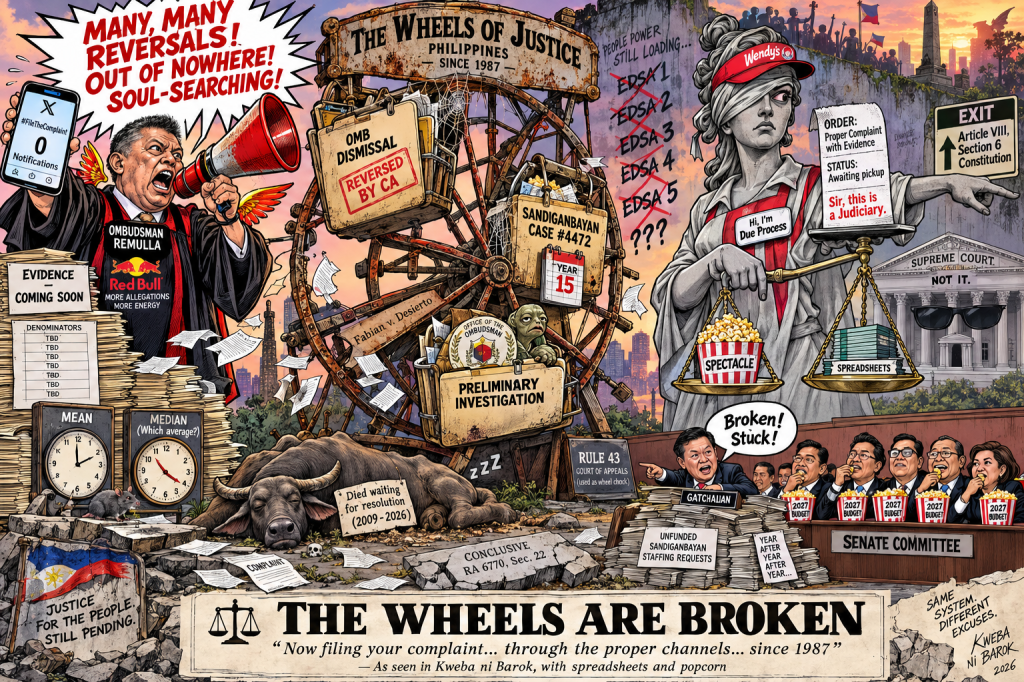
Soul-Searching Season: Remulla Forces the Judiciary to Confront What Five EDSA Revolutions Couldn’t Touch
By Louis ‘Barok‘ C. Biraogo | September 6, 2026
“The wheels of justice turn slowly, but grind exceedingly fine.”
Unless, of course, you’re Ombudsman Jesus Crispin Remulla. Then the wheels aren’t grinding at all—they’re just making noise. Lots of it. In Senate hearing rooms. With cameras rolling.
Here at the Kweba, we’ve spent the last 24 hours poring over every scrap of paper, every jurisprudential tea leaf, and every political calculation behind the most entertaining institutional brawl since the Supreme Court told Congress to go pound sand over the pork barrel. And let me tell you something: this isn’t just a spat between two co-equal branches of government. This is a masterclass in how to channel institutional frustration into a legitimate call for reform—while simultaneously testing the boundaries of constitutional comity.
So grab your gavels, your Rule 43 petitions, and your popcorn. The Kweba is open for business.

The Ombudsman vs. The Judiciary: A Kweba Investigation
THE THEATER OF THE ABSURD: A BUDGET HEARING BECOMES A NATIONAL CONVERSATION
Let’s set the scene. September 3, 2026. The Senate Committee on Finance. The agenda: the Ombudsman’s proposed 2027 budget. The expected content: line items, personnel requests, maybe a PowerPoint about “enhanced investigative capacity.”
What actually happened: Remulla decided to channel his inner constitutional law professor—if that professor had been drinking Red Bull and reading separation-of-powers treatises while nursing legitimate frustration against every appellate justice who ever reversed him.
His greatest hits, for those who missed the live performance:
- “The wheels of justice are broken.” Not squeaky. Not misaligned. Broken. As in, call-the-tow-truck broken.
- “Many, many cases” dismissed by the Ombudsman are being reversed by the Court of Appeals (CA). Not “some.” Not “a concerning pattern.” Many, many. The kind of many that requires doubling for rhetorical effect.
- These reversals “came out of nowhere.” Which, as any first-year law student knows, is a technical term meaning “I didn’t like the result and I refuse to read the reasoning.”
- The judiciary “never accounted for everything they’ve been doing” across all EDSA revolutions. Never. Not once. Not even a single “Oops, sorry we took 15 years to decide that graft case.”
- The Sandiganbayan takes “an average of 15 years” to resolve a case. FIFTEEN. YEARS. That’s longer than the entire lifespan of a Filipino carabao. Longer than some Supreme Court justices’ careers.
The Supreme Court, to its credit, responded with the institutional equivalent of: “Sir, this is a Wendy’s.”
Actually, no. It responded with something far more sophisticated—and far more devastating in its restraint. Spokesperson Atty. Camille Ting essentially said: “We take allegations of corruption seriously. File a proper complaint. Show us the evidence. We’ll investigate.”
Translation: “Put up or shut up, Ombudsman.”
And there, in that elegant, procedurally airtight response, lies the rub. The Supreme Court just called Remulla’s bluff. In front of everyone. With the legal equivalent of a raised eyebrow and a pointed look at the exit.
THE REAL ISSUE: REVERSAL IS NOT CORRUPTION
Here’s where the Kweba’s research materials get interesting. Because if you actually read Fabian v. Desierto—and I know, I know, you’d rather watch paint dry, but bear with me—you’ll discover something inconvenient for Remulla’s narrative.
The Supreme Court explicitly declared unconstitutional the original statutory provision that sent Ombudsman appeals directly to the Supreme Court. Why? Because Article VI, Section 30 of the Constitution says the SC can’t have its appellate jurisdiction increased without its advice and concurrence. So the Court said: “Fine. Appeals from Ombudsman administrative decisions go to the Court of Appeals. Under Rule 43. As the system intended.”
In other words, the very system Remulla is complaining about—CA review of Ombudsman decisions—is the constitutional and legal design. It’s not a bug. It’s a feature. A feature enshrined in black-letter law and Supreme Court jurisprudence.
And here’s the kicker: Section 22 of Republic Act No. 6770 (The Ombudsman Act of 1989) says Ombudsman findings of fact supported by substantial evidence are conclusive. CONCLUSIVE. As in, appellate courts are supposed to defer to them. As in, the law itself bends over backward to respect Ombudsman fact-finding.
So when Remulla says “many, many cases” are being reversed, what he’s really saying is one of two things:
- Option A: The Court of Appeals is systematically disregarding the law and substituting its judgment for the Ombudsman’s—which would be a massive judicial scandal requiring immediate Supreme Court intervention.
- Option B: Some of those Ombudsman decisions weren’t actually supported by substantial evidence, and the CA is doing its job by reversing them.
Remulla is clearly pushing Option A. But he’s offered exactly zero case numbers, zero statistical analysis, zero specific allegations of judicial misconduct. Just vibes. “Many, many” vibes. “Out of nowhere” vibes.
And the Supreme Court, bless its institutional heart, has called him on it. “File the complaint. Show us the evidence.”
Which brings us to the missing denominator problem.
THE MATHEMATICS OF OUTRAGE: WHERE ARE THE NUMBERS?
Suppose, hypothetically, the Ombudsman decides 10,000 administrative cases in a year. Suppose 1,000 are appealed to the CA. Suppose 200 are reversed.
That’s a 20% reversal rate among appealed cases—but only 2% of all Ombudsman decisions. Are 200 reversals “many, many”? Compared to what? Compared to the 8,000 cases that weren’t appealed? Compared to the 800 that were affirmed?
Without the denominator, “many, many” is just rhetorical fog. And here at the Kweba, we don’t do fog. We do spreadsheets.
Because here’s the thing: reversals happen for legitimate reasons. Insufficient evidence. Due process violations. Errors of law. Excessive penalties. A dozen other possibilities that have nothing to do with judicial corruption or incompetence.
If Remulla wants to prove systemic dysfunction, he needs to publish:
- Total Ombudsman decisions per year
- Total appeals filed
- Total affirmances, modifications, reversals, dismissals
- Reversal rates by ground (evidence, due process, law, penalty)
- Subsequent Supreme Court dispositions
- Average processing times at each stage
Without this, his claim is analytically worthless. It’s the institutional equivalent of shouting “The system is rigged!” while refusing to show your cards.
THE 15-YEAR SANDIGANBAYAN CLAIM: PROBABLY TRUE, BUT INCOMPLETELY HONEST
Let’s give Remulla credit where credit is due. The Sandiganbayan is slow. Glacial. Continental-drift slow. The Supreme Court itself relieved a Presiding Justice years ago for failing to manage caseload, with 415 cases pending beyond the constitutional period—some over 10 years.
So when Remulla says cases take “an average of 15 years,” he’s probably in the ballpark. But here’s the problem: average versus median.
If the mean is 15 years but the median is 7, that means a handful of extraordinarily old cases are skewing the numbers upward. The typical case might be moving much faster than the “average” suggests.
And here’s the deeper irony the Kweba’s research uncovered: the Ombudsman itself is often responsible for delay.
Remember Cagang v. Sandiganbayan? The Supreme Court established rules for speedy disposition. And then in Camsol v. Sandiganbayan (2022), the Court dismissed a case because the Ombudsman took approximately six years of unexplained delay during preliminary investigation.
Six years. In the Ombudsman’s own office. Before the case even reached the Sandiganbayan.
So when Remulla points fingers at the judiciary for being slow, the judiciary can legitimately respond: “Physician, heal thyself. Or at least conduct your preliminary investigations in less than a presidential term.”
THE SUPREME COURT’S RESPONSE: A MASTERCLASS IN INSTITUTIONAL JUDO
Let’s take a moment to appreciate the genius of the Supreme Court’s September 3 statement.
It didn’t:
- Dismiss Remulla’s concerns as illegitimate
- Attack him personally
- Escalate the conflict
- Threaten contempt proceedings
- Defend the status quo reflexively
Instead, it:
- Acknowledged the right to criticize courts
- Took allegations of misconduct seriously
- Invited formal complaints with evidence
- Shifted the burden back to Remulla
- Preserved its institutional legitimacy
This is institutional judo—using the weight of your opponent’s attack against them. Remulla made broad, unsubstantiated allegations. The Court responded: “Thank you for your concern. Please submit your evidence through the proper channels. We look forward to reviewing it.”
If Remulla files complaints and they have merit, the Court looks responsive and accountable. If he files complaints and they’re weak, the Court looks magnanimous and patient. If he doesn’t file anything, the Court looks like the adult in the room while Remulla looks like a man who raises legitimate concerns but needs to substantiate them.
Either way, the Court wins. And Remulla’s credibility hangs in the balance.
THE DEEPER CONSTITUTIONAL QUESTION: CAN THE OMBUDSMAN CRITICIZE THE JUDICIARY?
Yes. Absolutely. The Ombudsman is not subordinate to the courts. Article XI, Section 13(6) even authorizes the Ombudsman to “publicize matters relating to malfeasance, misfeasance, or non-feasance in government” when warranted.
But—and this is the crucial but—the Ombudsman cannot:
- Supervise the judiciary
- Discipline judges
- Pressure courts to decide cases a certain way
- Use public statements to influence pending litigation
- Transform legitimate appellate reversal into an accusation of corruption
Remember Maceda v. Vasquez (1993)? The Supreme Court held that the Ombudsman could not exercise administrative jurisdiction over a judge because Article VIII, Section 6 gives the Supreme Court exclusive administrative supervision over all courts and personnel.
And Caoibes v. Ombudsman (2001)? Complaints involving judges must be referred to the Supreme Court where an administrative aspect is implicated.
This is the constitutional line Remulla is dancing on. He can criticize. He can advocate reform. He can present evidence of misconduct to the SC. But he cannot become the Judiciary’s overseer.
THE FABIAN PARADOX: REMULLA IS COMPLAINING ABOUT A SYSTEM THE SUPREME COURT WAS FORCED TO CREATE
Here’s the delicious irony that the Kweba’s research uncovered.
Remulla is upset about CA reversals of Ombudsman decisions. But the reason appeals go to the CA—rather than directly to the Supreme Court—is because of Fabian v. Desierto.
And why did Fabian happen? Because Congress passed a law (RA 6770, Section 27) that tried to send Ombudsman appeals directly to the Supreme Court. The Supreme Court said: “You can’t increase our jurisdiction without our advice and concurrence. That’s unconstitutional.”
So the CA became the appellate forum. Not because the Supreme Court wanted to dilute Ombudsman power, but because the Constitution required it.
Remulla is essentially saying: “This constitutionally-mandated appellate system is broken.”
To which the Supreme Court can respond: “Then amend the Constitution. Until then, we’re all working within it.”
THE DUE PROCESS PARADOX: SPEED IS NOT JUSTICE
Let’s imagine, for a moment, that Remulla gets everything he wants. Faster trials. Fewer reversals. More judicial “accountability.”
What does that look like in practice?
- Shorter hearings
- Fewer postponements
- Restricted appeals
- Aggressive preventive suspension
- Expedited convictions
Sound good? Maybe. Until you’re the innocent public official whose case was rushed through a system optimized for speed rather than accuracy.
The constitutional objective isn’t speed. It’s speed + due process + accuracy + independence + legitimacy. That’s a package deal. You can’t pick and choose.
And here’s the uncomfortable truth: the Court of Appeals exists precisely to check the Ombudsman. The Ombudsman is investigator, prosecutor, and administrative adjudicator all rolled into one. That’s enormous power. Without appellate review, the Ombudsman would effectively become judge, jury, and executioner.
Remulla may not like reversals. But reversals are a feature of due process, not a bug. They exist to correct errors—including Ombudsman errors.
THE RECOMMENDATIONS: WHAT SHOULD ACTUALLY HAPPEN
The Kweba doesn’t just criticize. We propose. Because we’re helpful like that.
Step 1: Publish the Data.
Remulla should release a comprehensive statistical analysis of CA reversals of Ombudsman decisions over the past 5-10 years. Include denominators. Include grounds. Include outcomes. If the data supports his claims, the Supreme Court will have to respond. If it doesn’t, he should recalibrate and move on.
Step 2: File Formal Complaints.
If there are specific cases where CA decisions were so inexplicable that they suggest misconduct, Remulla should file them with the Supreme Court’s Judicial Integrity Office. Names. Case numbers. Evidence. Let the process work.
Step 3: Join the Justice Sector Coordinating Council.
The JSCC already exists. It involves the Supreme Court, Department of Justice (DOJ), and Department of the Interior and Local Government (DILG). Expand it to include the Ombudsman. Focus on case-flow management, data integration, and performance metrics—not judicial decision-making.
Step 4: Strengthen Sandiganbayan Capacity.
More divisions. More staff. Better technology. Strict postponement controls. Continuous trial. This requires Congress to appropriate funds, not just complain about delays.
Step 5: Recognize the Constitutional Limits.
The Ombudsman cannot supervise judges. The Supreme Court cannot dictate Ombudsman prosecutions. Congress cannot tell either institution how to decide cases. This is the system. Work within it or amend it.
THE BOTTOM LINE: REMULLA IS PARTLY RIGHT ABOUT THE PROBLEM, BUT MUST PROVE THE SOLUTION
Here’s the uncomfortable truth for everyone involved:
Remulla is right that:
- Judicial delay is a serious problem
- The Sandiganbayan takes too long
- Institutional coordination is poor
- The public bears the cost of dysfunction
Remulla must prove that:
- CA reversals indicate systemic judicial misconduct
- Public Senate hearings are the proper forum for specific allegations
- “Out of nowhere” decisions constitute evidence of corruption
- The judiciary has “never been held accountable”
- More executive-branch scrutiny of courts is the solution
The Supreme Court’s response was constitutionally sophisticated, procedurally correct, and strategically brilliant. It put the ball back in Remulla’s court without escalating the conflict.
Now Remulla has a choice: file the complaints, publish the data, and engage constructively—or continue the public campaign and risk looking like a man who raises important questions but cannot yet back them up with evidence.
The Kweba will be watching. With spreadsheets. And popcorn.
Because if there’s one thing we know about Philippine constitutional politics, it’s this: the show is never over. It just changes venues.
Louis ‘Barok’ C. Biraogo is the proprietor of the Kweba ni Barok, a cave of sharp political commentary, fearless institutional critique, and the fine art of reading between the lines. He can be reached at the cave, where the coffee is strong, the opinions are stronger, and the receipts are always kept.
Key Citations
A. Legal & Official Sources
- The 1987 Constitution of the Republic of the Philippines. Official Gazette of the Republic of the Philippines, 1987, http://www.officialgazette.gov.ph/constitutions/1987-constitution/.
- The 1987 Constitution of the Republic of the Philippines, art. VI, sec. 30. Official Gazette of the Republic of the Philippines, http://www.officialgazette.gov.ph/constitutions/the-1987-constitution-of-the-republic-of-the-philippines/the-1987-constitution-of-the-republic-of-the-philippines-article-vi/.
- The 1987 Constitution of the Republic of the Philippines, art. VIII, sec. 6. Official Gazette of the Republic of the Philippines, http://www.officialgazette.gov.ph/constitutions/the-1987-constitution-of-the-republic-of-the-philippines/the-1987-constitution-of-the-republic-of-the-philippines-article-viii/.
- The 1987 Constitution of the Republic of the Philippines, art. XI, sec. 13(6). Official Gazette of the Republic of the Philippines, http://www.officialgazette.gov.ph/constitutions/the-1987-constitution-of-the-republic-of-the-philippines/the-1987-constitution-of-the-republic-of-the-philippines-article-xi/.
- Republic Act No. 6770. An Act Providing for the Functional and Structural Organization of the Office of the Ombudsman, and for Other Purposes (The Ombudsman Act of 1989). 17 Nov. 1989, lawphil.net/statutes/repacts/ra1989/ra_6770_1989.html.
- 1997 Rules of Civil Procedure, Rule 43, “Appeals from the Court of Tax Appeals and Quasi-Judicial Agencies to the Court of Appeals.” Supreme Court of the Philippines, 1997, lawphil.net/courts/supreme/rc/rc_1-71_civil.html.
- Fabian v. Desierto, G.R. No. 129742, 16 Sept. 1998, lawphil.net/judjuris/juri1998/sep1998/gr_129742_1998.html.
- Maceda v. Vasquez, G.R. No. 102781, 22 Apr. 1993, lawphil.net/judjuris/juri1993/apr1993/gr_102781_1993.html.
- Caoibes v. Ombudsman, G.R. No. 132177, 19 July 2001, lawphil.net/judjuris/juri2001/jul2001/gr_132177_2001.html.
- Cagang v. Sandiganbayan, G.R. Nos. 206438 and 206458, 31 July 2018, lawphil.net/judjuris/juri2018/jul2018/gr_206438_2018.html.
- Camsol v. Sandiganbayan, G.R. No. 242892, 6 July 2022, lawphil.net/judjuris/juri2022/jul2022/gr_242892_2022.html.
- Supreme Court of the Philippines, Office of the Spokesperson. Statement in response to statements made by the Ombudsman during the Senate Committee on Finance hearing. 3 Sept. 2026, sc.judiciary.gov.ph/?p=172580.
- Supreme Court of the Philippines. Re: Problem of Delays in Cases Before the Sandiganbayan. A.M. No. 00-8-05-SC, 28 Nov. 2001, lawphil.net/judjuris/juri2001/nov2001/am_00-8-05-sc_2001.html.
- Supreme Court of the Philippines. “Justice Sector Coordinating Council.” sc.judiciary.gov.ph/spji/justice-sector-coordinating-council-2/.
B. News Reports
- Senate of the Philippines. “Committee on Finance (September 3, 2026).” YouTube, 3 Sept. 2026, http://www.youtube.com/watch?v=MvsMvLj88aw.
- Santos, Tina G. “Ombudsman Laments State of Judiciary, Slow Justice System.” INQUIRER.net, 3 Sept. 2026, https://newsinfo.inquirer.net/2298647/ombudsman-laments-state-of-judiciary-slow-justice-system.
- ABS-CBN News. “Remulla Says He Won’t Apply for Chief Justice, Urges Judiciary to Go on Soul Searching.” ABS-CBN News, 3 Sept. 2026, http://www.abs-cbn.com/news/nation/2026/9/3/remulla-says-he-won-t-apply-for-chief-justice-urges-judiciary-to-go-on-soul-searching-1309.
- Manila Bulletin. “Remulla Says Judiciary Must Go ‘Soul-Searching’, Cites Concerns over CA Decisions Reversing Dismissals.” Manila Bulletin, 3–4 Sept. 2026, mb.com.ph/tag/Boying-Remulla.

- ₱9 Billion in ‘Savings’? DILG’s Fire Truck Deal Smells Like Smoke

- ₱8B BBM Pork: CCTV for Every Captain’s Kumpare?

- ₱8.9 Billion, 331 Ghost Police Stations: The TIKAS Scandal Explained

- ₱8.4 Billion, 42,000 Barangays, 1 Election: The “Bawat Barangay Makikinabang” Vote-Buying Masterclass

- ₱75 Million Heist: Cops Gone Full Bandit

- ₱6.77B Ghost Haunts Duterte: RTC Dismisses Mans Carpio’s Desperate Plea

- ₱6.77 Billion and Zero Cash: The Sara Duterte SALN Math That Doesn’t Add Up

- ₱6.7-Trillion Temptation: The Great Pork Zombie Revival and the “Collegial” Vote-Buying Circus

- ₱58.53B, Zero Receipts: The LGSF Pork Barrel Nobody Wants to Name

- ₱53 Million Man Tells ₱695-a-Day Workers to Stop Being ‘Mayabang’: The Audacity of BSP’s Remolona

- ₱4.4 Billion and a Witness Who Can’t Explain It: The Duterte Impeachment’s Most Expensive Non-Answer

- ₱3.06 Billion for Evacuation Centers—But Nobody Knows Where They’ll Stand (Or If They’ll Exist)









Leave a Reply